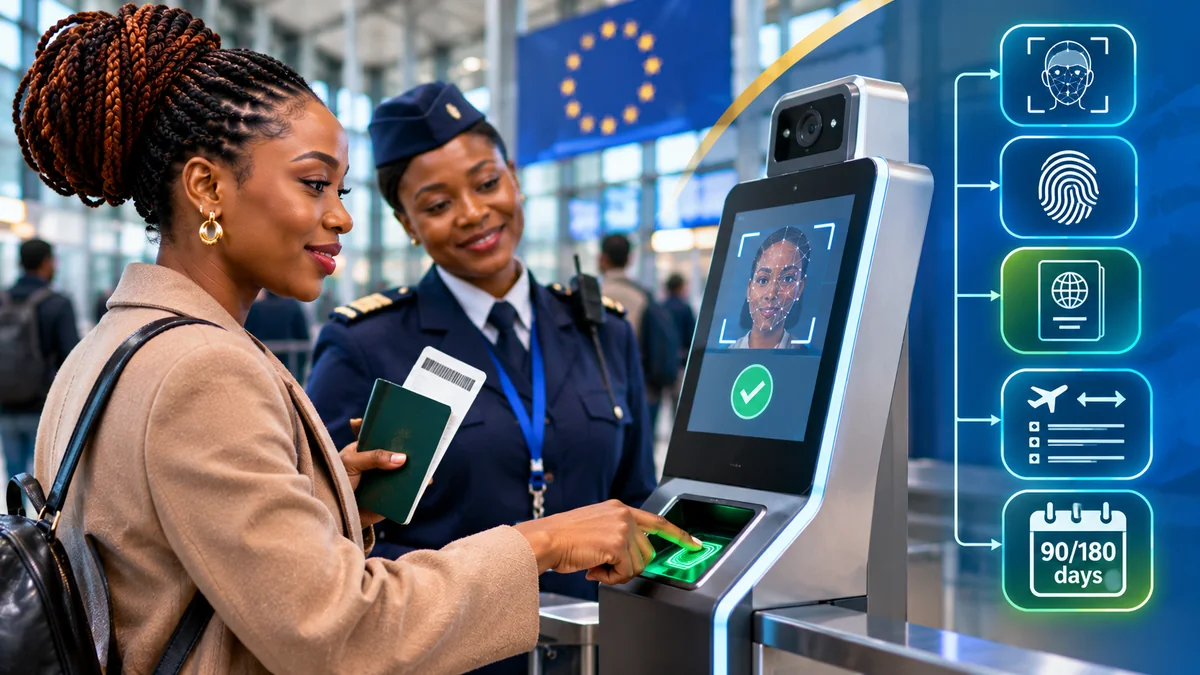
Nigerians travelling to Europe's Schengen area for a short visit should expect digital entry and exit records and biometric identity checks under the EU Entry/Exit System (EES). The system is already in operation: it began a phased rollout on 12 October 2025 and became fully operational at participating external borders on 10 April 2026. For an ordinary Nigerian passport holder, it does not replace the need for a valid Schengen visa.
The biggest practical change is at border control. Rather than relying on a passport stamp to document a short visit, the EES records travel-document information, the date and location of entry and exit, and relevant biometric information. A first enrolment may take additional time, and subsequent crossings normally involve quicker verification. The European Commission confirmed full deployment in April 2026.
This guide explains who is registered, what happens at the airport, whether a biometric passport is compulsory, what EES means for the 90-days-in-180 rule, and why it should not be confused with ETIAS. Information checked on 2 November 2026 against official EU guidance; individual visas, immigration circumstances and airline requirements must be checked separately.
What is the EU Entry/Exit System?
The Entry/Exit System is an automated European border information system for non-EU nationals making short stays across the external borders of 29 participating European countries. It records arrivals, departures and refusals of entry so authorised officials can check identity, immigration status and whether a person has exceeded the permitted stay.
It is not a new visa, a flight-booking system or a requirement to submit a standalone EES application from Nigeria. The normal border officer continues to decide whether entry conditions are met. The EES has replaced routine manual passport stamping for travellers covered by the system, but travellers still present passports and any required visas or supporting documents.
Border checks take place at relevant airports, seaports and land crossing points. If a traveller arrives directly from Lagos at a participating Schengen airport, that is generally where the EES check takes place. If the itinerary has an earlier Schengen entry point, the first external border is normally where the traveller is registered.
Does EES apply to Nigerian passport holders?
In most ordinary short-visit cases, yes. Nigerian citizens are non-EU nationals, and Nigeria remains on the EU list of countries whose ordinary passport holders require a visa for Schengen short stays. A tourist, conference participant, visiting relative or business visitor with a relevant short-stay Schengen visa is therefore generally covered by EES when entering or leaving the participating territory.
A long-stay visa or residence permit can lead to different treatment. The European Commission's July 2026 exemption explanation says that holders of qualifying long-stay visas and residence permits issued by an EES-operating country are not registered under the ordinary EES short-stay process. Different rules apply to family members with specific residence cards, citizens of EES countries and some other categories. Do not assume your exemption merely because you have studied, worked or previously visited Europe.
| Example traveller | EES position |
|---|---|
| Nigerian tourist with short-stay Schengen visa | Generally registered on eligible external border crossings |
| Nigerian attending a short business meeting or conference | Generally registered if travelling on a covered short stay |
| Nigerian with qualifying German residence permit | Generally exempt from EES registration; present residence document |
| Nigerian holding qualifying French national long-stay visa | Generally exempt while using the relevant long-stay status |
| Nigerian transiting airside without entering Schengen | Usually no EES entry record if no external-border crossing occurs; transit visa rules remain separate |
| Nigerian family member of an EU national | Depends on residence-document status and applicable free-movement rules |
Special situations can affect the answer, including a permit from Ireland or Cyprus, which do not themselves operate EES. Seek advice from the destination country's competent authorities where your status is not straightforward.
Which European countries use EES?
The 29 participating countries are Austria, Belgium, Bulgaria, Croatia, Czechia, Denmark, Estonia, Finland, France, Germany, Greece, Hungary, Italy, Latvia, Lithuania, Luxembourg, Malta, the Netherlands, Poland, Portugal, Romania, Slovakia, Slovenia, Spain and Sweden, together with Iceland, Liechtenstein, Norway and Switzerland.
Ireland and Cyprus do not use EES. A journey to London in the United Kingdom is not an EES entry either. But if a traveller moves from the UK or Ireland into a participating Schengen country, an applicable EES registration occurs at that external border. Travelling onward between Schengen countries ordinarily does not create a new external EES entry.
Always check an unusual itinerary, overseas territory or travel document against the official Travel Europe portal , because border rules depend on the actual location and circumstances rather than the phrase "Europe" in an airline advertisement.
What happens when a Nigerian traveller arrives at border control?
The official EES process distinguishes an initial registration from later verification:
- Present the passport and visa. A border officer or authorised equipment reads the travel document and checks your identity and entry eligibility.
- Provide the required personal details. Relevant passport information and the place and date of entry are associated with your digital record.
- Complete facial and fingerprint checks. Officials capture or verify the applicable biometric information according to your visa record and the EES rules.
- Answer ordinary border questions. You may be asked about the purpose and duration of the visit, accommodation, onward or return travel and ability to support yourself.
- Receive an entry decision. A valid visa does not by itself guarantee admission. If admitted, the entry is recorded digitally; if refused, the refusal can also be recorded.
- Complete an exit check when leaving. The relevant departure is recorded so the system can account for the period of stay.
At a later visit, the previously recorded biometric and passport information can normally be matched, making verification faster than the initial record creation. Officials can repeat collection where needed. Automated kiosks or pre-registration tools are available only at supported locations, and travellers must follow the instructions at the border.
Fingerprint scans, facial photographs and Nigerian visa biometrics
There are two related but distinct systems. The Visa Information System (VIS) supports the visa-application and identity-checking process. During a qualifying Schengen visa application, fingerprints and a photograph may be collected and stored in VIS. The EES records the border crossing and uses the relevant biometric information to check identity.
The EU's EES data guidance explains that fingerprints already stored in VIS for a short-stay visa holder are not stored again in EES. Border officers can still scan fingerprints to verify identity against stored records. That is why a Nigerian who submitted fingerprints for a Schengen visa may still be asked to use a fingerprint reader on arrival.
Children under 12 are normally exempt from fingerprint collection under the relevant biometric rules, although facial images and other border checks can still apply. Physical inability to provide fingerprints is handled under the applicable rules and should be explained to the officer rather than treated as deliberate refusal.
For travellers who are legally required to provide biometrics, refusing the process can lead to refusal of entry. The official EU EES information explicitly warns of that consequence. If a scanner fails or a person needs assistance, ask border staff how the applicable alternative or exception is handled.
Do Nigerians need a biometric passport to use EES?
No separate EES rule requires every eligible traveller to have an electronic biometric passport. The EU's EES frequently asked questions explain that valid biometric and non-biometric passports can be accepted; travellers are not, in principle, refused entry simply because the passport lacks a biometric chip.
However, an electronic passport can make certain self-service checks easier where kiosks support it. That is different from visa validity, document authenticity or airline rules. Nigerian travellers should verify the passport meets the Schengen entry conditions, including the general requirement for it to have been issued within the previous ten years and remain valid for at least three months after the planned departure, subject to applicable exceptions.
Check passport name, date of birth, number, expiry and the corresponding visa details well before booking a non-refundable journey. If you replace a passport after obtaining a visa, seek official guidance on travelling with the old visa and new passport rather than assuming the EES automatically updates every document record.
Does EES change the 90 days in any 180 days rule?
The short-stay limit remains generally 90 days within any rolling 180-day period across the participating Schengen territory. The EES helps authorities record arrivals and departures and identify people who have stayed beyond an authorised period. But a visa can allow fewer days, fewer entries or a narrower validity period. The 90-day framework is a ceiling for many ordinary short stays, not an unconditional entitlement to spend 90 days in Europe.
Imagine a Nigerian visitor spends 30 days in France, later 20 days in Spain, then 15 days in Germany, all within the same rolling 180-day window. That is 65 days across the covered area, not 30, 20 and 15 fresh allowances per country. The person must still consider visa entry limits and the moving 180-day window.
The EU provides an official Check how long you can stay tool, but it warns that certain visits before 10 April 2026 may not be represented in the EES display. Keep a personal travel record and contact the competent border or immigration authorities where the result is unclear. Overstaying can lead to national penalties, removal or restrictions on future admission, depending on the case.
Will the new system cause longer queues at European airports?
Initial biometric enrolment and operational problems can add time, especially during busy arrival periods. The system is designed to make subsequent checks more efficient, but actual waiting times depend on border staffing, kiosk availability, terminal capacity and the number of travellers arriving at once.
FlyingEze has reported on airport queues during the EES rollout and on countries' operational responses to congestion . These reports concern particular incidents and should not be interpreted as a guarantee that every EU airport currently has long queues or that all EES checks are suspended.
For a Nigerian flying through an unfamiliar hub, allow a reasonable buffer for passport control and onward transport. Follow your airline's check-in and boarding deadlines, check whether luggage must be collected during a connection, and avoid making an extremely tight onward booking on the assumption that the first registration will take only a few minutes.
What if your route includes another country before the Schengen area?
Where EES applies depends on the external Schengen border you actually cross. For example, on an illustrative Lagos–Paris–Amsterdam itinerary, the EES process ordinarily takes place when the traveller first enters the Schengen area at Paris, rather than at the later internal connection. On an itinerary Lagos–London–Amsterdam, the EES entry would normally happen at Amsterdam, assuming the passenger enters Schengen there.
If you remain wholly in the international airside transit zone and do not pass an external Schengen border, an EES entry generally is not recorded. That does not mean every transit is visa-free: an airport transit visa may be required depending on nationality, country, route and exemptions. Check official Schengen visa and transit rules before travel.
EES versus ETIAS: do Nigerians need to apply for both?
No. The systems do different jobs. EES is the border record system for covered non-EU short-stay travellers, including visa-required Nigerian nationals. ETIAS is a planned pre-travel authorisation for eligible visa-exempt travellers. It is not a replacement for a Nigerian citizen's Schengen short-stay visa.
| Question | EES | ETIAS |
|---|---|---|
| Purpose | Record covered border entry, exit, identity data and refusals | Pre-travel authorisation for qualifying visa-exempt nationals |
| Operational status as checked | Fully operational since 10 April 2026 | Not yet accepting applications on the official portal |
| Ordinary Nigerian short-stay visa holder | Generally registered at covered external borders | No ETIAS application instead of the required visa |
| Separate online application? | No standalone EES application required | Application applies after launch to eligible visa-exempt travellers |
| Replaces a passport or visa? | No | No |
The European Commission's EES–ETIAS comparison describes different scopes and timelines. The official ETIAS FAQs currently say the authorisation system is not operating and applications are not being collected. Do not pay an unofficial website claiming to sell an "EES visa", an EES enrolment slot or an ETIAS authorisation for an ordinary Nigerian visa applicant.
What happens to personal and biometric data?
EES contains passport details, entry and exit records, relevant biometric identifiers and refusal-of-entry information where applicable. The official data protection notice says ordinary entry, exit and refusal records are generally kept for three years, and individual files may follow a three-years-and-one-day rule. Where no exit is recorded, a five-year retention rule can apply from the expiry of the authorised stay. Special categories have different arrangements.
Border and immigration authorities have defined access for specified purposes, and law-enforcement use is subject to legal conditions. Travellers have data-protection rights, including seeking access to applicable records and requesting correction of inaccurate information through the competent authorities. Do not send passport scans or biometric records to a third-party "EES registration service" advertising on social media.
Checklist: what a Nigerian traveller should do before departure
- Confirm whether a Schengen visa is required. For an ordinary Nigerian passport and short visit, it generally is; apply through the competent consulate or its authorised application channel.
- Inspect your passport and visa. Check validity, permitted entries, stated duration, names and relevant itinerary details.
- Understand the first external border. Identify where you actually enter Schengen, particularly if connecting through another European airport.
- Prepare normal supporting documents. Carry evidence of itinerary, accommodation, visit purpose, return or onward travel and means of support as relevant to your journey.
- Expect EES identity checks. Be ready for a facial image and fingerprint verification or capture under the applicable rules, and follow authorised staff instructions.
- Allow border time. First-time biometric checks and queues vary; plan a sensible connection or pickup buffer without assuming a universal delay.
- Check the visa's stay allowance. Count visits across the participating territory and respect the authorised entries and dates.
- Use official EU sources. Check Travel Europe , the embassy or consulate and your carrier before departure.
Common EES misunderstandings that can disrupt a trip
"My Schengen visa was approved, so I can skip EES." No. Visa issuance and border registration are separate procedures; both can apply to the same Nigerian traveller.
"I already gave fingerprints in Lagos, so the officer cannot scan them again." Incorrect. VIS biometrics may be checked at the border; a verification scan does not necessarily mean a second fingerprint record is being stored in EES.
"Every European destination uses EES." No. Ireland and Cyprus do not operate it, and the UK has its own border arrangements.
"A non-biometric passport is automatically rejected." No. The official EES FAQs say non-biometric documents can be accepted if otherwise valid and recognised.
"The EES gives me 90 extra days when I cross into another Schengen country." No. The applicable short-stay period is calculated across the area within a rolling window, subject to visa restrictions and exemptions.
"I should pay an agent to register for EES." No standalone paid EES application is needed before arrival. Beware of unofficial fee demands and websites requesting passport or identity data.
Frequently asked questions
Is the EU Entry/Exit System already operating in November 2026?
Yes. After a phased launch on 12 October 2025, it became fully operational on 10 April 2026 in the 29 participating European countries.
Do Nigerians need a new visa because of EES?
No new type of EES visa exists. Ordinary Nigerian passport holders still generally need the appropriate Schengen visa for short visits, and EES registration occurs at the covered external border.
Will my Nigerian passport be stamped?
For an EES-covered short stay at a participating border, digital entry and exit records replace routine manual stamping. Different treatment can apply outside EES, including Ireland and Cyprus, or to exempt travellers.
Do children need fingerprint scans?
Children below 12 are generally exempt from fingerprint collection, but passports, facial images and other applicable border checks still matter.
Can I use an app to complete EES before flying?
Some participating countries may offer the official Travel to Europe application or self-service registration to speed up part of the process. Availability varies; it does not replace the border check and is not a compulsory standalone Nigerian application.
Can I be refused entry even with a valid Schengen visa?
Yes. Border authorities still check the usual entry conditions. EES records applicable refusals; a valid visa is not an unconditional guarantee of admission.
Does ETIAS apply to an ordinary Nigerian passport holder?
ETIAS targets qualifying visa-exempt travellers once operational. An ordinary Nigerian passport holder travelling on a visa-required Schengen short visit should not attempt to use ETIAS instead of the necessary visa.
Conclusion
The EU Entry/Exit System is now part of normal external Schengen border procedures for many Nigerian short-stay visitors. It makes entries and departures digital, introduces or verifies biometric identity data, and helps authorities apply stay limits. But it has not abolished Schengen visa requirements, made biometric passports compulsory for everyone or created a new paid EES application. Check the correct visa and travel documents, prepare for border verification and rely on official EU and consular information before departure.