
Joby Completes 3,199-Mile Autonomous Flight Across US
Joby Aviation says its autonomous J208 flew 3,199 miles across the US with zero control inputs from its onboard safety pilot. Here is what the milestone means.
 Written byEze Chidiebere Paul
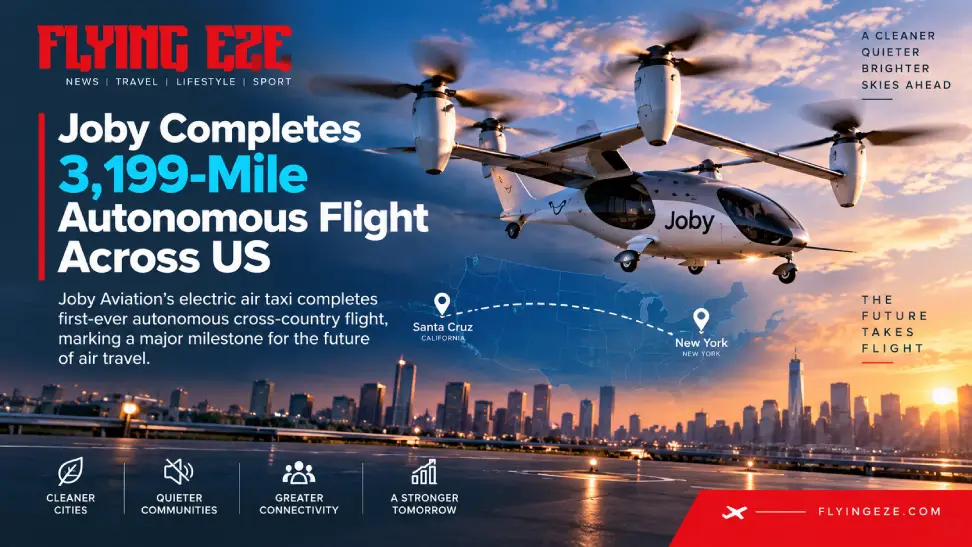
Joby Aviation says an aircraft equipped with its autonomy technology has completed a 3,199-mile flight across the United States without any control inputs from the onboard safety pilot, marking a significant real-world test of autonomous aviation.
The aircraft, a J208 based on the Cessna Caravan platform, travelled from California to North Carolina as part of Joby’s month-long coast-to-coast demonstration tour. According to the company, the aircraft autonomously handled taxiing, take-off, cruise and landing while being supervised remotely.
The milestone is notable because it moves autonomous flight testing beyond short demonstration routes into a long-distance journey through varied terrain and operating environments. It does not, however, mean passenger aircraft are about to begin routinely flying without pilots.
Key takeaways
- Joby says its autonomy-equipped J208 covered 3,199 miles across the United States.
- The onboard safety pilot made zero control inputs during the autonomous journey, according to the company.
- The aircraft autonomously taxied, took off, cruised and landed while remaining under remote supervision.
- The technology is being developed initially around uses including freight, emergency response and defence logistics.
- The demonstration is separate from Joby’s electric vertical take-off and landing air taxi certification programme.
What Joby says the aircraft accomplished
In its 18 September announcement, Joby Aviation said the aircraft completed the eastbound leg of its cross-country tour in North Carolina’s Outer Banks, near Kitty Hawk.
The company says the J208 covered 3,199 miles with no control input from the safety pilot on board. Remote supervision was conducted from locations as far as 2,323 miles from the aircraft.
The journey included autonomous ground movement, departure, en-route flight and landing. Joby describes it as the first autonomous flight across the United States.
The Wall Street Journal independently reported the completion of the transcontinental flight and the company’s claim that the safety pilot did not manually control the aircraft.
What 'autonomous' means in this flight
The presence of an onboard safety pilot and remote supervisors is an important qualification. Autonomous does not mean the aircraft operated without human oversight.
Instead, the flight demonstrated that Joby’s software could execute the aircraft’s core flying tasks without manual control inputs while humans remained available to supervise the operation and intervene if necessary.
That distinction matters for passengers and regulators. Commercial autonomous aviation will require not only reliable flight-control software but also certification standards, communications systems, contingency procedures and clear rules defining the responsibilities of remote operators.
The flight builds on hundreds of earlier tests
Joby announced the cross-country tour on 10 September. At that point, the company said the autonomy platform had already completed more than 400 flights and 800 automated flight hours.
The aircraft is visiting 10 US states during the month-long tour. Joby says the programme is intended to demonstrate potential applications in commercial freight, emergency response and defence logistics.
The technology has also participated in US military exercises, giving the company experience operating autonomous systems in more demanding environments.
Why the J208 matters
Joby is best known for developing an electric vertical take-off and landing aircraft for urban air-taxi services. The autonomous J208 is a different aircraft and programme.
Using an established fixed-wing platform allows Joby to test autonomy in an aircraft capable of carrying useful payloads over longer distances while the company continues work on its electric air taxi.
That could make autonomous freight one of the more practical early commercial uses. Cargo operations can provide a path to gathering operational experience without immediately confronting all of the public-acceptance questions associated with pilotless passenger transport.
Potential uses go beyond cargo
Joby says its autonomy technology could eventually support emergency response, disaster logistics and access to remote communities as well as commercial freight.
An autonomous aircraft capable of operating over long distances could, in principle, deliver supplies to areas where pilot availability, infrastructure or safety conditions make conventional operations difficult.
Defence is another important part of the programme. Autonomous aircraft can potentially reduce the number of people exposed to dangerous missions while extending logistics capacity.
What the flight does not prove
A successful demonstration is not the same as regulatory approval for unrestricted autonomous commercial operations.
The flight demonstrates the maturity of Joby’s technology under the conditions of this particular tour. Regulators will still need evidence covering system reliability, failure modes, cybersecurity, communications links, human supervision and safe integration with other air traffic before autonomous systems can be deployed broadly.
It is also important not to confuse this achievement with certification of Joby’s electric air taxi. The company’s eVTOL passenger aircraft follows a separate certification and commercialisation pathway.
Why this milestone matters for aviation
Aviation automation has progressed steadily for decades, from autopilot and flight-management systems to highly automated landing capabilities. Full operational autonomy is a larger step because software must safely handle a much wider range of decisions and abnormal situations.
A 3,199-mile autonomous journey provides useful evidence that such systems can operate across a long and geographically varied route rather than only in tightly controlled local demonstrations.
The more consequential question now is how quickly regulators, aircraft manufacturers and operators can translate technical demonstrations into certified systems with transparent safety standards.
What happens next
Joby’s J208 is continuing its month-long US tour. The company is expected to use the programme to demonstrate the autonomy system to regulators, government agencies and potential commercial customers.
For travellers, pilotless passenger flights remain a longer-term prospect. In the nearer term, autonomous cargo, logistics and emergency-response operations may provide the clearest route for the technology to prove itself at scale.
Sources
Continue reading
Jet Financiers Say Fuel and Borrowing Costs Now Eclipse Aircraft Shortages
Jet financiers say soaring fuel and borrowing costs have overtaken aircraft shortages as aviation’s biggest concern, reshaping airline and leasing risks.

France Opens Smart-Glasses Harassment Probe as Privacy Scrutiny Grows
Paris prosecutors have opened a smart-glasses harassment investigation as France’s CNIL warns about covert recording, consent and privacy risks.

Huawei Cloud Launches New Agentic AI Infrastructure and Enterprise Agent Tools
Huawei Cloud has launched new agentic AI infrastructure and enterprise tools at HUAWEI CONNECT 2026, including an updated AI Cluster Service, Agentic MaaS and expanded AgentArts platform.
AirAsia Says Strong Liquidity Can Weather Jet Fuel Cost Spike
AirAsia says strong liquidity and resilient demand can help it withstand soaring jet fuel costs as the airline refinances debt and adjusts capacity and fares.