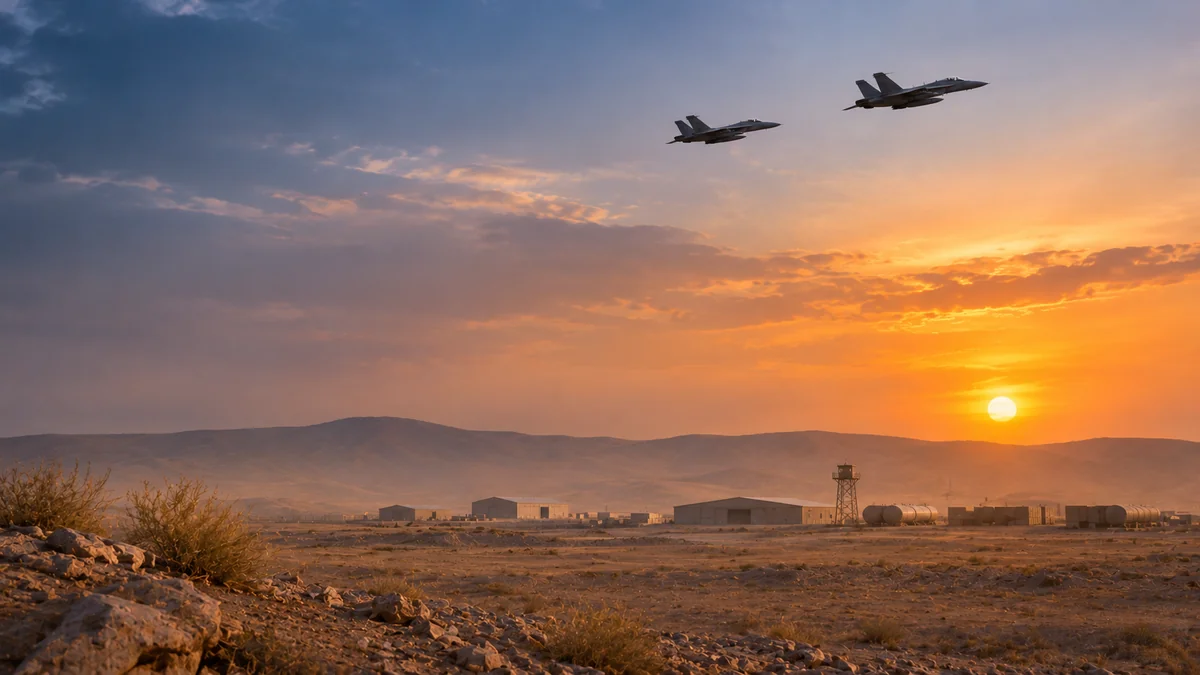
Historical retrospective — researched 7 November 2026. This article examines US military action on 27 June 2021 and its immediate aftermath. It is a newly researched reconstruction, not the original lost FlyingEze text and not a report of military operations occurring today. The original FlyingEze publication timestamp has not been recovered.
On Sunday, 27 June 2021, US forces carried out airstrikes against three facilities near the Iraq–Syria border that the Pentagon said were used by Iranian-backed militia groups. Two targets were in Syria and one was in Iraq. President Joe Biden authorised the operation following repeated drone and rocket attacks on American personnel and facilities in Iraq. The strikes provoked condemnation from Baghdad, reports of militia deaths and warnings of retaliation.
The central facts come from a 27 June Pentagon statement attributed to press secretary John Kirby and Biden's written notification to Congress dated 29 June . Both confirm the number of targeted locations and the stated US rationale. Contemporary Reuters reporting and Associated Press coverage document the reaction.
The term Iran-backed refers to groups aligned with or receiving support from Tehran; it does not, by itself, prove that Iranian officials directly ordered every operation attributed to those groups. Likewise, describing the US strikes as defensive reflects Washington's legal and military explanation, which was disputed by the Iraqi authorities and scrutinised by legal analysts.
What happened during the 27 June 2021 US airstrikes?
The US Department of Defense announced that American forces had hit what it called operational and weapons-storage facilities in the border region. In its account, the selected facilities were associated with militia attacks involving unmanned aerial vehicles, commonly called drones, against US personnel and installations based in Iraq.
Two sites were struck on the Syrian side of the border and a third on the Iraqi side. The Center for Strategic and International Studies (CSIS) analysis published on 8 July 2021 places the targeted areas near Al-Bukamal in Syria and Al-Qa'im in Iraq. The Pentagon's original public statement did not provide a detailed, building-by-building account of every target.
It identified Kata'ib Hezbollah and Kata'ib Sayyid al-Shuhada among the Iran-aligned militia organisations using the facilities. The American government said the purpose was to degrade the capacity to conduct further attacks and deter the armed groups from targeting US interests.
The US account establishes that strikes took place, but its statements about the facilities' use and the responsibility for prior attacks remain official US assessments. They should not be presented as independently observed facts about every individual site or person on the ground.
Why did President Biden order the strikes?
The operation followed a series of incidents during the spring of 2021 in which American and coalition facilities in Iraq faced rocket or drone attacks. In his 29 June letter to congressional leaders , Biden provided examples that his administration considered evidence of an ongoing threat.
He listed rocket attacks on Balad Air Base on 4 April, 18 April and 3 May, and on Al-Asad Air Base on 4 and 24 May. He also identified reported drone attacks against facilities in Erbil on 14 April, Al-Asad on 8 May, Bashur Air Base on 10 May, and US facilities near Baghdad International Airport on 9 June.
The White House said these incidents threatened and injured American and coalition personnel. Its position was that targeting storage, command and logistical sites would reduce the likelihood of future attacks. The letter also expressed an intention to deter Iran and armed groups backed by Iran from conducting or supporting further operations against US troops.
That rationale explains why Washington targeted militia facilities even though the American military's main declared mission in Iraq was support for Iraqi forces fighting remnants of the Islamic State group (ISIS). The June strikes were not raids against ISIS. They were directed against organisations that US officials accused of threatening the troops involved in the anti-ISIS mission.
Which armed groups were named?
Kata'ib Hezbollah is an Iraqi armed faction with longstanding ties to Iran, distinct from the Lebanese organisation also known as Hezbollah. Kata'ib Sayyid al-Shuhada is another Iraq-based armed faction identified in US reporting about activity around the Syria–Iraq border.
These organisations operated in a complex Iraqi security environment that included the Popular Mobilisation Forces, sometimes referred to as the PMF or Hashd al-Shaabi. Certain factions were formally connected to the Iraqi security structure while retaining their own political identities and relationships with Iran. The result was a delicate balance for an Iraqi government working with Washington against ISIS while also facing pressure from Iran-aligned domestic armed groups.
Identifying a faction as Iran-aligned does not establish that every member shared the same responsibilities or that the Iranian state exercised direct operational control over the specific facilities struck. The Pentagon attributed use of the sites to several militia organisations; independent public evidence about the full chain of command was limited.
Were people killed in the June 2021 strikes?
Contemporary accounts reported four militia fighters killed, but the source of that figure matters. A statement attributed to Kata'ib Sayyid al-Shuhada named four of its members as killed near the border. Reuters reported the faction's claim while noting that the US military had not initially released a confirmed casualty assessment.
Anadolu Agency's 28 June report similarly attributed four deaths to the militia and reported an account of injuries from an unnamed Iraqi military source. These accounts were not a comprehensive, independently verified assessment of casualties at every target.
Accordingly, this retrospective does not assert a definitive overall death toll or invent civilian casualty statistics. It states what was reported at the time and identifies where verification was incomplete. In conflict reporting, statements by militaries and armed groups can be significant evidence, but they are not equivalent to independent forensic findings.
How did Iraq's government respond?
The Iraqi government's response was unusually direct. On 28 June 2021, Baghdad condemned US strikes on its territory, describing them as an infringement of Iraqi sovereignty. Reuters reported that the government led by Prime Minister Mustafa al-Kadhimi convened an emergency security meeting and considered legal options to prevent a repetition.
This illustrates a central dispute. Washington emphasised that US troops were in Iraq at the invitation of the Iraqi government to support counter-ISIS efforts. Baghdad did not accept that this invitation amounted to permission for unilateral American strikes against militia targets on Iraqi territory.
Washington's view focused on the safety of its personnel; Iraq's objection focused on the limits of foreign military action within a sovereign state. These were different legal and political questions, and the existence of an anti-ISIS partnership did not settle the disagreement.
Reuters also reported Syrian condemnation of US military action on Syrian territory. The resulting controversy therefore extended beyond relations between Washington and the armed factions: both affected states objected to the strikes.
What did the militias say, and what happened next?
The militia groups reacted angrily and threatened retaliation. The precise language of their statements varied across reports, but contemporary Reuters coverage on 28 June documented calls for revenge from the Iran-aligned factions. That response raised concerns that operations intended by Washington as deterrence could instead contribute to a sequence of attacks and counterattacks.
On 28 June, US-led coalition personnel in northeast Syria came under rocket fire near the al-Omar oil field. According to contemporaneous reporting citing coalition spokesman Colonel Wayne Marotto , multiple rockets targeted the facility and no casualties were reported among the US personnel. American forces responded with artillery fire.
News reports linked the timing of that rocket attack to the heightened tension following the airstrikes, but responsibility was not immediately claimed. It would therefore be inaccurate to state as a proven fact that a named faction carried out the attack in direct retaliation.
The episode exposed a problem for deterrence policy: a limited strike may impair a group's infrastructure without immediately stopping every attack, while armed groups may interpret the strike as a reason to respond. That risk formed an important part of the debate about the June operation.
Was this Biden's first strike against Iran-aligned militias?
No. On 25 February 2021, months before the June operation, the Biden administration had authorised an airstrike against facilities used by Iran-aligned militias in eastern Syria. The Pentagon's February announcement described that earlier action as a response to attacks against American and coalition personnel in Iraq.
The June operation was therefore the second publicly announced round of such strikes ordered by Biden after taking office, not the beginning of US military operations in Iraq and Syria. It differed from February because the June strikes included a target inside Iraq as well as sites across the border in Syria.
Both actions reflected the administration's argument that it could conduct limited operations to protect US troops without initiating a broader war. Critics questioned how repeated operations could be reconciled with congressional authority and international law.
What was the US legal justification?
The Pentagon relied on two legal explanations. Under US domestic law, it cited Article II of the Constitution, which concerns presidential authority, including responsibilities as commander-in-chief. Under international law, it invoked the United States' asserted right of self-defence.
In his 29 June letter, Biden referred specifically to Article 51 of the United Nations Charter and provided the notification to Congress consistent with the War Powers Resolution. The administration argued that the strikes were limited and intended to protect personnel from an ongoing series of attacks.
That was the administration's legal position, not an internationally adjudicated finding that every aspect of the operation was lawful. Iraq's sovereignty objection and questions about the absence of consent from the affected states complicated the assessment.
The CSIS analysis published on 8 July 2021 discusses the competing arguments. Legal specialists debated whether a series of earlier attacks justified self-defence against future threats and whether repeated presidentially ordered strikes might eventually require explicit authorisation from Congress.
It also noted that the administration had not relied on the US laws authorising force in 2001 or 2002 for these particular strikes. That distinction matters because the legal foundation for an anti-ISIS mission does not automatically settle the authority to attack a different armed group.
Why did the operation matter for relations with Iran?
In 2021, relations among Washington, Tehran and Baghdad were already tense. American officials accused Iran-aligned militias of threatening their personnel, while Iraq's government sought to avoid becoming the battlefield for a confrontation between stronger foreign powers.
The Biden administration said the operation was designed to deter attacks, but using military force in two countries introduced the possibility of additional retaliation, political pressure on Iraqi leaders and diplomatic setbacks. Reuters reported that US Secretary of State Antony Blinken defended the strikes as a limited response, while Baghdad and Damascus criticised the unilateral action.
It is important to distinguish an Iran-aligned militia from the Iranian armed forces. The June strikes were described by Washington as operations against militia facilities, not direct attacks on Iran itself. The wider diplomatic significance came from the militias' relationships with Tehran and from concerns about possible escalation.
What the episode revealed about the anti-ISIS mission
The United States maintained troops in Iraq to assist Iraqi security forces against ISIS. Yet those troops also faced threats from militias that opposed the American presence. The June 2021 strikes highlighted the difficulty of carrying out one military mission while becoming involved in a different confrontation.
From Washington's perspective, the strike sought to protect the forces carrying out the anti-ISIS mission. From Baghdad's perspective, an unapproved strike on Iraqi soil undermined sovereignty and created risks for a partnership intended to combat a shared security threat.
FlyingEze has separately covered later concerns about the security implications of US military withdrawal from Iraq . That is a different, subsequent debate and is included only as contextual reading; it should not be treated as evidence about what happened in June 2021.
For historical analysis, the distinction between the American military's stated anti-ISIS role and its response to other militias is central to understanding the political reaction.
Timeline of the June 2021 US airstrikes and aftermath
- 25 February 2021: Biden authorises an earlier strike against Iran-aligned militia infrastructure in eastern Syria.
- April–June 2021: US facilities in Iraq face a series of rocket and drone incidents, according to the administration's later list.
- 27 June 2021: US forces strike three sites near the Iraq–Syria border: two in Syria and one in Iraq.
- 28 June 2021: Iraq condemns the operation. Militia sources report four fighters killed and threaten retaliation.
- 28 June 2021: Rockets target a facility housing US personnel in northeast Syria; coalition officials report no US casualties.
- 29 June 2021: Biden submits a written account and legal justification to congressional leaders.
- 8 July 2021: CSIS publishes an assessment of the operation's legal basis, sovereignty concerns and risks of further escalation.
Frequently asked questions
When did the United States strike militia sites in Syria and Iraq?
On 27 June 2021, during Joe Biden's presidency.
How many locations were targeted?
The Pentagon said US forces targeted two locations in Syria and one in Iraq, all near their shared border.
Which militia groups were named?
The Pentagon named Kata'ib Hezbollah and Kata'ib Sayyid al-Shuhada among the organisations it said used the targeted facilities.
Why did Biden authorise the airstrikes?
The administration said it sought to disrupt and deter drone and rocket attacks against American personnel and facilities in Iraq.
How many people were killed?
A militia faction reported four members killed. The original US announcement did not provide a confirmed overall casualty figure, and the available reporting does not establish a final independently verified total.
Did Iraq approve the strikes?
The Iraqi government publicly condemned the action on its territory as a violation of sovereignty. No consent for the specific strike was established in the reviewed official statements.
Was this an attack on Iran itself?
No. The United States said it targeted facilities used by Iran-aligned militia groups in Iraq and Syria, rather than Iranian territory.
Conclusion
The 27 June 2021 airstrikes were a targeted military response ordered by President Biden against facilities the Pentagon associated with Iran-aligned armed groups near the Iraq–Syria border. The United States described the operation as a limited measure to defend its personnel following recurring drone and rocket attacks. Two sites were struck in Syria and one in Iraq.
The aftermath showed why the event mattered beyond the targets. A militia faction reported four deaths and promised retaliation; Iraq rejected the action as a breach of sovereignty; and US personnel came under rocket fire in Syria the following day. The Biden administration maintained a self-defence justification, while analysts questioned the implications for international law, congressional war powers and regional escalation.
A historically reliable account must distinguish official assessments from independently established facts, preserve the competing positions and avoid presenting June 2021 as a current crisis. The episode illustrates the uneasy relationship between protecting coalition troops, respecting the sovereignty of host states and trying to prevent an expanding cycle of armed confrontation.
Editorial disclosure: This is an original historical reconstruction prepared for FlyingEze using contemporaneous US government records, Reuters/AP reporting, Iraq's public response and subsequent legal analysis. It does not reproduce the missing FlyingEze article or any newswire story. The original FlyingEze publication date is unverified. The featured illustration is AI-generated and must not be presented as actual footage or photography from the operation.