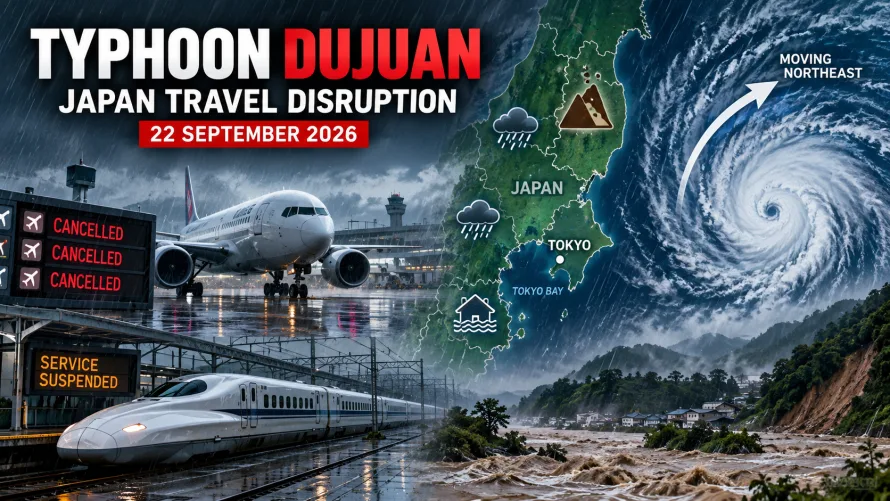
Typhoon Dujuan has left at least two people dead in Japan after record-breaking rain triggered flooding and landslides across parts of the Tokyo region, while transport disruption continued into Tuesday.
Record rain leaves deadly damage
The powerful storm battered eastern Japan on Monday, 21 September, before moving northeast over the Pacific. Reporting on Tuesday said landslides and flooding had killed at least two people, with searches continuing in affected areas.
Rainfall totals broke records in several locations. The Japan Times reported 672.5 mm of rain in Izu Oshima in the 24 hours to late Monday afternoon, while parts of Chiba and the greater Tokyo area also recorded exceptional totals. The saturated ground means landslide danger can persist even after the heaviest rain has moved away.
Flights and trains disrupted
Dujuan struck during Japan's Silver Week holiday period, magnifying the impact on travellers. Japan Airlines cancelled 120 domestic and 15 international flights on Monday, while All Nippon Airways cancelled 140 domestic services, according to reporting based on airline and Japanese broadcaster information.
Rail operations were also affected. JR East lines in parts of Chiba, Ibaraki and western Tokyo saw suspensions, and disruption continued on some routes on Tuesday. Travellers should check directly with their airline or rail operator before setting out because recovery schedules can change as inspections are completed.
Evacuations and power outages
Authorities issued high-level evacuation and landslide warnings as the storm crossed the region. More than one million people were covered by evacuation advice or orders during the event, while tens of thousands of households lost electricity at different points.
The storm also disrupted public events. The Tokyo Game Show ended early, while an equestrian competition at the Asian Games in Aichi was postponed as organisers monitored the weather.
Risk remains after the typhoon moves away
Although Dujuan was moving away from Japan's eastern coast by Tuesday, officials continued to urge caution in areas where record rainfall weakened slopes and raised river levels. Residents and visitors should follow current Japan Meteorological Agency and local-government alerts rather than assuming the danger has ended because the storm centre has passed.
The episode is a reminder that a typhoon's travel impact can last well beyond its closest approach, particularly when flooding, debris, damaged infrastructure and safety inspections affect roads, railways and airports.