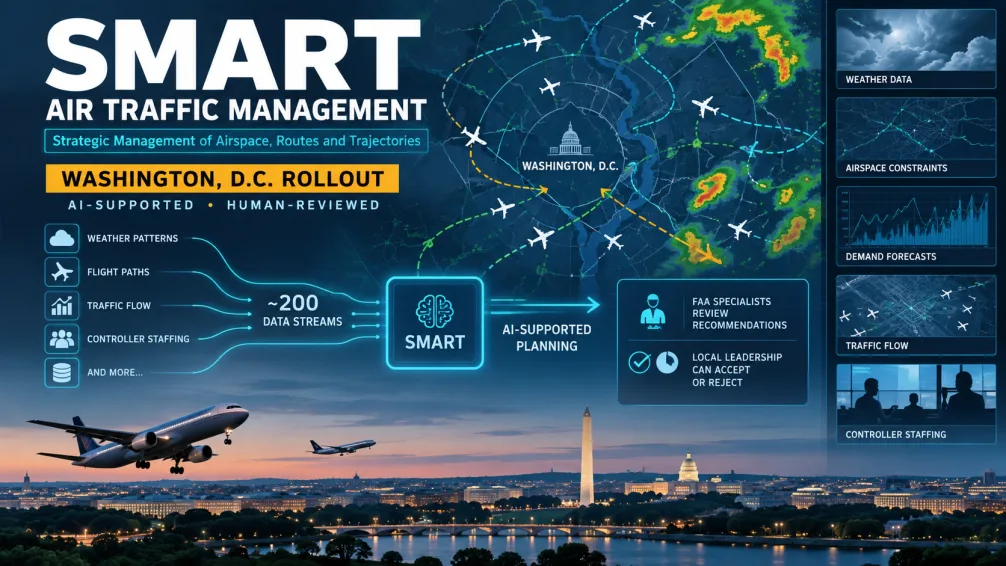
The US Federal Aviation Administration has begun limited use of a new artificial-intelligence-supported platform designed to help aviation specialists anticipate congestion and make better airspace-planning decisions.
What is FAA SMART?
SMART — Strategic Management of Airspace Routes and Trajectories — was introduced on Monday, 21 September, in the National Capital Region around Washington, D.C. The Department of Transportation says the platform centralises about 200 data streams and produces recommendations intended to improve how airspace is managed and flights are scheduled.
The initial deployment covers a region that includes Baltimore/Washington International Thurgood Marshall Airport, Washington Dulles International Airport and Ronald Reagan Washington National Airport.
AI advises, humans decide
The FAA says SMART is not taking control of aircraft or replacing air traffic controllers. It analyses information such as weather, flight paths, traffic flow and controller staffing to identify possible constraints earlier. Recommendations are reviewed by FAA staff and local facility leadership before action is taken.
That distinction matters: the system is an operational decision-support tool rather than an autonomous air traffic controller. Transportation Secretary Sean Duffy said humans will continue to manage US airspace.
Why the FAA says it could reduce delays
By combining information that previously sat across different systems, SMART is intended to help planners see developing problems hours or days earlier and consider alternative routes or traffic-flow measures. The government says potential benefits include fewer delays and cancellations, more predictable operations and reduced fuel waste.
The platform was developed by Air Space Intelligence under a long-term contract worth nearly $876 million, according to FedScoop. The FAA plans a gradual expansion as it tests the system, trains staff and measures performance.
A wider air traffic control modernisation effort
The launch comes as the FAA faces pressure to modernise ageing communications and air traffic infrastructure. On the same day SMART debuted, a telecommunications failure in the Northeast contributed to widespread flight disruption after a primary circuit failed and a backup fibre line was severed.
SMART does not itself solve those physical infrastructure problems, but officials are presenting it as one component of a broader effort to improve the resilience and efficiency of the US aviation system.