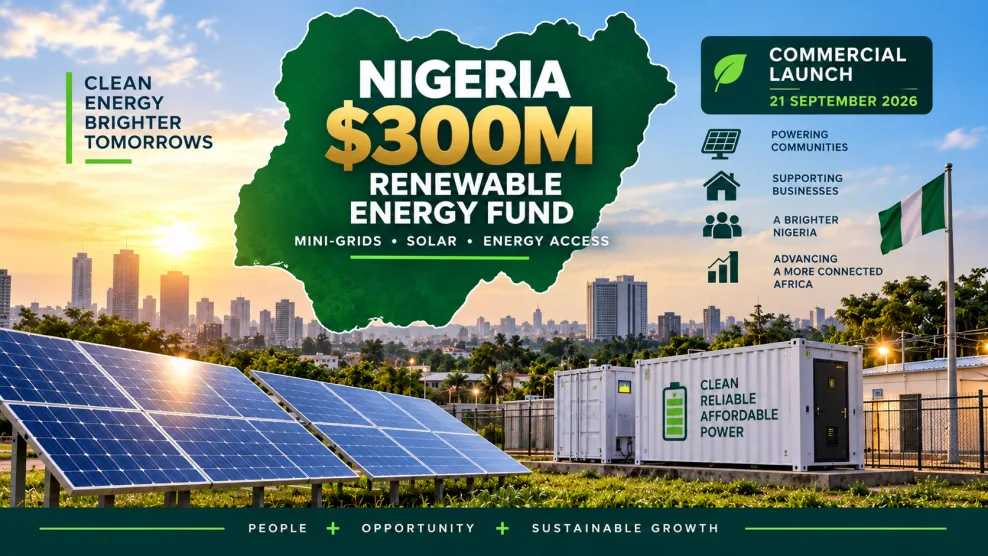
Nigeria's $300 million Distributed Renewable Energy (DRE) Fund has reached commercial launch, moving from fund structuring into active capital deployment as the country seeks to expand reliable electricity access through mini-grids, standalone solar systems and other decentralised energy projects.
The investment vehicle was unveiled by the Nigeria Sovereign Investment Authority (NSIA), Africa50 and Sustainable Energy for All (SEforALL) on the sidelines of the United Nations General Assembly in New York. The partners say the fund is intended to mobilise capital for distributed renewable energy projects serving communities and businesses that remain underserved by traditional power infrastructure.
What the commercial launch means
The latest milestone is important because it moves the fund beyond its structuring phase and towards deploying capital. SEforALL said the vehicle is designed to scale distributed renewable energy across Nigeria and support the country's ambitions for more reliable, affordable and sustainable electricity access.
Distributed renewable energy produces power closer to where it is consumed. In Nigeria, that can include solar mini-grids for communities, standalone solar systems and commercial or industrial installations that reduce dependence on central grid infrastructure.
NSIA and Africa50 will co-manage the fund
The fund is co-managed by NSIA and Africa50. SEforALL is among the partners supporting the initiative, while the World Bank Group is a founding partner. According to the launch announcement, the World Bank's initial contribution is $25 million through the International Development Association.
The partnership combines Nigerian institutional investment experience with pan-African infrastructure finance and international energy-access expertise. Its broader objective is to use catalytic public and development finance to attract more private investment into projects that can be deployed at scale.
Mini-grids and standalone solar are central to the plan
The launch announcement specifically identifies mini-grids and standalone solar systems as technologies with an important role in closing electricity-access gaps. Such systems can be particularly useful where extending conventional grid infrastructure is difficult, slow or uneconomic.
For households, reliable distributed electricity can improve lighting, communications and access to services. For businesses, more dependable power can support productive activity and reduce exposure to the cost and disruption associated with unreliable electricity supply.
How the fund connects with Mission 300
The Nigeria DRE Fund also supports Mission 300, the continent-wide effort to connect 300 million people in Africa to electricity by 2030. The Nigerian vehicle is being presented as a country-level financing model that could inform similar investment platforms elsewhere in Africa.
SEforALL said the fund's commercial launch reflects growing readiness in Nigeria's distributed renewable energy market. The organisation and its partners are positioning the structure as a way to combine national leadership, development finance and private capital around bankable energy projects.
Why the funding figure changed from the earlier plan
The commercial-launch figure is $300 million. An earlier partnership announcement in March 2025 had described plans for a $500 million Nigeria DRE Fund. The current launch materials now identify the commercial vehicle as a $300 million fund. Readers should therefore distinguish the earlier announced ambition from the amount attached to the fund at this commercial-launch milestone.
What happens next
The key test will be how quickly the fund converts its capital platform into financed and operating projects. The commercial launch establishes the investment vehicle, but individual project deployments, locations, capacities and connection numbers will depend on subsequent investment decisions and implementation.
For Nigeria, the development adds another financing channel to efforts to close persistent electricity-access gaps while attracting institutional and private capital into cleaner, decentralised power infrastructure.