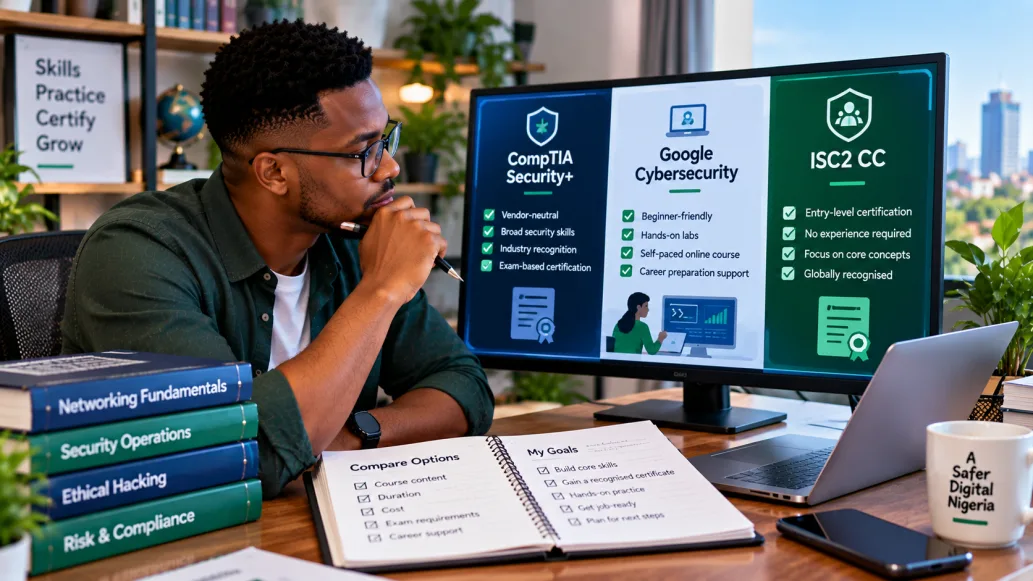
Can you start a cybersecurity career in Nigeria without studying computer science at university? Yes—but individual employers and specialist positions may still require degrees or experience. Cybersecurity depends on practical knowledge, responsible judgement and evidence that you can protect systems, investigate incidents or manage risk. A relevant degree can help, but it is not the only route.
For readers researching cybersecurity courses in Nigeria, the real challenge is knowing what to learn first, where to practise and which jobs to pursue. This 2026 guide covers affordable training, portfolio projects, certifications and practical application strategies. It does not promise employment within a fixed period.
Do you need a computer science degree?
No universal rule requires every cybersecurity worker to hold one. Employers set their own hiring conditions; regulated or advanced roles may demand additional qualifications. The NIST NICE Workforce Framework describes cybersecurity jobs in terms of tasks, knowledge and skills that learners can demonstrate.
ISC2 Certified in Cybersecurity (CC) explicitly requires no prior work experience. Google's Cybersecurity Professional Certificate welcomes learners without a degree or cybersecurity background. Those are training and certification eligibility rules, not promises of job offers.
1. Choose a path that fits your existing skills
| Background | Possible starting direction | Skills to demonstrate |
|---|---|---|
| Customer service or administration | Identity support, security awareness | Clear incident notes, escalation, confidentiality |
| Accounting or business | Governance, risk and compliance (GRC) | Risk registers, policy review, evidence tracking |
| IT support or networking | Security operations centre (SOC) | Networks, logs, endpoint troubleshooting |
| Web development | Application security | HTTP, authentication, secure coding, approved labs |
| No technical work history | Fundamentals and technical-support roles | Operating systems, networks and documentation |
Roles and entry requirements vary. Someone starting from zero may gain experience through IT support or an internship before entering a dedicated security position. GRC also demands evidence-based reasoning: it is not automatically an easy alternative to technical work.
2. Learn networks, operating systems and security basics
Understand how devices communicate, what IP addresses and DNS do, why account permissions matter and how Windows and Linux log activity. Learn basic command-line navigation, updates, multifactor authentication, backups and common threats such as phishing.
Start with Cisco Networking Academy's free six-hour Introduction to Cybersecurity , which includes seven labs and requires no prerequisites. Continue into networking and operating-system fundamentals. Six introductory hours alone are insufficient for most security positions.
Keep a learning journal. Explain a suspicious login, a misconfigured account or a DNS request in your own words. If you cannot describe the issue clearly, another completion badge will not fix the knowledge gap.
3. Compare free and structured learning before paying
IBM SkillsBuild provides free beginner learning. TryHackMe's Pre Security pathway introduces systems and defensive concepts through guided exercises; some content requires a paid subscription.
Check current course names. TryHackMe's 2026 update says its old Complete Beginner and Introduction to Cyber Security learning paths were replaced by Cyber Security 101.
Google's professional certificate teaches security monitoring, Linux, Python, SQL and incident handling through Coursera. Its subscription costs depend on the country, payment method and duration. For detailed costs and exam comparisons, see FlyingEze's guide to cybersecurity courses, fees and certifications , scheduled to appear before this article.
4. Check Nigerian public and nonprofit training programmes
Nigeria's 3 Million Technical Talent (3MTT) programme lists cybersecurity among its skills. The official programme information describes hybrid learning, entry assessments and no selection commitment fee for the cited phase. This does not establish that a new cybersecurity cohort is accepting applicants today.
CyberSafe Foundation's CyberGirls Fellowship offers free training and mentoring for eligible young African women. Its official page currently says applications are temporarily closed. Check the source directly for future intakes.
Local classrooms can be worthwhile for supervised practice. Before paying, request the complete curriculum, instructor details, refund rules, laboratory access, total tuition and confirmation of whether an external examination voucher is included.
5. Practise legally in environments built for learning
A cybersecurity course does not give permission to probe banks, schools, government websites or unrelated businesses. Use your own machines, approved capture-the-flag challenges, training sandboxes or systems you are expressly authorised to assess.
PortSwigger Web Security Academy provides free web-security labs for learning about vulnerabilities and remediation. Work only within its permitted practice environment.
Defensive projects are equally useful: document account permissions, create a patch checklist, review synthetic access logs or design an incident-escalation flow. Ethical boundaries and careful documentation form part of professional competence.
6. Build three small projects instead of collecting certificates
A portfolio can demonstrate your skills even when you have no relevant degree or paid security history. Choose projects matching the job you want and publish only work that contains no private information.
| Project | Useful deliverable |
|---|---|
| Home-lab security baseline | Fictional inventory, patching policy and account-permission checklist |
| Practice phishing investigation | Synthetic email indicators, risk explanation and escalation note |
| Sample SOC incident report | Invented login-event timeline, findings and recommendations |
Explain your objective, the tools used, evidence, limitations and conclusions. A GRC applicant might instead produce a fictional risk register and control-assessment spreadsheet. An application-security learner can use authorised PortSwigger challenges and describe appropriate fixes.
Never publish client logs, login credentials or information that could compromise real systems. Label practice work as practice, not employer experience.
7. Decide whether a certification is worth its cost
Independent certifications can substantiate knowledge, but they are not substitutes for practical skill. ISC2 CC is an entry-level option without an experience prerequisite. Its published Africa examination price is US$199, excluding any applicable tax or payment adjustments. The annual maintenance fee for CC-only members is US$50.
Do not rely on outdated videos offering everyone a free CC exam. ISC2 closed new enrolments in its free programme on 20 May 2026 . Previously issued, unexpired codes may remain usable through 31 December 2026, subject to programme rules.
Microsoft security fundamentals and CompTIA Security+ may suit other goals. Check actual examination requirements, current prices, renewal obligations and whether the course provider's completion certificate is separate from the professional assessment.
8. Prepare a CV that proves ability
List your actual education, whether in English, economics, engineering, business or another discipline. Add completed cybersecurity courses, relevant projects and links to work you are authorised to share. Describe genuine activities such as “Analysed synthetic access logs and prepared an escalation report”.
Transferable skills count: documenting problems, protecting confidential information, solving technical issues and communicating with teams can all be relevant. FlyingEze's international remote-work CV guide
Interviewers may ask why an alert matters or how you would secure a compromised account. Clear explanations based on real practice will usually be more credible than a long list of unfamiliar security tools.
9. Search for realistic first jobs in Nigeria
Try role-specific terms such as junior SOC analyst Nigeria, information security intern, IT support security, GRC trainee and security operations assistant. Search official employers' careers pages, LinkedIn and reliable job boards. Inspect each advert individually: some positions still require particular degrees, experience or qualifications.
Also consider technical-support, network-administration and junior compliance positions that can build transferable experience. A professional study community may provide feedback, but referrals and employment cannot be guaranteed.
For international remote work, confirm that an employer actually hires candidates living in Nigeria. FlyingEze's legitimate remote-job platforms guide
10. Follow a realistic six-month learning roadmap
- Month 1: Complete introductory cybersecurity lessons and study networks, Windows and Linux basics.
- Month 2: Explore SOC, GRC and application security; select one direction.
- Month 3: Practise in approved labs and publish one clearly labelled project.
- Month 4: Develop two further projects and seek constructive feedback.
- Month 5: Review genuine job descriptions, tailor your CV and consider certification if worthwhile.
- Month 6: Apply to suitable internships, junior and adjacent IT roles; improve from interview feedback.
This is a suggested progression, not a deadline for employment. Some learners need longer due to limited computing access, prior knowledge or time. Regular practice matters more than purchasing every available course.
Budget carefully and avoid career scams
Begin with free Cisco, IBM and PortSwigger lessons where suitable. Practical costs may include mobile data, electricity, a computer, optional subscriptions, exams and travel. Verify Nigerian checkout prices rather than guessing naira equivalents of foreign vouchers.
Be wary of “guaranteed placement” promises, advance recruiter payments and courses claiming you can become a senior penetration tester in days. Do not test unauthorised systems or exaggerate employment history. A genuine opportunity will still require qualifications suited to the role.
Frequently asked questions
Can arts or business graduates enter cybersecurity?
Yes. Relevant pathways include GRC, security awareness and technical operations, provided the individual develops the necessary skills and meets the employer's requirements.
Must cybersecurity professionals know how to code?
Not every role requires extensive coding. Scripting is useful in many jobs, while application security and some engineering positions require deeper technical skills.
Which certification should a beginner take first?
ISC2 CC is one entry-level option, but the right choice depends on your target role, available funding and practical experience. No single certificate guarantees a job.
Can I become job-ready in three months?
You can learn fundamentals in that period, but readiness depends on previous knowledge, practice and the job. Avoid promises of guaranteed employment after a short course.
Internal Linking Recommendations
Use FlyingEze's cybersecurity training cost comparison to choose a course. Then consult its international CV guide for presenting portfolio work, or its remote-jobs guide for job searches and location restrictions. The report on small-business cybersecurity risks provides industry context.
Conclusion
A computer science degree can help, but it is not the only starting point for a cybersecurity career in Nigeria. Master essential systems concepts, select a realistic role, practise ethically and build a portfolio that demonstrates what you know. Treat paid courses and certifications as investments, not shortcuts to guaranteed employment.
If you are comparing cybersecurity courses in Nigeria, start with one quality beginner course and one small, explainable project before committing to expensive training.
Research verified 30 October 2026. Course availability, examination prices, application windows and hiring requirements can change.