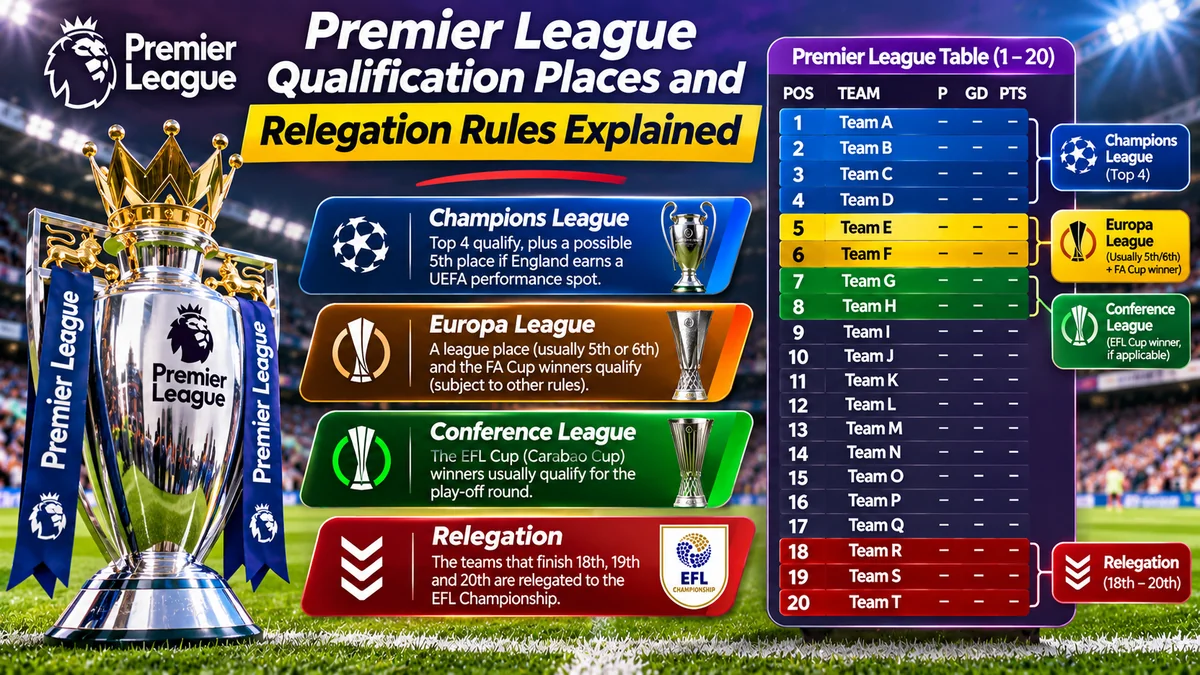
In the Premier League table from first to 20th, the team finishing first is champion, the top four normally qualify for the UEFA Champions League, and the bottom three—18th, 19th and 20th—are relegated to the Championship. Positions between those extremes can also lead to European football, but the precise qualification line changes according to UEFA's European Performance Spots, FA Cup and EFL Cup winners, and sometimes European title holders.
That is why a live Premier League table 1 to 20 cannot always label fifth, sixth or seventh as guaranteed Europa League or Conference League places. The colour beside a club's name may be a projection, not a final award.
This guide explains the qualification routes, the rules of relegation, how cup results shift places down the table and what the completed 2025/26 season teaches us about the 2026/27 campaign. For changing standings, consult the official 2026/27 Premier League table . Research verified: 14 November 2026.
Premier League positions 1 to 20: which places matter?
England's top division consists of 20 clubs. Each plays 38 league games, earning three points for a win and one for a draw. The team that tops the final standings wins the title, while the last three go down. The Premier League's official explainer confirms these fundamentals.
The table below is a guide to the consequences of positions, not a live league table. European allocations shown for the middle and upper rows depend on results in other competitions and applicable UEFA rules.
| Final position | What it means | Important condition |
|---|---|---|
| 1st | Premier League champions; Champions League qualification | Position must be secured at season's end |
| 2nd–4th | Standard Champions League league-phase places | Subject to club eligibility and UEFA admission requirements |
| 5th | Often Europa League; Champions League if England earns an extra European Performance Spot | The additional Champions League place is season-dependent |
| 6th | Possible Europa League or other European qualification | Depends on extra Champions League allocation and cup winners |
| 7th–8th | May reach European competition through redistributed places | Not automatic from league position alone |
| 9th–16th | Normally outside European qualification by league standing | A cup or European title can provide a separate route |
| 17th | Last survival position | Remains in the Premier League |
| 18th | Relegated to the Championship | Final season position, not a midseason projection |
| 19th | Relegated to the Championship | Same rule |
| 20th | Relegated to the Championship | Same rule |
European qualification follows a distribution system; it is not as simple as “first four Champions League, fifth Europa League, sixth Conference League” every year.
How do Premier League clubs qualify for the Champions League?
The top four: the usual league route
Under England's standard allocation, clubs finishing first, second, third and fourth qualify for the Champions League league phase. That makes a top-four finish a primary target for sides challenging at the top. UEFA still applies its competition admission requirements.
The Champions League now uses a league phase rather than the old four-team group format. For a separate explanation of that tournament, see FlyingEze's Champions League format and qualification guide .
When does fifth place qualify for the Champions League?
UEFA awards two European Performance Spots (EPS) to the associations whose clubs performed best collectively across UEFA men's competitions in the preceding European season. Each qualifying association receives one additional Champions League league-phase entry for its next-highest domestic league finisher who has not otherwise qualified.
UEFA's 2026/27 regulations, Article 3.08 , set out the basis for these places. They reward the collective results of an association's clubs, not simply the historical fame or popularity of its league.
Important date distinction: England earned a European Performance Spot through the 2025/26 European season, so the fifth-placed Premier League club in 2025/26 qualified for the 2026/27 Champions League. But the fifth-placed club in the 2026/27 Premier League is seeking a place in the 2027/28 Champions League; that extra spot must be earned through the relevant 2026/27 UEFA performances. One season's bonus cannot be carried forward automatically.
The UEFA 2026/27 allocation report identifies England and Spain as the two EPS beneficiaries for that tournament, with Liverpool taking England's place after finishing fifth in the 2025/26 Premier League.
How do Premier League teams qualify for the Europa League?
Under the standard English allocation, two places are associated with the UEFA Europa League: one for the highest Premier League finisher not already qualified for the Champions League, and one for the FA Cup winners.
With four Champions League league places, the standard league route normally starts at fifth. If England earns a fifth Champions League place, the ordinary Europa League league-position berth shifts to sixth. The FA Cup winner also earns a Europa League league-phase place, subject to the rules governing clubs with multiple qualifications.
The Premier League's European qualification explainer and its EFL Cup qualification analysis describe these routes.
What if the FA Cup winners already qualify for Europe?
When FA Cup winners have already earned a Champions League or Europa League place under the applicable rules, the unused FA Cup Europa League berth can pass to the next-highest Premier League team not otherwise qualified for UEFA competition. It does not automatically go to the losing FA Cup finalist.
Illustration: suppose England has five Champions League league places; clubs finishing first to fifth occupy them; sixth takes the normal Europa League league spot; and the FA Cup winners finish third. The FA Cup's Europa League place can then move to seventh, provided the governing allocation requirements are satisfied.
If the cup winner finishes outside the European league places and has no other superior qualification, that club may take the FA Cup berth itself. In that situation, fans should not assume a further league place is created.
How does the EFL Cup winner qualify for the Conference League?
Winning the EFL Cup (Carabao Cup) normally earns entry to the UEFA Conference League play-off round, not automatic entry to the Conference League's league phase. The winner must meet admission requirements and, where applicable, succeed in the qualifying play-off.
If the EFL Cup winners already qualify for the Champions League or Europa League through their Premier League position, their Conference League berth generally passes to the next-highest league club without European qualification.
That is one reason a club finishing seventh or eighth may reach Europe even when its placing alone does not confer an automatic spot. However, UEFA-title-winner cases can have different reallocation consequences. The Premier League's official March 2026 explanation notes that where an EFL Cup winner qualifies for Europe by winning a UEFA competition but finishes outside the league's European positions, the Conference League place may be forfeited rather than simply passed down.
Therefore, count confirmed qualification routes and apply the season-specific access list; do not mechanically assign every team in sixth, seventh or eighth a fixed continental tournament.
A real example: why eighth place reached Europe in 2025/26
The Premier League's final 2025/26 season review provides a valuable real-world case study of how places were allocated. England had secured an EPS for 2026/27, and Manchester City won both domestic cup competitions while also qualifying for the Champions League.
| 2025/26 league finish | Club | Qualification for 2026/27 |
|---|---|---|
| 1st | Arsenal | Champions League |
| 2nd | Manchester City | Champions League |
| 3rd | Manchester United | Champions League |
| 4th | Aston Villa | Champions League |
| 5th | Liverpool | Champions League via EPS |
| 6th | AFC Bournemouth | Europa League via league position |
| 7th | Sunderland | Europa League via FA Cup place reallocation |
| 8th | Brighton & Hove Albion | Conference League via EFL Cup place reallocation |
| 15th | Crystal Palace | Europa League via UEFA Conference League title |
Two lessons follow. First, there is no universal rule that an eighth-placed Premier League club qualifies for Europe: Brighton benefited from a particular combination of cup winners and qualification allocations. Second, a club can qualify through a European title despite finishing outside the normal qualifying league positions. Crystal Palace, fifteenth, reached the 2026/27 Europa League by winning the 2025/26 UEFA Conference League.
FlyingEze's contemporaneous report on Crystal Palace's Conference League final victory provides match-report context for that unusual route. The Premier League's nine-club qualification summary verifies the overall outcome.
Do not project these 2025/26 positions directly onto the 2026/27 table. League standings, UEFA coefficient outcomes and domestic cup winners for the current campaign must be determined separately.
Can a Premier League club qualify for Europe by winning a European trophy?
Yes. Winning the UEFA Champions League, Europa League or Conference League can carry a title-holder qualification route for the following season under the applicable UEFA rules. These routes are distinct from ordinary league placings.
However, winning a European trophy does not automatically award an extra Premier League league-position place to the club just below the standard cut-off. If a club has already qualified through its domestic league, the relevant UEFA vacancy can be reallocated under UEFA's access-list procedures.
The Premier League's May 2026 title-holder explanation addressed precisely that distinction. For readers, the key lesson is to identify how the club qualifies and which competition's regulations control any vacancy.
What are the Premier League relegation rules?
The relegation rule is more straightforward than European qualification: the three clubs finishing 18th, 19th and 20th are relegated to the EFL Championship. They do not play a separate survival play-off merely because they occupy those positions. Clubs finishing seventeenth or higher remain in the Premier League for the following season, subject to any exceptional regulatory consequences.
The Premier League relegation FAQ confirms the bottom-three rule. A team in eighteenth in November is in the provisional relegation zone—not automatically relegated that day. It can move up by winning matches, while a team above it can drop down as results change.
Is seventeenth place always safe?
Seventeenth is the last position above the normal relegation line in a completed season. It does not guarantee comfort earlier in the campaign. A club may be seventeenth by goal difference only, or lead eighteenth by several points; those are different situations for fans analysing the survival race.
Keep separate the concept of current survival position and mathematically secured survival. A club can clinch safety before the last game if the sides below can no longer overtake it under the rules.
How many points guarantee Premier League survival?
There is no fixed official points total that guarantees staying up in every season. The familiar “40-point rule” is a guideline supporters use, not a Premier League regulation. The survival threshold depends on how many points other clubs earn.
For example, in a hypothetical final-week scenario, Team A in seventeenth has 35 points and Team B in eighteenth has 33. If both have one match remaining, B can finish on 36 by winning. A is not safe merely because it starts outside the relegation zone; its final result and tie-breakers may still matter.
The Premier League's relegation analysis explains why historical survival totals should not be treated as a legal threshold.
What happens when clubs finish level on points at the cut-off?
The Premier League first ranks teams by points, then goal difference (goals scored minus goals conceded), and then total goals scored. If they remain level, points won in their head-to-head league fixtures and then away goals in those meetings are considered.
If a decisive tie for the title, a European place or safety from relegation still cannot be resolved, the rules provide for a neutral-venue play-off. According to the league's May 2026 FAQ , a table-deciding neutral play-off had not been required in Premier League history as of that report.
Example: Suppose two clubs finish on 38 points, with the same goal difference, at seventeenth and eighteenth. The club with more league goals scored ranks higher before head-to-head records are considered. A better result in their direct match does not jump ahead of the goal-difference and goals-scored tests.
For an introductory explanation of the table columns and how to interpret a standings page, FlyingEze's earlier reporting on why Newcastle appeared above Chelsea in a historical league table illustrates why close rankings prompt questions from supporters.
Who replaces the relegated clubs?
Three Championship clubs are promoted to replace the three relegated Premier League teams. The first- and second-placed teams in the Championship earn automatic promotion. The final promotion place is decided through the Championship play-offs.
A 2026/27 rule change is important here: the Championship expanded its play-off field from four teams to six for that season. According to the Premier League's promotion guide , clubs finishing third through eighth enter the competition: fifth plays eighth and sixth plays seventh in preliminary single-leg ties, while third and fourth enter the subsequent two-leg semi-finals. The finalists then compete for the remaining promotion place.
This change concerns the Championship promotion play-offs, not the Premier League's normal relegation process. Premier League teams finishing eighteenth through twentieth still go down directly.
When can a team be crowned champion or confirmed relegated before May?
The final league positions are settled after the fixture schedule, but a result can become mathematically certain sooner. A leader can clinch the title when its rivals cannot catch it with the points remaining, taking relevant tie-breakers into account. Similarly, a bottom-three side can be relegated before its final match when it can no longer reach safety.
A win is worth three points; a draw one. To estimate what is still possible, multiply remaining games by three to find the maximum additional match points a club can collect. Then compare that theoretical total with the teams around it—but do not assume every rival loses all remaining fixtures. For complex multi-team survival scenarios, the clubs' direct meetings and other outstanding fixtures matter.
That explains why a league graphic may show “relegation zone” long before a sports website can legitimately say “relegated”. The first is a snapshot; the second requires a final or mathematically unavoidable result.
How to follow the 2026/27 qualification and relegation races correctly
- Start with the official standings. Check the 2026/27 season, matches played, points, goal difference and the date of the last update.
- Separate the two European seasons. Premier League final positions in May 2027 normally determine qualification for UEFA's 2027/28 competitions; England's 2026/27 Champions League bonus spot came from an earlier European season.
- Track the UEFA performance-spot race. Fifth-place Champions League qualification is conditional until the relevant association coefficient outcome is secured.
- Track both domestic cups. The FA Cup and EFL Cup can allocate places to winners or, in qualifying cases, cause places to be redistributed through the league.
- Watch European title holders. A club outside the usual qualifying places may still earn a European route through a UEFA title.
- Focus on seventeenth and eighteenth. The points and goal-difference gap across that boundary is central to the relegation battle.
- Respect mathematical uncertainty. Games in hand and remaining fixtures create possibilities, not points already awarded.
- Confirm final UEFA allocations. Use the Premier League's qualification information and UEFA regulations rather than a colour key in a third-party table alone.
Frequently asked questions
Do the top five Premier League clubs always qualify for the Champions League?
No. The standard league allocation is four. Fifth place can gain a Champions League entry when England earns a UEFA European Performance Spot for the relevant European season; the extra place must be earned again when applicable.
Does finishing sixth guarantee the Europa League?
No. Sixth can qualify for the Europa League in seasons where the top five receive Champions League berths, but cup results and other access-list rules can affect how positions are allocated. Check the current season's confirmed places.
Can seventh or eighth reach the Conference League?
Yes, under some allocation scenarios. In 2025/26, Brighton finished eighth and took the 2026/27 Conference League place after the EFL Cup winners qualified for the Champions League. This is a precedent, not an automatic rule for eighth place.
Does an FA Cup runner-up automatically qualify for Europe if the winner is already in the Champions League?
No. Under the current described allocation, the spare Europa League place passes to the next eligible Premier League club rather than automatically to the losing finalist.
Which Premier League positions are relegated?
Eighteenth, nineteenth and twentieth in the final table. Seventeenth is the last standard survival place.
Can a team be relegated with 40 points?
There is no official rule granting safety at exactly 40 points. Whether a total is enough depends on every club's final record and the applicable tie-breakers.
Conclusion: qualification is conditional, relegation is fixed
The Premier League table from first to 20th gives a clear answer at its extremes: first becomes champion, while eighteenth, nineteenth and twentieth go down. Between them, European qualification requires a little more care. Standard top-four Champions League places can be joined by a fifth European Performance Spot, and domestic cup or UEFA title winners can alter the final distribution.
Fans should read the standings alongside UEFA allocation rules, cup results, matches remaining and the points gap across seventeenth and eighteenth. The best way to understand who qualifies—and who goes down—is to distinguish a live league position from a result that has actually been secured.