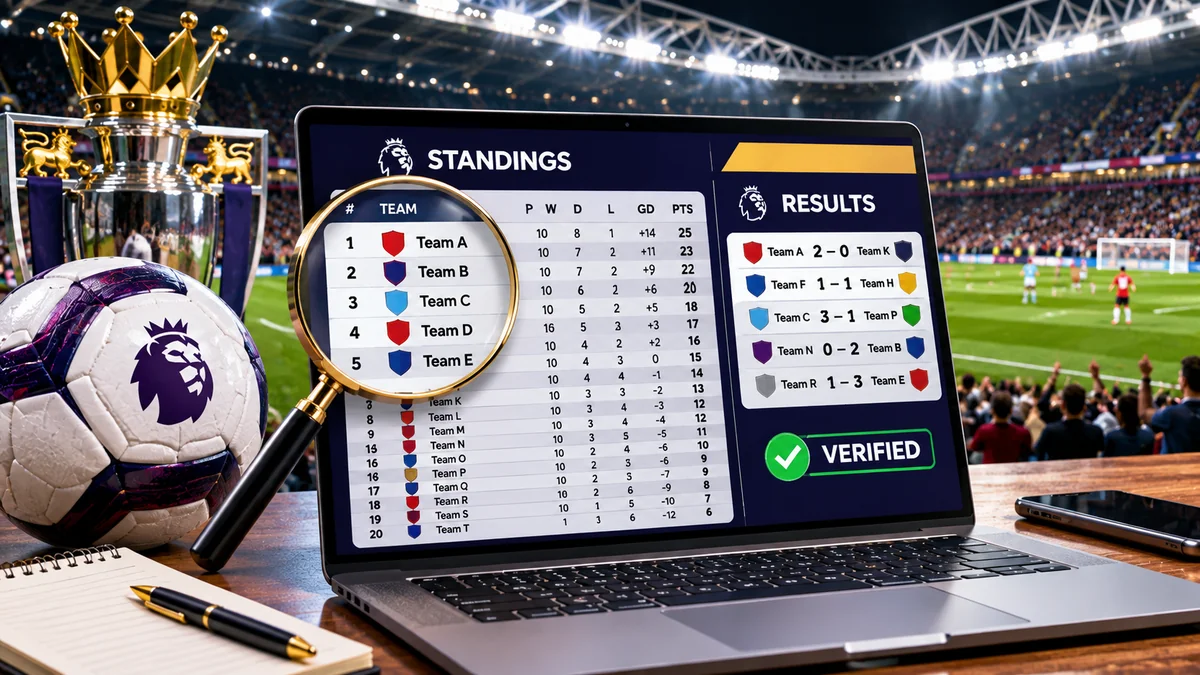
The safest way to check the Premier League table from 1 to 20 is to use the competition's official standings page, confirm that the correct season and First Team competition are selected, and then cross-check any disputed score against the official match record. A league table is updated as results are confirmed. Screenshots, search previews and social posts can display an earlier position even when they look convincing.
This matters when a club is tied on points, has a game in hand, suffers a late goal or plays a rescheduled fixture. It is also important for bloggers, social-media publishers and supporters trying to distinguish the live position from a projected table.
For the 2026/27 Premier League season, the official standings page is the starting point, while the official matches page is where to review fixtures, results and match information. This guide explains how to verify both, interpret the calculations and avoid common errors. Research checked on 14 November 2026.
Where can you find the official Premier League table?
Go directly to premierleague.com/en/tables/premier-league/2026-27 or follow the Table menu on premierleague.com . This is the competition organiser's website, not a third-party prediction, fantasy football table or unofficial social-media page.
Before using the numbers, make three checks:
- Season: make sure the selected season is 2026/27 or whichever historical season you intend to research. A link, saved bookmark or search result can open a different season.
- Team category: use First Team rather than U21 or U18. The official site provides separate competition views.
- Data and update context: look for the current matchweek, games played and latest completed results. If a page seems stale, reload the official site rather than trusting a cached search preview.
The table displays the teams from first to 20th with standard performance columns and can include form and next-match information. It is not safe to copy a snapshot without recording the season and when it was checked. In particular, web search indexes sometimes retain older table data, even for a current-season URL.
For the latest live positions, use the official link above rather than the position of a team quoted in this article. That keeps this explainer useful as the season progresses.
How to verify official Premier League results
The league's 2026/27 match centre and fixtures page is the corresponding record for games, dates, opponents and scores. It is especially important when a live-score app reports a late goal, a match has moved from its original date, or a viral screenshot shows a different final score.
- Open the matches page from the official website and choose the relevant season and First Team competition.
- Locate the fixture using the match date, club names or available filtering/navigation. Check which team was at home.
- Inspect the match status. A fixture that is upcoming, in progress, postponed or finished should not be treated the same way. Use the confirmed result when calculating final points.
- Open the match details or linked report. Verify the final score and, when relevant, scorers, own goals, dismissals and match events.
- Check the table again after completion. A score may appear on the live match page before every cached table, widget or third-party app refreshes.
- If information conflicts, check the league's official news or match report and the clubs' official channels, then note the time of your verification.
A match report is useful context, but a speculative preview or a social post published during a game is not a final result. The Premier League provides match reports on its official news pages, such as this 2026/27 report of Newcastle's win over Tottenham . For a specific disputed game, use the corresponding report and match record rather than unrelated reporting.
What does each Premier League table column mean?
The official Premier League explainer describes a 20-team competition in which clubs meet home and away: 38 league games per team and 380 overall in a complete season. Three points are awarded for a win, one for a draw and none for a loss.
| Column | Meaning | How to verify it |
|---|---|---|
| Pos | Current official position from 1 to 20 | Compare points and applicable ranking criteria |
| Pl / P | Premier League matches completed | W + D + L should equal Pl |
| W | League matches won | Count final victories |
| D | League matches drawn | Count final draws |
| L | League matches lost | Count final defeats |
| GF / F | Goals scored in league matches | Sum goals scored across completed fixtures |
| GA / A | Goals conceded in league matches | Sum opponents' goals across completed fixtures |
| GD | Goal difference | GF − GA |
| Pts | League points total | Normally 3 × W + D, adjusted for any official sanction |
| Form | Recent results shown by the provider | Check the specified number of recent fixtures |
Do not mistake GF (goals for) for GD (goal difference). A club with 25 goals scored and 19 conceded has a goal difference of +6, not +25. Equally, a team with more wins can be below a rival if its draws and total points yield a lower official total.
How to independently check a team's points
Use the points formula Points = (wins × 3) + draws. Losses do not add points. The basic formula can be checked against final league results for the season, provided there are no applicable league points adjustments.
For example, imagine a fictional club has played 11 matches, won six, drawn three and lost two:
- Games played = 6 + 3 + 2 = 11.
- Points from wins = 6 × 3 = 18.
- Points from draws = 3 × 1 = 3.
- Total points before adjustments = 21.
Suppose the same fictional club has scored 19 goals and conceded 11. Its goal difference is 19 − 11 = +8.
These checks help identify a screenshot that accidentally mixes the latest score with an older points total. They also reveal common spreadsheet or social-graphic errors. If the official table differs, do not immediately claim the league is wrong: first confirm that all games belong to the correct Premier League season, that no match is duplicated and that no official points deduction or other adjustment applies.
For a season summary, fixtures played in the FA Cup, EFL Cup, European competitions and pre-season friendlies must not be counted as Premier League wins or losses. A club's overall competitive record is different from its domestic league record.
How does the Premier League decide who ranks higher on equal points?
Being level on points does not automatically mean two clubs share a table position. According to the Premier League's published ranking rules , the sequence for separating teams is:
- Higher total league points.
- Better goal difference.
- More goals scored.
- More points earned in head-to-head league matches between the tied clubs.
- More away goals scored in those head-to-head matches.
In exceptional cases involving a title, European qualification or relegation position that remains unresolved by the prescribed criteria, the rules provide for a potential play-off. This is not the ordinary way table positions are decided.
Consider two entirely hypothetical teams, A and B, both with 21 points and +8 GD. Team A has scored 19 and conceded 11; Team B has scored 17 and conceded nine. Team A would rank higher because 19 goals scored is greater than 17, so a head-to-head comparison is unnecessary.
Important: head-to-head results are not the first tie-breaker. Fans sometimes incorrectly rank the winner of an earlier meeting higher despite the other team having superior goal difference. The order of criteria matters.
For a published FlyingEze example of why seemingly similar totals can lead to different rankings, see Why Newcastle Were Above Chelsea in the Premier League Table . Always check that article's season and date before applying its particular club comparison to a new table.
Why a live score and official table might temporarily disagree
Live, provisional and completed are different states. During a match, a live table can show projected positions based on the score at that moment. A late equaliser, overturned goal or stoppage-time winner may change the projected order immediately. A different provider may display only the last completed standings until the match ends.
Other common causes of temporary differences include:
- Refresh delay: the match clock, score, match report and league table do not always update in the same instant on every device.
- Cached pages: search engines or social cards may show table values retrieved hours or days earlier.
- Different season selection: a saved 2025/26 view can look similar to 2026/27, even with a different set of clubs.
- Different team category: First Team, U21 and U18 standings are separate.
- Different competition: an FA Cup or European match does not change Premier League points.
- Time-zone confusion: the match may appear under a different calendar date for viewers in another country.
- Postponement or rescheduling: matches not completed do not award the normal three, one or zero result points.
It is sensible to treat an app's “as-it-stands” label as a projection until the relevant final score is confirmed. For journalistic reporting, state whether the table is live during a match or after the completion of named fixtures.
How to verify a postponed or rescheduled Premier League match
The Premier League's fixtures FAQ explains that matches can move for broadcast selections, domestic cups and European competition scheduling. The league's 2026/27 fixture-change explainer also stresses that fixtures released at the beginning of the season remain subject to change.
When you see conflicting kick-off dates, check the current official match schedule rather than treating an initial fixture-release article as an immutable calendar. The clubs' official announcements can provide additional confirmation, especially for ticket-holders.
A postponed match normally means the two teams have played fewer games than others, not that they have already earned points for the unplayed fixture. Some fixture lists include placeholders or subject-to-change dates. Record both the original date and the replacement date when publishing an update, and clearly distinguish a postponed game from a completed one.
If two clubs have played different numbers of league matches, points per game (Pts ÷ Pl) may help readers compare pace, but PPG does not replace the official points table. Nor should games in hand be treated as guaranteed victories.
How to check a goal, VAR decision or disputed result
A dramatic incident can circulate as a short clip before the full match ends. To verify it, open the official match information and check the final score and match report. Ask whether the goal was awarded, ruled out, credited as an own goal or followed by a later score change. Do not assume a screenshot captured during a VAR review proves the final decision.
The league also publishes Key Match Incident (KMI) Panel assessments of refereeing decisions. In the 2026/27 season, these reports provide transparency about refereeing performance; they should not be mistaken for a separate league-results table or treated as automatically changing the score of a completed match.
If a reported score appears wrong, compare the league match page with its own report and the clubs' official communications. A screenshot with no match date or season cannot resolve a disputed claim on its own.
Where else can you cross-check football information?
Use sources in an order that separates official records from commentary:
| Source | Best use | Limitation |
|---|---|---|
| Premier League official table | Current 1–20 standings and competition data | A cached copy may not be current |
| Premier League official match centre | Fixtures, match status and result | Check completion and season |
| Official club website or verified club communications | Squad and fixture announcements; result cross-checks | Some content is fan-facing commentary |
| Reputable sports news outlets | Reporting, interpretation and context | Reports can have earlier publication timestamps |
| Live-score apps and search widgets | Convenient alerts | Refresh delays and different live-table conventions |
| Social-media screenshots | Leads for further verification | Can be old, cropped, altered or lacking context |
The Premier League publishes a guide to its official social-media channels . Checking accounts against that guide can help avoid impersonators, but a social post is still less useful than the actual official match record for verifying a disputed result.
FlyingEze's archived Brighton and Arsenal table update from August 2026 illustrates an important newsroom distinction: a headline can truthfully describe the standings on its publication date and become outdated as later matches are played. Always preserve the timestamp when resharing a historical ranking.
How to check the table accurately on a mobile phone
You do not need specialist statistical software. In a browser, open the official table, confirm the season and First Team selection, and read the position, played, goal difference and points columns. If the display is narrow, switch between available short and full views or scroll sideways as the interface allows.
Then open the match schedule in another tab, locate the most recent game you are interested in and confirm its status. If a social post claims a team has climbed three places, compare the standings after that match with a dated earlier snapshot, not an undated screenshot.
When sharing a table image, include a caption such as “Premier League standings after matches completed on [date], 2026/27 season.” Do not write “live” unless your graphic or embedded data is actually being updated live. Consider adding the source URL and the time the data was checked.
For Nigeria-based viewers, remember that UK fixtures may be advertised in local UK time, which switches seasonally between Greenwich Mean Time and British Summer Time. Nigeria remains on West Africa Time (UTC+1). Check the date and displayed time zone before assuming a late-night game has moved or is missing.
A seven-point verification checklist for football publishers
- Capture the source: save the exact official table or match URL and its season.
- Identify the snapshot: record the date, time zone and whether matches are final or ongoing.
- Reconcile the arithmetic: confirm Pl = W + D + L, GD = GF − GA and ordinarily Pts = 3W + D.
- Check ranking criteria: apply goal difference, goals scored and then the relevant head-to-head rules when points are tied.
- Inspect unusual cases: check for official deductions, rearranged fixtures or fewer matches played before calling the table inaccurate.
- Cross-check disputed results: compare the match page with the league report and clubs' verified statements, not a viral image alone.
- Label everything accurately: distinguish “official final standings”, “live as-it-stands table”, “historical snapshot” and “predicted finish”.
A basic automated table feed also needs safeguards: retain its source and time of retrieval, treat missing data as unknown rather than zero, and do not publish a league position if the feed has not been updated following the latest known completed fixtures. Store the result of each verification so later corrections can be explained transparently.
Common mistakes that lead to incorrect Premier League rankings
Confusing points with goal difference. A team cannot pass a rival on goal difference if it has fewer league points, unless a separate official points adjustment changes that comparison.
Assuming head-to-head is the first tie-breaker. It follows goal difference and goals scored in the ranking sequence.
Adding cup victories. Domestic cups, continental games and friendlies do not count towards league W, D, L or Pts.
Reading an old season. Promoted and relegated clubs change the composition of the top flight between seasons.
Trusting a screenshot with no timestamp. Even an authentic image can be out of date minutes after a late match result.
Confusing prediction with confirmation. A supercomputer projection or a “live table” in mid-match is not the official final table.
Assuming fixture dates are fixed. The league can change dates and kick-off times for specified reasons, so check its current match schedule.
Frequently asked questions
What is the most reliable site for the Premier League table from 1 to 20?
The competition's official season-specific table is the primary source for standings, provided the correct season and First Team view are selected. For matches, use the league's official 2026/27 schedule and match records.
How often does the Premier League table change?
It can change after matches finish, and some providers show provisional standings while matches are in progress. The official table may also reflect a confirmed adjustment or correction. Always note when the data was checked.
How do you calculate Premier League points?
Multiply league wins by three and add league draws: Pts = 3W + D, before any officially applicable points adjustment. Losses earn zero points.
Why is a team above another with the same points?
Compare goal difference first, then goals scored, then the prescribed head-to-head criteria. A team does not move higher solely because it won the most recent meeting.
Does a postponed fixture count as a loss?
Not simply because it was postponed. A match that has not been completed should not be treated as a normal played loss. Check the eventual result or any separate formal competition ruling.
Are Premier League app scores always final?
Scores shown during a match are provisional. Check the status and match report once the game ends. Different services may refresh their records at different times.
Can a Premier League team lose points without losing a match?
Yes, a competition authority may impose a formally applicable points deduction under its rules. Before adjusting a published table yourself, find the official decision and verify how the competition displays it.
Where can I see an old Premier League table?
Use the season selector or available archived views on the official Premier League tables page , and record the intended season. If you need a table from a particular earlier matchweek, verify that the selected view matches that point in time.
Final takeaway: the result, season and timestamp matter
Checking the Premier League table from 1 to 20 is straightforward when the source is reliable. Start with the league's official standings, ensure you have the correct season and team category, and use official match records to confirm completed results. Understand the basic points and goal-difference calculations before drawing conclusions from a team's rank.
Most table disputes come down to context: an old screenshot, an unfinished match, a missed fixture change or a misunderstood ranking rule. Verify those details before posting an update or sharing a dramatic claim about the title race, European places or relegation.
Editorial note: Researched on 14 November 2026. This guide intentionally links to the official updating 2026/27 table rather than reproducing a static 1–20 ranking as though it were live.