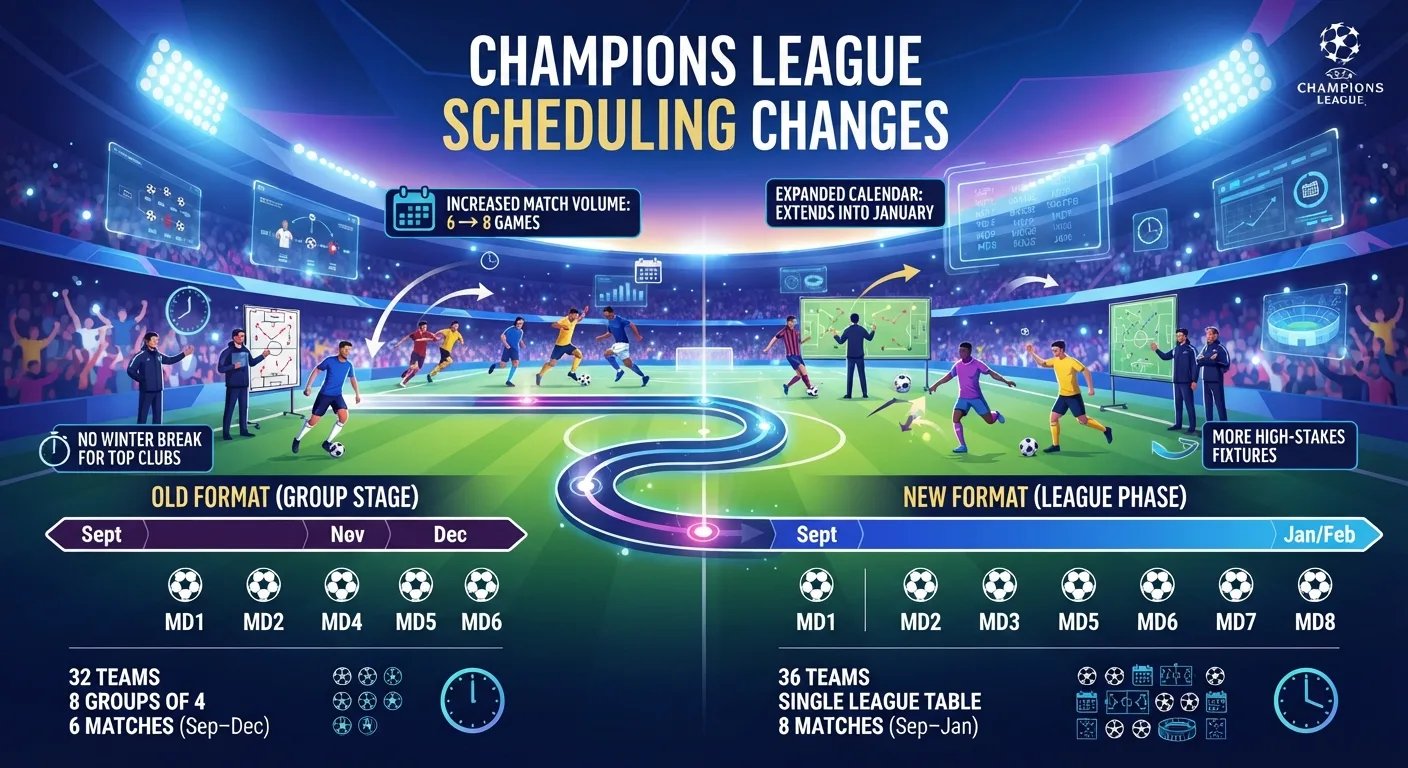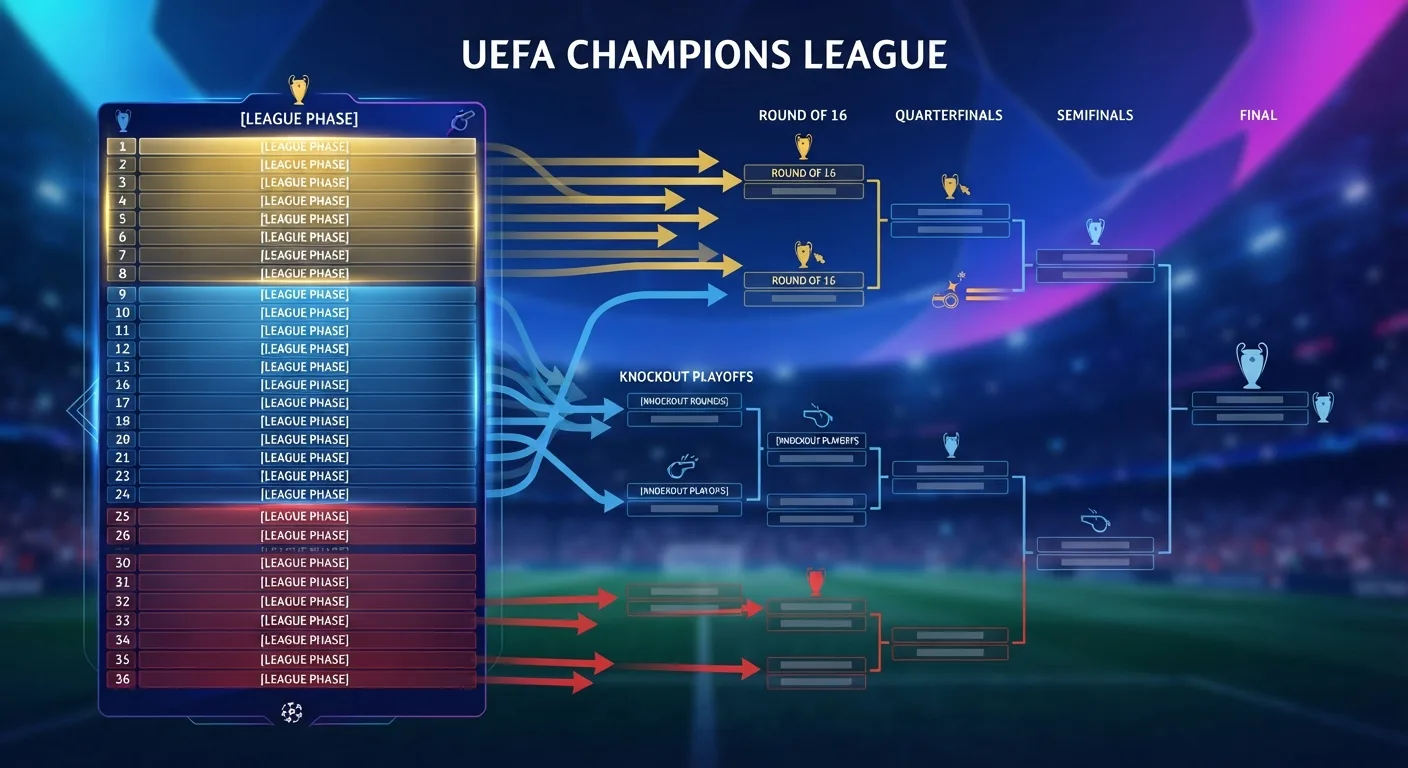
The UEFA Champions League uses a 36-team league phase, followed by knockout play-offs, a round of 16, quarter-finals, semi-finals and a one-match final. Each club plays eight different opponents—four at home and four away—instead of the old four-team group format. The top eight go straight to the round of 16; clubs ranked ninth to 24th enter two-legged play-offs; teams finishing 25th to 36th are eliminated.
That is the basic answer for anyone searching for “European championship league” or trying to understand the modern Champions League. But qualification, league-table ties and knockout seeding contain important details. For 2026/27, UEFA's competition regulations also reward higher league-phase finishers with a potential second-leg home advantage deeper into the knockout bracket.
This guide explains the rules as they apply to the 2026/27 men's UEFA Champions League, using UEFA's official season regulations and competition guide . Fact-check date: 8 November 2026.
What is the UEFA Champions League?
The UEFA Champions League is Europe's leading men's club football competition. Clubs qualify largely through results in their domestic leagues, with additional routes for European titleholders and teams coming through summer qualifying rounds. It should not be confused with the UEFA European Championship, usually called the Euros, which is a competition for national teams.
Originally known as the European Champion Clubs' Cup, the competition began in 1955/56. It adopted the Champions League name in 1992/93 and changed again in 2024/25, replacing its familiar 32-team, eight-group first stage with one 36-club league ranking. UEFA describes 2026/27 as the third season under this system.
For fans, the defining change is simple: a club no longer plays three group opponents twice. It instead faces eight separate opponents and is ranked alongside every other club in the competition's league phase.
The 2026/27 Champions League format at a glance
| Stage | Teams | How it works |
|---|---|---|
| Qualifying and play-offs | Clubs competing for remaining places | Home-and-away knockout ties through the qualifying routes |
| League phase | 36 | Eight matches against eight opponents; one overall table |
| Knockout play-offs | 16 (places 9–24) | Eight two-legged ties; eight winners advance |
| Round of 16 | 16 | Eight top league finishers plus eight play-off winners |
| Quarter-finals | 8 | Four two-legged ties |
| Semi-finals | 4 | Two two-legged ties |
| Final | 2 | One match at a preselected venue |
The league phase consists of 144 matches—18 per matchday across eight matchdays. Every league-phase result matters because the ranking affects qualification for the knockouts, the draw and potential home-leg advantages.
How do clubs qualify for the Champions League?
Entry begins with UEFA's access list, which considers each national association's performance in UEFA club competitions over the relevant ranking period. A higher-ranked domestic league generally receives more places and may send several clubs straight to the league phase. A lower-ranked league's champion may have to begin in an earlier qualifying round.
1. Domestic league positions
UEFA's 2026/27 Article 3 provides for one, two, three or four domestic league representatives in its standard association allocation. The starting round depends on the access list. That is why fourth place in one league can bring automatic qualification while a champion in another league must negotiate several qualifying ties.
2. Champions League and Europa League titleholders
The previous Champions League and Europa League winners are guaranteed league-phase places even if they do not qualify through their domestic championships. UEFA has vacancy and rebalancing rules when a titleholder also qualifies by its domestic league position. That means places are not simply added without adjusting the access list.
3. Two European Performance Spots
Two extra league-phase places are allocated to the national associations whose clubs achieved the best collective performance in UEFA men's club competitions the previous season. These are known as European Performance Spots (EPS). Each goes to the highest domestic league finisher in that association who has not already qualified for the Champions League league phase, after the relevant rebalancing rules.
For 2026/27, UEFA confirmed England and Spain as the two EPS associations, with Liverpool and Real Betis taking the additional places. Those specific recipients concern this season: the associations and clubs can change in future seasons.
4. Qualifying rounds: champions path and league path
The qualifying phase offers another route to the league phase. It has a first qualifying round, second and third qualifying rounds, then play-offs. From the second qualifying round, teams are divided between the champions path, for eligible domestic champions, and the league path, for eligible non-champions from leagues with more than one entry. A team's entry round depends on its association's access-list position and adjustments.
According to UEFA's 2026/27 qualifying summary , 29 clubs entered the league phase directly and the final seven spots came through qualifying: five via the champions path and two via the league path. Qualifying ties are normally played across two legs, with aggregate goals deciding the winner. Clubs eliminated at qualifying stages may move into the Europa League or Conference League under UEFA's separate transfer rules.
The UEFA Champions League is not an invitation-only competition for famous clubs. Sporting qualification still matters, although the allocation of places reflects the association-ranking system.
How does the 36-team league phase work?
All 36 teams appear in one overall league table. Each has eight fixtures against different opponents. A win brings three points, a draw one and a defeat none. There are no separate four-team groups and no home-and-away double-header against the same league-phase opponent.
How are opponents drawn?
UEFA divides the 36 teams into four seeding pots of nine, based on club coefficients, with the reigning Champions League winner receiving the top seed in Pot 1. Each team is drawn against two opponents from each pot: one home game and one away game against opponents from each pot. In principle, clubs from the same national association are not drawn against one another in the league phase, and a club faces at most two opponents from any other one association. UEFA may adjust constraints where necessary to complete the draw.
The draw was held on 27 August 2026 for the current competition. It determines opponents and home or away status—not final points, qualifying positions or a guaranteed route to the trophy.
Does everyone play the same opponents?
No. Every club has a different combination of opponents, so strength of schedule can vary. That is one reason UEFA's league-stage tiebreakers eventually consider the collective performance of each club's opponents. But the primary ranking is still built from points and results obtained by each club itself.
Who qualifies for the knockout rounds?
At the end of matchday eight, positions in the table have three different consequences:
| Final league-phase position | Outcome |
|---|---|
| 1–8 | Automatically advance to the round of 16 |
| 9–16 | Enter the knockout play-offs as seeded teams |
| 17–24 | Enter the knockout play-offs as unseeded teams |
| 25–36 | Eliminated from European competition via this route |
Clubs in 25th place or lower do not move into the Europa League after the league phase. This is a significant difference from older Champions League formats, in which certain eliminated group-stage sides could continue in Europe's second-tier club tournament.
Consider a hypothetical club finishing eighth on 15 points and another finishing ninth on 15 points but behind on tiebreakers. The eighth-place club goes directly to the last 16, while ninth place must survive an additional two-legged play-off. Exact position—not merely reaching a certain points threshold—determines progression.
Champions League league table tiebreakers explained
UEFA's 2026/27 Article 18 specifies how clubs level on points are ranked after the league phase. The criteria, applied in order, are:
- Superior league-phase goal difference
- More league-phase goals scored
- More away goals scored in league-phase matches
- More league-phase wins
- More away wins
- More points collectively earned by the club's league-phase opponents
- Better collective goal difference of those opponents
- More goals collectively scored by those opponents
- Lower disciplinary-points total from relevant yellow and red cards
- Higher UEFA club coefficient
Therefore, goal difference comes before goals scored. Head-to-head results between two tied clubs are not the primary test, because the clubs may not even have faced each other in the eight-match league phase. Opponent-based criteria enter only after the earlier results-based criteria fail to separate teams. UEFA has also explained how standings are displayed during the competition before all eight matches have been completed.
For a simple example, two clubs on 16 points might have goal differences of +7 and +4. The club with +7 ranks higher without needing to compare goals scored or later criteria.
How are the knockout play-offs drawn?
The knockout play-offs involve teams ranked ninth to 24th. UEFA groups clubs into paired ranking positions rather than conducting a completely unrestricted draw. Under Article 19 , the ranking-based possibilities are:
| Seeded team positions | Possible unseeded opponents |
|---|---|
| 9 or 10 | 23 or 24 |
| 11 or 12 | 21 or 22 |
| 13 or 14 | 19 or 20 |
| 15 or 16 | 17 or 18 |
The draw establishes the actual match-up within those possibilities. In principle, seeded clubs host the second leg. Eight winners then advance to face the eight clubs that qualified directly for the round of 16.
The knockout bracket is therefore partly determined by league-phase ranking, rather than being an entirely open draw at every stage. UEFA's official bracket view is useful for tracking the possible paths as league-phase positions take shape.
Round of 16, quarter-finals and semi-finals: what are the rules?
Round of 16
Clubs ranked first to eighth are paired for the round-of-16 draw (positions 1–2, 3–4, 5–6 and 7–8). Each team can be drawn into the corresponding part of the bracket against a knockout play-off winner. The eight seeded clubs normally play the second leg at home. As the bracket develops, possible opponents are limited by the predetermined paths.
Quarter-finals and semi-finals
Each tie normally has a home and an away leg. For 2026/27, UEFA's Article 19 adds a specific reward for performing well in the league phase: clubs originally ranked 1–4 are seeded to host the second leg in the quarter-finals; the clubs ranked 1–2 have that advantage in the semi-finals.
There is an important extension. If a seeded club is eliminated, the winning club inherits that seeded position in its bracket path. The ranking advantage is not recalculated afresh after each round. That means a team that defeats a top seed may later benefit from the top seed's bracket position.
These provisions reflect the regulations for this edition; fans should not assume older home-leg draw rules still describe the current competition.
Can two teams from the same country meet?
Yes, the knockout bracket can bring together clubs from the same national association or teams that already met in the league phase. The league-phase country restrictions do not operate as a blanket ban on knockout meetings. The actual combinations still follow the bracket draw and any applicable UEFA administrative constraints.
Do away goals count in the Champions League?
Away goals do not carry an extra tiebreaking value in Champions League knockout ties. If a two-legged tie ends level on aggregate, the teams play extra time and, if still level, a penalty shoot-out. UEFA abolished the old away-goals tiebreaker from its club competitions starting in 2021/22.
Consider a hypothetical two-leg tie: Team A wins the first match 2–1 and loses the second match 1–0. The aggregate score is 2–2. Team B does not progress simply because it scored a goal away from home; the tie proceeds to extra time. The same principle applies to qualifying and knockout two-leg ties, subject to exceptional one-leg arrangements authorised by UEFA.
UEFA's Article 21 specifies two 15-minute periods of extra time after a level aggregate. If the teams remain level after extra time, penalties decide who progresses.
How is the Champions League final decided?
Unlike the earlier knockout rounds, the final is one match at a stadium chosen in advance. If the score is level after 90 minutes, there are two 15-minute periods of extra time; if the score is still level, a penalty shoot-out determines the winner. A club's league-phase ranking does not give it a second final leg.
The 2026/27 UEFA Champions League final is scheduled for Saturday, 5 June 2027, at Estadio Metropolitano in Madrid . UEFA notes that the venue previously hosted the 2019 final. Dates and arrangements are subject to official changes.
The winner earns the trophy and a place in the following Champions League league phase if it has not already qualified through its domestic competition. It also earns entry to the subsequent UEFA Super Cup against the Europa League winner.
2026/27 Champions League dates: key matches and milestones
UEFA's schedule published for the current edition lists these dates. They are useful for following the competition, but consult UEFA's live fixtures page for changes in kick-off times or arrangements.
| Stage | Scheduled dates |
|---|---|
| Qualifying began | 7 July 2026 |
| League phase matchday 1 | 8–10 September 2026 |
| Matchday 2 | 13–14 October 2026 |
| Matchday 3 | 20–21 October 2026 |
| Matchday 4 | 3–4 November 2026 |
| Matchday 5 | 24–25 November 2026 |
| Matchday 6 | 8–9 December 2026 |
| Matchday 7 | 19–20 January 2027 |
| Matchday 8 | 27 January 2027 |
| Knockout play-offs | 16–17 and 23–24 February 2027 |
| Round of 16 | 9–10 and 16–17 March 2027 |
| Quarter-finals | 6–7 and 13–14 April 2027 |
| Semi-finals | 27–28 April and 4–5 May 2027 |
| Final | 5 June 2027 |
UEFA's final league-phase matchday brings all teams' positions into focus. Margins such as the difference between eighth and ninth or 24th and 25th can be decisive, making the standings worth following even after certain clubs have accumulated enough points to be optimistic about progression.
Why did UEFA change the Champions League format?
The switch to the league phase created more matches against different opponents and more variation in potential fixtures. Instead of six group fixtures, each of the 36 clubs plays eight league-stage games. UEFA's format explainer says the aim was greater competitive variety and more meaningful league-stage encounters.
For fans, the advantage is a broader set of match-ups and a single table where every place can matter. The additional fixtures also bring trade-offs: a longer calendar, more travel and potential workload pressure for clubs and players. The exact competitive impact cannot be decided from the format alone; it depends on results, scheduling and how teams manage their squads.
FlyingEze previously reported on the original approval of the format changes . That historical report is useful context, but the 2026/27 rules and dates in this guide come from UEFA's current regulations.
How to follow a club's path: a simple example
Imagine an entirely hypothetical club finishes sixth in the 36-team league phase. It goes directly to the round of 16, avoiding the February knockout play-offs. Its opponent is determined through the seeded bracket and the play-off results. Because it ranked sixth rather than second, it does not enjoy the same seeded second-leg privilege in the later quarter-final and semi-final rounds under the current rules—unless it inherits a more favourable bracket position by eliminating a higher seed.
Another hypothetical club finishes 20th. It must first win a two-legged play-off against one of the possible seeded opponents drawn from positions 13 or 14. Only then can it enter the round of 16. Finishing 20th is therefore very different from finishing eighth, even if both teams ultimately have a route to the trophy.
The central lesson is that league-phase ranking influences how many matches a club must survive and which potential knockout path it receives, not just whether it remains in the competition.
Frequently asked questions
How many teams play in the Champions League league phase?
Thirty-six teams take part. Each plays eight different opponents, four at home and four away, and all teams are ranked in one table.
How many teams automatically qualify for the round of 16?
The top eight teams at the end of the league phase advance directly. Teams ranked ninth to 24th must first contest knockout play-offs.
Can a club finishing 24th win the Champions League?
Yes, in principle. A club finishing 24th can enter the play-offs and, if it wins every required knockout tie, reach and win the final. A team finishing 25th or lower is eliminated.
Do Champions League teams still play group-stage matches?
The old four-team group stage has been replaced by a single 36-club league phase. Fans sometimes use “group stage” informally, but “league phase” is the correct term for the current format.
Are Champions League knockout ties decided on away goals?
No. A tie level on aggregate goes to extra time and, if necessary, penalties. Away goals do not give a team extra weighting in the aggregate calculation.
How are teams separated when they finish on equal points?
Goal difference comes first, followed by goals scored, away goals scored and the other criteria set out in UEFA's Article 18. Opponents' collective results also feature further down the list.
Where is the 2027 Champions League final?
UEFA has scheduled the final for 5 June 2027 at Estadio Metropolitano in Madrid, Spain, subject to any official update.
Conclusion
The modern UEFA Champions League rewards both consistent league-phase performances and success in knockout football. Its 36-club league phase gives each team eight different opponents; places one to eight advance directly; ninth to 24th enter play-offs; and the bottom 12 are eliminated. The later rounds use two-leg aggregate scoring without away-goals tiebreakers until a single-match final decides the champion.
For 2026/27, pay particular attention to league ranking and bracket seeding. A strong finish can influence who a club might play and who gets to host the second leg deep into the knockout stage. For definitive fixtures, results and any rule updates, consult UEFA's official Champions League site and the 2026/27 competition regulations .