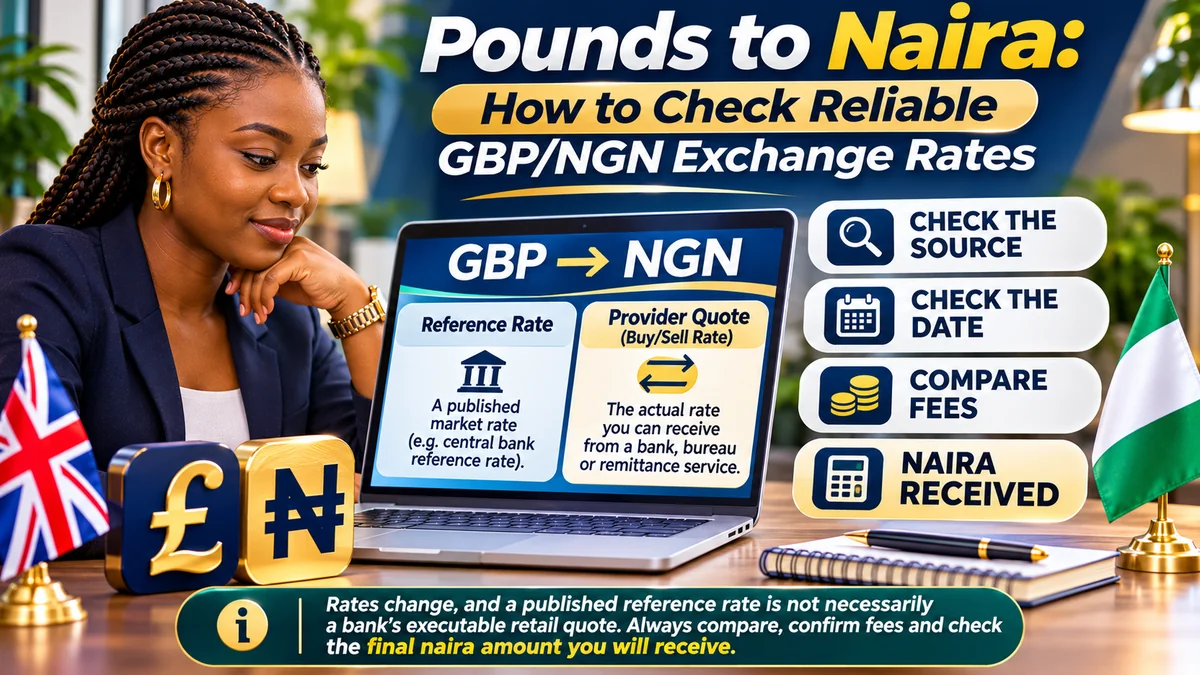
Quick answer: To check a reliable pounds-to-naira (GBP/NGN) exchange rate, start with the Central Bank of Nigeria (CBN) exchange-rate page for an official market reference, then compare it with a reputable currency-data service and the actual buy or sell quote offered by your bank or authorised transfer provider. Check the publication time, fees and the final amount of naira the recipient will receive before making a payment. A reference rate is not necessarily a price at which an individual customer can exchange money.
People searching for sterling to naira, one pound to naira or GBP to NGN today often see different figures on central-bank pages, Google, rate-comparison sites, remittance applications and social media. Those figures can all be describing different things: a dated official benchmark, an indicative mid-market quote, a retail cash rate or the amount actually payable on a money transfer.
To illustrate why the date matters, third-party publishers reproducing CBN currency tables showed a 12 November 2026 GBP/NGN central reference of approximately ₦1,797.24 per £1. That is a dated reference, not a live November 13 transaction quote, and must not be treated as the amount any bank or transfer service is obliged to pay. The CBN website is the primary source to consult, while the historical GBP table is useful for checking the date and reported values independently.
This guide explains which sites are useful, what the quoted numbers mean, how to calculate an effective rate and how to protect yourself from misleading offers and fraudulent transfer services.
Research verified: 13 November 2026. This is an evergreen educational guide, not an assertion of a guaranteed live rate or a recommendation to transact through any named provider. Figures in examples are explicitly hypothetical unless a historical source date is given.
Where to check reliable GBP/NGN exchange rates
| Source | What it helps you check | Important limitation |
|---|---|---|
| Central Bank of Nigeria | Official Nigerian FX-market reference and historical data; the public NFEM table particularly identifies USD/NGN | Not an executable consumer GBP-to-naira remittance or cash quote |
| Bank of England | UK central-bank spot data against sterling for comparison or cross-rate context | BOE says its rates are indicative, not official tradeable rates; NGN is not necessarily shown directly |
| Wise mid-market explanation | What an indicative midpoint between buy and sell prices represents | Does not establish that any provider will deliver that rate or support your particular route |
| Your bank's official FX quote | Rate the bank proposes for a particular transfer, card payment or currency exchange | Can involve margins, service charges and different customer eligibility |
| Authorised remittance provider's final checkout | The rate, amount deducted, fee and actual NGN credited | May expire or change before funds are received or the quote is accepted |
Start with the type of question you have. If you are writing a report on exchange-rate trends, a central-bank series may be appropriate. If you are about to send £500 from the UK to Nigeria, the executable provider quote and the beneficiary's naira amount matter more than a published daily benchmark.
What does “sterling to naira” actually mean?
Pound sterling is the currency of the United Kingdom, represented by GBP and the symbol £. The Nigerian naira uses the code NGN and symbol ₦. An exchange-rate pair such as GBP/NGN states how many naira correspond to one pound.
For example, a hypothetical quote of GBP/NGN = 1,800 means £1 is valued at ₦1,800 at that particular quoted rate. Under a simple multiplication, £100 would be ₦180,000 before commissions, fees, adjustments or tax. This arithmetic is not a claim that a real provider currently offers ₦1,800.
The reverse pair is NGN/GBP: it expresses how much of one pound a single naira buys. Do not accidentally use the reciprocal quotation as if it were another naira-per-pound price. Check the direction of the transaction too: receiving naira for pounds and buying pounds with naira usually involve different sides of a dealer's bid–ask spread.
1. Start with the CBN's official Nigerian foreign-exchange data
Go directly to cbn.gov.ng/rates/ExchRateByCurrency.html . The CBN's Nigerian Foreign Exchange Market (NFEM) table explains that the NFEM rate is volume-weighted and is the official market rate for the day. Its publicly viewable NFEM series is prominently expressed in naira per US dollar, so a displayed NFEM USD figure should not be copied and labelled GBP/NGN.
Depending on the CBN rate table and data view available, other currencies may be shown in a separate currency-rate publication or dataset. Always check the actual GBP label and its rate date before quoting a sterling figure. If the page displays only USD/NGN, it cannot independently establish a current pound-to-naira transaction rate. The bank's market-reference data and a commercial bank's customer quote serve different purposes.
Historical snapshot, not a live quote: Independent historical-data republications of the CBN currency series list the following for Thursday, 12 November 2026: buying ₦1,796.5729, central ₦1,797.2359 and selling ₦1,797.8989 per pound. The figures appear in the dated historical currency table and another dated CBN-series reproduction . These are secondary data reproductions; use the original CBN publication where accessible for authoritative verification, and do not treat the snapshot as today's or tomorrow's quote.
Readers who follow the broader FX environment can compare those principles with FlyingEze's historical coverage of the official-versus-parallel-market gap in USD/NGN . That article concerns the dollar and a specific past period, not today's sterling rate.
2. Understand mid-market rates, buying prices and selling prices
An exchange-rate website may show a mid-market rate—roughly the midpoint between the prices at which market participants are willing to buy and sell currency. Wise's explanation of mid-market pricing describes this benchmark and notes that providers may instead apply an exchange-rate margin.
The bid–ask spread is the difference between buying and selling prices. For a retail transaction, terminology should be read from the provider's perspective: if it is buying your pounds and paying you naira, the rate relevant to you may be its GBP buying rate. If you are paying naira to acquire pounds, the relevant rate may be its GBP selling rate.
A provider quoting a large number such as “₦1,850 per pound” has not yet told you all you need to know. Ask whether it is a buying rate, selling rate, reference estimate or rate locked for a specific transaction. Ask about cash handling, transaction charges and other deductions. An apparently better exchange rate can be outweighed by a higher fee.
| Term | Meaning | Question to ask |
|---|---|---|
| CBN or published reference rate | Market benchmark or published historical data | What currency pair and effective date does it describe? |
| Mid-market rate | Indicative midpoint of buying and selling prices | Is it informational, or actually offered for my transaction? |
| Provider buying rate | Price at which provider buys GBP from customer | How many naira do I receive for my pounds? |
| Provider selling rate | Price at which provider sells GBP to customer | How many naira must I pay to obtain each pound? |
| Exchange-rate margin | Difference between benchmark and the provider's applied rate | Is the displayed fee the only cost? |
| Guaranteed or floating rate | Whether the rate can change before completion | How long is the quote valid, and what causes a repricing? |
3. Compare the final naira received, not just the headline rate
For somebody sending pounds from the UK to a Nigerian account, a practical comparison is the net amount received in naira for the same number of pounds paid by the sender. A higher advertised GBP/NGN rate does not always deliver more money.
Consider two fictional services for a £200 transfer:
| Comparison | Provider A | Provider B |
|---|---|---|
| GBP amount paid | £200 | £200 |
| Advertised conversion rate | ₦1,830/£1 | ₦1,800/£1 |
| GBP fee deducted before conversion | £5 | £0 |
| GBP amount converted | £195 | £200 |
| Naira received | ₦356,850 | ₦360,000 |
The calculations are (£200 − £5) × ₦1,830 = ₦356,850 for A, versus £200 × ₦1,800 = ₦360,000 for B. In this example, Provider B pays ₦3,150 more even though it advertises the lower headline rate.
These values are examples, not current providers, prices or recommendations. Real transactions may apply fees in naira rather than pounds, include intermediary bank charges or offer different rates for a bank transfer versus a card payment. Compare the same total pounds paid and the exact naira the intended recipient will receive.
4. Calculate the effective GBP/NGN exchange rate
Where the sender has paid a known total in pounds and the beneficiary receives a known amount in naira, the effective rate is:
Effective GBP/NGN rate = Final naira received ÷ Total pounds paid.
Using the fictional example above, Provider A's effective rate is ₦356,850 ÷ £200 = ₦1,784.25 per pound. Provider B's effective rate is ₦360,000 ÷ £200 = ₦1,800 per pound.
This method incorporates deductions into a single useful comparison. It is particularly important when a transfer app promotes a “no fee” offer but gives an exchange rate materially different from an indicative market benchmark, or when a provider quotes a high exchange rate but adds a fixed transfer charge.
For budgeting, write down the total GBP you will spend, the NGN amount expected, the date and time of the quote, the fee and the rate-guarantee period. Screenshots can help, but do not share sensitive account details or identification documents in public discussions.
5. How to convert £1, £100, £500 or £1,000 to naira
The basic conversion is:
GBP amount × NGN per GBP = naira equivalent before fees.
For illustration only, the 12 November 2026 historical GBP central reference reproduced above was approximately ₦1,797.2359 per £1. Applying that dated number arithmetically—not as a transaction offer—gives:
| Pound sterling | Historical reference calculation (12 November 2026) |
|---|---|
| £1 | ₦1,797.24 |
| £10 | ₦17,972.36 |
| £100 | ₦179,723.59 |
| £500 | ₦898,617.95 |
| £1,000 | ₦1,797,235.90 |
These figures are dated historical conversions with no retail margin or service fee, not a November 13 live price and not a promise of what any individual can exchange. For a real payment, replace the historical benchmark with the provider's valid transaction rate and account for all fees.
6. Check the publication date, update time and trading hours
Even a respected data source can appear to disagree with another because one displays a previous business-day fixing while the other streams a more recent indicative market quote. The time zone matters: a site publishing in London time and another publishing in West Africa Time may label updates differently.
Look for the actual date and time of the data, not merely a page heading that says “today”. The UK market, Nigerian market and transfer provider may update at different intervals. Weekends, public holidays and periods of low liquidity can cause providers to keep an older rate visible or widen margins. A quote can also move between the initial search and final confirmation.
The Bank of England explicitly notes that its published spot data are not official transaction rates and are no more authoritative than comparable commercial-bank market quotations. Treat them as context, not an instruction that a Nigerian remittance service must use that exact exchange price.
Before sending a payment, confirm whether the provider is offering a guaranteed rate for a specified period or a live/floating rate that may change before conversion. Wise's explanation of live-rate transfers illustrates how the final amount may vary when the rate is not locked. Availability and terms depend on the provider and route.
7. Why CBN, Google, banks and transfer apps show different rates
One does not necessarily have to be “fake” because its figure differs. They may be measuring different instruments or stages of a transaction.
- CBN data: Official market benchmark and historical reporting, potentially including different currency-specific views. The NFEM benchmark shown prominently is USD/NGN and should not be mistaken for GBP/NGN.
- Currency converters: Often display an indicative, midpoint or aggregated market price, sometimes delayed or subject to rounding.
- Commercial banks: Can quote different buy/sell rates for foreign-currency transfers, cash, cards or account conversion, plus applicable charges.
- Remittance platforms: May incorporate a spread or explicit fee, and offer route-specific prices for GBP-funded transfers to Nigerian recipients.
- Retail cash dealers: May quote cash-buying and cash-selling prices that differ from digital bank-transfer rates and depend on their lawful operating conditions.
Always compare like with like: the same currency direction, same transaction size, same funding method, same delivery method and approximately the same time. Comparing an online mid-market number at noon with a cash selling price from the previous evening can create a misleading conclusion about the spread.
FlyingEze has covered the evolving naira market in articles such as its dated October 2026 USD/NGN market report . That historical article is useful background for how FX reporting dates are presented, but it is not a substitute for a current GBP quote.
8. How to verify a pounds-to-naira transfer provider
A favourable exchange rate is not enough. Confirm that the company is legitimate and permitted to provide the relevant service. This is particularly important for people sending money between the United Kingdom and Nigeria, where a firm may need to satisfy requirements in more than one jurisdiction.
For a Nigeria-facing international money transfer, review the CBN's published International Money Transfer Operators (IMTOs) list . It displays the names of operators licensed through the CBN's relevant department. Verify the entity's legal name, not merely a similar app logo or social-media handle, and do not assume every listed firm supports every funding, payout or currency route today.
For a UK-based payments or remittance company, check the Financial Conduct Authority (FCA) Firm Checker and the permitted activity, and compare its official contact information with the website you are using. The FCA warns that criminals operate clone firms mimicking legitimate authorised or registered companies. Regulatory registration reduces some risks but does not guarantee that every transfer will succeed or that all regulatory compensation protections apply.
For a local bureau de change, verify current licensing through the CBN's financial-institution records or published current operator lists. Avoid private arrangements requiring an advance deposit to an individual's unrelated account, suspicious cash handovers or guaranteed rates that cannot be verified. Do not send card PINs, passwords or one-time codes to an exchange dealer.
9. Common GBP/NGN mistakes to avoid
- Searching “sterling” without “GBP”: Sterling is also used in company and personal names; make sure the page is actually about British pound currency conversion.
- Confusing GBP and USD: A CBN NFEM dollar benchmark is not the GBP/NGN exchange rate.
- Treating the mid-market rate as a retail guarantee: Your bank or transfer provider may use a spread or transaction fee.
- Ignoring quote dates: A price from yesterday can be unsuitable for a transfer today or next week.
- Comparing headline rates but not amount received: Deduct charges and compare the actual naira expected.
- Reversing buy/sell labels: Check which currency you are selling and which the provider is buying.
- Assuming all transfer methods cost the same: Funding by card, bank transfer or cash may produce different charges and prices.
- Using unlicensed or impersonated providers: Verify the firm through CBN and, where relevant, the UK FCA.
- Sending money to “test” a suspicious rate: Fraudsters may present attractive prices to induce transfers to personal accounts.
- Confusing estimated with locked quotations: Check whether the rate expires or may move before settlement.
For broader financial safety, FlyingEze's guide to responding after sending money to a suspected fraudulent bank account explains why prompt action, transaction records and formal bank reporting matter.
10. Pounds to naira for tuition, remittances, imports and business invoices
UK-to-Nigeria family remittances
Ask the sender to enter the exact GBP they will pay and compare the naira the recipient gets after the service fee. For larger or recurring transfers, even a small rate difference can add up. Availability of a route and beneficiary account type should be checked with the chosen authorised service.
Remittances are a meaningful part of Nigeria's external financial flows. FlyingEze has reported on Nigeria's diaspora remittance inflows and CBN comments . That background helps explain the importance of transparent pricing for families, without turning one historical headline into an exchange-rate guarantee.
Tuition and education expenses
When paying UK school fees, first determine whether the school must receive a specific GBP amount or whether a service is quoting a naira budget. Your bank or payment service may apply a selling rate, transfer charge and other permitted fees. Ask for the total naira cost required to deliver the exact sterling amount.
Imports, suppliers and business invoices
If an invoice is denominated in GBP but the buyer holds naira, obtain a valid transaction quote and document its timestamp, fees and payment deadline. Avoid copying a CBN reference rate into a contract as though it fixes the bank's commercial settlement cost unless the contract expressly specifies the reference, valuation date and calculation method.
Personal travel and cash exchange
Cash conversion can have a different spread from an electronic transfer. Check the licensed operator, receipt, cash notes and fees. Do not assume a travel-card or ATM conversion will match a physical cash counter, particularly where foreign card fees or terminal conversion choices apply.
Frequently asked questions about pounds to naira
What is the exchange rate of one pound to naira today?
It depends on the date, source and transaction type. The latest historical example quoted in this article is a 12 November 2026 reference of about ₦1,797.24 per £1 reported by secondary publishers of CBN daily GBP data. It is not a confirmed live rate for today's retail exchange. Check the CBN and your provider's current quote before transacting.
Where can I find the official GBP/NGN exchange rate?
Start with the CBN's official exchange-rate resources and verify that the data entry is actually for GBP, not the prominent USD/NGN NFEM table. A bank's retail rate can differ from an official published reference.
Is the CBN pound-to-naira rate the same as my bank's rate?
Not necessarily. The CBN publishes market-reference information; commercial banks and payment providers quote transactions according to their products, buy/sell spreads, fees and applicable rules.
What is the mid-market rate for GBP to NGN?
It is an indicative midpoint between buying and selling prices on a currency market. It is useful for comparison but may not be the price a bank or money-transfer company offers an individual customer.
How do I calculate £100 in Nigerian naira?
Multiply 100 by the naira-per-pound rate. For example, at a purely illustrative ₦1,800/£1, the gross equivalent is ₦180,000 before charges. Replace the assumed rate with a current valid quote for an actual transaction.
Why do exchange-rate websites show different GBP/NGN values?
They may use different providers, update times, reference calculations, spreads and rate directions. Compare the same date, buy/sell side and transaction method before assuming one source is wrong.
How can I check whether a UK-to-Nigeria transfer service is legitimate?
Check the legal entity and relevant activity through the UK FCA Firm Checker and consult the CBN's licensed IMTO list for Nigeria-facing operations. Verify the operator's contact details independently.
What does “naira received” mean on a remittance quote?
It is the estimated or guaranteed amount the Nigerian recipient should receive once the quoted transaction completes, subject to the stated terms. It is a better comparison metric than a headline exchange rate alone.
Can an exchange rate change after I approve the transfer?
That depends on the provider's terms. Some offers are fixed for a defined time; others use floating rates determined when funds are received or converted. Read the applicable rate-guarantee and expiry conditions.
Is a black-market GBP rate an official CBN rate?
No. An informal cash-market quote and an official published market reference represent different sources and transaction settings. Check whether a dealer is appropriately licensed and do not confuse an unverified social-media rate with a regulated, executable offer.
Does the Bank of England publish a guaranteed pound-to-naira rate?
No. The Bank of England says its exchange-rate data are not official or guaranteed transaction rates. They may help with market context but do not oblige a Nigerian bank to trade at the displayed price.
What should I do if a transfer provider advertises a good rate but asks for my PIN?
Stop. A legitimate exchange transaction does not justify disclosing banking passwords, card PINs or one-time verification codes to a person by text or phone. Confirm the provider independently and contact your bank if you have already exposed credentials.
Conclusion: a reliable sterling-to-naira rate is a verified, dated and usable quote
The safest way to check sterling to naira is to combine three checks: a trustworthy benchmark, a correct timestamp and an executable provider quote. The CBN and Bank of England provide useful market context, while currency data sites can help explain the midpoint. But the rate that matters when sending money is the one the authorised provider actually applies after all disclosed fees.
Before exchanging or remitting pounds, confirm the GBP amount paid, the rate direction, all charges, the quote's validity and the final NGN amount delivered. Verify the operator's credentials, save the transaction record and avoid treating a dated website headline as a guaranteed price. Doing these checks helps readers make more informed and safer GBP/NGN decisions, whatever direction the market moves.
Editorial verification: 13 November 2026. Sources: CBN rate reporting and licensed IMTO information, Bank of England exchange-rate notices, Wise's public explanations of mid-market and floating rates, the UK FCA's firm-verification guidance, and independently labelled historical currency reproductions. The 12 November 2026 figures are dated reference examples, not live executable rates. No FX transaction was performed.