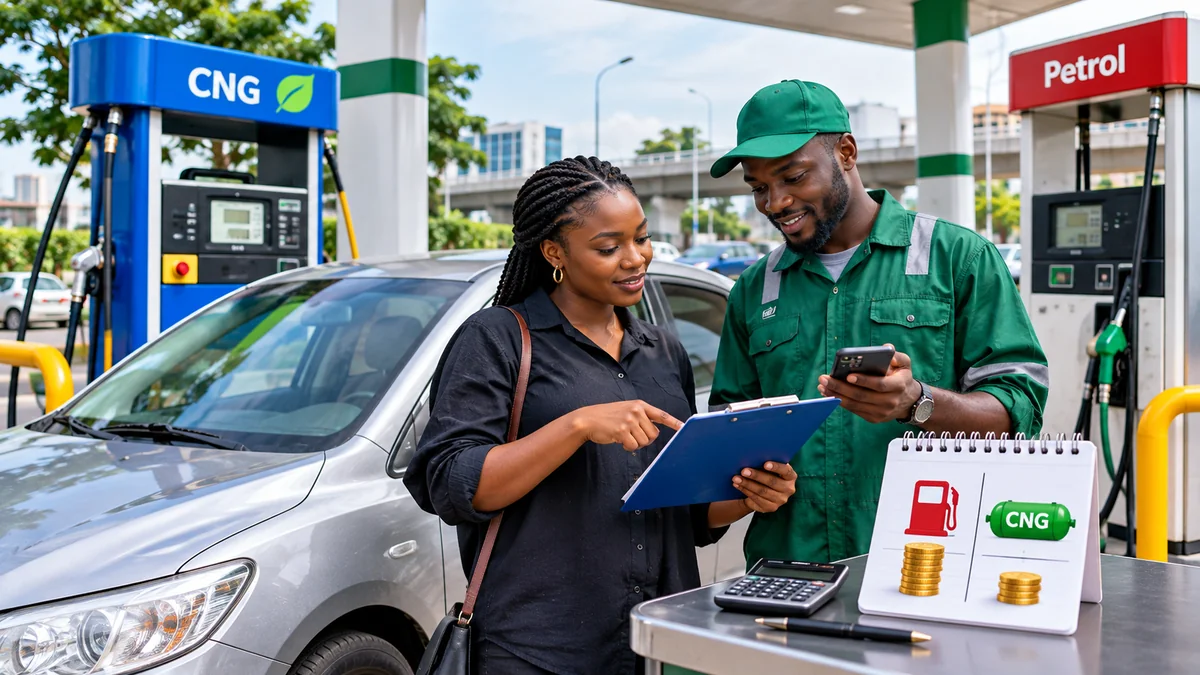
Petrol vs CNG in Nigeria: How to Calculate Your Monthly Fuel Savings
Should a Nigerian driver keep buying petrol or convert a vehicle to compressed natural gas (CNG)? The answer depends on more than the price displayed at the filling station. Petrol is usually sold by the litre, while CNG is commonly priced per standard cubic metre (SCM). A proper comparison starts with how far the vehicle travels on each fuel, then accounts for the conversion bill and whether reliable CNG refuelling is available.
To calculate monthly fuel savings, compare the cost of driving the same number of kilometres on petrol with the total cost of the kilometres actually driven on CNG and any remaining petrol use. After finding the monthly difference, divide the upfront conversion cost by realistic monthly savings to estimate how many months it may take to recover the investment.
This guide explains the formulas, works through a Nigerian naira example and provides a practical checklist before conversion. Figures are illustrations, not guaranteed outcomes for any vehicle or city. Prices and sources checked on 6 November 2026.
Petrol vs CNG in Nigeria: what is the latest price picture?
Recent prices show why drivers are exploring CNG. Vanguard reported on 4 November 2026 that sampled petrol prices in Lagos included approximately ₦1,349, ₦1,360 and ₦1,370 per litre, depending on the marketer. BusinessDay's late-October reporting cited CNG at around ₦380 per SCM for cars and buses and ₦450 for heavy trucks, alongside warnings about supply and conversion costs.
These are dated market observations, not nationwide fixed tariffs. Petrol pump prices differ by state and outlet, CNG pricing can vary by operator and category, and both can change. The Presidential Initiative on Compressed Natural Gas and Electric Vehicles (Pi-CNG & EV) describes CNG as a lower-cost-per-kilometre alternative, but actual savings depend on vehicle efficiency and travel patterns.
FlyingEze has previously reported on changes in Nigerian CNG pump prices . That history reinforces the need to update both fuel prices instead of relying on a calculation performed months earlier.
Why comparing ₦380 per SCM with ₦1,360 per litre is not enough
A litre of liquid petrol and an SCM of compressed natural gas are different units. They do not necessarily move the same vehicle the same distance. CNG economy varies with the engine, conversion kit, calibration, load, traffic, air-conditioning and driving conditions.
Rather than treating one SCM as automatically equal to one litre, measure each fuel separately:
- Petrol consumption: litres per 100 kilometres (L/100 km), or kilometres per litre.
- CNG consumption: standard cubic metres per 100 kilometres (SCM/100 km), or kilometres per SCM.
- Distance: the actual kilometres you drive per month.
- Fuel price: the amount you actually pay per litre or SCM at usable stations.
If a station quotes CNG in kilograms rather than SCM, do not mix the numbers in one formula. Use the quantity unit printed on the receipt and obtain the corresponding price and measured consumption for that same unit. Do not apply a guessed kg-to-SCM conversion factor, as the relationship depends on gas composition and reference conditions.
Step 1: Work out your monthly driving distance
Start with your odometer, trip log, delivery records or ride-hailing mileage. You can calculate monthly kilometres from an actual month's trips, or estimate it using daily kilometres multiplied by the number of driving days.
For example, a motorist who travels 50 km per day for 20 days covers about 1,000 km in that month. A taxi or commercial bus might travel much further; a household vehicle used occasionally may travel considerably less.
Use normal journeys, not an unusually busy or quiet week. Include commuting, errands, delivery work and trips to CNG stations if they require significant detours. If your driving changes from month to month, make a low-, medium- and high-distance scenario.
Step 2: Calculate what petrol currently costs you
Find your real petrol efficiency by recording litres added and kilometres driven between fills. For a useful sample, take readings over several ordinary journeys. Suppose your petrol car consumes 10 litres per 100 km, and you pay ₦1,360 per litre.
Monthly petrol litres = (monthly km ÷ 100) × petrol L/100 km.
Monthly petrol cost = monthly petrol litres × petrol price per litre.
For 1,000 km, this gives (1,000 ÷ 100) × 10 = 100 litres. At ₦1,360 per litre, monthly petrol spending is ₦136,000.
The 10 L/100 km consumption is a hypothetical example, not an efficiency claim for Nigerian vehicles generally. Your own reading may be substantially different.
Step 3: Calculate the equivalent monthly CNG cost
Next, obtain a realistic estimate of how much CNG your converted vehicle would use over the same distance. Ask an accredited installer for evidence from a comparable engine, and later measure your own consumption using station receipts and odometer readings.
For the example, assume 12 SCM per 100 km at ₦380 per SCM. Both the CNG efficiency and the selected retail price are model inputs; 12 SCM/100 km is not a universal vehicle specification.
Monthly CNG SCM = (monthly km ÷ 100) × CNG SCM/100 km.
Monthly CNG cost = monthly CNG SCM × CNG price per SCM.
For 1,000 km, the vehicle would use (1,000 ÷ 100) × 12 = 120 SCM. At ₦380 per SCM, that costs ₦45,600.
Compared with ₦136,000 on petrol, the example produces ₦90,400 in monthly fuel-only savings if the entire distance is driven on CNG. That is approximately 66.5% less fuel spending. This calculated rate reflects the specified assumptions; it is not a predicted percentage for every converted car.
Step 4: Include trips that still require petrol
For many Nigerian motorists, a 100% CNG scenario is too optimistic. The petrol system usually remains available in a bi-fuel conversion, allowing the driver to switch fuels when CNG is unavailable. The Pi-CNG & EV frequently asked questions explain that typical petrol-vehicle conversions retain the existing petrol system.
Suppose our sample driver covers 75% of the month's 1,000 km on CNG and the remaining 25% on petrol. The correct calculation uses the distance covered by each fuel:
- CNG distance: 750 km, requiring (750 ÷ 100) × 12 = 90 SCM, costing ₦34,200.
- Petrol distance: 250 km, requiring (250 ÷ 100) × 10 = 25 litres, costing ₦34,000.
- Total monthly fuel cost after conversion: ₦68,200.
- Fuel-only savings against petrol use for all 1,000 km: ₦67,800 per month.
This is about a 49.9% reduction in fuel spending for the example. It is a more useful planning model when the driver cannot consistently reach a CNG station.
Petrol vs CNG monthly savings table
The following scenarios use the same illustrative 1,000 km monthly distance, petrol economy of 10 L/100 km, CNG economy of 12 SCM/100 km, and prices of ₦1,360/litre and ₦380/SCM.
| Share of kilometres on CNG | Monthly fuel cost | Savings versus petrol-only | Fuel cost reduction |
|---|---|---|---|
| 0% (petrol only) | ₦136,000 | ₦0 | 0% |
| 50% CNG | ₦90,800 | ₦45,200 | 33.2% |
| 75% CNG | ₦68,200 | ₦67,800 | 49.9% |
| 100% CNG | ₦45,600 | ₦90,400 | 66.5% |
The numbers show that CNG access and the percentage of kilometres driven on gas can matter almost as much as the quoted CNG price.
Use these formulas to calculate your own fuel savings
Let D be monthly distance in kilometres; P be petrol litres per 100 km; G be CNG SCM per 100 km; PP be the price per petrol litre; GP be the price per SCM; and S be the share of monthly kilometres driven on CNG, expressed as a decimal from 0 to 1.
Petrol-only monthly cost = (D / 100) × P × PP
Mixed-fuel monthly cost = ((D × S) / 100 × G × GP) + ((D × (1 - S)) / 100 × P × PP)
Monthly fuel savings = Petrol-only monthly cost - Mixed-fuel monthly cost
Fuel savings percentage = (Monthly fuel savings / Petrol-only monthly cost) × 100
For example, use S = 0.75 when three-quarters of your driving is on gas. If you know actual kilometres per SCM instead of SCM/100 km, divide the CNG kilometres by that distance-per-SCM figure to calculate SCM used.
For a fleet, repeat the calculation for each vehicle or class of vehicles rather than using one assumed fuel-consumption rate for every car, van and bus.
Step 5: Add conversion cost and calculate the payback period
Monthly fuel savings do not show whether a conversion is financially worthwhile by themselves. You must recover the upfront cost of the kit, certified installation, cylinders and any necessary work. Quoted prices vary substantially. The Pi-CNG & EV FAQ gives indicative conversion ranges, while recent reporting documents higher private quotes and financing costs. Get a written, vehicle-specific offer rather than using any published average as a guaranteed price.
Suppose a certified installation costs ₦850,000 in a hypothetical quote and the driver achieves ₦67,800 in monthly fuel-only savings under the 75% CNG scenario.
Simple payback months = total upfront conversion cost ÷ monthly savings.
That gives ₦850,000 ÷ ₦67,800 = approximately 12.5 months. With 100% CNG use and otherwise identical assumptions, the simple fuel-only payback would be about 9.4 months.
These simple payback figures omit financing interest, extra maintenance, inspection, station detours and time spent waiting to refuel. For a better estimate, subtract incremental monthly operating costs from fuel savings before dividing. If additional ongoing expenses average an illustrative ₦5,000/month, net savings in the 75% scenario fall to ₦62,800 and simple payback extends to about 13.5 months.
What happens if you drive 500 km instead of 2,000 km per month?
Distance affects the value of converting. Using the same 75% CNG scenario and assumptions:
| Monthly distance | Petrol-only fuel cost | Mixed-fuel cost | Monthly fuel savings | ₦850,000 conversion payback* |
|---|---|---|---|---|
| 500 km | ₦68,000 | ₦34,100 | ₦33,900 | 25.1 months |
| 1,000 km | ₦136,000 | ₦68,200 | ₦67,800 | 12.5 months |
| 2,000 km | ₦272,000 | ₦136,400 | ₦135,600 | 6.3 months |
*Illustrative fuel-only payback; excludes financing, maintenance, inspection and downtime. A commercial driver with high monthly mileage can recover a conversion cost faster than a household vehicle used mainly at weekends, provided the commercial driver can actually refuel with CNG consistently.
Step 6: Check where you can refuel before you convert
One of the biggest practical risks is converting a vehicle before confirming accessible CNG stations on normal routes. The Pi-CNG & EV programme provides refuelling-station and conversion-centre directories . Its website reports an expanding network, but a national station count does not guarantee that a station near you has gas in stock, is open at your normal travel hours or has an acceptable queue.
Before booking a conversion, identify at least one reliable station near home, work or your principal route—and ideally a backup. Ask the operator about its current dispensing unit, actual pump price, vehicle-category rules and ordinary hours. Consider how often you would need to refuel and how far the detour is.
In September 2026, FlyingEze reported that Osun minibus operators were demanding more CNG stations . That illustrates why infrastructure availability is not a minor footnote: it directly affects the percentage of driving that can be done on gas and therefore the monthly savings calculation.
For an intercity driver, evaluate the whole route, including return journeys. When you cannot reliably buy CNG, use a lower CNG share in your spreadsheet rather than assuming every kilometre will be cheaper.
Step 7: Treat conversion quality and safety as financial requirements
A very cheap conversion can become expensive—or dangerous—if unqualified technicians use uncertified components. In a 14 September 2026 official warning , Pi-CNG & EV said an Abuja refuelling incident involved a cylinder not certified for automotive CNG storage. The agency urged motorists to use NADDC-accredited centres and SON-certified kits and cylinders.
Use the NADDC verified-workshops directory and confirm a centre's current accreditation before paying. Ask for a written quote identifying the approved cylinder, kit components, installation, pressure testing, calibration, documentation, warranty and maintenance schedule.
Do not install an improvised, expired, repurposed or visibly damaged cylinder. Follow the manufacturer's inspection instructions, arrange periodic checks and report leaks or abnormal behaviour to qualified technicians. If the vehicle has been in a collision or the CNG system is damaged, do not continue operating it on gas until professionally assessed.
Fuel savings should never be used to justify unsafe equipment or skipped maintenance. A prudent payback calculation includes realistic inspection costs and the possibility of downtime.
What else can reduce actual monthly CNG savings?
Even with cheaper gas, several everyday expenses can narrow the margin:
- Price changes: higher CNG tariffs or lower petrol prices reduce the advantage; recalculate whenever pump prices change.
- Conversion financing: repayment interest, arrangement fees and insurance can change the effective conversion cost.
- Additional maintenance: filters, inspections, calibration, ignition-system work and certified cylinder testing may add costs.
- Refuelling inconvenience: detours, long queues or unplanned petrol use can reduce net benefit.
- Carrying capacity: CNG cylinders may take up luggage space, which can matter to a taxi, delivery van or family vehicle.
- Fuel measurement: billing and consumption must use consistent units, and inaccurate fill or odometer records distort the calculation.
It is also worth checking petrol-dispensing accuracy. FlyingEze covered NMDPRA action on under-dispensing at filling stations , an issue that can make recorded purchases differ from the fuel actually delivered. Reliable records matter when comparing two fuels.
How to measure your real savings after conversion
For the first four to eight weeks, keep a log of each fill and every journey. Record the date, station, unit price, litres or SCM, odometer reading, fuel used and any unusual delays or servicing costs. Avoid using only the cost of the first CNG fill: cylinder pressure and remaining gas can make single-fill estimates misleading.
Calculate actual naira per kilometre separately for petrol and CNG over comparable trips. Then compute monthly savings from the kilometres actually driven on each fuel. For the most useful before-and-after comparison, match similar routes and loads and account for price changes between the periods.
Commercial fleet operators should also record conversion downtime, inspection costs and driver feedback. One exceptionally efficient vehicle should not automatically define the business case for an entire fleet.
Frequently asked questions
Is CNG always cheaper than petrol in Nigeria?
Not automatically for every driver. CNG may cost much less per kilometre, but actual savings depend on pump prices, consumption, station access, conversion costs and the portion of trips still made on petrol. Compare measured cost per kilometre rather than the price per unit alone.
How much is CNG per SCM in Nigeria in November 2026?
Recent reporting cited approximately ₦380 per SCM for cars and buses, but it is not a guaranteed nationwide price. Confirm the current price, measurement unit and availability at the particular station you would use.
Can a converted car still run on petrol?
Most standard petrol-to-CNG conversions under the Nigerian programme are bi-fuel, meaning the original petrol system remains in place. Confirm the exact configuration with your accredited installer.
How quickly can I recover the conversion cost?
Divide the all-in conversion cost by realistic net monthly savings. In this article's illustrative ₦850,000 conversion and 75% CNG scenario, simple fuel-only payback is about 12.5 months; ongoing costs can lengthen it considerably.
Is a CNG cylinder the same as an LPG cooking-gas cylinder?
No. Do not improvise with cylinders intended for other gases or purposes. Automotive CNG systems require suitable certified high-pressure components installed and tested by accredited specialists.
What information do I need for a personal CNG savings calculator?
Monthly kilometres, petrol litres/100 km, CNG SCM/100 km, current prices for both fuels, expected CNG driving share, and the full conversion and ongoing costs. Measure actual consumption whenever possible.
Conclusion
The useful question is not simply whether a litre of petrol costs more than an SCM of CNG. It is how much a particular vehicle spends to cover its normal monthly kilometres, and how long it takes to recover a safe, certified conversion.
Start with your petrol receipts and odometer, estimate or measure CNG consumption, include the journeys that still require petrol, and calculate savings and payback under realistic conditions. Confirm current station prices, refuelling access and accredited installation before spending money. With these checks, Nigerian motorists can make a more informed choice between continuing on petrol and investing in CNG.