
Nvidia-Backed Nscale Files for US IPO After Revenue Jumps 1,252%
Nscale has filed for a US IPO after first-half revenue surged 1,252% to $140.6 million, even as losses widened and the AI infrastructure company continued a huge capital build-out.
 Written byEze Chidiebere Paul
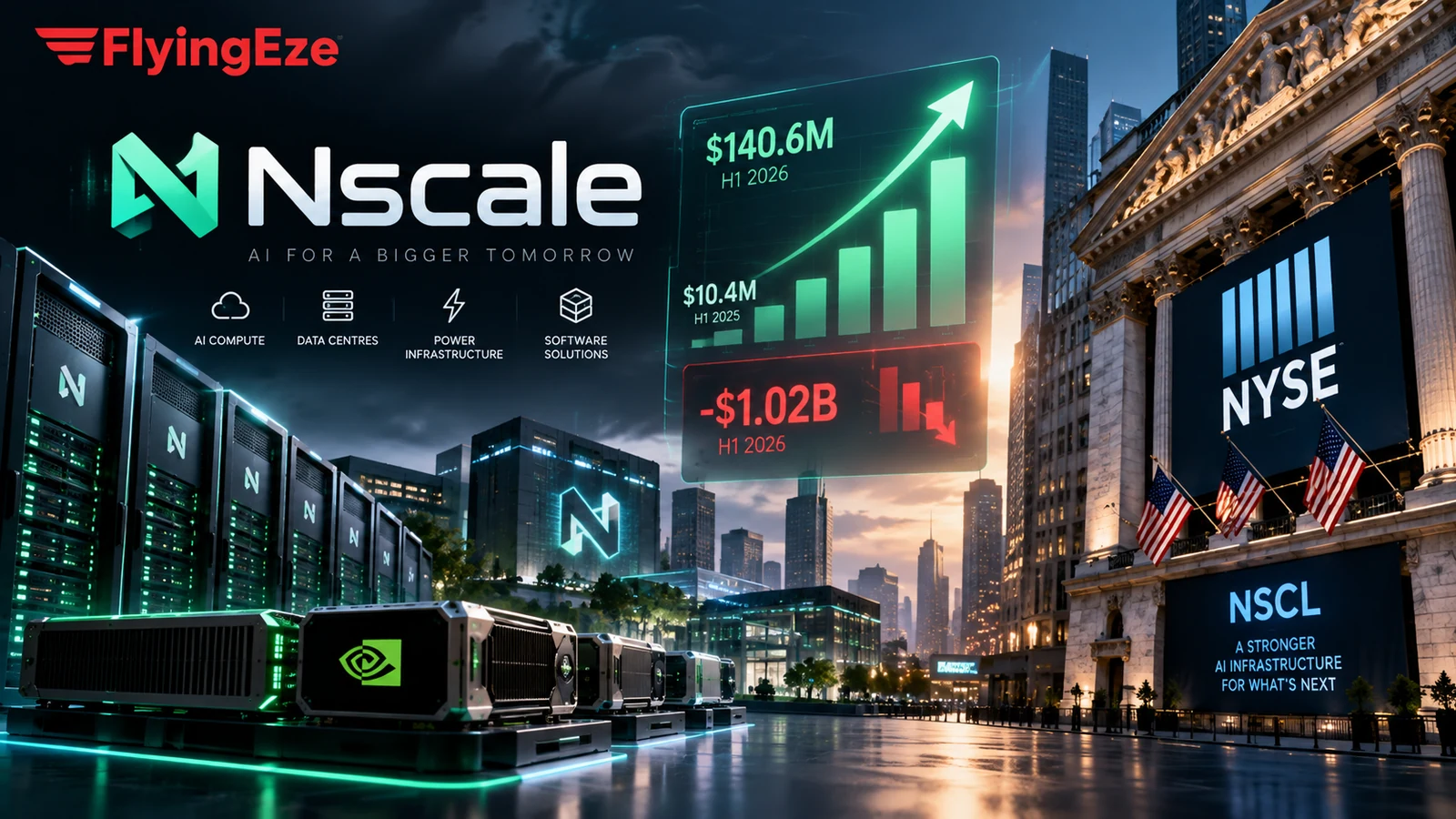
Nscale, the Nvidia-backed British AI infrastructure company, has filed for a US initial public offering after reporting extraordinary revenue growth alongside equally striking losses.
The company filed its registration statement with the US Securities and Exchange Commission on 18 September 2026 and said it intends to apply to list ordinary shares on the New York Stock Exchange under the ticker NSCL. The preliminary prospectus does not yet specify the number of shares to be offered or an IPO price range, so the final size and valuation of the offering remain undetermined.
For the six months ended 30 June 2026, Nscale reported revenue of $140.6 million, up from $10.4 million in the same period of 2025 — an increase of 1,252%, according to the filing. Reuters reported that the company posted a net loss of roughly $1.02 billion over the same first-half period, compared with a loss of $368.9 million a year earlier.
Why Nscale is attracting so much attention
Nscale is building a vertically integrated AI infrastructure business that combines power, data centres, high-performance GPU clusters and cloud software. Its thesis is straightforward: as artificial-intelligence workloads grow, access to power and specialised computing infrastructure becomes as important as the models themselves.
The company says it has expanded rapidly. Its SEC filing states that active and contracted total contract value reached about $103.4 billion as of 31 August 2026, supporting roughly 461,000 GPUs that were active or contracted. It also says its owned-and-controlled power pipeline has grown to more than 10 gigawatts and that it operates across 14 regions.
Those figures help explain why infrastructure providers have become central to the AI investment cycle. Frontier-model developers and large enterprises increasingly need long-duration access to enormous quantities of electricity, GPUs, cooling, networking and physical data-centre capacity.
FlyingEze recently covered how Anthropic is weighing another AI model release as competition with OpenAI intensifies . Nscale sits one layer beneath that race: instead of building the models themselves, it aims to provide the physical and cloud infrastructure required to train and run them.
Microsoft and Anthropic are central to the growth story
Nscale's filing shows how quickly the company has accumulated large customer commitments. Between September 2025 and April 2026, it entered into statements of work with Microsoft that provide for payments of up to approximately $43.8 billion through December 2033, subject to delivery and service-availability requirements.
In August 2026, Nscale also entered into four service agreements with Anthropic that could provide aggregate payments of up to approximately $44.6 billion. Those agreements call for dedicated GPU infrastructure at Nscale's Monarch Compute Campus and depend on the company obtaining the financing needed for the required hardware and data-centre build-out.
That last point is important. The headline contract values are not the same thing as guaranteed cash already received. The prospectus repeatedly notes that future payments depend on Nscale meeting delivery obligations and, in some cases, arranging substantial project financing.
Nvidia's role goes beyond supplying GPUs
Nvidia is both strategically and financially connected to Nscale. The SEC filing says Nscale entered into a subscription agreement on 15 September for at least $3.1 billion of convertible financing, including a further $1 billion of notes or non-voting shares to be issued to Nvidia.
That relationship gives Nscale access to one of the most important companies in the AI-computing supply chain, but it also underlines how capital-intensive this business is. Building data centres, power systems and GPU clusters requires huge upfront spending before customer contracts generate their full economic return.
The biggest risk: rapid growth is coming with heavy losses
Nscale's revenue trajectory is impressive, but investors evaluating the IPO will also have to consider the company's losses and financing requirements.
Reuters reported a first-half 2026 net loss of about $1.02 billion. The company is simultaneously acquiring sites, securing power, financing GPUs, constructing campuses and expanding its cloud software stack. That means revenue growth alone does not show whether the business can eventually produce sustainable margins and positive cash flow.
Its filing also reveals a significant customer-concentration risk. Nscale's largest customer accounted for 52% of first-half 2026 revenue, compared with 73% in 2025. Microsoft and Anthropic are expected to remain significant customers in future periods.
A concentrated customer base can accelerate early growth because a small number of large contracts can fill enormous amounts of capacity. But it also increases exposure if a customer delays a deployment, renegotiates requirements or reduces spending.
Power may be the real competitive advantage
Nscale argues that access to contiguous, low-cost power is becoming the primary constraint on AI infrastructure deployment. Its strategy therefore goes beyond leasing racks in existing data centres.
The company says its infrastructure business combines land, power generation, liquid-cooled data centres and high-performance compute. Its Monarch Compute Campus in West Virginia has a power-generation runway that Nscale says can scale to more than 8 gigawatts of gross power.
If demand for AI compute continues to grow, controlling power and physical infrastructure could give hyperscale providers an important advantage. But these assets also bring planning, construction, regulatory, financing and utilisation risks that software companies do not face to the same degree.
The IPO terms are still incomplete
The filing confirms that Nscale intends to list on the NYSE under NSCL, but it is still a preliminary prospectus. No final share count or price range has been disclosed.
Reuters reported that the company is targeting a valuation of around $30 billion, but that figure should be treated as an expected target rather than a confirmed IPO valuation. Final pricing will depend on the amended prospectus, investor demand and market conditions.
That distinction matters because early IPO filings often leave key commercial terms blank. Investors should rely on subsequent SEC amendments for the final offering size, price range and dilution details.
What Nscale's filing says about the AI infrastructure boom
The broader story is that AI infrastructure has moved from a supporting technology to a major capital-markets theme. Companies such as Nscale, CoreWeave and other specialist infrastructure providers are attempting to turn extraordinary demand for compute into long-term contracted businesses.
Nscale's filing illustrates both sides of that opportunity. Revenue has grown at a remarkable rate and contracted demand is enormous, but so are the financing requirements, losses and execution risks.
For investors and enterprise customers, the key question is no longer whether demand for AI compute exists. The harder question is which infrastructure providers can finance, build and operate that capacity efficiently enough to turn demand into durable profits.
This article is for general information and does not constitute investment advice.
Sources: Nscale's Form S-1 filed with the US Securities and Exchange Commission and Reuters .
Continue reading

Google Ordered to Open Up Ad Tech Auctions but Avoids Breakup
Google must loosen parts of its ad-tech stack, support rival integrations and accept six years of monitoring, but the court stopped short of forcing an AdX breakup.

Dangote Refinery IPO Rush Exposes Stress Points in Nigeria’s Fintech Infrastructure
The Dangote Refinery IPO overwhelmed several Nigerian investment platforms, exposing fintech scaling and third-party risks while widening retail market access.

Anthropic Weighs New AI Model as OpenAI’s GPT-6 Astra Intensifies Enterprise Race
Anthropic is considering a new AI model as OpenAI’s GPT-6 Astra gains enterprise momentum, raising questions about safety, competition and IPO timing.

Cloudflare Lets Websites Block AI Training Without Leaving Search
Cloudflare's Disallow AI Training setting separates traditional search discoverability from AI-training permission for mixed-use crawlers such as Googlebot, Bingbot and Applebot.