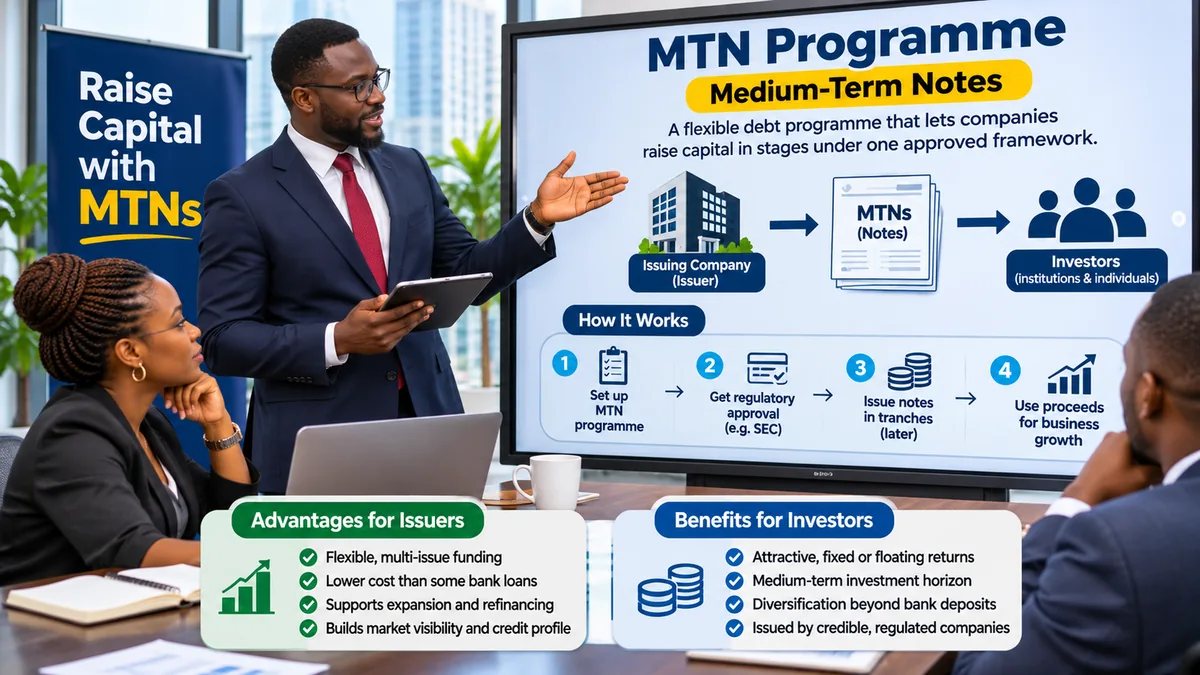
Medium-Term Notes Explained: How MTNs Work for Issuers and Investors
Companies, banks and other eligible borrowers sometimes need funding that cannot be covered by ordinary short-term cash or a single bank loan. They may turn to medium-term notes (MTNs)—debt securities that promise specified payments to investors under an agreed contract. The notes may be issued through a programme that allows the borrower to bring separate issues to market over time.
An MTN is a form of borrowing, not a share in a business. The issuer receives investors' money when notes are sold; investors acquire a right to the interest, redemption amount or other payments provided in that note's terms. Those payments are not automatically guaranteed: the issuer may default, market prices can change and some notes have complex conditions.
This introduction explains MTN terminology, who issues the notes, how investors earn returns, why programmes are useful and what risks matter, with practical Nigerian capital-market examples. Research verified: 8 November 2026.
What does “medium-term note” mean?
A medium-term note is a debt instrument commonly issued under an ongoing or repeat-issuance programme. Its contractual maturity, interest calculation, redemption and credit support depend on the particular issue. The US Securities and Exchange Commission's investor education on corporate debt explains the basic relationship: investors lend money to a company, which promises to repay principal and make applicable interest payments.
The word medium should not be interpreted as a strict maximum of five years. MTN programmes can issue securities with different maturities, including longer-term notes. For example, FMDQ records a ten-year bond under Nigeria Mortgage Refinance Company's medium-term note programme. Read the actual series' tenor instead of relying on the name.
How do medium-term notes work?
The issuer generally starts with a financing purpose—such as buying equipment, expanding a business, supporting lending operations or refinancing debt—and arranges a suitable programme or specific issuance. Its advisers prepare the necessary documents, complete the applicable regulatory processes and market the notes to eligible investors.
An investor who subscribes provides cash in exchange for the security. After settlement, the issuer must make the payments specified in the agreement. Depending on the terms, these may include periodic fixed coupons, floating-rate payments, amortising instalments or a bullet principal repayment at maturity. Some structured notes calculate returns differently and can expose investors to underlying market performance.
The contractual promise matters more than the label. A security described as “an MTN” is not automatically secured, capital-protected, government-guaranteed or suitable for every individual.
The key terms: principal, coupon, yield, maturity and tranche
| Term | Plain-English meaning |
|---|---|
| Issuer | The company or other entity that owes the contractual payments |
| Principal or face value | The amount stated as the note's principal, subject to its redemption terms |
| Coupon | Contractual interest rate or payment, if the note bears interest |
| Yield | Investment return implied by the price and cash flows, not necessarily equal to coupon |
| Maturity | The date or schedule on which outstanding principal is due |
| Programme limit | The maximum issuance capacity under the defined programme conditions |
| Series and tranche | Specific issues made under the programme, often with distinct terms |
| Trustee | A party with duties defined in the debt documents for noteholders' benefit |
| Credit rating | An opinion on a specified credit risk, not a payment guarantee |
When comparing two MTNs, investors should also read the issue price, payment frequency, seniority, security, early redemption rights, fees, tax treatment and governing documents. The Investor.gov corporate-bond guide explains why price, coupon and yield can produce different returns.
What is the difference between an MTN and an MTN programme?
An individual medium-term note is the debt security purchased by investors. A medium-term note programme is the wider framework through which several notes can potentially be issued.
Think of the programme as a set of financing documents and permissions, and each series as a particular borrowing transaction. A company could have a programme allowing up to ₦40 billion of qualifying notes, issue ₦8 billion this year and consider another issue next year. Until an issue is actually sold and settled, unused programme capacity is not money raised.
Terms differ between programmes: a stated limit may be defined by the maximum amount outstanding, rather than simply the sum of all historical issues, and approvals may require renewal or supplementary documents. It is therefore misleading to add a programme's full ceiling to a company's cash balance.
Why do companies issue MTNs?
The issuer may want access to bond-market investors, different maturities, predictable interest terms or financing beyond its existing lenders. A programme can help an eligible business plan staged issuance for different projects while reusing an established framework, subject to updating and approval requirements.
For example, a firm investing in new facilities might raise a first tranche for equipment and a later tranche for expansion. A financial institution might use proceeds to support longer-term customer lending. Some issuers use notes to refinance maturing debt where permitted by the transaction documents.
Flexibility is not free: preparing a programme and individual transactions can involve legal fees, issuing-house charges, ratings, trustees, disclosures and continuing compliance. The interest rate demanded by investors may exceed a bank's offer. Issuers should compare actual all-in funding costs rather than assume MTNs are automatically cheaper.
Why would investors buy medium-term notes?
Investors may seek contractual income, a maturity suited to their cash needs or diversification away from deposits and shares. For context on the wider cost of borrowing, FlyingEze's guide to high interest rates and fees explains how borrowing expenses affect financial decisions. Some notes offer fixed nominal payments that can be easier to plan around than equity dividends. Other notes provide floating returns or have more complex payoff structures.
However, investors are creditors, not shareholders. They generally do not participate in the issuer's unlimited upside merely because the company's profit increases. Conversely, the issuer remains obliged to make contractual debt payments even if its earnings weaken, subject to insolvency laws and contractual arrangements.
For retail savers, the first question is not “How high is the advertised return?” but “Who actually owes me the money, what can go wrong and can I sell the instrument when needed?” Some offerings may be limited to qualified or professional investors.
How interest payments work: a simple MTN example
Consider a purely hypothetical plain-vanilla note with a ₦1,000,000 face value, a 16% annual fixed coupon, interest paid every six months and principal repaid at the end of three years. Assume the investor buys at par, there are no fees or taxes and the issuer pays on time.
| Calculation | Illustrative amount |
|---|---|
| Face value invested | ₦1,000,000 |
| Annual coupon at 16% | ₦160,000 |
| Each six-month coupon | ₦80,000 |
| Coupon payments over three years | ₦480,000 |
| Principal due at maturity | ₦1,000,000 |
The example's coupons total ₦480,000, but that is not a promise of real-world profitability or purchasing-power protection. If an investor buys a note at a discount or premium, its yield differs from the coupon. Fees, withholding taxes, early redemption, changes to scheduled principal and default can all alter outcomes.
A floating-rate note may reset its coupon under a stated formula, creating different cash-flow uncertainty for the holder. A structured note may not provide conventional coupons at all.
Can medium-term notes have maturities longer than five years?
Yes. The term refers partly to a mode of issuance rather than a strict five-year cap. Nigeria Mortgage Refinance Company's ₦11.50 billion 10-year, 17.25% Series 1 note was listed in 2026 under an ₦440 billion medium-term note programme, as reported by FMDQ .
That example also shows another distinction: a ₦440 billion programme ceiling is not evidence that ₦440 billion was drawn immediately. The publicly described series had its own ₦11.50 billion issue amount and particular maturity. Each issuance must be assessed on its own documents.
MTNs versus corporate bonds, commercial paper and shares
| Instrument | Basic purpose | Important distinction |
|---|---|---|
| MTNs | Debt issued within an established programme or similar structure | Repeat issuance with terms that may vary by series |
| Standalone corporate bonds | Company borrowing via a particular debt issue | Does not necessarily use a repeat-issue MTN framework |
| Commercial paper | Usually short-term corporate funding | Shorter maturity and potentially frequent refinancing |
| Ordinary shares | Equity capital | Ownership stake; dividends are not contractual debt coupons |
The terms overlap: a debt issue under an MTN programme may be marketed or listed as a bond. Conversely, not every corporate bond is an MTN drawdown. FlyingEze's report on the settlement of an oversubscribed Federal Government of Nigeria bond illustrates debt-market issuance and settlement, although government bonds and corporate MTNs have different credit exposures.
Understanding the risks of medium-term notes
Credit and default risk: an issuer may miss interest or principal payments. A company with heavy debt, weak cash flow or deteriorating operations may be less able to meet its obligations.
Interest-rate and price risk: when comparable market yields increase, an existing fixed-rate note may be worth less to a buyer. Selling before maturity can result in receiving less than the purchase price. Investor.gov's bond FAQ explains this relationship.
Liquidity risk: even a listed security may not have an active buyer when an investor wants to sell. The theoretical market price and the price available for an immediate trade can differ.
Inflation risk: fixed payments may lose purchasing power as prices rise. A nominal return that appears high may deliver a modest or negative inflation-adjusted return.
Early redemption and reinvestment risk: if the terms permit an issuer to call notes before maturity, an investor might have to reinvest at a lower yield. Not all notes are callable.
Structure and currency risks: guarantees, underlying assets, foreign-currency payments or index-linked returns can change the risk substantially. A complex note is not the same as a simple fixed-coupon bond.
How MTNs are issued and regulated in Nigeria
Nigerian capital-market issuance operates under the Investments and Securities Act, 2025 and applicable Securities and Exchange Commission rules , including 2025 changes to corporate debt and private-company securities provisions. A proposed note issue may require appropriate registration, shelf or programme documentation, approved transaction documents, and licensed intermediaries, according to its structure.
FMDQ Securities Exchange provides public information about admitted programmes, listed bonds, issuer disclosures and specific series. For example, the DLM Funding SPV programme entry identifies the issuer, programme size, advisers, trustees and issues. These records help readers distinguish the framework from an individual note and review published terms.
Private-company issuance may be subject to qualified-investor restrictions. Regulatory registration or listing is not an endorsement of investment returns and should not be mistaken for an official guarantee.
How to evaluate a particular MTN before investing
- Confirm the legal issuer and any guarantor or special-purpose vehicle.
- Read the prospectus, pricing supplement and risk disclosures for that exact issue.
- Check the face value, purchase price, coupon, yield, payment frequency and maturity.
- Understand whether principal is due at maturity or amortised in instalments.
- Review security, ranking, covenants and what happens after missed payments.
- Verify the credit rating and the particular obligation it assesses.
- Ask whether the notes can be sold easily and whether early redemption is possible.
- Consider taxes, charges, inflation, currency exposure and concentration in one issuer.
- Verify the issuing institution and intermediaries with the relevant regulator before transferring funds.
In May 2026, Nigeria's SEC warned the public against unregistered online investment operators that promote unrealistic guaranteed returns. Its public notice advises investors to check a promoter's registration. Be wary of anyone using “MTN” as a label for an undocumented online high-return scheme.
Frequently asked questions
Are medium-term notes the same as Treasury bills?
No. Treasury bills are short-term government debt instruments; medium-term notes can be issued by eligible corporations or other entities under different terms and with different credit risks.
Is the coupon rate the same as investment yield?
Not always. Coupon reflects contractual interest relative to the specified principal, while yield also reflects price and timing of payments. A discount or premium purchase can change yield.
Are MTNs safer than stocks?
They have different risks. Noteholders are creditors rather than owners and may have priority over ordinary shareholders in insolvency, but MTNs can still default, lose market value or be hard to sell.
Can MTNs be issued for ten years?
Yes. FMDQ documents a 2026 ten-year NMRC security issued under a medium-term note programme. Always read the terms of the exact issue.
Does an approved programme limit mean all the money has been raised?
No. The limit describes capacity under specified conditions. Cash is raised through individual issues when investors purchase and settle the notes.
Can anyone buy a medium-term note in Nigeria?
Not necessarily. Investor eligibility depends on the particular issue and applicable rules. Some private-company debt securities are restricted to qualified investors.
Conclusion
Medium-term notes are an adaptable form of debt finance, and MTN programmes allow eligible issuers to bring separate securities to investors under a common framework. For companies, they can provide options for funding investment and refinancing. For investors, they can offer contractual cash flows—but also issuer, market, liquidity and structural risks.
The essential rule is simple: judge the actual note, not the attractive headline or the programme limit. Understand the issuer, price, promised payments, maturity, protections and risks before making any borrowing or investment decision.