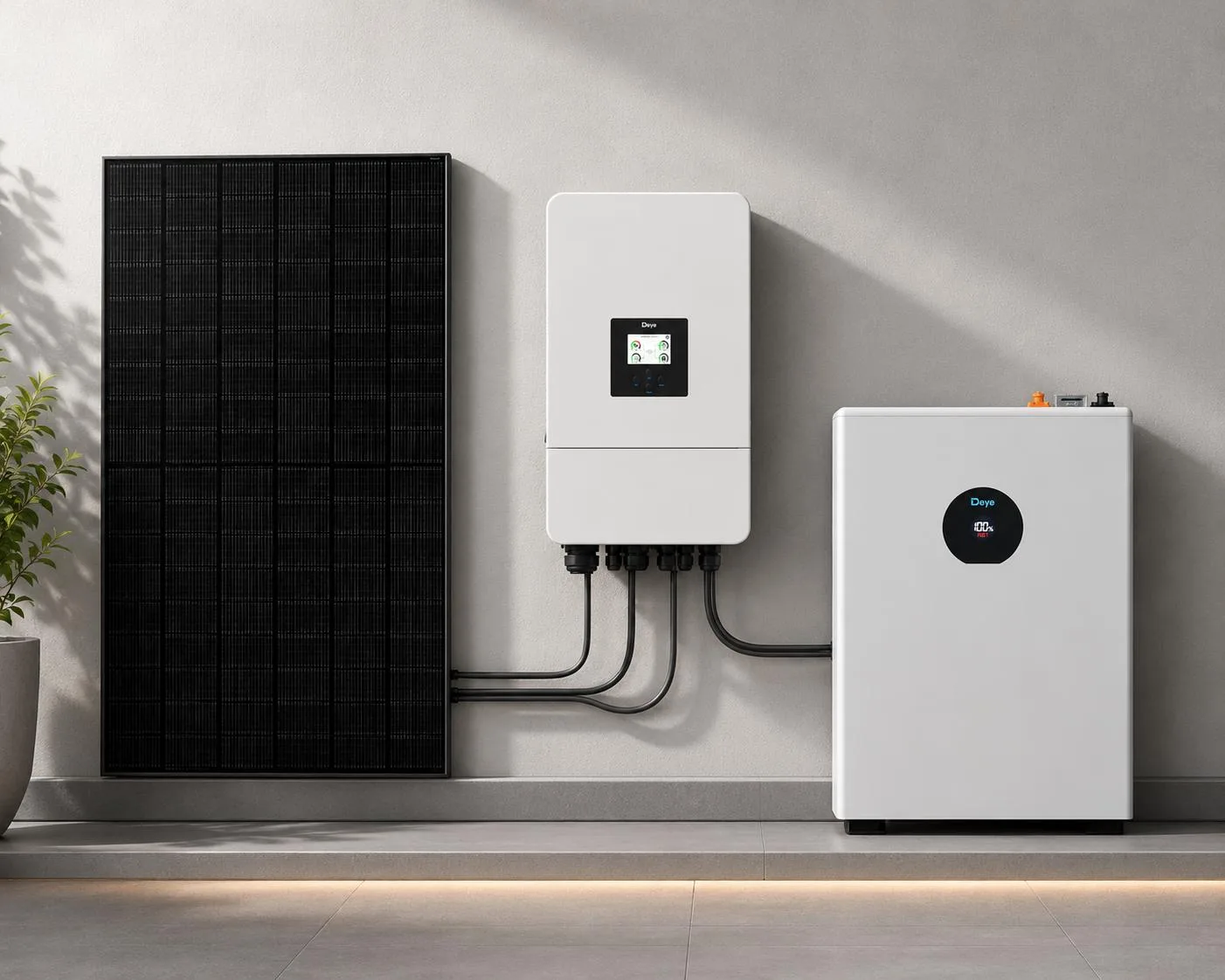
A Nigerian business owner planning solar electricity will encounter terms such as 5kVA inverter, 5kWh lithium battery, 550W solar panel and MPPT charge controller. Understanding these specifications helps prevent buying equipment unable to support daily operations. The simplest distinction is that panels generate electricity, batteries store electrical energy, and inverters convert and manage electricity for business equipment.
This guide explains the components, how their specifications affect performance, and what Nigerian small businesses should check before accepting an installation quote. The examples are illustrative, not equipment quotations or promises of actual electricity production.
How a complete solar system works
Solar photovoltaic (PV) cells convert sunlight into direct-current (DC) electricity. An inverter converts suitable DC into alternating-current (AC) electricity for conventional appliances. Compatible chargers and charge controllers manage energy storage in batteries. With storage, some systems supply electricity at night or during outages. Not every solar installation includes a battery, and conventional grid-tied systems generally shut down during outages for safety. The US Department of Energy explains that panels are one component of the larger power system.
1. What is a solar panel?
A photovoltaic solar panel contains cells that use semiconductor materials to turn sunlight into electrical current. It is commonly rated in watts (W) or kilowatts (kW). A panel with a 550W nameplate rating does not continuously generate 550W every hour of daylight. Ratings are established under standard test conditions, including sunlight of 1,000W per square metre and a cell temperature of 25°C, whereas actual sunlight and panel temperature vary.
What does a 550W panel mean?
Six 550W panels have a combined nameplate rating of 3,300W, or 3.3kWp. At an illustrative four equivalent full-power hours, they would theoretically generate 13.2kWh of DC energy before practical losses. That is not a site-specific Nigerian output forecast. Temperature, weather, shading, dirt, orientation, wiring and inverter losses affect usable generation. Request a monthly energy estimate based on the installation site rather than assuming the nameplate output is achieved continuously.
Practical panel checks
Ask for panel model numbers, datasheets, rated power, physical dimensions, electrical voltage and current, product and performance warranty terms, and mounting design. A larger panel wattage does not make a poor installation better. Roof strength, appropriate mounting, shading and electrical protection are important.
2. What is a solar inverter?
The inverter converts DC power into AC electricity for appliances. Depending on the model, it may also manage solar charging, batteries, switching between grid and generator sources and protective functions. An ordinary standalone inverter is not necessarily the same as a hybrid inverter.
Common inverter types
A standalone/off-grid inverter supplies AC from a DC source such as a battery. A conventional grid-tied inverter converts solar output for a grid-connected system; it normally does not provide backup during a blackout. A hybrid inverter can integrate solar generation, batteries and sometimes grid or generator input. Microinverters convert power at individual panels in suitable systems. The correct choice depends on whether the business values daytime savings, backup operation or both.
Understanding kW and kVA
Kilowatts (kW) describe real power; kilovolt-amperes (kVA) describe apparent power. Their relationship is kW = kVA × power factor. At a power factor of 0.8, 5kVA corresponds to 4kW, but manufacturers differ in output ratings and constraints. Do not assume every 5kVA inverter provides exactly 4kW. Check continuous output in watts, surge rating, efficiency, supported battery voltage and solar input limits.
Why starting surges matter
Refrigerators, water pumps, compressors and air conditioners may draw substantially more power while starting than while running. An inverter capable of meeting normal loads may still trip during motor startup. Ask installers to evaluate running load, starting demand and which appliances can operate simultaneously. Some equipment can use soft-start devices, but compatibility must be established professionally.
3. What is a lithium battery?
A rechargeable battery stores energy, allowing electricity generated earlier to be used after sunset or during interruptions. A battery does not generate energy: it must be charged from a suitable source. Lithium-ion describes a family of chemistries. Lithium iron phosphate, known as LiFePO4 or LFP, is commonly used in stationary battery storage.
How lithium compares with lead-acid
LFP systems typically offer useful advantages in weight, routine maintenance, usable depth of discharge and cycle durability, depending on exact product specifications. Lead-acid batteries may have a lower initial cost, but their practical usable capacity and expected life can differ. Compare the warranty, tested cycle-life conditions, usable energy, permitted charge/discharge current and temperature limits rather than relying on claims such as 'lasts 15 years'.
What does 5kWh of battery capacity mean?
A nominal 5kWh battery contains five kilowatt-hours of stored energy at its rated condition. A load averaging 500W over eight hours consumes 4kWh before accounting for inverter losses. A 5kWh battery may support this but actual available runtime depends on depth-of-discharge restrictions, battery health, efficiency and other loads. Battery energy capacity, measured in kWh, differs from maximum discharge power, measured in kW. A battery can store enough energy while still lacking the output power for a demanding appliance.
Understanding the battery management system
A battery management system (BMS) monitors conditions such as cell voltages, temperature and current, sometimes balancing cells and communicating with a compatible inverter. It improves management and protection but cannot eliminate every safety risk. Use qualified installers, compatible equipment and appropriate overcurrent protection, ventilation and manufacturer-required clearances. Never bypass a BMS or improvise high-current battery wiring.
4. How panels, inverter and battery cooperate
Imagine a shop open from 8 a.m. to 8 p.m. In sunshine, the solar array can supply eligible loads through the inverter, while surplus energy may charge the battery. As sunlight declines, stored electricity may supply essential appliances. In a correctly configured hybrid installation, grid or generator input may be available if the battery falls below an operating threshold. Actual operation depends on inverter architecture, charging settings and approved power-source interconnections.
A large battery cannot compensate permanently for insufficient solar generation; equally, extra panels cannot overcome an inverter that lacks adequate continuous output. Panel electrical voltage and current must fit the inverter's solar input range. Battery voltage, discharge limits and communications must also be compatible. System design matters more than treating the three devices as independent purchases.
5. Watts, kilowatts, kilowatt-hours and ampere-hours
Watts indicate power at a moment; 1kW equals 1,000W. A 2kW appliance running for three hours uses 6kWh of energy. kWp represents solar nameplate peak capacity. kVA represents apparent power. Ampere-hours (Ah) measure electric charge and cannot describe battery energy without voltage. For example, a nominal 51.2V, 100Ah battery has 51.2 × 100 = 5,120Wh, or 5.12kWh nominal capacity; usable AC energy is lower once operating limits and conversion losses are included.
6. Worked example: Electricity needs of a small shop
Consider a hypothetical shop using six LED bulbs totalling 60W for eight hours (0.48kWh), two fans totalling 120W for eight hours (0.96kWh), a 40W POS terminal and router for ten hours (0.40kWh), a laptop averaging 60W for six hours (0.36kWh), and a refrigerator averaging 100W during ten equivalent running hours (1.00kWh). Total estimated daily energy use is 3.20kWh. These are assumptions, not metered readings; real refrigerators cycle and have motor starting loads.
For first-pass screening, adding an illustrative 25% allowance gives 4.0kWh/day. With four equivalent peak-sun hours and an assumed 75% energy-delivery factor, 4.0 ÷ (4 × 0.75) suggests roughly 1.33kWp of panels. This is not a final system specification. A designer must separately assess daytime versus nighttime consumption, battery reserve, autonomy, worst-month sunlight, efficiency and motor surges. A shop needing several nights of backup will need a different storage design from a shop operating mainly during daylight.
7. Common mistakes business owners make
One common error is buying on the inverter's kVA label alone while ignoring actual watts and starting surges. Another is assuming a 5kWh battery supplies a 5kW load for one hour in practice. Some buyers also assume panels generate their peak output continuously, overlook battery recharging requirements, or mix equipment that cannot communicate reliably. Others ignore roof mounting, earthing, circuit protection, isolators, fuses and proper cable sizing. The Rural Electrification Agency's technical standards cover renewable-energy design, storage and system interoperability, reinforcing the need for qualified installation.
8. What to check before paying an installer
Request exact inverter brand/model, continuous output, surge output and solar-input voltage range. Request panel brand/model, quantity, total kWp and production estimates. Request battery chemistry, nominal and usable kWh, maximum charge/discharge power, BMS compatibility and warranty terms. Require a clear schematic and itemised quotation covering mounting, earthing, protection, wiring, commissioning and servicing. Ask which appliances are supported simultaneously, the expected backup hours at a stated load, and who handles warranty claims.
Before making an investment, compare longer-term running expenses using FlyingEze's solar-versus-generator cost guide . A related FlyingEze sizing guide is scheduled for 2 November 2026; a separate installer due-diligence guide is scheduled for 3 November 2026. Public links should only be inserted after those pages are live.
Frequently asked questions
Can solar panels operate without lithium batteries?
Yes. Some grid-connected installations operate without batteries but do not provide conventional blackout backup. Purpose-built daytime off-grid configurations may also operate particular loads without storage.
Can an inverter operate without solar panels?
Yes. A suitable inverter can supply AC from a charged battery, with charging provided through another compatible source.
Is lithium always better than a tubular battery?
Not in every commercial comparison. LFP can offer useful technical advantages but may cost more upfront. Compare lifetime cost, usable energy, maintenance and manufacturer conditions.
How long does a 5kWh lithium battery last?
Runtime depends on the load and usable storage. At 500W, an ideal fully usable 5kWh store suggests ten hours, but real AC output is less because of discharge limits and conversion losses.
Does a bigger inverter create more electricity?
No. The inverter converts and controls power; panels and other approved sources provide energy. Oversizing an inverter cannot correct inadequate generation or storage.
Conclusion
Solar panels generate electricity, inverters convert and manage it, and lithium batteries store energy for later use. Their ratings describe different things and should not be treated as interchangeable. Nigerian businesses considering solar should first measure electricity consumption, then obtain a professionally engineered system with compatible components, transparent performance estimates, warranties and safety provisions. A correctly sized, reliably installed system offers more business value than impressive nameplate numbers alone.