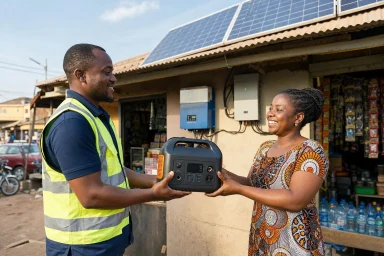

For Nigerian small businesses considering solar power, one of the biggest decisions is whether to purchase the installation outright or spread its cost over several months or years. Upfront payment can avoid financing charges; instalments can protect valuable working capital. Neither approach is universally best.
Why solar financing matters for SMEs
Solar systems can reduce reliance on fuel-powered generators, but their initial costs include panels, an inverter, batteries where needed, mounting, cabling, protection devices and professional installation. A shop, restaurant, salon and agro-processor have different electricity requirements. The World Bank-backed DARES programme explicitly targets better electricity access for Nigerian enterprises through standalone systems and other renewable-energy solutions.
Before choosing how to pay, establish how much energy the business uses each day, which appliances are essential and the maximum simultaneous power demand. A technically unsuitable installation remains poor value even on an attractive payment plan. See FlyingEze's solar versus generator cost comparison for the broader operating-cost decision.
Option one: Buy solar outright
Under an upfront purchase, a business pays the agreed equipment and installation price and typically takes ownership after the contractual requirements are met. The advantage is avoiding interest and instalment administration charges, while retaining greater control over servicing and future expansion. An outright buyer usually has no continuing purchase repayments.
The drawback is the immediate drain on cash. A company with ₦5 million in readily available funds that spends ₦3 million on solar has ₦2 million left for inventory, salaries, rent and emergencies. This can be reasonable for a business with steady income and sufficient reserves, but dangerous for one with seasonal or unpredictable revenue. The owner must also budget for maintenance and eventual component replacement unless these are covered by warranty or a service agreement.
Option two: Pay for solar in instalments
Instalment financing allows a business to pay an initial deposit and recurring amounts, or to borrow separately to purchase the equipment. It can preserve cash and allow earlier access to solar electricity. Fixed, clearly disclosed payments can make budgeting easier, particularly where the business already spends heavily on generator electricity.
However, the full amount payable may exceed the cash price because of interest, fees, insurance or other charges. Missed instalments may trigger penalties, restrictions on access, repossession or enforcement action according to the contract. Legal ownership may remain with a provider until completion. SMEs should compare the complete signed repayment schedule, not just the advertised monthly instalment.
Upfront purchase versus instalment financing: Practical comparison
| Factor | Upfront purchase | Instalments |
|---|---|---|
| Initial cash required | High | Usually lower |
| Total financing charges | Usually none | May apply |
| Ownership | Generally immediate | Contract-dependent |
| Working capital | Reduced immediately | More cash retained initially |
| Repayment risk | No continuing purchase debt | Monthly commitments |
| Servicing | Buyer's responsibility unless agreed otherwise | Depends on contract |
Worked example: A ₦3 million solar installation
Suppose an SME receives a hypothetical cash quotation of ₦3,000,000. A financing plan requires a ₦600,000 deposit and 24 monthly payments of ₦125,000. The monthly payments total ₦3,000,000, so the deposit plus repayments equal ₦3,600,000. That is ₦600,000, or 20%, above the quoted cash price. These illustrative figures are not a current supplier quotation or stated market interest rate, and exclude maintenance and undisclosed fees.
The instalment buyer nevertheless retains ₦2.4 million at the beginning. That money could support inventory or cash reserves. Whether preserving it justifies ₦600,000 of additional nominal expense depends on the business's actual cash-flow needs and the value of retaining liquidity. A longer term can lower the monthly payment yet increase total costs, so compare proposals on equivalent terms.
Pay-as-you-go, lease-to-own and solar-as-a-service
An REA market study identifies outright purchase, planned instalments to ownership and pay-as-you-go as distinct financing approaches. Under pay-as-you-go, payments buy access to the service; the provider may retain the equipment. Under lease-to-own, a customer pays over time with ownership expected to transfer under agreed conditions. Energy-as-a-service contracts may instead charge for energy availability or consumption without transferring ownership.
The distinction is especially important for small businesses. A contract advertised as a monthly solar plan is not automatically a loan to own the installation. Check who holds title to the system, whether remote restriction is possible, who repairs failed batteries, whether early settlement is permitted and whether the final payment transfers ownership.
Solar financing opportunities in Nigeria
DARES Solar for Business
Nigeria's Rural Electrification Agency describes Solar for Business within the DARES standalone-solar component as supporting MSME clusters, commercial hubs and productive energy users, with lease-to-own and energy-as-a-service arrangements among the intended models. The REA announced a Solar for Business and Productive Use of Energy application round on 18 December 2025, closing on 16 January 2026. That stated window has passed; check official REA announcements for subsequent opportunities. Results-based support to eligible providers must not be mistaken for unrestricted cash grants to individual SMEs.
Commercial pay-as-you-go providers
In May 2025, the International Finance Corporation announced an $80 million naira-denominated debt facility involving Sun King and Stanbic IBTC Bank to support solar access through pay-as-you-go financing. The announcement demonstrates private financing activity, but does not guarantee that every business qualifies or that any particular product or payment term is currently offered. Obtain a live written quote directly from the provider.
Bank and microfinance credit
Equipment loans or SME finance from licensed institutions may also be worth comparing. Check the annual financing cost, repayment schedule, collateral requirements, fees and early settlement provisions. The Central Bank of Nigeria's Solar Connection Facility supports qualifying solar-value-chain participants, including manufacturers and distributors, and should not be confused with an automatically available consumer solar loan for every shop owner.
Five steps to choosing a suitable solar financing plan
1. Audit electricity needs
List every appliance, its power rating and daily operating hours. Include starting demand for motors or refrigeration and the amount of nighttime battery storage needed. Ask a qualified installer for an itemised design showing panel output, inverter sizing and battery capacity.
2. Request comparable quotations
Obtain a complete cash price and all-in financing price for systems with equivalent specifications. Confirm installation labour, electrical protection, transport, taxes if applicable, warranties and servicing. Comparing different capacities or battery technologies can produce misleading savings.
3. Calculate real operating savings
Estimate how much grid and generator expenditure the system will displace rather than assuming it replaces every electricity expense. If present generator-related electricity spending is ₦180,000 a month but expected solar savings are ₦120,000, a ₦125,000 instalment exceeds estimated monthly savings by ₦5,000 before any solar upkeep. Reliability improvements may justify the purchase, but the example is not initially cash-flow-neutral.
4. Stress-test repayments
Test the instalment against a slow sales month, unexpected repair and lower-than-forecast electricity savings. Keep sufficient cash for payroll, stock and emergencies. A financing agreement affordable only in the best trading months is risky.
5. Review the legal terms
Check ownership, late-payment charges, early termination, early settlement, transfer when relocating, servicing obligations and whether the supplier may restrict system operation for arrears. Ask for everything in writing.
Questions to ask before signing
- What is the full cash price and full amount payable under financing?
- Is the rate fixed or variable, and are there mandatory extra charges?
- When does equipment ownership legally transfer?
- Who pays for maintenance, failed batteries and replacement parts?
- What happens if the business misses payments, relocates or closes?
- Can the provider disable the system remotely?
- What are the penalties or benefits of early repayment?
Common financing mistakes
Avoid selecting a system solely because its monthly bill is small, overlooking the effective total cost or buying undersized equipment to qualify for a cheaper plan. Account for possible battery replacement, excluded warranty events and variable seasonal sunlight or electricity demand. Forecasts are estimates, not guaranteed savings.
Frequently asked questions
Is instalment financing always more expensive than cash?
Not always, but ordinary interest-bearing arrangements often have a higher nominal total cost. Grants, discounts and financing structures can change the comparison; examine the actual written quote.
Can a Nigerian SME get solar without paying the entire cost upfront?
Yes, some providers offer instalments, PAYG or lease-to-own products, subject to availability, eligibility and contract conditions.
Are government-backed solar loans open to all SMEs?
No. Programme eligibility varies and some facilities finance approved suppliers or developers, not individual shop owners. Check official current application rules.
Does every monthly solar payment lead to ownership?
No. Energy-as-a-service and PAYG arrangements may leave ownership with the provider; lease-to-own agreements should specify the transfer conditions.
Conclusion
Upfront purchasing can minimise financing costs but tie up cash. Instalments and pay-as-you-go arrangements can make solar accessible and protect working capital, but may bring added charges or ownership restrictions. SMEs should size the system correctly, calculate the total cost of every offer, evaluate savings conservatively and choose a payment structure resilient enough to withstand difficult trading months.