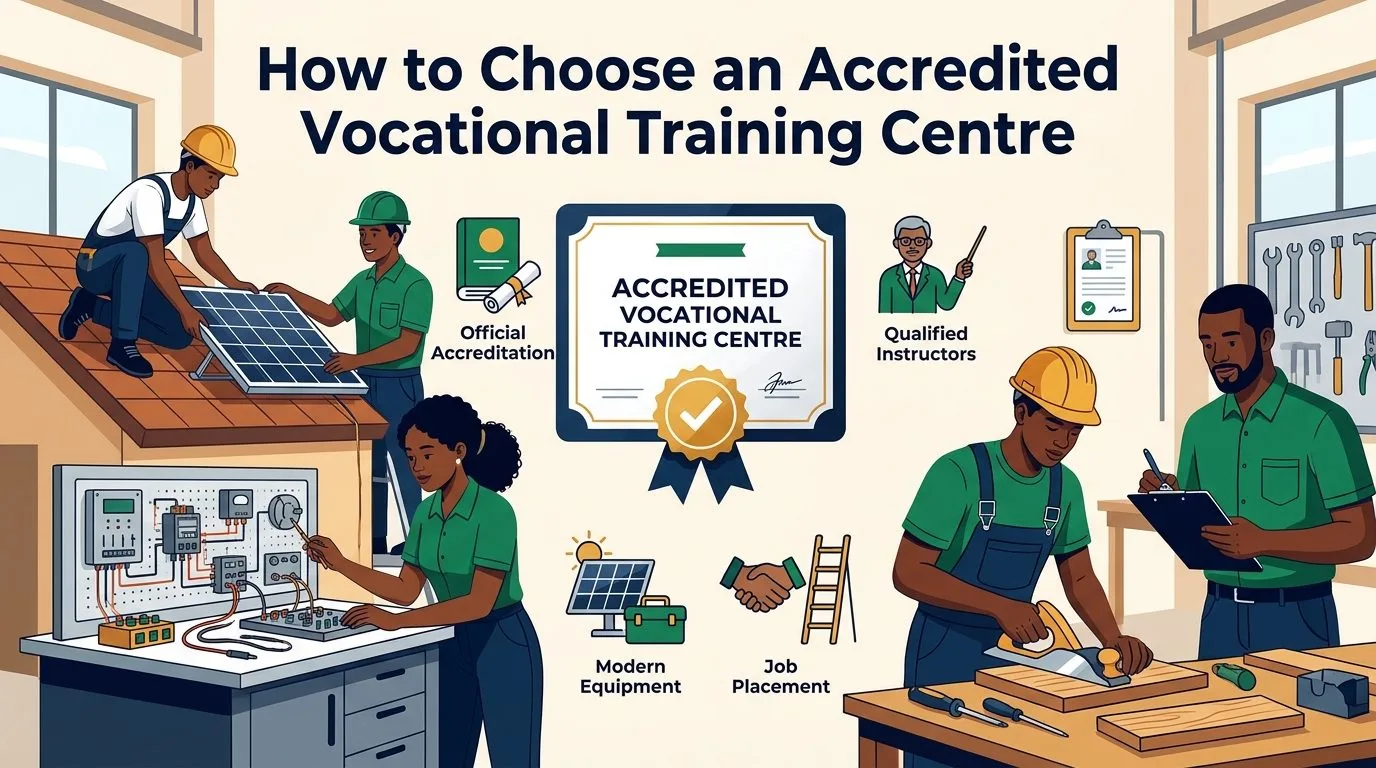
To choose an accredited vocational training centre in Nigeria, verify more than the name on its signboard. Check whether the institution appears in the National Board for Technical Education (NBTE) public register , whether your exact trade is approved, whether the approval is current, and which organisation will assess and certify your skills. Then visit the workshop, question the trainers and compare the complete cost before making a commitment.
That process matters whether you want to learn electrical installation, fashion design, welding, solar technology, computer repair, hospitality or another skill. A centre may be registered as a business but lack approval for a specific training programme. Another may be accredited but offer limited practical equipment, unsuitable safety arrangements or unclear certificate information.
This guide provides a step-by-step verification method for Nigerian TVET programmes, a centre-visit checklist, warning signs to avoid and a simple comparison scorecard. Research checked on 14 November 2026. Accreditation and government training intakes can change, so use the live official records at the point of enrolment.
What does “accredited vocational training centre” actually mean?
An accredited vocational training centre is one whose relevant training arrangements have been approved or quality-assured under an appropriate recognised scheme. In Nigeria, the NBTE regulates technical and vocational education within its remit and maintains information about skills training centres, vocational enterprise institutions, master craft persons and other TVET providers.
However, there are three different questions: Is the organisation a legally registered business? Is it authorised to provide the specific training or assessment it advertises? And is its promised certificate recognised by the named awarding body? A Corporate Affairs Commission (CAC) registration certificate can answer the first question, but it does not by itself prove NBTE programme accreditation or permission to award a National Skills Qualification (NSQ).
The distinction also applies to the word “approved”. A centre listed for computer networking should not be assumed to have approval for welding, refrigeration or fashion simply because it advertises those courses. NBTE's public institution register allows applicants to check a particular institution, its listed trades and associated programme records.
Step 1: Verify the centre in the official NBTE register
Start at digitalnbte.nbte.gov.ng/Public , the NBTE public verification portal. The service provides institution searches, programme listings and an official-document checking facility. Because its contents can be updated, search immediately before committing, not only when a friend first recommends the school.
- Search the exact name. Open the institutions page and search the registered centre name. Try a distinctive word if spelling or abbreviations differ.
- Check the location. Confirm the town, state, provider category and, where available, the relevant campus or training site. A similar name is not proof you found the correct branch.
- Open the institution record. Identify the approved trades and programme-specific details. Ask the centre to show where your intended course appears.
- Check the accreditation end date. The public portal uses status labels for active, approaching-expiry and expired programmes. If a record is expiring or expired, obtain its latest approval letter and confirm it through NBTE rather than relying on a verbal assurance.
- Verify approval documents. Use the dedicated Verify a document feature to check an official letter's code or QR-linked record. Compare the registered recipient and approved trades with the centre's claims.
- Resolve discrepancies. If a programme cannot be found, ask for the NBTE reference and seek confirmation through the Board's official channels before paying.
NBTE's register explains that an institution's listing identifies approved providers, while individual programme records show what was accredited and when approval expires. Do not treat an institution-level listing as proof that every trade it markets is accredited. The directory's displayed totals are live and can change; a screenshot from an earlier year is less useful than the current programme record.
Step 2: Understand the type of vocational provider
Different TVET routes have different purposes. The NBTE's institution-category guide distinguishes several categories relevant to skills training.
| Provider or pathway | What it commonly offers | Check before enrolling |
|---|---|---|
| Skills Training Centre (STC) | Trade-specific practical learning, often linked to a six-month pathway in the federal initiative | Exact approved trade, trainers, quality assurance and training-site details |
| Vocational Enterprise Institution (VEI) | More extended vocational learning, including a one-year pathway under the federal initiative | Approved programme, learner eligibility and assessment arrangements |
| Master Craft Person (MCP) | Practical apprenticeship-style training by an approved experienced craftsperson | Trainer recognition, trade, facilities and supervision |
| Technical college or tertiary institution | Structured technical education or diploma programmes | Institution, exact course, relevant awarding body and current accreditation |
| Independent short-course provider | Private workshops, boot camps or certificates of participation | What the certificate actually means; avoid assuming government recognition |
One abbreviation can create confusion: STC can refer to a Skills Training Centre, while the Federal Ministry's learner pathway is called the Short-Term Certificate programme. Similarly, a VEI provider category and a one-year VEI training track are closely related but should not be confused with an automatic admission or certificate guarantee.
For an overview of the wider education routes, compare technical colleges, NSQ recognition and apprenticeships rather than assuming one pathway suits everyone. An earlier FlyingEze report about NBTE approval for an Akwa Ibom skills training centre illustrates why formal approval is itself a distinct development from a provider advertising training.
Step 3: Confirm the trade, curriculum and qualification
Ask the training centre to show the course outline and National Occupational Standard (NOS) or other officially applicable curriculum, not just a poster of exciting job titles. The NBTE National Skills Qualifications Framework (NSQF) guidance explains that employer-informed occupational standards define the competence being assessed, while recognised awarding bodies issue qualifications through defined assessment and quality-assurance processes.
Request written answers to four questions: What tasks will I be able to perform independently? Which qualification or certificate will I receive? Who will assess my competence? Which awarding body will issue or verify the final award?
For example, a learner in solar PV installation should expect actual supervised installation, safe isolation, testing and troubleshooting—not only slides explaining solar energy. In computer repairs, a credible curriculum should involve fault diagnosis and hands-on work. In tailoring, there should be repeated cutting, fitting, sewing and finishing practice using actual materials.
A centre's certificate of attendance is not necessarily an NSQ. A promised “international certificate” should be verified with the named awarding organisation; words like “global standard” on an advert are not proof of recognition. NBTE's NSQF pages describe assessors, internal quality assurance managers and external verification roles. A centre should be able to identify how these work for its programme.
Step 4: Visit the workshop before paying
An impressive social-media video can conceal an inadequate workshop. Where practical, inspect the centre when training is taking place. Ask to see the equipment trainees actually use, the number of functioning workstations, the materials allocated to practical sessions and the amount of time each learner gets to practise.
For electrical or solar courses, look for safe wiring boards, testers, protective devices and supervised practice. For welding, inspect eye protection, gloves, ventilation, extinguishers and safe handling arrangements. For catering, look at sanitation, food storage and hygiene routines. For automotive or refrigeration work, evaluate tool condition, safe lifting and safe handling of electrical and refrigerant systems.
Also ask whether the class size permits meaningful participation. A workshop with 40 students and only one working machine may provide very little hands-on time even if a brochure promises “practical training”. Count the equipment, observe instruction and ask current trainees what they do in an ordinary session.
NBTE's provider-category information describes qualified instructors, technical facilities and quality-assurance personnel among the expectations for STCs and VEIs. It also references an instructor-to-trainee expectation for VEIs. These are regulatory considerations; a prospective learner should still judge whether the particular equipment and supervision are adequate for the skill being taught.
Step 5: Ask about trainers, assessment and learner support
A competent trainer needs both occupational experience and the ability to teach safely. Ask about practical qualifications, recent work in the trade, instructional experience and the arrangements for handling beginners. Where a centre claims NSQ-based training, request details of the competence assessors and internal quality-assurance arrangements.
The NBTE NSQF components distinguish Quality Assurance Assessors (QAAs), who assess competence, and Internal Quality Assurance Managers (IQAMs), who check assessment quality within centres. External assurance provides additional checks through the relevant system. A single enthusiastic instructor cannot simply declare that an award is nationally recognised without following the approved processes.
Look beyond graduation day. Ask whether the programme includes supervised projects, workplace visits, portfolio building, referrals to employers, entrepreneurship guidance or opportunities to continue to more advanced training. Employment assistance is not a job guarantee. A credible centre should explain what support it can document, not promise a guaranteed salary.
Step 6: Compare the complete cost—not just advertised tuition
Before choosing a training centre, request an itemised cost statement. Depending on the provider, expenses may include admission, instruction, assessment, protective clothing, workshop materials, examinations, tools, transport, meals and accommodation. A “free course” may still involve personal living costs, while a privately funded centre may have several payment milestones.
The Federal Ministry of Education's TVET portal advertises government-funded tuition and monthly stipends for eligible trainees in its initiative, but that does not mean every vocational centre or course in Nigeria is free. Nor does registration guarantee placement, payment, tools, loans or a job. Confirm the current cohort's official terms and ask how additional expenses are handled.
Under the FME initiative, the official portal describes a six-month Short-Term Certificate (STC) pathway for beginners and a one-year Vocational Education & Innovation (VEI) option for learners with some education or prior training. These are different routes with different documentation requirements. For the FME-funded route, select a centre through the official application process when an intake is open; a centre's accreditation alone does not prove that it currently has funded seats.
For applicants receiving stipends, there is also an operational check. A Federal Ministry of Information notice explains that biometric attendance compliance is tied to training-centre and trainee payments under the scheme. Ask the approved centre how official attendance requirements are implemented. Never pay someone to falsify attendance or supply banking one-time passwords.
Step 7: Watch for fake approvals and misleading promises
Not every poor-quality centre is a criminal enterprise, but some warning signs justify stopping an application immediately.
- It refuses to provide the exact registered name, programme name or accreditation reference.
- Its approval letter refers to a different institution, trade, campus or period.
- It claims CAC registration alone is equivalent to NBTE trade accreditation.
- It demands payment to an unrelated personal account to secure a supposedly government-funded slot.
- It advertises guaranteed employment, a fixed salary or automatic government grants without verifiable conditions.
- It refuses reasonable access to observe workshop facilities or discuss safety measures.
- Its “certificate” has no identifiable awarding organisation or independent verification route.
- It requests your card PIN, banking OTP or access to your banking app.
A school that is missing from the live NBTE register may have a spelling variation or pending record; that alone does not establish fraud. But it is enough reason to pause payment, obtain the current approval letter and verify it through NBTE's official document-checking facility . Do not rely solely on screenshots sent through a messaging app.
Also be cautious about obsolete qualifications. NBTE's reform notice discontinuing the National Innovation Diploma (NID) is relevant to older adverts from former Innovation Enterprise Institutions. If a centre now claims to admit new NID students, verify the status and authorised replacement award with NBTE instead of assuming the old marketing material is current.
A practical centre-comparison scorecard
Use this table to compare two or three centres. Mark each as Verified, Needs clarification or Not verified. The scorecard is an editorial decision aid, not an official NBTE grading system.
| What to check | Evidence that should satisfy you | Priority |
|---|---|---|
| Centre and trade approval | Matching NBTE live register record and current approval | Essential |
| Correct qualification | Named award, awarding body and assessment process | Essential |
| Safety and supervision | Visible protective measures, equipment and competent instructors | Essential |
| Hands-on time | Working tools and realistic learner access to practical tasks | High |
| Assessment quality | Practical evidence, feedback and assessor details | High |
| Written costs | Itemised fees, refund terms and incidental expenses | High |
| Timetable and accessibility | Class hours, location, transport and attendance requirements | High |
| Post-training outcomes | Traceable portfolios, projects or credible employer links | Useful |
Do not let attractive facilities or a famous instructor compensate for a missing critical approval. A centre that fails an essential check should be held for clarification rather than awarded a high overall score.
Three real-life decision examples
Example 1: A school leaver choosing electrical installation
The learner finds two nearby centres. One has a modern signboard and a low fee, but no evidence that electrical installation appears in its NBTE-approved trade record. The other can show a matching approved programme, qualified trainers, supervised practical boards and a clear assessment route. Even if the second requires a longer journey, its verifiable training may provide the sounder starting point. The student should confirm all costs and safety arrangements before deciding.
Example 2: A tailor seeking formal skills recognition
An experienced tailor may not need to repeat an introductory course. The NBTE Recognition of Prior Learning (RPL) pathway allows competence gained through work or informal learning to be assessed against occupational standards. The published process includes evidence, practical assessment and quality checks. A trade listing alone does not establish that a centre is authorised for RPL; the applicant must confirm RPL eligibility and assessor arrangements separately.
Example 3: A beginner applying for funded TVET training
The applicant checks the FME portal and qualifies for the STC route. Before selecting a provider, the applicant verifies its trade approval and asks about tools, schedules, attendance checks, travel costs and the actual application process. Rather than trusting an intermediary promising payment immediately, the applicant waits for official matching and placement confirmation.
Ten questions to ask a centre before enrolling
- What is your exact registered name and physical training address?
- Can I see my intended trade in NBTE's live register, with its accreditation dates?
- Can your approval letter be verified through NBTE's official document tool?
- What will I do practically by the end of the course, and how many supervised hours are planned?
- Who are the trainers, and what qualifications or trade experience do they have?
- Which organisation assesses and awards the final qualification?
- What equipment and materials will I personally use, and what safety training is compulsory?
- What is the entire cost, including exams, protective gear and transport-related expenses?
- What exactly happens if I withdraw, miss an assessment or need to repeat a practical task?
- What evidence can you show of past training quality, projects and genuine post-training support?
Frequently asked questions
How can I verify an accredited vocational training centre in Nigeria?
Search the centre on the NBTE public institution register , inspect its approved trades and programme end dates, and confirm any current approval letter through the NBTE verification page . Contact the Board if the record is unclear.
Does CAC registration prove that a training centre is accredited?
No. CAC registration concerns the legal existence or registration of a business. Programme accreditation and recognised assessment involve the competent education or qualification authority, such as NBTE within its remit.
Are all NBTE-approved centres part of the free federal TVET programme?
No. Regulatory approval of a provider is separate from participation and available places in a particular government-funded intake. Check the official FME application portal for the applicable cohort, approved trade and centre matching.
Is a certificate of participation equal to a National Skills Qualification?
Not automatically. An NSQ is competence-based and connected to occupational standards and recognised assessment and awarding arrangements. Ask for the precise certificate title, awarding body and independent verification procedure.
Can I choose a centre outside my state?
That depends on the particular training or funding scheme's placement rules, available centres and any residency or attendance requirements. Confirm through the current official application process rather than assuming a nationwide directory means every location is available to you.
What if a centre is listed but its programme accreditation is expired?
Ask for its most recent NBTE approval letter and verify it. Do not treat the older listing or a verbal claim of renewal as conclusive evidence of current approval.
Is there a guaranteed job after accredited vocational training?
No. Good training can build employable skills, but hiring depends on competence, experience, market conditions and employer needs. Treat placement support as an opportunity rather than a promised job offer.
Conclusion: verify the exact trade before choosing the centre
An accredited vocational training centre should offer more than a logo, a certificate promise or a convincing advert. The strongest choice combines current programme-specific approval, competent instructors, safe practical facilities, transparent costs and a verifiable assessment pathway.
Begin with NBTE's official register, inspect the learning environment, question the training and certification arrangements, and check any government-funded intake separately. Taking these steps before paying can help protect your time, money and future career options.
Verification note: Information checked on 14 November 2026. Accreditation, approved trades, programme availability and funding terms can change. Recheck the relevant authority's live records immediately before enrolment.