DEATHS related to A&E overcrowding have soared by more than 850 per cent in just a decade, shock data suggests.
The Royal College of Emergency Medicine has estimated there were 15,860 excess deaths linked to prolonged A&E waits in England in 2025.
By comparison, the figure stood at an estimated 1,657 in 2015.
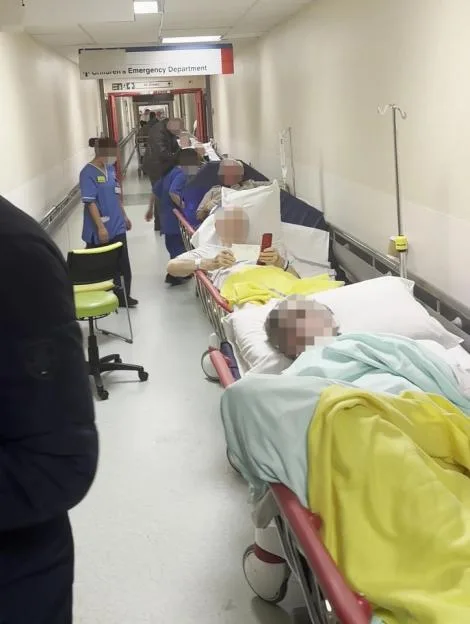
One of the UK’s leading medics today warned that “corridor care” has now become “a convenient label” that normalises prolonged emergency department waits.
Corridor care refers to when patients are treated in hospital corridors or waiting areas while they wait for a proper bed on a ward.
Figures show this was a rare occurrence before the pandemic but now happens thousands of times per month.
Writing in the British Medical Journal, Dr Asif Qasim, consultant cardiologist at King’s College Hospital and Croydon University Hospital, argued that corridor care “masks” the true NHS crisis, such as a lack of social support for frail, old patients.
He added: “A patient waiting 12 to 24 hours for a hospital bed should not be led to believe that this represents normal, safe care simply because it has become commonplace.
“Nor should staff be expected to reassure patients about conditions they know fall below acceptable clinical standards.”
Latest , just 74 per cent of the 2.4 million patients that attended emergency departments in England were admitted, transferred, or discharged within four hours.
Under NHS guidelines, 95 per cent of patients of arriving in A&E, but this target hasn’t been met since 2015.
More than 50,000 waited for more than 12 hours before being admitted, transferred or discharged – equivalent to more than 1,600 every day.
Across 2025/26, there were 570,957 waits of over 12 hours, up 7.2 per cent on the previous year.
According to the figures, by area, University Hospitals Birmingham NHS Foundation Trust had the highest number of patients waiting at least 12 hours in September, with 2,085.
This was followed by Royal Free London NHS Foundation Trust (2,031) and The And Telford Hospital NHS Trust (1,373).
Dr Qasim called for new data to be published on the number of patients spending long periods in unsuitable spaces and for serious incidents involving prolonged waits to be reviewed.
He added: “Most importantly, we owe candour to patients and their families.
“We should ask not only how we reached this position, but why we have become willing to accept it.
“When services are overwhelmed every day, and winter pressures are all year round, the pressures on staff are relentless.
“The first step towards restoring safe hospital care is to stop normalising its failure.”
It comes as NHS national medical director, Professor Frankie Swords, warned earlier this month that of winter pressure building on the health service.