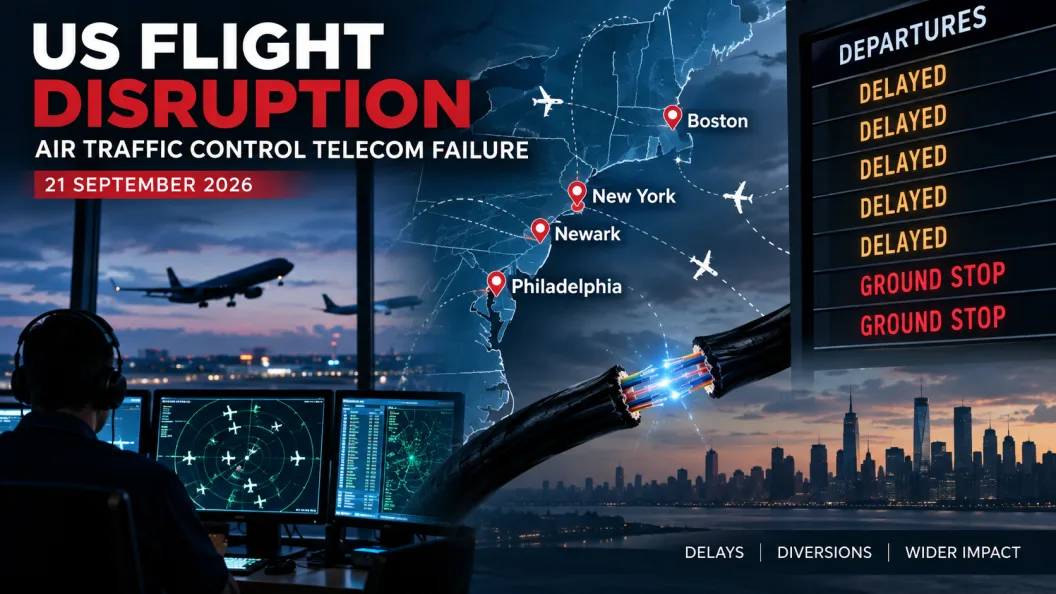
Thousands of flights across the United States were delayed or cancelled on Monday after a telecommunications failure disrupted air traffic control operations at major Northeast airports.
What caused the disruption?
The disruption involved the FAA's Philadelphia Terminal Radar Approach Control facility. A primary communications circuit failed and a backup fibre-optic connection was also severed during construction work in New Jersey, according to the FAA and reporting by Reuters and Associated Press.
The combination left the system without its normal communications resilience and prompted the FAA to temporarily stop or restrict incoming flights at airports including Newark Liberty, John F. Kennedy, LaGuardia, Philadelphia and Boston.
Thousands of flights affected
Reuters reported that roughly 7,000 flights had been delayed or cancelled by the end of Monday, with more than 1,400 disruptions at the major New York-area airports alone. Newark was among the hardest-hit hubs.
Passengers faced cancellations, lengthy delays and diversions while airlines adjusted schedules around the ground stops. Travellers connecting through affected airports were also exposed to knock-on disruption elsewhere in the US network.
Operations resume after repairs
Officials said the damaged telecommunications links were repaired later on Monday and airport operations across the Northeast began resuming. However, clearing accumulated aircraft and passenger backlogs can take hours after a major ground stop, so travellers were advised to continue checking their flight status directly with airlines.
Outage renews focus on ageing infrastructure
The incident has renewed scrutiny of the resilience of US air traffic control communications. Transportation Secretary Sean Duffy and FAA Administrator Bryan Bedford have argued for further modernisation and stronger redundancy so that the failure of a physical communications path does not have such widespread consequences.
The outage occurred on the same day the FAA introduced SMART, a separate AI-supported planning platform around Washington, D.C. SMART is intended to improve traffic-flow planning and reduce delays, but it does not replace the communications infrastructure affected by Monday's failure.