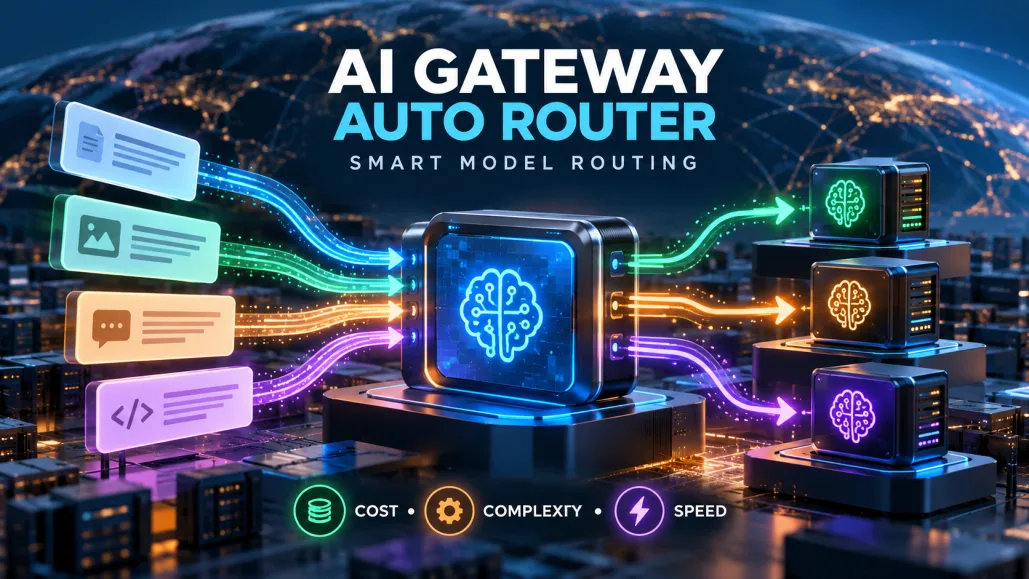
Cloudflare has released Auto Router in public beta for AI Gateway, giving developers a way to route requests automatically to different models based on estimated complexity.
The idea is simple: not every prompt needs the most capable or expensive model. A lightweight request can be sent to a lower-cost model, while a harder task can be routed to something more capable.
How Auto Router works
Cloudflare says Auto Router uses a classifier deployed at the edge to evaluate an incoming request. The classifier estimates complexity and selects an appropriate model according to the routing configuration.
That decision happens before the request is sent to the model provider, allowing the gateway to manage routing centrally.
Why model routing matters
AI costs can rise quickly when every task is sent to a premium model. Many production workloads contain a mix of simple extraction, short classification, routine summarisation and genuinely difficult reasoning.
Automatic routing can help match model capability to task difficulty rather than applying the same cost profile to every request.
What Auto Router does not guarantee
Routing is an optimisation tool, not a guarantee that every request will be handled by the cheapest possible model or that output quality will always match a manually selected model.
Teams should test representative workloads and monitor quality, latency and spend before relying on automated routing for critical tasks.
Where it fits in AI Gateway
AI Gateway already provides a central layer for observability, provider access and control around model requests. Auto Router adds a decision layer that can choose among models rather than simply forwarding a request to a fixed target.
What developers should test
- Simple versus complex prompt behaviour.
- Quality differences across routed models.
- Latency introduced by classification and routing.
- Cost changes over realistic workloads.
- Fallback behaviour when a provider or model is unavailable.
Bottom line
Cloudflare's Auto Router reflects a broader trend toward multi-model AI systems. As model choice becomes more dynamic, developers may spend less time hard-coding one provider for every task and more time defining the policies that govern quality, cost and latency.