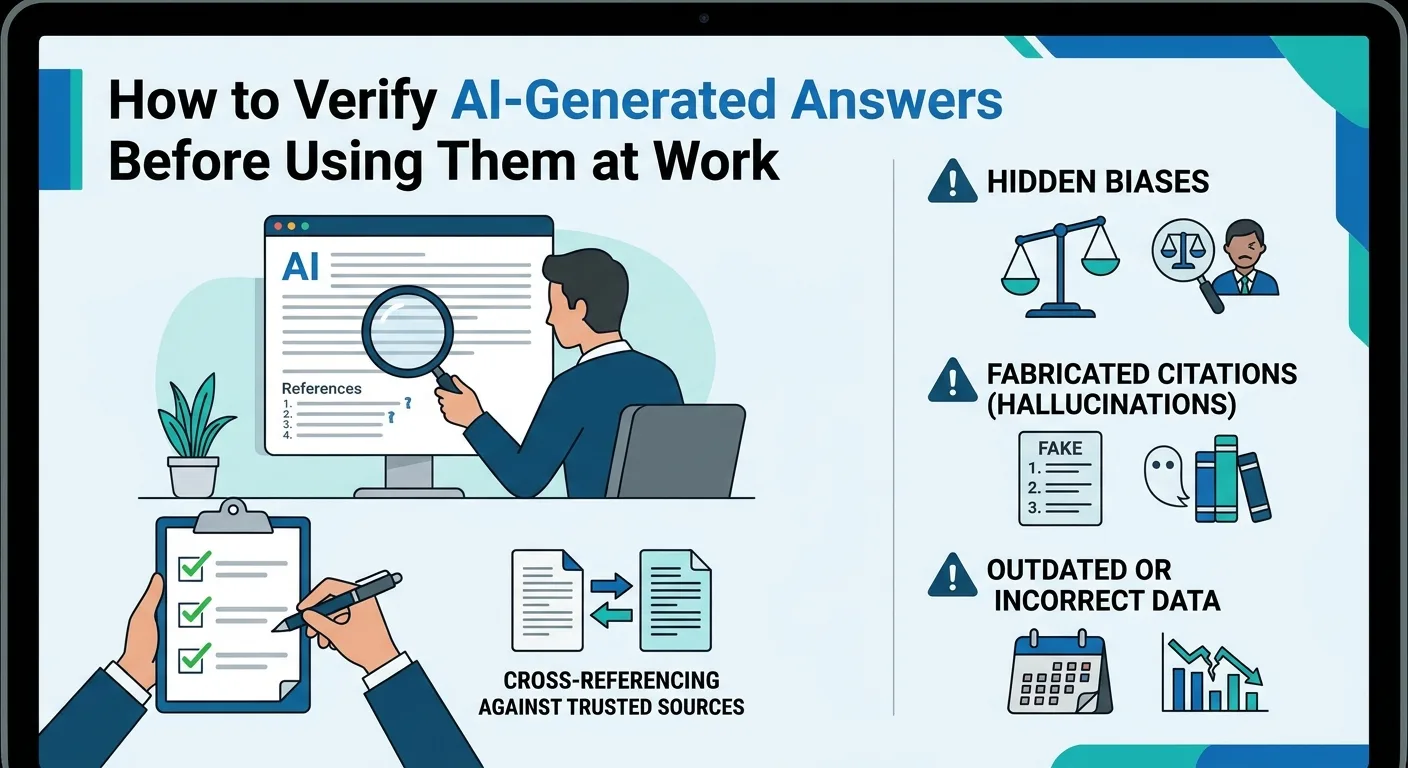
Before using an AI-generated answer at work, identify its factual claims, check them against authoritative sources, verify every important number and decide whether the result needs expert approval. A useful AI response may be fast, clear and well written, but those qualities do not prove that its facts, quotations, calculations or recommendations are correct.
Consider a seemingly routine task: an AI assistant drafts a customer email about a refund. It might confidently give the wrong deadline, quote a policy that has changed or promise a payment the employee cannot authorise. If the message is sent unchecked, the mistake becomes a real business problem. A similarly convincing error in a report, spreadsheet or software script can lead to financial loss, inaccurate publishing or security exposure.
This practical guide explains how to verify AI-generated answers before using them at work, including a repeatable workflow, a claim-checking worksheet, examples for different job types and clear rules for when to stop or escalate. It draws on the UK House of Commons Library's May 2026 briefing , the US National Institute of Standards and Technology (NIST) , and professional AI security guidance. Research verified: 9 November 2026.
Why do AI-generated answers need checking?
Generative AI systems can produce plausible text without verifying every claim against an independent source. They can also omit important qualifications, misread tables, blend facts from different documents or misunderstand an instruction. NIST calls convincingly presented false or erroneous generated content confabulation, commonly known as hallucination, and specifically notes that fabricated citations or faulty explanations may increase user trust.
The House of Commons Library's 2026 guidance recommends using AI as an assistant rather than treating it as the final authority. It explains that factual statements should be identified and checked against independent sources, especially when a human expert needs to take responsibility for the result.
There is evidence that this problem remains important even as AI capabilities improve. Stanford's 2026 AI Index reports widely varying hallucination rates across a particular accuracy benchmark involving 26 models. Those percentages describe that benchmark, not the chance that any given business answer will be wrong. The practical lesson is to assess the answer and the task rather than assume a model's reputation guarantees reliability.
Start with the stakes: not every answer needs the same review
The required verification effort depends on what happens if the answer is wrong. A brainstormed meeting title is different from an instruction to transfer money or a summary of a legal obligation. Use this risk-based starting point:
| Risk level | Typical use | Minimum review before use |
|---|---|---|
| Low | Headline ideas, non-factual brainstorming, style suggestions | Check relevance, tone, originality and any factual wording that remains |
| Moderate | Customer emails, internal summaries, research notes, meeting minutes | Check claims, dates, original documents, permissions and likely omissions |
| High | Payroll, banking, financial reporting, contracts, hiring, security, health or legal decisions | Use independent evidence, documented calculations, qualified reviewer and approval controls; do not execute until cleared |
These categories are editorial examples, not regulatory classifications. Organisations should apply their own sector-specific rules and legal obligations. Where the potential harm is serious and reliable checking is unavailable, the appropriate decision may be not to use the AI answer.
The eight-step workflow for verifying AI answers
Step 1: Separate the answer into checkable claims
Do not try to verify an entire page as one vague statement. Highlight individual factual assertions: names, statistics, product specifications, legal provisions, dates, quotations, figures and statements about what an organisation has announced. Distinguish these from recommendations, opinions or hypothetical examples.
Suppose an AI summary says: “The supplier increased prices by 15% in September and our contract allows immediate cancellation.” That contains at least three claims to check: the supplier's old and new prices, the applicable date, and the precise cancellation clause. The third claim is especially sensitive because interpreting a contract depends on its full wording.
Make a short claim list. Rank the claims that affect money, rights, customers or public statements as the highest priority for independent confirmation.
Step 2: Check the original document or authoritative source
Prefer the entity directly responsible for the fact. For a company's refund policy, use its current policy document. For a regulatory obligation, consult the competent regulator's official publication. For financial totals, review the underlying approved ledger or report. For a quoted statement, find the original speech, document or complete interview.
Secondary reporting can provide helpful context but may repeat an earlier mistake. A source should be appropriate to the claim, not merely a well-known website. The House of Commons Library's source-evaluation guide explains the need to consider origin, accuracy, evidence and purpose when assessing information.
Opening a reference is essential: an AI-generated hyperlink can lead to a nonexistent page, an unrelated document or a genuine source that does not support the sentence beside it.
Step 3: Verify the citations, quotations and context
For every important citation, ask four questions: Does the source exist? Is it the right version? Does it actually say what the AI claims? Is the relevant passage being presented fairly?
Check that a quotation's wording is accurate, that the stated author or institution is correct and that the excerpt has not omitted a qualification. If the text is paraphrased, ensure the paraphrase preserves the original meaning. A citation to the homepage of a regulator cannot prove a precise legal rule unless the underlying rule has actually been identified.
NIST's Generative AI Profile specifically recognises that fabricated sources and reasoning may accompany otherwise fluent answers. A bibliography alone should therefore never be treated as verification.
Step 4: Check dates, versions and changing information
A claim can have been accurate last year and still be wrong today. Look for the publication date, the date of the underlying event, effective dates and any later correction or superseding notice. This is especially important for prices, tax procedures, bank limits, software versions, public appointments, deadlines and regulatory requirements.
Ask whether the AI tool searched live sources, relied on a provided document, or answered without a current reference. A newly written AI answer is not necessarily based on newly published information. If two official pages disagree, report the discrepancy and seek clarification instead of choosing whichever number sounds more convenient.
Step 5: Recalculate every consequential number independently
Numbers often look authoritative in polished text. Recheck percentages, currencies, units, totals, dates, comparisons and assumptions with a trusted calculator, spreadsheet formula or approved accounting system. Do not merely ask the same AI to check its arithmetic and accept the second response as independent proof.
Take a fictional order of 600 units at ₦1,250 each. The pre-discount total is ₦750,000. A 5% discount is ₦37,500, giving a discounted amount of ₦712,500 before any applicable taxes, shipping or other charges. The arithmetic is simple, but the business still needs to check that 600 units, the unit price and the discount authority were correct in the original records.
Keep different concepts separate: revenue versus profit, percentage change versus percentage-point change, gross versus net, and the date of a transaction versus the date it cleared. If the AI produces a spreadsheet, inspect formulas and source ranges rather than just looking at the final cell.
Step 6: Look for missing information, bias and misleading certainty
An answer may be technically correct in one sentence while still being misleading overall. A summary might omit an exception, treat a disputed allegation as fact, present an average as applying to every customer, or fail to explain that the evidence is preliminary.
Compare the output with the original material for omitted risks, contrary findings, definitions and limits. Ask whether relevant groups or viewpoints are represented accurately. When evidence is limited, replace unwarranted certainty with qualified language and cite the reason for the uncertainty. The UK Data and AI Ethics Framework stresses fairness, accountability, privacy and appropriate human oversight for AI-supported decisions.
Step 7: Check privacy, permissions and unsafe instructions
Verification is not only about factual accuracy. It also concerns whether the information was obtained and used legitimately. Do not upload a client's bank statement, an employee's medical details or a confidential contract to an unapproved tool merely to confirm a draft. Use permitted, appropriately minimised or anonymised material wherever possible.
If an AI assistant reads webpages, emails, files or search results, those inputs may contain malicious instructions. OWASP's prompt-injection guidance recommends treating external content as untrusted, validating outputs and enforcing tool permissions outside the model. Do not let an AI-generated answer automatically trigger a bank transfer, delete records, publish content or change a security setting.
For businesses handling customer records, FlyingEze's guide to protecting customer data when using AI tools provides a complementary checklist.
Step 8: Sign off the answer and keep an evidence record
Once the checks are complete, record the conclusion: verified, corrected, unresolved or rejected. Identify who performed the check, which source and version were used, and who approved the result. A high-impact answer should be reviewed by someone with the relevant professional knowledge or authority before it guides action.
The UK government's data and AI ethics guidance calls for clear human responsibilities and mechanisms to challenge AI-assisted decisions. A meaningful human review means being able to see the evidence and stop or amend the action—not simply clicking “approve” because the output sounds confident.
A real-world verification log: what to record
Use a small table or shared record, especially for reports, financial work and customer-facing information:
| Field | Example entry |
|---|---|
| Claim or output | “Discounted order total is ₦712,500” |
| Source of truth | Approved purchase order and current pricing record |
| Check performed | 600 × ₦1,250; less 5% |
| Result | Calculation verified, tax treatment pending confirmation |
| Reviewer | Named responsible employee |
| Decision | Hold until tax and payment details are checked |
The sample is illustrative. Avoid putting unnecessary personal information into the verification log itself. Its purpose is accountability and reproducibility, not creating another database of sensitive data.
How to verify different types of AI-generated work
AI-written emails and customer messages
Check recipient identity, the correct account or order, dates, refund promises, policy wording, tone and attachments. Ensure any requested action is authorised. A wrong name may be embarrassing; an invented refund policy can have financial consequences. Staff should review a customer message before sending it whenever the tool has not been approved for that category of communication.
Research reports and SEO articles
Check factual claims, dates, quotations, statistics and outbound references against original material. Make sure the headline does not claim more than the body supports. Confirm any internal links actually exist and are relevant. Separate verified findings from prediction or commentary; attribute disputed claims instead of presenting them as established fact. A polished AI article with invented citations is not ready to publish.
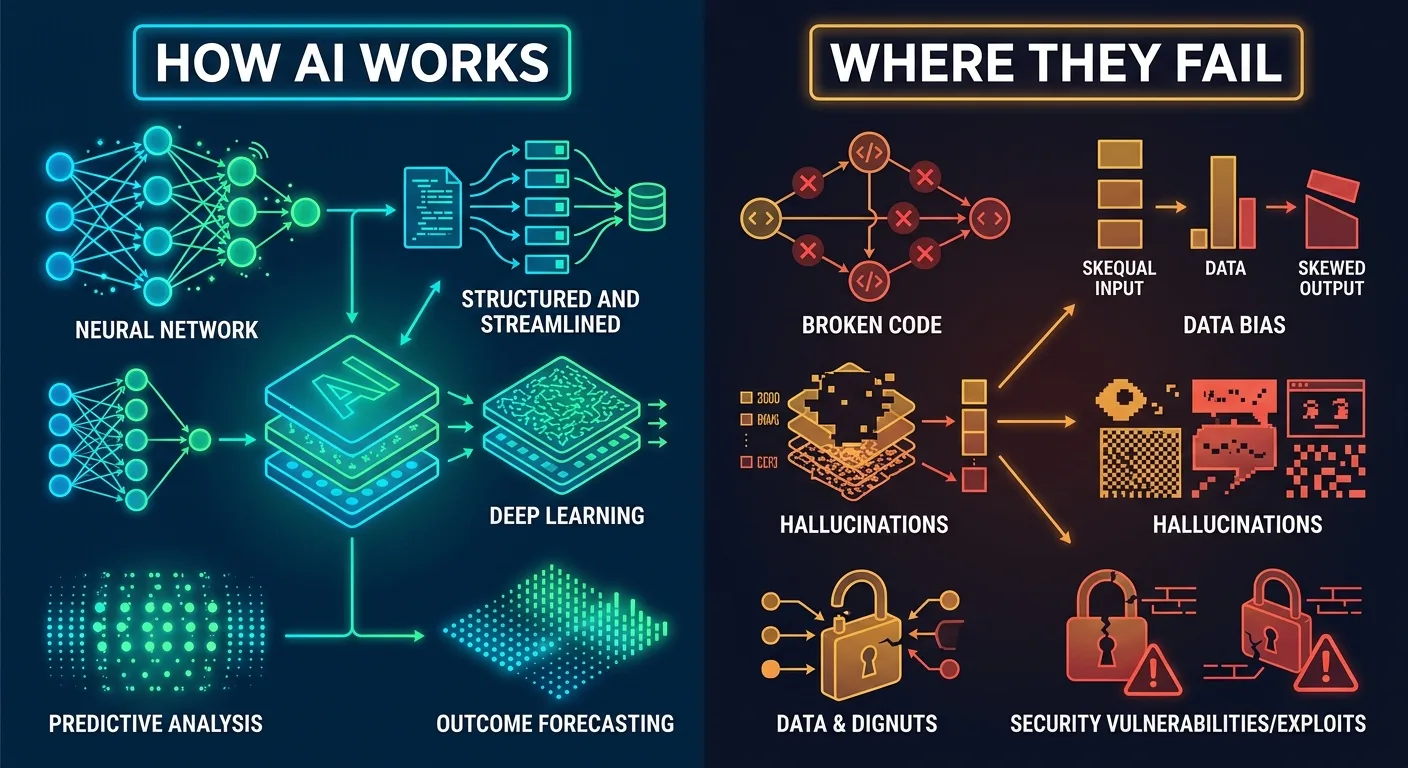
Readers who want to understand why such errors occur can consult FlyingEze's explanation of how AI systems work and where they fail . This guide focuses on what to do with an answer before using it.
Spreadsheets, budgets and financial forecasts
Check data inputs, totals, formula references, currency conversions, assumptions, rounding, excluded rows, dates and scenario labels. Compare a representative sample with calculations done independently. A forecast should disclose its assumptions and uncertainty; it is not a record of what will definitely happen. Any instruction to pay, reimburse, change payroll or post an accounting entry should remain inside an authorised financial workflow.
Meeting minutes and audio summaries
Review the approved recording or notes where lawful and available. Confirm who attended, who said what, which decisions were made, the named action owners and the deadlines. Speech recognition can confuse speakers or numbers; summarisation can convert a suggestion into a decision. Share the draft with attendees or the meeting owner when appropriate before treating it as an official record.
Generated code and technical instructions
Inspect the code instead of assuming it is safe because it runs. Test behaviour in an isolated development environment, review dependencies and licences, run automated tests and relevant security checks, and confirm that credentials and production data are protected. AI-produced commands affecting databases, servers, payments or deployment pipelines deserve particularly close attention.
OWASP identifies excessive agency as a risk when AI tools have more permissions or autonomy than their task requires. Critical actions should have independently enforced access controls and approval mechanisms.
Can another AI model verify the first model?
A second model can sometimes help spot inconsistencies or suggest missing questions, but agreement between two AI systems is not independent evidence. Models may share training sources, repeat common misconceptions or both fail to check the original data. Similarly, asking the first model to “double-check” can be useful for drafting a checklist but does not prove that its next answer is correct.
The safer procedure is to check against a source of truth external to the generated answer: an authoritative document, current official record, validated calculation or appropriately qualified reviewer. If another model is used as an additional reviewer, document its role and still perform those independent checks.
Can AI detectors tell whether an answer is trustworthy?
No. Trying to detect whether text was written by AI is a different task from deciding whether its claims are true. Human-written content can contain errors; AI-assisted content can be well sourced and accurate. The House of Commons Library cautions that AI-detection tools are unreliable as conclusive evidence of authorship and that the stronger approach is assessing the text's actual evidence and claims.
Do not reject a factual report simply because a detector labels it AI-generated, or approve it because a detector labels it human-written. Check sources, calculations, context and accountability instead.
When should an employee stop using an AI answer?
Stop and escalate when the answer cites nonexistent evidence, contradicts an authoritative current source, cannot explain a material calculation, exposes private data, or instructs a person to perform an unauthorised action. Stop as well when an answer concerns a consequential decision but nobody with suitable expertise can review it.
For example, if AI-generated payment instructions contain an unfamiliar bank account, do not transfer funds because the assistant seems confident. Verify the payee and the account through an independent, trusted business channel and the organisation's normal approval process. If a generated legal or medical conclusion affects someone's rights or safety, refer it to a qualified professional instead of treating an unverified summary as the decision.
OpenAI's research on why language models hallucinate notes that systems can be rewarded for guessing instead of expressing uncertainty. A tool that acknowledges it cannot verify an answer may be behaving more responsibly than one that offers an unsupported confident assertion.
A printable 12-question checklist before using AI output at work
| Question | Check |
|---|---|
| 1. Is the task suitable for AI? | Yes / No |
| 2. Have all consequential factual claims been identified? | Yes / No |
| 3. Are the cited sources real and accessible? | Yes / No |
| 4. Do the original sources support each claim? | Yes / No |
| 5. Are dates, versions and effective periods current? | Yes / No |
| 6. Are quotations accurate and fairly contextualised? | Yes / No |
| 7. Were numbers recalculated independently? | Yes / No / N/A |
| 8. Were important omissions, uncertainty and bias reviewed? | Yes / No |
| 9. Is all data use authorised and privacy-protective? | Yes / No |
| 10. Have unsafe tool actions and access permissions been checked? | Yes / No / N/A |
| 11. Has a suitable human reviewed high-risk content? | Yes / No / N/A |
| 12. Is the result documented as verified, corrected or unresolved? | Yes / No |
For any question that is materially relevant to the decision, a “No” means the output is not ready for that use. “Not applicable” is appropriate only when the category genuinely does not apply. This is a suggested workplace editorial checklist—not a certification or a substitute for mandatory professional procedures.
How to ask AI to make human verification easier
Useful prompting can improve the organisation of an answer even though it does not guarantee truth. Consider a request such as:
“Separate your answer into factual claims, calculations, assumptions and recommendations. For each factual claim, identify the source you used and its date. Mark any claim that you cannot verify. Do not invent citations. List what a human must check before using this answer.”
Then perform the checks yourself. Asking an AI to disclose uncertainty can reduce the appearance of unwarranted certainty, but the resulting list is only a starting point. Missing a claim from the list does not make it safe.
How should employers build verification into the workflow?
Start with a written policy that makes clear which tools and data may be used, which outputs require review, who approves them and what evidence should be retained. Give employees practical examples—not merely a warning to “be careful with AI”. Train reviewers to verify citations and calculations, recognise missing context and spot suspicious instructions embedded in external documents.
A sensible implementation distinguishes drafting from execution. An AI may prepare an email, report or code change, while an authorised person checks the work before sending, publishing or deploying it. Payments, database updates and other high-impact actions should be controlled in the underlying system, not left to a chatbot's promise that it will ask permission.
The NIST AI Risk Management Framework supports ongoing evaluation and governance rather than one-time checking. Review the process after errors, tool updates or changes to the data being used. For a complementary approach to choosing software in the first place, FlyingEze's AI Tools for Everyday Work: A Responsible Evaluation Checklist is scheduled separately; this article concentrates on verifying the answers produced after a tool is chosen.
Frequently asked questions
How do I fact-check an AI answer quickly?
Extract the key factual claims, open authoritative original sources, verify dates and context, and independently check any numerical results. Prioritise claims that could affect money, customers, safety or public reporting. A quick answer should not be used for a high-stakes decision if sufficient checking is impossible.
Can AI-generated citations be trusted?
Not without checking. AI can invent references, cite unrelated pages or misstate what a real source says. Open the cited document and verify the precise claim against the original passage.
Why can AI give different answers to the same question?
Generative systems may produce different outputs because of sampling, context, model updates, access to tools and changes in the prompt. Differences do not prove that all answers are wrong, but inconsistent factual claims signal the need for independent verification.
Is an answer correct if two AI chatbots agree?
Not necessarily. They may share the same mistaken assumptions or repeat the same incorrect source. Independent primary evidence matters more than agreement between models.
Should I check AI-written emails before sending them?
Yes, particularly where dates, client names, prices, policies, refunds or commitments are involved. Match the draft against approved company records and have the appropriate person authorise important promises.
Can AI be used to calculate business figures?
It can assist, but consequential calculations should be checked with reliable formulas or approved systems. Confirm the original inputs and assumptions as well as the arithmetic.
Do AI-content detectors establish whether a claim is true?
No. Authorship detection and factual verification are different questions. Assess the evidence and content instead of relying on a detection percentage.
When should I reject an AI-generated answer completely?
Reject or hold it when a material claim cannot be supported, it conflicts with verified evidence, it exposes sensitive information or it proposes an unauthorised or unsafe action. Seek qualified review for high-impact legal, financial, medical or security matters.
Conclusion: verify the evidence, not the confidence
AI can accelerate research, drafting, summarisation and problem-solving, but speed and fluent writing do not make an answer ready for work. Before relying on it, separate claims, inspect original sources, check dates, verify quotations, recompute numbers, review missing context and protect confidential information. Then record who verified the result and who is responsible for using it.
A trustworthy process does not require every task to undergo an expensive audit. It requires checks proportionate to the consequences of being wrong. For a casual outline, a brief review may suffice. For customer funds, sensitive information or important decisions, an unverified response should remain a draft—never an instruction to act.
For further guidance, consult the House of Commons Library's 2026 working-with-AI briefing , NIST's Generative AI Profile and the UK government's data and AI ethics framework .