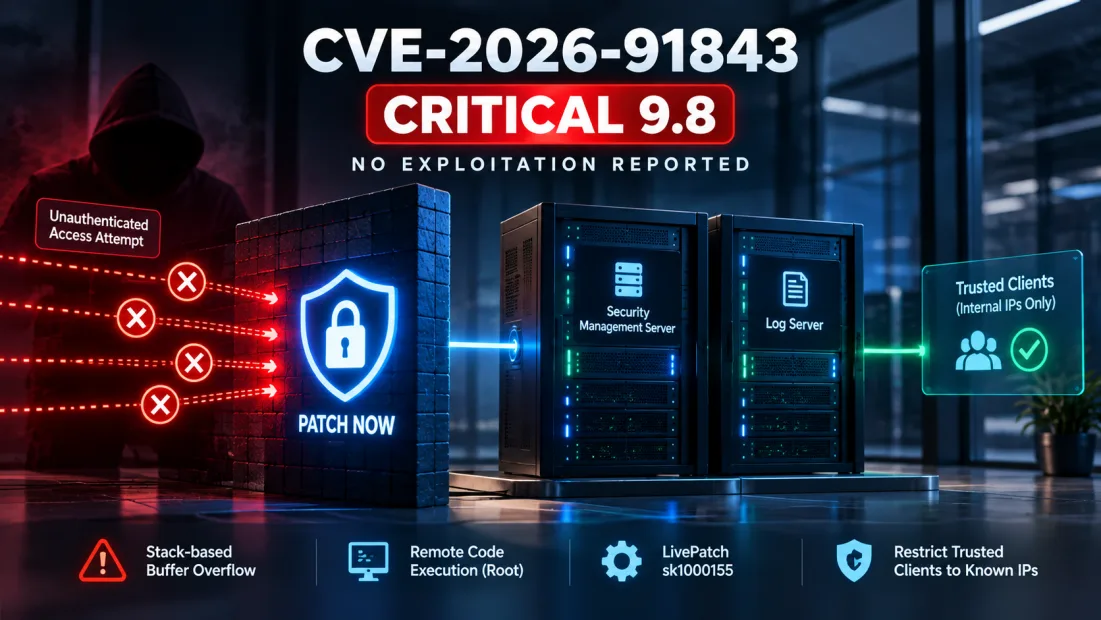
Check Point customers running affected Security Management or Log Server software should prioritise remediation of CVE-2026-91843, a critical vulnerability that can allow an unauthenticated remote attacker to execute code with root privileges.
What CVE-2026-91843 does
The vulnerability has been described as a stack-based buffer overflow affecting a management-server service. Because exploitation does not require valid login credentials and successful code execution can occur with root privileges, the potential impact is severe.
Security management infrastructure is particularly sensitive: it often sits at the centre of policy administration, logging and operational visibility. Compromise of a management server can therefore have consequences beyond a single endpoint.
What Check Point administrators should do
Administrators should consult Check Point’s current advisory for the exact affected releases and remediation applicable to their deployment, then install the vendor-provided fix or supported LivePatch as soon as operationally possible. Back up relevant configuration before maintenance and verify the system after patching.
Reduce exposure while patching
Management interfaces should not be broadly reachable from untrusted networks. Restrict access to known administration networks and authorised hosts, review firewall rules around management services and monitor for unexpected connections.
Look for suspicious activity
Teams should review management and operating-system logs for unusual inbound connections, unexplained processes, privilege activity or configuration changes. If compromise is suspected, normal incident-response procedures should take precedence over simply installing the patch.
Is the vulnerability being exploited?
Reporting around the disclosure said Check Point was not aware of exploitation at the time of disclosure. That distinction matters: a critical vulnerability can demand urgent remediation without evidence that attacks are already occurring. Administrators should check the vendor advisory and threat-intelligence feeds for any subsequent change in exploitation status.
Why management servers deserve priority
Patch prioritisation is not only about a numerical severity score. Internet exposure, required privileges, exploit complexity and the role of the affected system all matter. A remotely reachable security-management server that can yield privileged code execution belongs near the top of most remediation queues.
Next steps
Inventory Check Point management and logging systems, map their software versions against the vendor advisory, apply the supported remediation and document completion. Organisations with change-control constraints should use compensating network restrictions while preparing the update rather than leaving management services unnecessarily exposed.