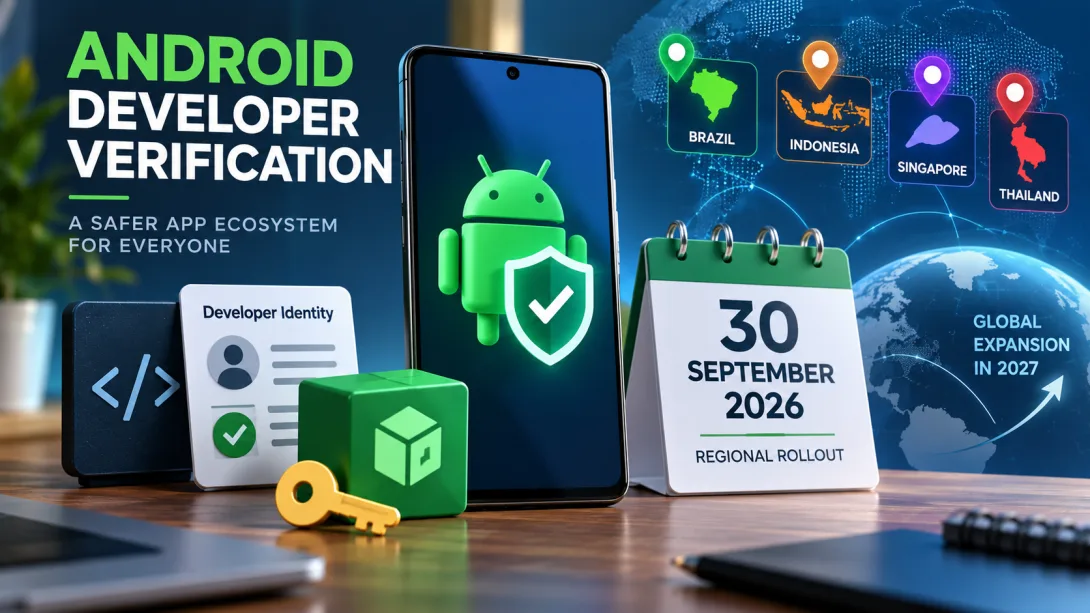
Android developers have an important deadline approaching. On 30 September 2026, Google’s new Android developer verification protections begin taking effect for users installing apps from participating stores on certified Android devices in Brazil, Indonesia, Singapore and Thailand.
The change does not mean Android is ending sideloading, nor does it mean every app installation worldwide changes on that date. The first phase is regional and applies to specified participating app stores. Google plans a broader global rollout in 2027.
Key takeaways
- Regional enforcement starts on 30 September 2026 in Brazil, Indonesia, Singapore and Thailand.
- Developers need a verified identity and must register the package names of apps covered by the requirements.
- Google says more than 99% of Google Play apps have already been registered automatically, but developers should check Play Console for anything outstanding.
- Apps on Google Play that remain unregistered after the deadline can be removed from Play under the updated Play Console requirements.
- Advanced users can still install unregistered apps through Android’s advanced sideloading flow, while ADB workflows remain available.
- Google says the verification protections will expand globally in 2027.
What changes on 30 September 2026?
Android developer verification adds an identity and app-registration layer to Android distribution. Google describes it as a way of establishing who is behind an app rather than reviewing the app’s content or dictating where developers distribute software.
Starting on 30 September, the protections apply to users in Brazil, Indonesia, Singapore and Thailand who install apps from participating stores on certified Android devices. Google’s current documentation lists Google Play, HONOR App Market, OPPO App Market, Galaxy Store, Palm Store, V-Appstore and GetApps among the stores participating in the initial phase.
The scope matters. Developers should not interpret 30 September as a universal global block on every unregistered APK. Google’s FAQ says that during the initial phase, apps distributed through stores outside the listed participants or sideloaded directly are not subject to the same September enforcement. Developers using those routes should nevertheless prepare for the planned global rollout in 2027.
What developers need to do
1. Verify the developer identity
The first requirement is identity verification. Developers who have already completed the relevant verification in Play Console generally do not need to repeat the same process. Google advises Play developers to check their developer-account information if they are unsure of their status.
2. Register app package names
Identity verification alone is not the whole requirement. Developers also need to ensure that their app package names are registered to the verified developer.
For Google Play developers, much of this work may already be complete. Google says it has automatically registered more than 99% of Play apps. The practical step is therefore to open Play Console and check whether any remaining package requires action.
Developers distributing outside Google Play use the Android Developer Console route and should follow the appropriate registration process for their distribution model.
3. Check ownership and signing information
Package-name registration is intended to associate an Android application with a verified developer. Developers should therefore review the account and signing information required by the relevant console rather than waiting until the deadline to discover an ownership conflict or incomplete registration.
What happens to unregistered Google Play apps?
Google’s Play Console guidance is explicit: effective 30 September 2026, Play packages must be registered to comply with Android developer verification requirements. Apps that remain unregistered can be removed from Google Play under the Play Console Requirements policy.
That makes the deadline particularly important for developers with older applications, multiple developer accounts, transferred apps or packages that were not automatically registered.
The safest approach is to check Play Console now rather than assuming automatic registration covered every package.
Does Android developer verification end sideloading?
No. This is one of the most important distinctions in the new system.
Google says advanced users can use an advanced installation flow to install an app from an unverified developer after acknowledging the risks and completing a one-time setup. Google also says the ADB workflow and experience remain unchanged.
That means Android continues to provide routes for power users and developers who need to test or install software outside normal store distribution. The user experience, however, can differ depending on the installation route.
What about hobbyists, students and small-scale distribution?
Google has also introduced a limited-distribution account intended for use cases such as students and hobbyists. According to Android’s developer documentation, this account can register apps and distribute them to up to 20 explicitly authorised devices.
That option is different from mainstream commercial distribution and should not be treated as a workaround for developers who need to reach a general audience. It is designed for genuinely limited distribution.
What about enterprise apps?
Managed enterprise environments are treated differently. Google says apps distributed through an organisation’s store to managed devices do not need to complete the same verification requirements because the organisation’s IT administrator already controls that environment.
Developers should still consider registration when an enterprise app may also be distributed outside managed devices or through public channels.
Why this matters beyond Google Play
The policy is broader than a conventional Play Store rule because Android developer verification is designed around certified Android devices and verified developer identities. The initial enforcement includes several major Android app stores, not just Google Play.
That distinction is particularly relevant after years of debate over mobile app-store competition and alternative distribution. FlyingEze has previously covered changes to the Android app-store landscape, including Fortnite’s planned return to Google Play after the Epic Games dispute .
The verification system effectively separates the question of where an app is distributed from the question of who is responsible for it. Google says developers can continue using their preferred distribution channels, subject to the verification rules as they expand.
A practical checklist before 30 September
- Confirm which developer account owns each Android package you maintain.
- Check that the relevant developer identity has been verified.
- Open Play Console and review package-registration status for every active app.
- If you distribute outside Play, review the Android Developer Console requirements for your distribution route.
- Resolve package ownership or signing issues before the deadline rather than during enforcement.
- Document any enterprise-only or limited-distribution apps separately so the correct rules are applied.
- Test your installation and update paths in the regions and stores relevant to your users.
- Prepare for the broader 2027 rollout even if the September regional phase does not yet affect your distribution channel.
The deadline is regional, but preparation should be global
For developers serving users in Brazil, Indonesia, Singapore and Thailand through participating stores, 30 September 2026 is an immediate operational deadline. For everyone else, it is an early view of a system Google intends to expand globally in 2027.
The most useful action is straightforward: verify the developer account, confirm package registration and understand which distribution path applies to each app. Developers should rely on the live Android Developer and Play Console documentation because implementation details can continue to evolve as the rollout progresses.