A 30-SECOND test could reveal that millions of Brits are living with ‘hidden obesity’.
While has always been thought of as the final word when it comes to revealing who’s , many have criticised the measurement.
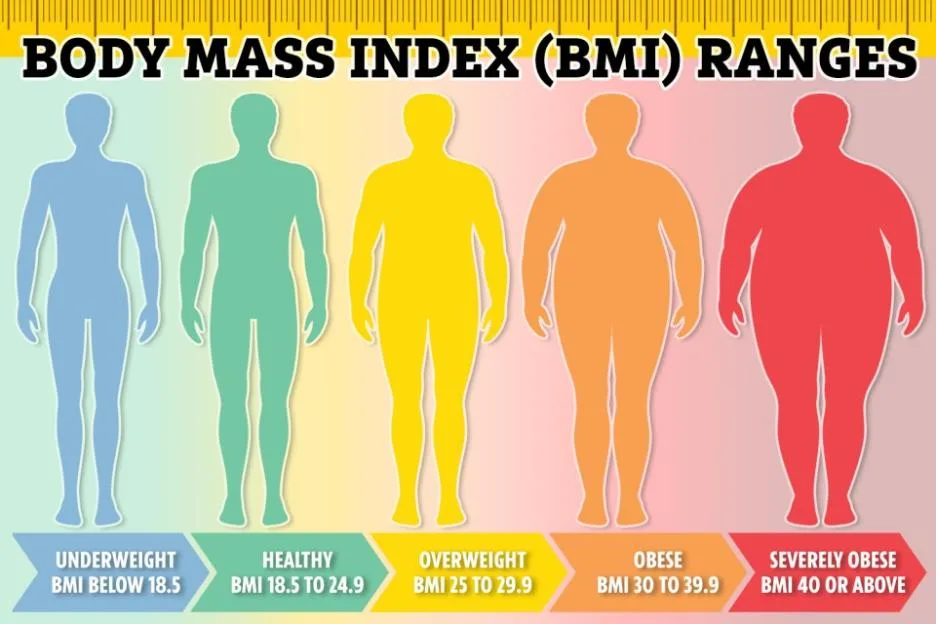
Experts have raised concerns that it doesn’t take the weight of muscle or bones into consideration, meaning people with a muscular build may be classed as overweight.
Now, however, a new study has suggested that BMI may have misclassified millions of people, both by underestimating and overestimating how excess body fat could harm their .
Researchers have instead suggested that people’s – which take 30-seconds or less – should be used alongside BMI to determine whether they are obese.
By using people’s waist-to-hip or waist-to-height ratio as well as BMI, the study observed that up to 8.6 per cent of participants had “hidden “.
This means that while they were classed as overweight on the BMI scale, the new diagnostic framework revealed obesity-levels of body fat.
The study, published in Nature, also found that 3.1 per cent were overdiagnosed as obese using BMI – but when waist measurements were used no excess fat was shown.
In the UK, this could translate to 2.4 million people having dangerous levels of body fat that BMI misses, it suggested.
What’s more, it could also mean that 1.3 million people who are classed as obese actually have no excess fat.
“The inaccuracy of BMI at scale really applies to many, many, many people in every single country,” said Professor Francesco Rubino, chair of metabolic and bariatric surgery at King’s College London.
To come to these findings, a global team of researchers, led by King’s College London, analysed health data from 844,108 adults in the UK, US, China and .
They suggested that use of their new diagnostic framework would help to distinguish people with obesity – where excess fat impairs organ function – and pre-clinical obesity, where excess weight poses increased health risks, but the organs remain functional.
Speaking about these findings, Professor Rubino said: “This study shows that up to a third of all cases of obesity are clinical obesity, an active disease that should be treated as such.”
He suggested that the new measurement – combining BMI and waist size – “makes personalised, proportionate care possible, whereas a uniform BMI-based definition prevents it”.
“Getting the scope of care right – treating existing disease or reducing risk – and matching its intensity to individual needs matters enormously, both for the billion-plus people affected and for healthcare systems,” he added.
Prof Rubino continued: “BMI doesn’t tell you anything about body fat content.
“It doesn’t tell you whether a person’s organs [are] working or not. It doesn’t tell you if somebody, as an individual, is ill or healthy. It’s just a measure of the overall risk of ill health.
“Nevertheless, these BMI thresholds are being used to determine who receives treatment, or even who gets coverage for treatment, despite the fact it doesn’t accurately measure the individual’s health.”
Also commenting on the study, Diego Bellido, Head of the Endocrinology and Nutrition Department at the Ferrol Hospital Complex and President of the Spanish Society for Obesity, said: “It reinforces something we have been advocating for years: BMI is useful, but insufficient for assessing a person with obesity.”
He warned, however, that this was only an observational study.
Meanwhile, Ana Belén Crujeiras Martínez, Director of the Epigenomics Research Group within the Endocrinology and Nutrition Group at the Santiago Health Research Institute, said that waist measurements can be “easily applicable in routine clinical practice”.
“[They] would help to avoid the over – or under – diagnosis of obesity,” she added.
is a formula used to discover whether an individual is classed as underweight, a healthy weight, overweight or obese.
Many medical professionals believe that having a BMI that’s too high or low can increase your risk of health problems, including , and type 2 .
The measurement evaluates age, gender, height and weight but many have criticised it for failing to distinguish between fat and muscle.