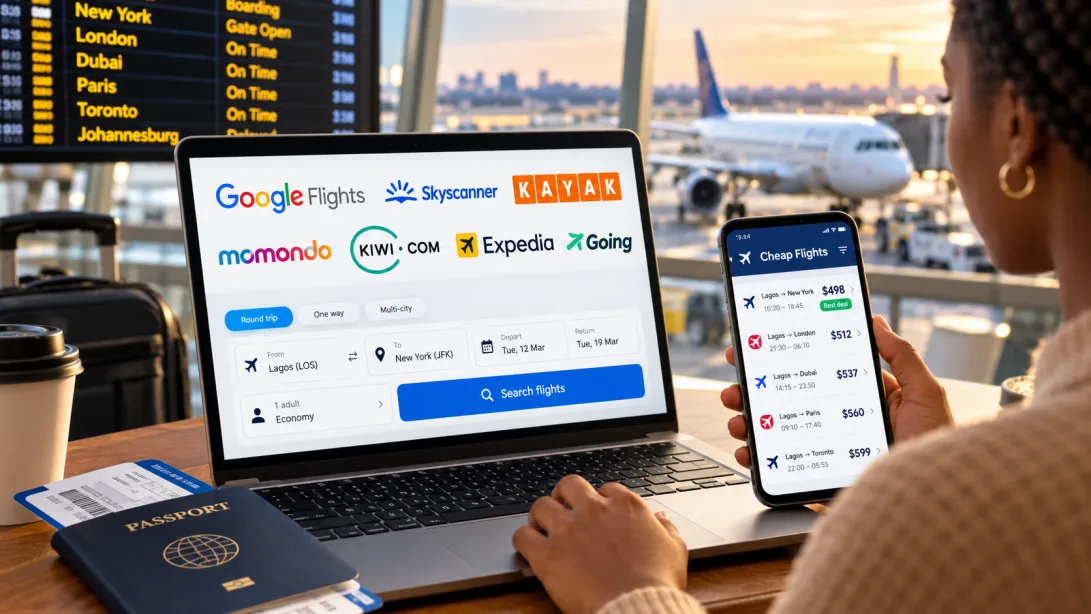
Search for cheap flights and you will find many apps promising the lowest fares. But the same journey may be offered by different sellers with different baggage allowances, payment charges and support conditions. The lowest number on a results page is not necessarily the best deal.
We compared seven major services—Google Flights, Skyscanner, KAYAK, momondo, Kiwi.com, Expedia and Going—using official feature documentation and consumer guidance. This is a feature comparison, not a controlled live-price test. No website can be declared universally cheapest without comparing bookable fares for the same routes, dates, travellers and ticket conditions.
Cheap-flight apps compared: quick verdict
| Service | Best use (editorial judgment) | Important limitation |
|---|---|---|
| Google Flights | Quick benchmarking, flexible dates, fare tracking and convenience | Incomplete airline coverage; some low-fare results involve self-transfers |
| Skyscanner | “Everywhere” inspiration, month search, comparing ticket sellers | Calendar prices are estimates, not reserved fares |
| KAYAK | Alerts, Explore maps, filters and price forecasts | Forecasts are uncertain; baggage may cost extra |
| momondo | Additional sellers, calendar searches and Mix & Match returns | Split bookings follow separate conditions |
| Kiwi.com | Creative combinations of independently ticketed flights | Self-transfers can create visa and missed-connection risks |
| Expedia | Agency checkout, trip management and eligible price-protection options | Protection is conditional and does not compare every seller |
| Going | Curated deal alerts from selected US departure airports | Not an airline or general ticket-booking service |
These “best use” descriptions evaluate documented functionality, not a ranking by statistically proven cheapest fares.
1. Google Flights: start with price and journey trade-offs
Google Flights offers a date grid, price graph, route and airline filters, airport alternatives and fare alerts. Its Best tab weighs price against convenience; Cheapest prioritises lower fares, sometimes including travel agencies, self-transfers or changes between nearby airports.
Google explains that listings come from hundreds of partners but may omit some airlines and offers. Its price tracking can email alerts for chosen flights or dates, including flexible “Any dates” searches. Alerts do not lock fares.
Verdict: The strongest general starting point for establishing a reasonable price and travel-time benchmark. Confirm the final price on the actual booking website.
2. Skyscanner: discover destinations and flexible dates
Skyscanner is especially helpful when your dates or destination are flexible. Its Everywhere feature suggests destinations from a departure airport, while month searches and alerts help compare dates.
Its March 2026 guidance notes that month and Everywhere prices are estimates drawn from user searches over the preceding eight days. They can change when you select a flight.
Skyscanner redirects customers to airlines and travel agents to book. Therefore the provider you choose—not Skyscanner itself—typically handles payment, ticketing and support.
Verdict: Excellent for travel inspiration and flexible searches; verify exact-date availability and the reputation of the booking partner.
3. KAYAK: compare more sellers and monitor price movements
KAYAK combines offers from many providers and includes Explore, flexible-date searches, fare alerts and an optional Price Forecast. According to its pricing guide , forecasts estimate whether fares might rise or fall over the coming seven days, but are unavailable on some routes and never guaranteed.
KAYAK Explore may use fares observed within the preceding 48 hours. Its advertised prices generally include mandatory taxes and fees, but checked baggage and selected seats can still cost extra.
Some Hacker Fares pair separate one-way bookings; check which airline and seller is responsible for each ticket.
Verdict: A useful second opinion and fare-monitoring service. Do not interpret a forecast or recently observed fare as a guaranteed checkout price.
4. momondo: inspect alternative providers and split-ticket returns
momondo offers a Price Calendar, Price Alerts and Mix & Match results. The latter can combine an outbound ticket from one provider with a return ticket from another; users may complete two different booking flows.
That flexibility can reveal a cheaper arrangement, but you also inherit two sets of change, refund and support rules. As a metasearch engine, momondo does not guarantee sellers' prices .
Verdict: Worth checking for additional offers and mixed returns, especially when travellers are comfortable managing separate reservations.
5. Kiwi.com: inventive routes but added connection risk
Kiwi.com can combine separate flights that airlines do not offer as a protected connection. Its self-transfer guidance explains that carriers are generally not responsible for another independent ticket if a delayed first flight causes you to miss the second.
Passengers may need to collect and recheck bags, enter a transit country, change terminals and clear immigration. This is particularly significant where a traveller's passport requires additional visas.
Kiwi offers a Guarantee with specified disruption assistance, but conditions and possible Kiwi.com Credit are not equivalent to an airline-issued through-ticket.
Verdict: Consider when savings are substantial and the itinerary is feasible. Avoid a complicated self-transfer when punctual arrival is essential.
6. Expedia: a booking platform with conditional price tracking
Expedia is an online travel agency rather than only a search engine. It offers booking management and price tracking on eligible searches.
Its Price Drop Protection applies to selected flights and compares the booked itinerary's price on Expedia, not against every airline or travel site. Depending on the product, benefits can be cash or OneKeyCash after the trip, and eligibility or fees differ.
Verdict: Compare Expedia's final payable fare with airline-direct pricing. Consider protection only after reading its actual terms rather than assuming it is free or universally available.
7. Going: fare alerts for US-based departures
Going , previously Scott's Cheap Flights, sends selected flight deals to members. It does not book tickets ; subscribers follow instructions to purchase on an airline website or through an agency.
The free plan focuses on certain domestic US deals, while paid plans cover more international and premium-cabin opportunities. Going's service coverage centres on US departure airports.
Verdict: A potentially useful membership for travellers frequently flying from the United States, but not a primary cheap-flights tool for someone mainly departing Lagos, Abuja, Accra or Nairobi.
Why no app wins every price comparison
Airlines and booking agents can offer different fare classes, payment currencies, service charges and baggage packages on the same flight. Comparison engines also index different providers and may display prices that have already changed.
A credible “cheapest overall” claim would require repeated identical searches, live checkout verification and a disclosed sample of destinations and dates. No such benchmark is claimed here. A platform can perform better for one itinerary and worse for another.
Example: the lowest advertised price is not the best deal
Consider two fictional offers for the same traveller and destination:
| Offer | What it costs | Overall |
|---|---|---|
| Option A | $460 fare + $80 baggage + $60 airport transfer + $40 agency charge | $640 |
| Option B | $580 fare including the necessary luggage and usual airport transfer | $580 |
Option B is $60 cheaper after unavoidable expenses. In a real search, also compare journey duration, overnight layovers, change rights and the seller's support.
How to compare flights fairly in five steps
- Set identical requirements: same airports, dates, cabin class, passengers, luggage and arrival deadline.
- Check complementary tools: begin with Google Flights, compare Skyscanner or KAYAK, then examine any different suppliers on momondo or elsewhere.
- Confirm at checkout: compare mandatory charges, baggage, card fees, currency conversion and the business taking payment.
- Review travel risk: check self-transfers, transit visas, airport changes, connection times and disruption protection.
- Benchmark against the airline: compare the operating carrier's own ticket and conditions before completing a third-party purchase.
For a more detailed explanation of total journey costs and sensible layovers, read FlyingEze's guide to genuinely cheap flights without sacrificing convenience , scheduled for publication before this comparison.
Special considerations for travellers in Africa
Check the site's supported billing country, card acceptance and settlement currency. A price shown in dollars or euros may differ from the amount ultimately charged in naira or another local currency once conversion or banking fees are applied.
Before buying an international ticket, confirm passport, visa and transit permissions for every relevant airport. The IATA Travel Centre is a useful starting point; official immigration authorities determine the actual requirements. A cheap self-transfer is useless if you cannot enter the connecting country to retrieve luggage.
Be alert to false agents on messaging apps. Skyscanner warns that it does not contact customers via phone or WhatsApp to complete payments. After paying any provider, confirm the ticket number and booking reference with the airline.
Understand refunds before choosing an agent
Under applicable US Department of Transportation rules , airlines selling qualifying tickets at least seven days before departure generally must offer a 24-hour no-penalty cancellation/refund option or a 24-hour fare hold. The requirement does not automatically extend to third-party online travel agents.
Refund or rebooking rights also depend on the flight route, airline, seller and governing law. Read who handles changes, whether agency service charges apply and how to contact support during disruptions.
Frequently asked questions
Is Google Flights cheaper than Skyscanner?
Not consistently. They can list different suppliers and fares. Compare an identical bookable itinerary, including charges, rather than the lowest search-result number.
Which app is best for flexible destinations?
Skyscanner Everywhere and KAYAK Explore both help with destination ideas. Indicative fares may be snapshots rather than live purchase offers.
Can Kiwi.com save money on flights?
Yes, separate-flight combinations may cost less, but they can create baggage, immigration and missed-connection risks. Review the full arrangement before booking.
Should I book through an app or directly with the airline?
Compare final prices and support terms. Airline-direct booking can make changes simpler, while a reputable agency may offer a worthwhile fare. Neither approach guarantees the lowest price.
Final verdict
For most travellers, a practical method is to start with Google Flights, cross-check Skyscanner or KAYAK, and verify the result directly with the airline. Use momondo to look for alternate ticket combinations, Kiwi.com when you consciously accept self-transfer risk, Expedia for a competitive agency offer, and Going when US-origin deal alerts fit your travel patterns.
The real bargain is a ticket you can actually buy and use at a competitive total journey cost—not merely the cheapest figure shown on an app.
Research verified 28 October 2026. Features and booking terms can change. This is an independent functional comparison, not a controlled live-fare ranking; no paid placements or affiliate links are included.