A vast new flight-restricted zone centred on Beijing has taken effect, imposing permanent controls across more than 280,000 square kilometres of northern China while preserving exemptions for commercial airline flights and several other authorised operations.
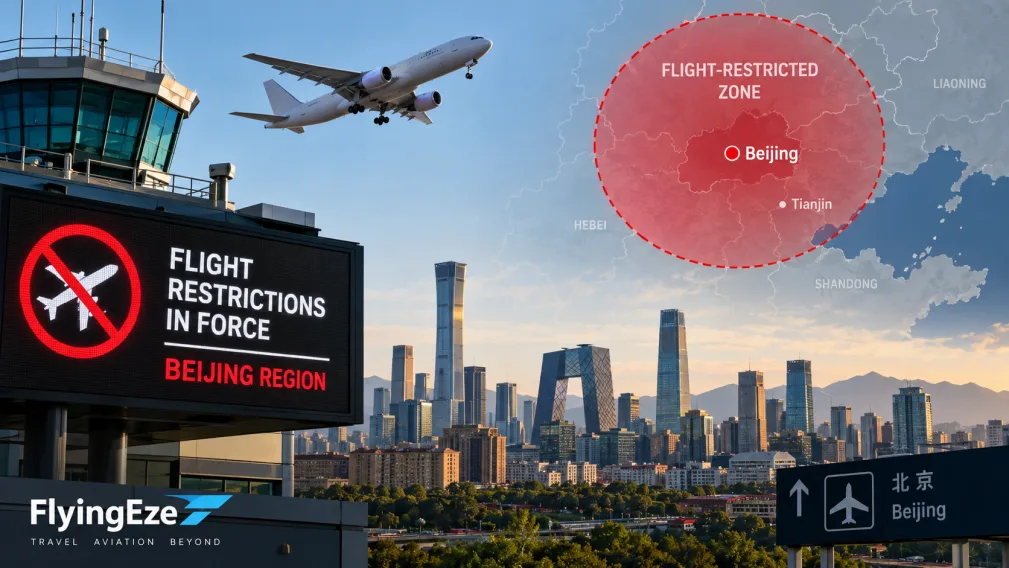
The Special Restricted Area, identified in an aviation notice as ZB(SR)801, applies within 300 kilometres of a point in Beijing and extends from the surface to unlimited altitude. Its effective time was 16:00 UTC on 19 September, corresponding to midnight on 20 September in Beijing.
What the new Beijing airspace restriction covers
The restricted area encompasses Beijing and Tianjin, much of Hebei province and parts of neighbouring regions, as well as part of the Bohai Sea. Reuters reported that the area exceeds 280,000 square kilometres — comparable with the size of Italy — and contains dozens of airports and smaller airfields.
The measure is permanent rather than a short-term restriction tied to a single event. That makes it a significant change for general aviation and other non-exempt flying in and around the Chinese capital.
Are normal airline flights banned?
No. The aviation notice provides exemptions for commercial airline flights, approved business flights and specified military, customs, police, firefighting and rescue operations.
That distinction matters for passengers: the measure should not be read as a shutdown of scheduled passenger aviation serving Beijing. Instead, it creates much tighter controls on aircraft that do not fall within the listed exemptions.
What authorised aircraft must do
Exemption does not mean unrestricted operation. Aircraft operating under the permitted categories must follow approved flight plans and meet operational requirements intended to allow air traffic authorities to identify and monitor them.
The notice requires continuous two-way communication with air traffic control and surveillance and identification equipment capable of supporting continuous electronic tracking. Pilots must also satisfy security-status and flight-plan requirements before operating in the restricted area.
According to the published NOTAM, civil aircraft flying at or below 3,000 metres above mean sea level should also remain within a specified indicated-airspeed limit.
Why China tightened the rules
The restrictions follow a rare breach of Beijing’s tightly controlled airspace in June, when a light sport aircraft struck the 108-storey CITIC Tower in the capital’s central business district.
Local authorities said the pilot, who was the only person aboard, died and 13 people on the ground were injured. Reuters subsequently reported that the aircraft had departed its approved flying area and lost contact with the general aviation airport from which it had taken off.
The new Special Restricted Area is part of a broader tightening of aviation security around the capital. Beijing has separately announced tougher rules for civilian drones, including measures due to take effect in November.
What travellers should know
Passengers with ordinary scheduled airline bookings should not assume their flights are cancelled because of the new zone. Commercial airline operations are explicitly among the exempt categories.
Travellers should nevertheless continue to check directly with their airline and airport for operational changes, particularly when using business aviation or connecting through smaller regional airfields. Individual flight schedules can change for reasons unrelated to the new restriction.
Private pilots, general-aviation operators and business-aviation users face a different situation. They should confirm current permissions, flight-plan requirements and applicable notices before operating anywhere within the affected region.
A permanent change to Beijing’s airspace
The scale of the new zone makes the change notable beyond Beijing itself. A 300-kilometre radius reaches across a large portion of northern China, while the surface-to-unlimited vertical extent makes the restriction unusually comprehensive.
For airline passengers, the central point is straightforward: scheduled commercial aviation is exempt. For general aviation, however, 20 September marks the start of a substantially more restrictive operating environment around the Chinese capital.