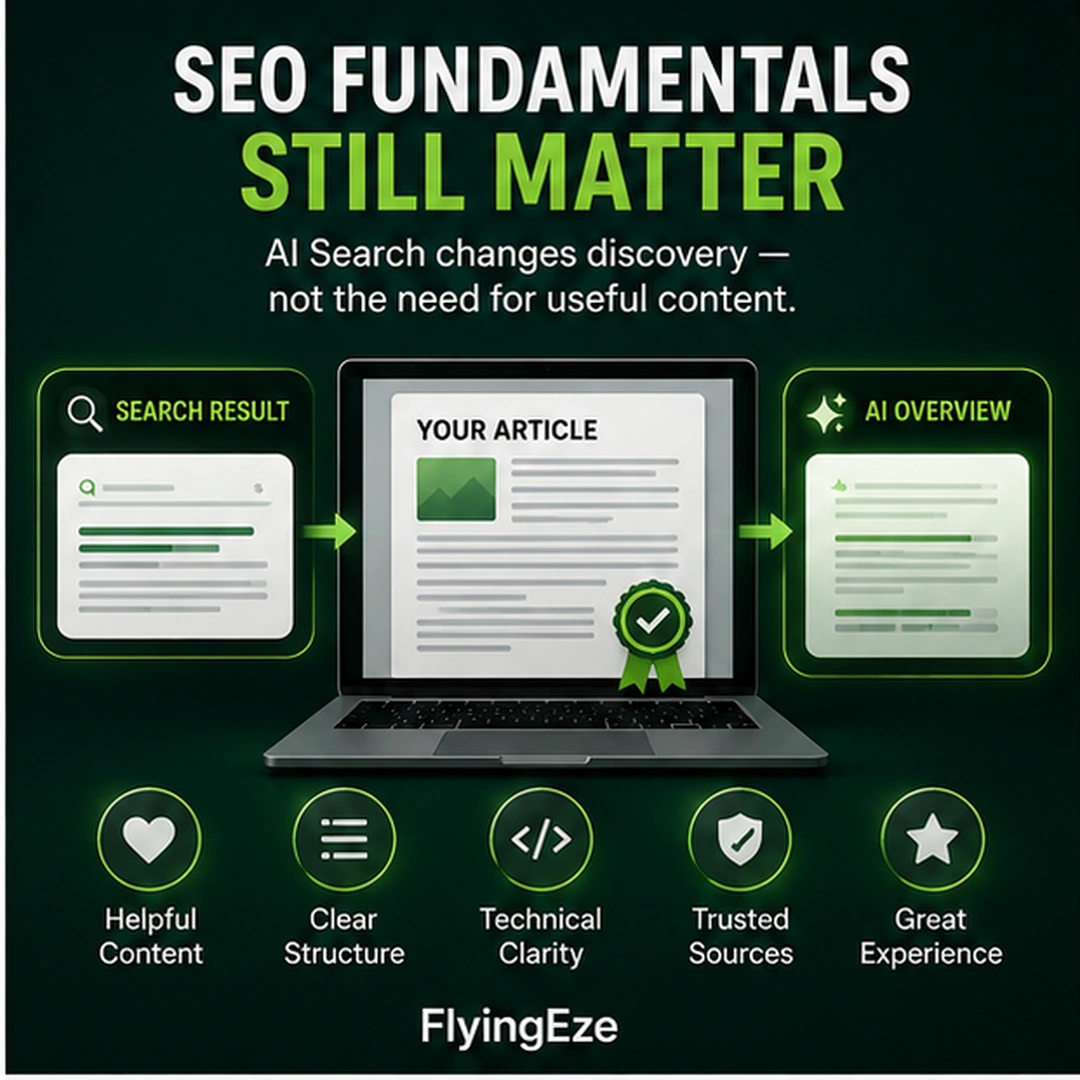
Artificial intelligence is changing search.
People can increasingly ask longer questions, receive generated summaries, continue with follow-up questions and explore information through AI-powered experiences rather than relying entirely on a traditional list of blue links.
That change has produced an entirely new vocabulary around search optimisation.
You may have encountered terms such as:
AEO — Answer Engine Optimisation
GEO — Generative Engine Optimisation
AI SEO
LLM optimisation
AI citation optimisation
Alongside those terms have come countless recommendations claiming publishers need completely new strategies to remain visible.
Some ideas may be useful.
Others are speculative.
Google's own current guidance provides an important reality check:
Established SEO best practices are still relevant to generative AI search.
Google says its generative AI features, including AI Overviews and AI Mode, are rooted in its existing Search ranking and quality systems.
For publishers and businesses, that means the arrival of AI search is not a reason to abandon SEO fundamentals.
If anything, it increases the value of having a website that is technically understandable, genuinely useful and worth referencing.
What Has Actually Changed?
Traditional search often looked roughly like this:
QUERY → SEARCH RESULTS → WEBSITE
AI-powered search can introduce another layer:
QUESTION → AI RESPONSE → SOURCES / LINKS → WEBSITE
That changes how information may be presented.
Instead of visiting several pages before developing an answer, a user may first receive a generated explanation assembled with information retrieved from multiple sources.
Google says its generative Search systems use techniques including retrieval-augmented generation, or RAG, to retrieve relevant and current pages from the Search index and use them to ground AI responses.
Its systems can also use query fan-out, where one complex user request leads to multiple related searches behind the scenes.
That means search behaviour may become more complex.
But an important requirement remains:
The underlying information still needs to be discoverable.
Google Says SEO Is Still Relevant
Google addresses this question directly in its current guidance:
Is SEO still relevant for generative AI search?
Its answer is yes.
Google explains that AI features in Search are built on its core ranking and quality systems.
This matters because it challenges the idea that publishers suddenly need an entirely separate optimisation discipline for every new search interface.
A strong page still benefits from being:
- crawlable;
- indexable;
- technically clear;
- useful;
- original;
- well organised;
- accessible;
- relevant to its audience; and
- supported by appropriate images, video and other useful resources.
Those principles did not disappear when AI arrived.
The First Requirement Is Still Discoverability
Before worrying about whether an AI system might cite your page, ask a more basic question:
Can Google properly discover and process it?
Google's current AI-search guidance says a page must be indexed and eligible to appear in Google Search with a snippet before it can be eligible for Google's generative AI Search features.
That brings the conversation straight back to technical SEO.
Publishers still need to pay attention to:
- crawlability;
- robots directives;
- internal linking;
- canonical URLs;
- JavaScript rendering;
- duplicate pages;
- mobile usability;
- page experience;
- sensible site architecture; and
- Search Console diagnostics.
You cannot optimise content for discovery while making it difficult for search systems to access.
Good Content Is Becoming More Important, Not Less
Google's current guidance places particular emphasis on what it calls valuable, non-commodity content.
That phrase is worth understanding.
Commodity content is information that can easily be reproduced by almost anyone.
For example:
“10 Basic Tips for Saving Money”
may contain useful information.
But if hundreds of websites repeat exactly the same obvious suggestions, there is little reason for a search system — or a reader — to prefer one version over another.
Non-commodity content provides something harder to replace.
That could include:
- original research;
- firsthand experience;
- expert analysis;
- proprietary data;
- testing;
- detailed case studies;
- unique examples;
- specialist knowledge;
- original interviews;
- photographs you created;
- useful comparisons; or
- a perspective unavailable elsewhere.
Google specifically encourages publishers to bring their own knowledge and experience rather than simply recycling information already available across the web.
That principle becomes especially important in a world where generative AI can produce generic summaries very quickly.
Ask a Better Content Question
Instead of asking:
“How many articles can we publish?”
ask:
“What can we publish that would still be useful if a reader already had access to a general AI summary?”
That question changes content strategy.
A generic article may explain:
How to Start a Small Business
A stronger piece might explain:
What We Learned From Helping 50 Small Businesses Digitise Their Customer-Enquiry Process
The second contains experience.
A generic article might explain:
How to Improve Website Speed
A stronger article might show:
How We Cut a WordPress Website's Mobile Load Time From 7.2 Seconds to 2.1 Seconds — With Before-and-After Measurements
AI can summarise common knowledge.
Original evidence gives it something new to discover.
Clear Structure Still Matters
There has been considerable discussion about whether publishers need to restructure every article into tiny “AI-friendly chunks”.
Google says there is no such requirement.
Its systems can understand multiple topics and relevant sections within a page.
There is also no universal ideal article length.
That does not mean structure is unimportant.
Good structure remains valuable because humans need it.
A useful article should generally have:
- a descriptive title;
- a clear introduction;
- meaningful headings;
- logical sections;
- readable paragraphs;
- lists where appropriate;
- tables when comparison helps;
- definitions for unfamiliar terms;
- descriptive anchor text; and
- a clear hierarchy of information.
Do this because it makes the content easier to use.
Do not arbitrarily divide every paragraph into fragments because somebody claims an LLM requires it.
Important Information Should Not Be Hidden From Search Systems
A beautiful page can still be difficult to understand if its essential information is inaccessible.
For example, imagine an infographic contains your entire explanation but the page provides almost no accompanying text.
A human can visually interpret the graphic.
Search systems may have fewer textual signals explaining its meaning.
Publishers should therefore ensure that important information is represented appropriately in crawlable page content.
Images and video can complement that information.
They should not automatically replace everything else.
Images and Video Still Matter
AI search is not purely textual.
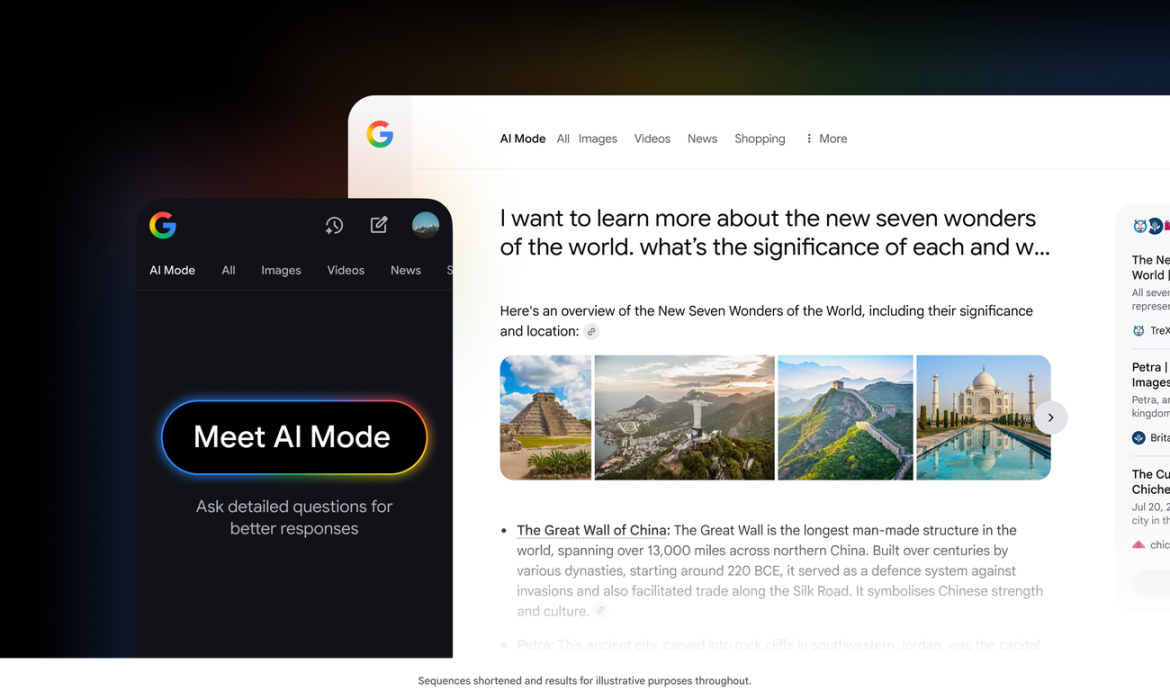
Google's generative Search features can surface relevant images and video in addition to web links.
That creates additional discovery opportunities.
For publishers, useful multimedia might include:
- original photographs;
- diagrams;
- charts;
- maps;
- demonstrations;
- instructional videos;
- comparison graphics;
- annotated screenshots;
- before-and-after examples; and
- infographics.
But the keyword is:
useful.
Adding an unrelated stock photograph after every 300 words does not automatically improve an article.
A diagram that helps someone understand a difficult concept does.
Internal Linking Has Not Become Obsolete Either
Internal links help readers move between related material.
They also help search systems understand:
- how pages relate;
- which topics a website covers;
- which pages are important;
- where additional context exists; and
- how content is organised.
Suppose you publish an article about:
AI Search and SEO
Relevant internal links might point towards:
How Google Crawls Websites
What Is Structured Data?
How to Write Helpful Content
How Internal Linking Works
What Is Search Intent?
Technical SEO Checklist
Together, those pages form a meaningful topic cluster.
That is more useful than publishing dozens of isolated articles that barely connect to one another.
Structured Data Still Has a Role — But There Is No Secret AI Schema
Another common claim is that websites require special structured data specifically for generative AI.
Google says they do not.
There is currently no special Schema.org markup that a publisher must add simply to appear in Google's generative AI Search features.
That does not mean structured data is useless.
Appropriate structured data can still help Google understand certain page information and can make pages eligible for supported rich-result features.
The distinction is important:
Structured data remains an SEO tool.
But:
There is no magical “AI visibility” schema that guarantees inclusion in AI responses.
What About LLMS.txt?
Another widely discussed idea is llms.txt.
It has been proposed as a machine-readable file that could help AI systems understand or navigate website content.
For Google Search specifically, Google's current documentation is explicit:
Google Search does not use llms.txt for its Search or generative AI Search features.
Publishers are free to maintain such a file if another service uses it.
But creating one does not currently improve or harm visibility in Google Search.
That is a useful example of why businesses should distinguish between:
an emerging web proposal
and:
a confirmed Google ranking requirement.
Do not spend disproportionate engineering time implementing speculative techniques while basic crawlability, content quality or internal linking remain poor.
You Do Not Need to Rewrite Everything for AI
Another misconception is that content must now be written in a special language designed for large language models.
Google says this is unnecessary.
Its systems can understand synonyms and broader semantic meaning.
You therefore do not need to create separate pages for every imaginable variation of the same search:
best business automation tools
top tools for automating a business
business automation software
software to automate business processes
best automation apps for companies
Creating numerous near-duplicate pages primarily to capture every possible variation can produce low-value content.
Write the page that best satisfies the underlying need.
Do Not Build Hundreds of Pages Around “Fan-Out Queries”
Google's AI systems may generate multiple related searches when answering a complicated question.
This has led some publishers to suggest creating separate pages targeting every possible sub-query an AI system could generate.
Google warns against overdoing this.
Producing large volumes of low-value pages primarily to manipulate rankings or AI responses can fall under its scaled content abuse policies.
The better approach is topical completeness.
If several subtopics naturally belong together, explain them well.
If one deserves a dedicated article because readers genuinely need greater depth, publish one.
Do not manufacture hundreds of thin pages solely because a software tool generated hundreds of keyword variations.
AI-Generated Content Is Not Automatically the Problem
The debate is sometimes framed as:
Human content = good
AI content = bad
Google's policies are more nuanced.
Its concern is not simply which tool produced the words.
The issue is whether content exists primarily to manipulate search systems while providing little value.
Google's spam policies specifically identify scaled content abuse as producing many low-value or unoriginal pages primarily to manipulate rankings — including when generative AI is used to produce them.
AI can therefore be useful in publishing workflows.
It might help with:
- research organisation;
- brainstorming;
- proofreading;
- structure;
- summarisation;
- editing;
- transcription; or
- identifying gaps.
But publishers remain responsible for the finished material.
The question should remain:
Does this page deserve to exist?
Citation-Worthy Content Is a Useful Strategic Goal
Google does not provide a simple formula saying:
Do X and AI Mode will cite you.
Publishers should be suspicious of anyone who claims such certainty.
But there is a useful strategic idea:
Publish information worth referencing.
Imagine an AI system needs evidence about:
How Nigerian SMEs use digital payments.
Which source is potentially more useful?
Page A
A generic 700-word article summarising what other websites have said.
Page B
A transparent survey of 1,000 Nigerian small businesses, including methodology, data tables, analysis and limitations.
Page B offers something much more distinctive.
The same principle applies at smaller scales.
Citation-worthy material can include:
- original statistics;
- direct quotations from interviews;
- unique calculations;
- firsthand product tests;
- specialist explanations;
- primary documents;
- detailed case studies; and
- well-supported analysis.
Do not merely ask how to “get cited by AI”.
Create things that deserve citation.
Accuracy and Source Quality Matter
AI search also gives publishers another reason to improve sourcing.
When making factual claims:
- identify the primary source where possible;
- distinguish evidence from opinion;
- link to authoritative material;
- explain uncertainty;
- date time-sensitive information;
- update outdated claims;
- avoid invented statistics;
- attribute quotations correctly; and
- correct errors when discovered.
Good sourcing helps readers verify what you say.
That is valuable regardless of whether a traditional result, an AI system, a journalist or another publisher discovers the page.
AEO and GEO Are Not Necessarily Separate Universes
Terms such as Answer Engine Optimisation and Generative Engine Optimisation can be useful for describing how search behaviour is changing.
The mistake is assuming that the new terminology automatically means completely different fundamentals.
Google's position is straightforward:
From its perspective, optimising for generative AI search is still part of optimising the search experience.
In other words:
AI search optimisation does not automatically require abandoning SEO.
Some tactics may evolve.
User behaviour will evolve.
Search interfaces will evolve.
Measurement will evolve.
But the underlying need to make trustworthy, useful information discoverable remains.
Beware of “Secret AI Ranking Factors”
Whenever a major technology shift occurs, an industry quickly develops around promises to exploit it.
AI search is no exception.
Be cautious when a service claims:
“We know Google's secret GEO score.”
“Install this file and AI Mode will rank your website.”
“Our proprietary metric reveals exactly how Google's AI chooses citations.”
Google explicitly warns publishers that third-party tools do not have access to its internal ranking or AI systems.
Third-party SEO software can still be extremely useful.
It can assist with:
- crawling;
- keyword research;
- competitor analysis;
- content auditing;
- link analysis;
- rank tracking;
- technical diagnostics; and
- workflow management.
But a useful tool and access to Google's internal systems are very different claims.
Search Console Is Becoming More Important
Measurement remains essential.
Google's current guidance directs publishers towards Search Console for understanding visibility in its generative AI Search experiences.
That matters because AI search may change the relationship between:
impressions
clicks
queries
and:
website visits.
Publishers should therefore avoid judging future search performance using only old assumptions.
Monitor:
- visibility;
- impressions;
- clicks;
- landing pages;
- conversions;
- engagement;
- branded demand;
- subscriber growth; and
- business outcomes.
Traffic remains useful.
But traffic without business or audience value should never have been the only objective.
A Practical AI-Search SEO Checklist
Before investing heavily in a new “AI SEO” tactic, check whether these fundamentals are already strong.
Technical foundation
- Can search engines crawl important pages?
- Are important pages indexable?
- Is your canonicalisation sensible?
- Are duplicate URLs controlled?
- Does the site work properly on mobile?
- Is important JavaScript-rendered content accessible?
- Is the site reasonably fast and usable?
- Is Search Console configured and monitored?
Content
- Does the page answer a genuine audience need?
- Does it contain information beyond generic summaries?
- Is it accurate?
- Is it current?
- Does it demonstrate useful experience or expertise where appropriate?
- Are major factual claims supported?
- Is the structure easy to follow?
Site architecture
- Are related articles internally linked?
- Are descriptive anchor texts used?
- Can important pages be reached easily?
- Do related articles form coherent topic clusters?
Multimedia
- Would an original image improve understanding?
- Would a chart explain the data better?
- Would a video demonstration help?
- Do images have appropriate filenames and alt text?
Trust
- Is the author identifiable where relevant?
- Can readers understand who operates the website?
- Are sources transparent?
- Are commercial relationships disclosed?
- Are outdated articles maintained?
Only after those foundations are healthy does it make sense to devote significant resources to experimental optimisation techniques.
What Has Changed for Publishers?
None of this means publishers should pretend AI search changes nothing.
It does.
People may:
- ask longer questions;
- expect direct answers;
- continue through conversational follow-ups;
- discover sources in different ways;
- search visually;
- interact with fewer or different result formats; and
- encounter a publisher's information before visiting its website.
Publishers therefore need to monitor these changes closely.
But adapting to a new search interface is very different from throwing away everything learned about good web publishing.
The Bigger Content-Strategy Lesson
SEO has experienced many supposed revolutions.
Voice search was going to replace typing.
Featured snippets were going to eliminate clicks.
Mobile changed how websites were designed.
Social platforms changed content discovery.
Generative AI is introducing another significant transition.
The interface changes.
The technology changes.
The tactics evolve.
But one principle keeps surviving:
Search systems need useful information to discover, understand and surface.
That leads to a remarkably durable strategy.
Make your website technically accessible.
Publish original information.
Answer genuine questions.
Demonstrate experience.
Use clear structure.
Connect related content.
Support important claims.
Add multimedia when it improves understanding.
Maintain your pages.
Measure what actually happens.
And give both readers and search systems a reason to trust your site.
Key Takeaway
AI search has changed how information can be discovered and presented.
It has not made the fundamentals of good publishing obsolete.
Google's own guidance effectively brings publishers back to familiar ground:
build a technically sound website and create distinctive, useful, people-first content.
Do not ignore new developments.
Experiment where evidence supports experimentation.
But do not neglect proven fundamentals while chasing an optimisation formula that may not exist.
The strongest AI-search strategy may therefore be surprisingly familiar:
Build a genuinely good website and publish material worth discovering — and worth citing.