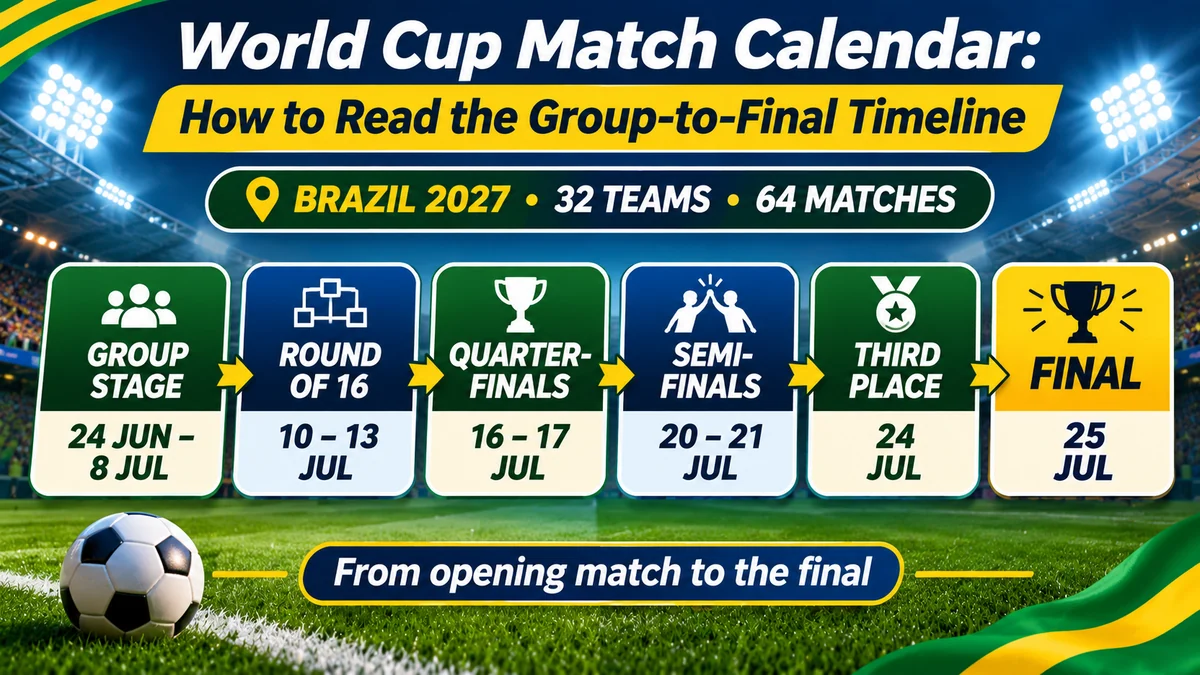
A FIFA World Cup match calendar is read from the opening group-stage fixtures through the knockout bracket to the final. For the next senior World Cup, the 2027 FIFA Women's World Cup in Brazil, the scheduled timeline begins on 24 June 2027 and ends on 25 July 2027. The group stage runs through 8 July, followed by the round of 16 on 10–13 July, quarter-finals on 16–17 July, semi-finals on 20–21 July, third-place match on 24 July and final on 25 July.
If you are searching when is the football world cup starting, it is important to name the competition. The men's 2026 FIFA World Cup already finished on 19 July 2026. The next men's edition is scheduled for 2030, with a more complex 48-team structure and separate planned centenary games. This article is a practical guide to reading a match calendar: interpreting dates, group labels, match numbers, winner codes, rest days, venues and Nigerian kick-off times without mixing different editions.
The 2027 match windows below follow FIFA's published 64-game framework and the dated fixture-by-fixture breakdown published by Netflix. FIFA confirms the host cities, opening date, final date and tournament structure. Research date: 13 November 2026. Opponents and kick-off times may be updated after the draw and outstanding qualification games.
World Cup match calendar: Brazil 2027 from group stage to final
| Stage | 2027 match dates | Number of matches | What happens |
|---|---|---|---|
| Group stage | 24 June–8 July | 48 | Eight groups of four; each country plays three group games |
| Round of 16 | 10–13 July | 8 | Top two teams in each group enter knockouts |
| Quarter-finals | 16–17 July | 4 | Eight remaining teams compete for semi-final places |
| Semi-finals | 20–21 July | 2 | Winners move to the final; losers go to the third-place game |
| Third-place match | 24 July | 1 | The two beaten semi-finalists play for bronze |
| Final | 25 July | 1 | Two semi-final winners compete for the title at the Maracanã |
| Total | 24 June–25 July | 64 | 32 national teams in eight Brazilian cities |
The official FIFA fixture announcement confirms that each of the eight host cities will stage group games and at least one knockout match. FIFA's ticketing FAQ names Rio de Janeiro's Estádio do Maracanã as the setting for both the opening match and final.
Step 1: identify the tournament, year and host country
Before reading any fixture, look for three details: the competition's exact name, the year, and the host country or countries. FIFA runs separate senior men's and women's World Cups, alongside under-age tournaments and other competitions. An old “World Cup fixtures” screenshot can refer to an entirely different event.
As of November 2026, the next senior FIFA World Cup is the Women's World Cup Brazil 2027, from 24 June to 25 July. The next senior men's World Cup is the 2030 centenary tournament, principally hosted by Morocco, Portugal and Spain, with special early matches in Uruguay, Argentina and Paraguay.
The recently completed men's tournament in Canada, Mexico and the United States ran from 11 June to 19 July 2026. FIFA's own 2026 tournament FAQ now identifies that competition as concluded. Any website still counting down to the June 2026 opener is outdated.
Always read the date within the correct competition page before making travel plans, publishing a fixture or setting an alarm for a match.
Step 2: read the group stage as three separate matchdays per team
In Brazil 2027, 32 teams will be divided into eight groups of four, labelled Group A through Group H. Every country plays each of the other three teams in its group once. Those are normally called its first, second and third group matchdays, even though matches across the entire tournament may be spread over different calendar dates.
With four teams, each group contains six games: four teams multiplied by three games each produces 12 team appearances, which is six actual fixtures because every game involves two teams. Multiply six matches by eight groups to get 48 group games.
FIFA's fixture release gives a useful real-world example for the host nation. Brazil is scheduled to play on 24 June in Rio de Janeiro, 29 June in São Paulo and 4 July in Brasília. Those three fixtures are Brazil's group-stage programme. The remaining teams in Group A also have three games, but their names and results are determined through the draw and actual tournament play.
Group standing tables help readers understand who can advance. Teams earn points from their results, then the applicable competition rules determine how tied teams are ranked. Never assume an exact tie-break procedure from an older tournament; use the regulations of the current edition.
Step 3: understand why some group games happen at the same time
As the third set of group matches approaches, fans often see two fixtures from one group listed for the same day, sometimes at the same kick-off time. Coordinated final group matches can protect sporting integrity by reducing opportunities for teams to react to an already-known result. However, simultaneous kick-offs must be confirmed from the live schedule rather than assumed from matching dates alone.
The 2027 framework places Group A's concluding fixtures on 4 July, including Brazil's game in Brasília and another match in Salvador. A calendar's date column is therefore not enough to tell a fan which fixture kicks off first. The local kick-off time and venue remain essential fields.
A single team does not play two different group opponents in one matchday. A tournament calendar groups many countries' fixtures together, whereas a team calendar shows only the games involving that country. Switching between those two views is one of the simplest ways to avoid confusion.
Step 4: find the knockout bracket after the groups end
Once group play is complete on 8 July 2027, the leading two countries in each of the eight groups qualify for the round of 16. That leaves 16 teams. Each winner proceeds and each loser leaves the title race, until only two finalists remain.
The Brazil 2027 knockout calendar starts on 10 July, rather than the day immediately following the last group match. This space helps accommodate travel and preparation. A schedule may show dates with no fixtures; that does not necessarily mean the whole tournament is suspended or that every squad enjoys exactly the same rest interval.
The round of 16 produces eight quarter-finalists. The quarter-finals produce four semi-finalists. The semi-final winners contest the trophy; the two semi-final losers meet in a separate third-place match. The bronze match occurs before the final in the calendar, but its winner does not progress into the final.
Step 5: decode match numbers and winner placeholders
A World Cup schedule frequently lists codes such as W49 v W50, RU61 v RU62 or W61 v W62. These are not mysterious teams. They are placeholders allowing the full bracket to be published before individual winners are known.
| Notation | What it means | 2027 example |
|---|---|---|
| M49 or Match 49 | A numbered fixture in the tournament | The first round-of-16 match |
| W49 | The winner of Match 49 | Advances to a quarter-final |
| W49 v W50 | Winner of Match 49 plays winner of Match 50 | One quarter-final pairing |
| RU61 | The runner-up or losing team from semi-final Match 61 | Goes to the third-place game |
| W61 v W62 | Winners of the two semi-finals | The 2027 final at the Maracanã |
| TBD or TBC | To be determined or confirmed | Opponent, team or kick-off detail not yet settled |
For example, the published 2027 schedule places Match 57, W49 v W50, at Estádio Mineirão in Belo Horizonte on 16 July. You can know the date and venue long before the winner of either round-of-16 game is clear. Similarly, the final on 25 July is listed as W61 v W62, because those finalists are not identified until the semi-finals.
These labels are useful for tickets, television listings and trip planning. They are not predictions of which country will advance.
Step 6: follow the 2027 round of 16, quarter-finals and semi-finals
The detailed published 2027 match listing assigns a day and stadium to every knockout fixture. FIFA's own announcement corroborates the host-city structure and the Maracanã final.
| Dates | Fixtures | Example locations |
|---|---|---|
| 10–13 July | Matches 49–56, eight round-of-16 ties | Fortaleza, Recife, Belo Horizonte, São Paulo, Porto Alegre, Salvador and Brasília |
| 16 July | Quarter-finals 57–58 | Belo Horizonte and Rio de Janeiro |
| 17 July | Quarter-finals 59–60 | Fortaleza and São Paulo |
| 20 July | Semi-final 61 | Arena Itaquera, São Paulo |
| 21 July | Semi-final 62 | Maracanã, Rio de Janeiro |
| 24 July | Third-place match | Arena Itaquera, São Paulo |
| 25 July | Final, winners of Matches 61 and 62 | Maracanã, Rio de Janeiro |
After a country qualifies from its group, locate its specific round-of-16 match number. Then follow the winner of that match to the assigned quarter-final. This bracket-tracing method is more reliable than guessing that a team will always play in the same stadium or on the same day if it keeps winning.
Step 7: distinguish calendar gaps from a team's actual recovery time
World Cup calendars contain days with many games, days with only one or two games and dates with no fixtures. Such gaps allow for travel, rest, broadcasting and stadium operations. But the number of days between two scheduled stages is not necessarily the same amount of rest every team receives.
For instance, Brazil's planned group games on 24 June, 29 June and 4 July are spaced five calendar dates apart. Yet a team in another group may begin later or finish later. A side that plays the last game of a knockout round may have less time before its next scheduled match than a team that played earlier.
Check a team's actual preceding match time, next match time, cities and travel requirements. Do not infer a guaranteed five-day break from a graphic that merely labels an entire tournament phase as lasting five days.
When reading a calendar, a blank date is a scheduling fact—not a promise that every player and staff member is inactive on that day.
Step 8: convert World Cup kick-off times for Nigerian viewers
Dates and kick-off times are different pieces of information. The event dates in the 2027 calendar are assigned to Brazilian host cities, while Nigerian viewers normally follow West Africa Time (WAT, UTC+1). The eight Brazilian host cities ordinarily use Brasília Time (UTC−3), meaning WAT is typically four hours ahead under the applicable current time-zone rules.
As an illustration only, a game scheduled for 8:00 p.m. in Rio de Janeiro would be 12:00 midnight the following day in Nigeria if the four-hour difference still applies on match day. A 4:00 p.m. Brazil kick-off would correspond to 8:00 p.m. WAT. These are time-conversion examples, not official kick-off announcements.
Always check the city, local offset and exact kickoff printed on the official fixture. The time in a website's calendar might already have been converted automatically to your phone's timezone. Adding four hours to an already localised Nigerian time would introduce a second error.
For travel bookings, use the venue's local date. For television reminders, use the verified Nigerian broadcast time, particularly where a late-night game crosses into the next calendar day.
Step 9: learn from the completed men's FIFA World Cup 2026 calendar
The men's 2026 World Cup provides a complete historical example of a bigger tournament calendar because its 48-team structure contains one additional knockout round. It ran from 11 June to 19 July 2026, across Canada, Mexico and the United States, with 104 matches.
| Men's 2026 stage | Actual dates | Matches |
|---|---|---|
| Group stage | 11–27 June | 72 |
| Round of 32 | 28 June–3 July | 16 |
| Round of 16 | 4–7 July | 8 |
| Quarter-finals | 9–11 July | 4 |
| Semi-finals | 14–15 July | 2 |
| Third-place match | 18 July | 1 |
| Final | 19 July | 1 |
| Total | 11 June–19 July | 104 |
The FIFA 2026 results and fixtures record documents the group and knockout dates. FIFA's official format guide explains that the top two teams from each of 12 groups joined the eight best third-place teams to form a round of 32. That makes 32 knockout qualifiers, compared with the 16 who reach the women's 2027 elimination phase.
Do not paste those 2026 dates into a 2027 match calendar: the format, countries and actual fixtures differ. The completed edition is valuable as a guide to reading an expanded bracket, not a template promising identical dates for a later World Cup.
Why does the men's 48-team format require a round of 32?
A 48-team men's World Cup uses 12 groups of four. Each group produces six fixtures, so 12 groups yield 72 matches. With the top two in each group qualifying, there are 24 teams; adding the eight best third-place finishers brings the knockout field to 32.
A 32-team elimination bracket requires 16 round-of-32 games, eight round-of-16 games, four quarter-finals, two semi-finals and a final. Together with a third-place game, that gives 32 knockout matches. Add 72 group matches to get 104 fixtures.
Because the two eventual finalists may play eight matches, fans should not assume the traditional seven-game maximum from older 32-team men's tournaments. The same structural lesson applies when interpreting the planned 2030 men's format, subject to FIFA's final regulations.
How to read the planned men's World Cup 2030 calendar
The next men's edition has an unusual centenary arrangement. FIFA's current 2030 host and schedule guidance proposes three centenary games in Uruguay, Argentina and Paraguay on 8–9 June 2030, before the primary opening programme in Morocco, Portugal and Spain on 13–14 June 2030. The final is planned for 21 July 2030.
These are described as intended planning dates, not a fully settled calendar with every group, opponent, venue and kick-off time. The South American fixtures are special early matches forming part of the same World Cup, rather than a separate qualifying event. Their teams and group opponents require additional travel and rest arrangements.
For a 2030 calendar, check whether a date refers to the centenary opening games, the main opening ceremony, the group stage or a knockout match. Do not assume the 2026 quarter-final dates will repeat in 2030. Until FIFA publishes a final detailed fixture grid, avoid selling a precise journey or claiming a named team will play on an unconfirmed date.
How to follow a specific country from its first match to the final
A practical fan can build a team-specific mini calendar from the larger tournament schedule:
- Locate the correct competition. Choose Women's 2027, Men's 2030 or the edition you are following.
- Find the group. Note the group's letter, the opponent in each of the three games and the venue.
- Record the three group dates. Use the local kick-off and the date in your own timezone where applicable.
- Check the final group standings. Confirm that the team qualified and note its finishing position.
- Find its bracket match number. A group winner can have a different knockout path from a runner-up.
- Trace each winner placeholder. Follow W49, W50 or equivalent match labels without predicting the next opponent prematurely.
- Update after each result. Remove dates that no longer apply if the team is eliminated.
- Keep the bronze match separate. Losing a semi-final leads to the third-place playoff, not the final.
Nigerian readers following the Super Falcons can start with the relevant FlyingEze reporting on Nigeria's 2027 qualification pathway , then check FIFA's official qualified-teams page for the updated status. A qualifying preview is not proof that a country appears on the final tournament bracket.
How to tell a confirmed schedule from a provisional one
A fixture calendar passes through several stages before kickoff. At first, FIFA may announce only the tournament window and host countries. Later it can publish stadium allocations and match numbers without naming opponents. A draw adds the groups and provisional country pairings. Qualifiers and playoffs fill remaining places. Final kick-off details may still be adjusted through official updates.
| Calendar field | Can it be confirmed early? | What to verify |
|---|---|---|
| Opening and final dates | Often yes | FIFA event announcement and latest updates |
| Stage windows | When a match grid is issued | Official dated fixture schedule |
| Host city and stadium | Sometimes assigned early | Stadium-specific schedule and changes |
| Opponent | After draw and qualification where applicable | Updated team entries and fixtures |
| Exact kick-off time | Only when published | Time zone and official fixture listing |
| Knockout participants | After preceding results | Live bracket and confirmed winners |
At the November 2026 research date, FIFA had set the 2027 women's final draw for 11 December 2026 in Rio de Janeiro. The editorial team should refresh group and opponent details after that draw before publication, without altering the already verified overarching 2027 dates unless FIFA issues a revised timetable.
Do not mistake a fan-made printable bracket or a social-media graphic for a substitute for an official schedule. It can be useful as a personal planning tool, but its claims must be checked against FIFA's current fixture data.
Frequently asked questions about the World Cup match calendar
When is the football World Cup starting next?
The next senior FIFA World Cup is the Women's World Cup in Brazil on Thursday, 24 June 2027. The next senior men's World Cup is in 2030; FIFA's current plan includes early centenary matches on 8–9 June before the main opening games on 13–14 June.
When does the World Cup group stage end in 2027?
The published Brazil 2027 match schedule places the final group fixtures on 8 July 2027. The round of 16 begins on 10 July.
When are the Women's World Cup 2027 quarter-finals?
The four quarter-final fixtures are scheduled for 16–17 July 2027, in Belo Horizonte, Rio de Janeiro, Fortaleza and São Paulo.
What date is the Brazil 2027 final?
The women's final is scheduled for Sunday, 25 July 2027, at Rio de Janeiro's Maracanã, with the two semi-final winners competing.
What does W61 mean on a World Cup schedule?
W61 means the winner of Match 61. For Brazil 2027, W61 and W62 are the two finalists. It does not name a specific country in advance.
Does the third-place winner play in the World Cup final?
No. The third-place fixture is played by the losing semi-finalists. The semi-final winners contest the final separately.
What is the difference between a round of 16 and round of 32?
The round of 16 has 16 countries and eight games; the round of 32 has 32 countries and 16 games. The 2027 women's edition starts its knockouts at 16, while the expanded men's format has a round of 32.
Why are some dates on a World Cup calendar blank?
They may be fixture-free days set aside for travel, recovery or event logistics. The date gap is not automatically the amount of rest received by any one team.
Are 2030 men's World Cup knockout dates confirmed?
FIFA has an intended overall opening and final plan, but a full match-by-match 2030 fixture schedule remains subject to later official confirmation. Do not copy knockout dates from the completed 2026 edition.
How do Nigerian viewers check World Cup matches in WAT?
Use the official fixture's local kick-off time, stadium location and applicable timezone. The Brazilian 2027 host cities ordinarily operate four hours behind Nigeria's WAT; confirm the offset and whether a website already localises its times before setting a reminder.
Final takeaway: follow the bracket, not just the opening date
For fans asking when is the football world cup starting, the immediate answer is 24 June 2027 for Brazil's Women's World Cup. But understanding the full match calendar means following the competition from 48 group matches through the round of 16, quarter-finals and semi-finals to the 25 July final, with the third-place game on 24 July.
The men's format is larger: the completed 2026 edition had a round of 32 and 104 matches, and FIFA's 2030 plan follows that expanded structure with separate centenary opening arrangements. The simplest reading method is always the same: confirm the competition, find your team's group, record the actual local kick-off, trace match-number placeholders through the knockout bracket, and verify updated fixtures before travelling, publishing or booking a broadcast reminder.