Quick answer: The expanded FIFA World Cup 2026 began on Thursday, 11 June 2026, and ended on Sunday, 19 July 2026. For the first 48-team men's edition, FIFA allocated 46 direct places across its six confederations, including automatic qualification for hosts Canada, Mexico and the United States. A separate six-team intercontinental Play-Off Tournament decided the final two places. DR Congo and Iraq won those play-offs, completing the 48-team line-up on 31 March 2026.
For fans searching when is the football world cup starting, an essential date correction comes first: the 2026 tournament had already been completed by this article's 13 November 2026 verification date. What follows is a retrospective explanation of how national teams reached that historic edition, not a prediction of who might qualify for another tournament.
Qualification was much more complicated than awarding a fixed number of invitations to each continent. Most teams played regional preliminary rounds, leagues or group stages, while some also had to survive continental play-offs. Different confederations used different systems. This guide explains the places available, the routes teams took, why Nigeria missed out and how FIFA determined the final two entrants.
World Cup 2026 qualification: the numbers that matter
| Question | Verified answer |
|---|---|
| When did the tournament begin? | 11 June 2026 |
| When did it end? | 19 July 2026 |
| Number of finalists | 48 national teams |
| Direct qualification places | 46, counting the three hosts |
| Intercontinental play-off places | 2 |
| Teams in the global play-off | 6 |
| Global play-off winners | DR Congo and Iraq |
| Qualifying campaign scale | 899 matches over 937 days, as reported by FIFA |
| World Cup finals format | 12 groups of four, followed by a Round of 32 |
FIFA's 1 April 2026 confirmation records the final qualification outcome and campaign scale. Its official tournament dates page confirms that the World Cup ran from 11 June to 19 July.
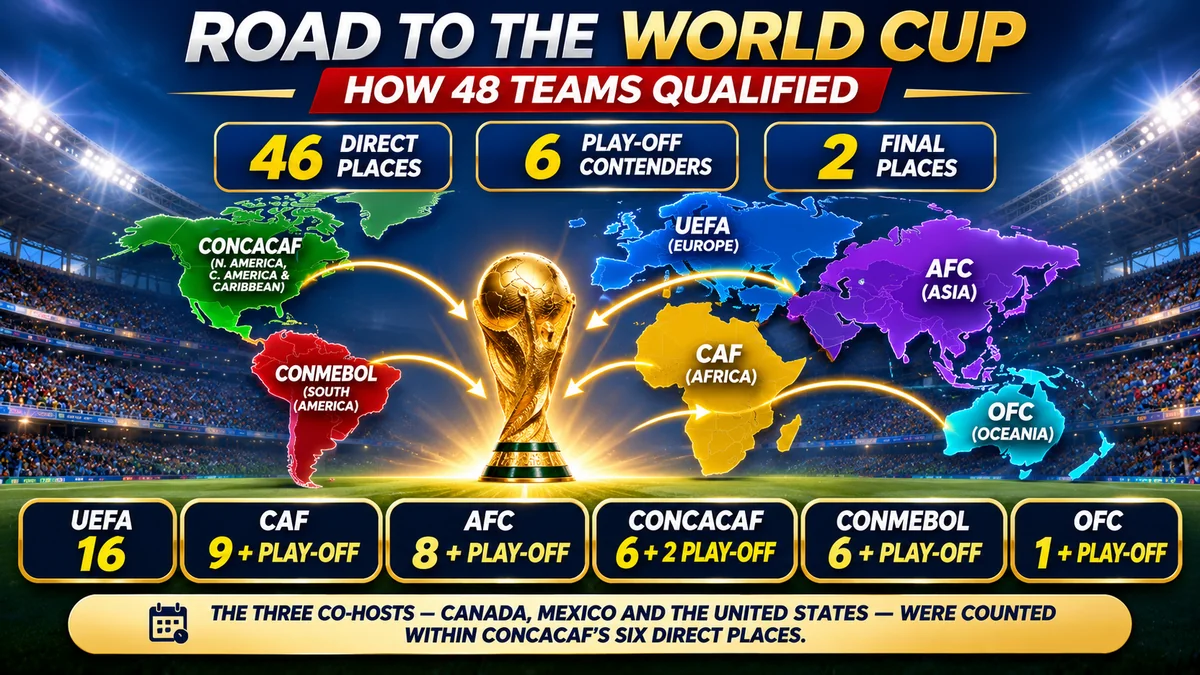
How FIFA divided the 48 World Cup places among six confederations
FIFA's six confederations represent different geographical regions. For 2026, each received a fixed number of direct berths, and five had opportunities to send representatives to the intercontinental play-off. UEFA did not participate in that global play-off: its 16 places were settled within the European qualification system.
| Confederation | Direct places | Entries to global play-off | Teams ultimately at finals |
|---|---|---|---|
| UEFA — Europe | 16 | 0 | 16 |
| CAF — Africa | 9 | 1 | 10 |
| AFC — Asia | 8 | 1 | 9 |
| Concacaf — North/Central America and Caribbean | 6 (including 3 hosts) | 2 | 6 |
| CONMEBOL — South America | 6 | 1 | 6 |
| OFC — Oceania | 1 | 1 | 1 |
| Total | 46 | 6 contenders for 2 places | 48 |
The arithmetic is simple: 16 + 9 + 8 + 6 + 6 + 1 = 46 direct places. The six intercontinental contenders competed for another two, making 48. It is incorrect to add all six play-off participants as guaranteed World Cup qualifiers. Only two reached the tournament.
These were the allocations for 2026; readers should not assume a future World Cup will necessarily use identical confederation quotas. FIFA's official allocation announcement and 2026 qualification overview support the breakdown.
Did Canada, Mexico and the United States need to qualify?
No. The three host nations had automatic places in the 2026 competition. Their qualification, however, did not create three additional berths on top of Concacaf's six direct allocations. Instead, the hosts counted within those six Concacaf places.
That left three other direct Concacaf places to be decided on the pitch. Curaçao, Haiti and Panama claimed them. The confederation also sent Jamaica and Suriname to the six-team global play-off, but neither advanced to the final tournament.
This distinction matters because the phrase “six Concacaf spots plus three hosts” would wrongly imply nine guaranteed regional finalists. The actual total was six: Canada, Mexico, United States, Curaçao, Haiti and Panama. FIFA's Concacaf qualifying review documents the three competitive winners.
How did African teams qualify for World Cup 2026?
For African supporters, the expansion was especially important. CAF received nine guaranteed places, compared with the five African teams that participated at Qatar 2022. A tenth African representative could qualify by winning the intercontinental play-off. That additional opportunity ultimately succeeded, as DR Congo joined the nine group winners.
African qualifying began in November 2023. Following Eritrea's withdrawal, the main phase comprised eight groups of six teams and one group of five. Teams faced opponents in their respective group home and away. Each of the nine group winners qualified directly.
That was not the end of the route for every runner-up. The four best second-placed teams advanced to a short CAF play-off series involving two one-off semi-finals and a final. Its winner qualified for the FIFA intercontinental Play-Off Tournament, not directly for the World Cup finals. FIFA outlines the structure in its African qualifying guide .
Which African countries reached the 2026 World Cup?
The final ten CAF representatives were:
| Qualification route | Countries |
|---|---|
| Nine CAF group winners | Algeria, Cabo Verde, Côte d'Ivoire, Egypt, Ghana, Morocco, Senegal, South Africa, Tunisia |
| CAF play-off winner and intercontinental play-off winner | DR Congo |
| Total African finalists | 10 |
The expanded format increased African representation, but still required teams to win their qualifying groups or survive the additional play-off pathway. It did not guarantee places to traditional African football powers.
Why did Nigeria fail to qualify for the 2026 World Cup?
The Super Eagles did not qualify for the 2026 finals. In their CAF qualifying group, South Africa took the direct place, while Nigeria reached the African play-offs as one of the best runners-up.
Nigeria defeated Gabon in the CAF play-off semi-final, setting up a final against DR Congo in November 2025. The match finished 1–1 after extra time. DR Congo then won the penalty shootout 4–3, ending Nigeria's route to the World Cup. The Congolese side still had to win the global play-off in March 2026 before its World Cup place became final.
FIFA confirms these results in its CAF qualification account . The outcome shows why simply earning a play-off place is not the same as qualifying for the tournament.
For more historical context about the Super Eagles' qualification system, FlyingEze's guide to how Nigeria qualifies for AFCON and the World Cup explains the relationship between continental qualification and the World Cup route.
How European teams qualified: UEFA's 12 group winners and four play-off winners
Europe received 16 places, the most of any confederation. UEFA's first qualifying round comprised 12 groups of four or five countries. The 12 group winners qualified directly for the World Cup.
The four remaining European positions were decided through a 16-team UEFA play-off, made up of the 12 qualifying group runners-up and four eligible teams entering through the UEFA Nations League route. The participants were divided into four paths, each producing one qualifier.
Bosnia and Herzegovina, Czechia, Sweden and Türkiye secured those four remaining places in March 2026. FIFA's European play-off review records the winners, including Bosnia and Herzegovina's victory over Italy on penalties.
A key distinction: these UEFA play-offs were within Europe's allocated 16 places. They were not the separate six-team FIFA intercontinental Play-Off Tournament. A European country winning its continental play-off had earned a World Cup place without having to enter the global play-off in Mexico.
How Asian teams qualified: AFC's five-round route
Asia's pathway was more layered. The Asian Football Confederation (AFC) had eight guaranteed World Cup places and one opportunity in FIFA's intercontinental play-off.
Early preliminary ties reduced the field before the second-round group phase. The second round featured nine groups of four, with the top two advancing. That produced 18 teams for the third round, divided into three groups of six.
The top two teams in each third-round group secured six direct World Cup places. Those six were Australia, IR Iran, Japan, Jordan, Korea Republic and Uzbekistan. The teams finishing third and fourth entered a fourth round of two groups of three, whose winners—Qatar and Saudi Arabia—claimed the remaining two direct AFC places.
Finally, the two fourth-round runners-up, Iraq and the United Arab Emirates, contested a two-legged fifth-round tie. Iraq won 3–2 on aggregate and became the AFC representative in the global Play-Off Tournament. Iraq later defeated Bolivia to become a ninth Asian finalist. FIFA's Asian qualification guide and competition review explain the route.
Asia therefore finished with nine World Cup teams, but only eight had guaranteed places before the intercontinental play-off.
How Concacaf qualifying worked beyond the three hosts
With Canada, Mexico and the United States already qualified as co-hosts, Concacaf's remaining nations competed for three direct berths and two global play-off opportunities.
After initial knockout ties and a second-round group phase, 12 teams reached the final regional qualifying round. They were placed in three groups of four and played each opponent home and away. The three group winners qualified directly: Curaçao, Haiti and Panama.
The two best runners-up, Jamaica and Suriname, entered FIFA's intercontinental Play-Off Tournament. Jamaica defeated New Caledonia in a play-off semi-final but lost to DR Congo in its pathway final. Suriname was eliminated by Bolivia in the other semi-final. Neither earned a seventh Concacaf World Cup place.
Haiti and Curaçao's successful qualification provided examples of how the enlarged tournament opened doors to nations that had seldom, or never, appeared on the World Cup stage. FIFA's Concacaf format guide details the rounds and winners.
How South America qualified: one league, six automatic places
CONMEBOL used a familiar structure: all ten South American member nations played one another home and away in a single league table. Each country had 18 qualifying fixtures.
The top six teams qualified automatically. Those places went to Argentina, Brazil, Colombia, Ecuador, Paraguay and Uruguay. The seventh-placed team, Bolivia, entered the intercontinental play-off.
Bolivia defeated Suriname in its play-off semi-final but lost to Iraq in the decisive match. It therefore did not become a seventh South American finalist. FIFA's CONMEBOL qualifying summary confirms the six direct countries, league format and Bolivia's play-off result.
How Oceania finally gained a guaranteed World Cup place
The Oceania Football Confederation (OFC) received one direct berth in the expanded 2026 competition and another place in the intercontinental play-off. This was particularly significant because Oceania had previously relied on play-offs to reach many World Cup finals.
New Zealand won OFC qualifying and took the direct place. New Caledonia, the regional runner-up, reached the FIFA Play-Off Tournament but lost 1–0 to Jamaica in the semi-final. As a result, Oceania's sole representative at the 2026 finals was New Zealand.
The difference between a guaranteed place and a global play-off opportunity is central to understanding the expansion. Having a play-off place does not mean having a second guaranteed qualification slot.
How the six-team intercontinental Play-Off Tournament decided the final two qualifiers
FIFA brought together six national teams from five confederations in Mexico in March 2026. Europe had no representative. Concacaf supplied two teams, while Asia, Africa, South America and Oceania supplied one each.
| Region | Play-off representatives | Final outcome |
|---|---|---|
| AFC | Iraq | Qualified |
| CAF | DR Congo | Qualified |
| Concacaf | Jamaica, Suriname | Eliminated |
| CONMEBOL | Bolivia | Eliminated |
| OFC | New Caledonia | Eliminated |
| Total | 6 competitors | 2 qualifiers |
FIFA divided the six teams into two separate pathways. The two highest-ranked sides, DR Congo and Iraq, entered at the pathway-final stage. The four others played semi-finals first. In each pathway, the winner of the final advanced directly to the World Cup.
| Date | Match | Result |
|---|---|---|
| 26 March 2026 | New Caledonia vs Jamaica | Jamaica won 1–0 |
| 26 March 2026 | Bolivia vs Suriname | Bolivia won 2–1 |
| 31 March 2026 | DR Congo vs Jamaica | DR Congo won 1–0 after extra time |
| 31 March 2026 | Iraq vs Bolivia | Iraq won 2–1 |
DR Congo and Iraq claimed the final two World Cup places. FIFA's post-tournament play-off review details the outcomes and the defining goals, while its 1 April announcement identifies Iraq as the 48th team to qualify.
Which 48 national teams actually reached the expanded World Cup?
Here is the completed 2026 line-up, grouped by confederation. The three co-hosts are shown inside Concacaf so they are not counted twice.
| Confederation | Teams at the finals |
|---|---|
| UEFA (16) | Austria, Belgium, Bosnia and Herzegovina, Croatia, Czechia, England, France, Germany, Netherlands, Norway, Portugal, Scotland, Spain, Sweden, Switzerland, Türkiye |
| CAF (10) | Algeria, Cabo Verde, DR Congo, Côte d'Ivoire, Egypt, Ghana, Morocco, Senegal, South Africa, Tunisia |
| AFC (9) | Australia, Iraq, IR Iran, Japan, Jordan, Korea Republic, Qatar, Saudi Arabia, Uzbekistan |
| Concacaf (6) | Canada, Curaçao, Haiti, Mexico, Panama, United States |
| CONMEBOL (6) | Argentina, Brazil, Colombia, Ecuador, Paraguay, Uruguay |
| OFC (1) | New Zealand |
| Total | 48 teams |
The list is consistent with FIFA's published 2026 participants . For readers wanting a dedicated full-list article, FlyingEze also published all 48 nations that qualified for the tournament .
Qualifying for the World Cup is different from advancing from the group stage
Two distinct processes are often confused.
World Cup qualification took place before the June 2026 tournament. National teams competed in CAF, UEFA, AFC, Concacaf, CONMEBOL and OFC qualifying competitions, with two final places allocated through an international play-off. That process determined which 48 teams attended.
The World Cup group stage then began after the teams arrived in North America. The 48 finalists were divided into 12 groups of four. The first two in each group and the eight best third-placed teams progressed to a Round of 32. FIFA's tournament-format explanation confirms those rules.
Thus, the international six-team play-off in March was not a Round of 32 match, and the eight best third-placed teams from the June group stage were not additional countries qualifying for the 48-team tournament. They were already among the 48 and were competing to stay in the finals.
Why the expansion mattered—and why qualification remained difficult
The move from 32 to 48 finalists increased access by 50%, adding 16 nations to the tournament field. Africa's direct allocation reached nine; Asia's reached eight; Oceania gained a guaranteed place; and Europe, the Americas and the Caribbean also had routes reflecting the expanded competition.
But more places did not remove competitive uncertainty. Nigeria was eliminated in a continental play-off. Jamaica won its first global play-off game but lost the decider. Bolivia came within one match of qualifying before Iraq stopped it. Conversely, new opportunities allowed nations such as Cabo Verde, Curaçao, Jordan and Uzbekistan to reach their first men's World Cup finals.
From a sporting perspective, the expanded field offered broader representation and more qualifying stories. It also introduced complicated multi-stage regional systems, significant travel and an additional knockout round once the finals began. There are reasonable debates about competitive balance, fixture congestion and the way extra places should be distributed across regions.
The decisive distinction is that expansion created opportunities; it did not award qualification to particular teams on reputation. Nations still needed to succeed within the allocated route. FlyingEze's earlier coverage of African qualification milestones shows how regional places were secured over time.
Frequently asked questions
When did the 2026 football World Cup start?
The FIFA World Cup 2026 began on 11 June 2026 and ended on 19 July 2026. Canada, Mexico and the United States hosted it.
How many teams qualified for the expanded World Cup?
48 teams. FIFA allocated 46 places through confederation qualification and automatic hosting rights, then two more through the six-team intercontinental Play-Off Tournament.
How many teams qualified automatically as hosts?
Three: Canada, Mexico and the United States. Their places counted within Concacaf's six direct allocations; they were not extra berths outside the 48.
How many African countries qualified for the 2026 World Cup?
Ten. Nine won their CAF qualifying groups, while DR Congo claimed Africa's additional place by winning both the CAF play-off and the FIFA intercontinental Play-Off Tournament.
Did Nigeria qualify for the 2026 World Cup?
No. Nigeria reached the CAF play-off final but lost on penalties to DR Congo after a 1–1 draw in November 2025.
Why did DR Congo get another chance after finishing second in its group?
CAF's system gave the four best group runners-up access to an African play-off. DR Congo won that mini-tournament and then defeated Jamaica in the FIFA global play-off to qualify.
Which teams won the two intercontinental play-off places?
DR Congo and Iraq. DR Congo defeated Jamaica 1–0 after extra time; Iraq beat Bolivia 2–1. Both matches took place on 31 March 2026.
Did Europe take part in the intercontinental play-off?
No. UEFA settled its 16 places within European qualifying: 12 group winners plus four winners of its separate European play-off paths.
Did Oceania have a guaranteed place?
Yes. New Zealand took OFC's direct berth. New Caledonia entered the global play-off but did not advance.
Was qualifying for the 2026 World Cup the same as finishing third in a finals group?
No. Regional qualification decided which nations attended the World Cup. Third-place qualification in the 12 tournament groups determined which already-qualified nations reached the Round of 32.
Will the 2030 World Cup use the same quotas?
The allocations described here were specific to 2026. Future host arrangements and confederation allocations should be checked against separate official FIFA decisions rather than assumed from this tournament.
Conclusion: the road to 48 teams ran through six confederations and one final play-off
The expanded 2026 World Cup did more than add 16 teams. Its qualification system combined 46 direct places, three hosts counted within Concacaf's quota, and two intercontinental play-off winners. UEFA, CAF, AFC, Concacaf, CONMEBOL and OFC used different regional methods to select their representatives.
The story ended on 31 March 2026, when DR Congo and Iraq completed the 48-team line-up. The finals then ran from 11 June to 19 July 2026. For Nigeria, the key lesson was that additional African places improved the opportunity to qualify, but the Super Eagles' decisive play-off loss still prevented a place at the tournament.
Editorial verification: 13 November 2026. This is a retrospective guide to the completed 2026 qualification process, not an open fixture schedule or forecast of future World Cup rules. Core sources are FIFA's qualification allocations, regional qualifying reports, final 48-team list and intercontinental play-off review. No speculative results have been presented as confirmed.