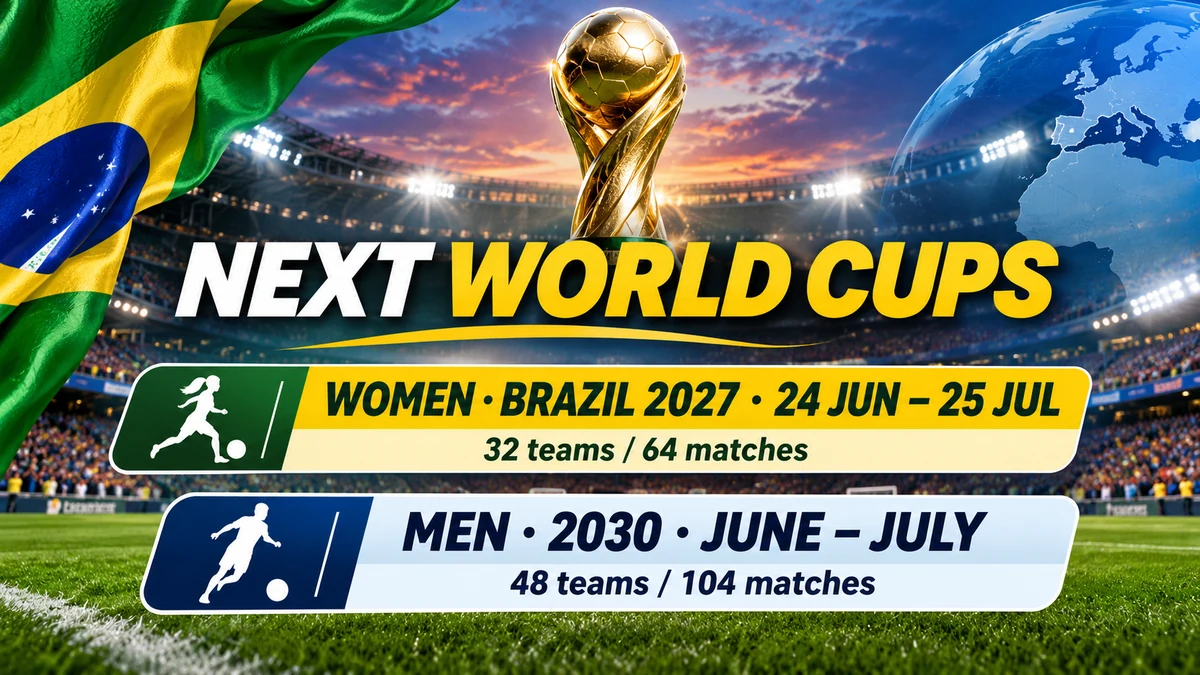
The next senior FIFA World Cup is the FIFA Women's World Cup in Brazil, which starts on Thursday, 24 June 2027 and ends on Sunday, 25 July 2027. If you mean the men's FIFA World Cup, its next edition is in 2030, following the completion of the 2026 tournament on 19 July 2026. FIFA's intended 2030 programme includes three centenary matches on 8–9 June, main opening events on 13–14 June and a final on 21 July 2030, although the detailed fixture calendar remains subject to confirmation.
That distinction matters because a search for when is the football world cup starting can refer to different FIFA competitions. Many results still describe 11 June 2026 as an upcoming opening date, but that was the start of the completed men's tournament hosted by Canada, Mexico and the United States. The next senior tournament on the calendar is the 2027 women's event, with a confirmed 32-team format and 64 matches.
Below are the official dates, opening fixtures, venues, competition formats and important differences between Brazil 2027 and the centenary men's tournament in 2030, checked against FIFA information available on 13 November 2026. Tournament fixtures, remaining qualifiers and broadcast times can still change; use FIFA's official event pages for live updates.
Next FIFA World Cup dates: the essential comparison
| Tournament | First matches | Final | Hosts | Teams / matches |
|---|---|---|---|---|
| Women's World Cup 2027 | 24 June 2027 | 25 July 2027 | Brazil | 32 teams / 64 matches |
| Men's World Cup 2030 | Planned centenary matches 8–9 June; main opening 13–14 June 2030 | Planned 21 July 2030 | Morocco, Portugal and Spain; three opening-stage centenary games in Argentina, Paraguay and Uruguay | 48 teams / 104 matches |
| Men's World Cup 2026, completed | 11 June 2026 | 19 July 2026 | Canada, Mexico and United States | 48 teams / 104 matches |
FIFA's Brazil 2027 overview confirms the women's tournament dates. Its 2030 World Cup guide outlines the men's centenary programme, while the 2026 event FAQ explicitly identifies that edition as concluded.
When does the FIFA Women's World Cup 2027 start?
The 2027 FIFA Women's World Cup opens on 24 June 2027 in Rio de Janeiro, Brazil. Hosts Brazil will play the opening fixture at the Estádio do Maracanã. The tournament runs for just over a month and concludes with the final on 25 July 2027 at the same historic stadium.
FIFA's official opening-match and final FAQ lists Brazil against an opponent to be determined in the opening match. At this research date, the opponent should not be guessed from an incomplete or outdated group draw.
This will be the tenth edition of the FIFA Women's World Cup and the first held in South America. Brazil automatically qualifies as the host nation. FIFA announced the complete 64-match schedule framework in August 2026, including which cities and stadiums will stage the games; individual national-team matchups depend on qualification and the draw.
Where will the 2027 Women's World Cup be played?
Brazil will stage the tournament across eight host cities, each with a designated stadium. The spread of cities brings the competition to different parts of the country rather than keeping all fixtures in Rio de Janeiro or São Paulo.
| Host city | Stadium | Tournament role |
|---|---|---|
| Rio de Janeiro | Estádio do Maracanã | Opening match, semi-final and final, among other fixtures |
| São Paulo | Arena Itaquera | Group matches, a semi-final and bronze-medal match |
| Belo Horizonte | Estádio Mineirão | Group matches and knockout fixtures including a quarter-final |
| Brasília | Estádio Nacional | Group stage and round of 16 |
| Fortaleza | Arena Castelão | Group matches and knockout fixtures including a quarter-final |
| Porto Alegre | Estádio Beira-Rio | Group stage and round of 16 |
| Recife | Arena de Pernambuco | Group stage and round of 16 |
| Salvador | Arena Fonte Nova | Group stage and round of 16 |
All eight cities will host at least one knockout game. The official FIFA host-cities page and ticketing FAQ provide stadium information. Brazil is scheduled to play its first three group-stage matches in Rio de Janeiro, São Paulo and Brasília, respectively, according to the August 2026 fixture framework.
How does the 32-team Women's World Cup format work?
The women's tournament retains the 32-team format that was used in 2023. The competition begins with eight groups of four national teams. Each team plays its three group opponents once, and the top two teams from every group advance to the knockout stage.
With four teams in a group, there are six group-stage matches. Across eight groups, that produces 48 group matches. The knockout section then includes eight round-of-16 games, four quarter-finals, two semi-finals, a third-place game and the final—16 knockout games and 64 matches in total.
| Stage | Teams involved | Matches |
|---|---|---|
| Group stage | 32 in eight groups of four | 48 |
| Round of 16 | 16 | 8 |
| Quarter-finals | 8 | 4 |
| Semi-finals | 4 | 2 |
| Third-place match | 2 | 1 |
| Final | 2 | 1 |
| Total | 32 entrants | 64 |
The group-stage table determines qualification according to the applicable FIFA regulations and tiebreak procedures. Knockout ties must produce a winner, using the tournament's extra-time and penalty procedures where required. It is important not to confuse this women's structure with the larger men's competition, which introduced a new round of 32 in 2026.
How do national teams qualify for Brazil 2027?
FIFA has allocated 29 direct qualification places and three places through an intercontinental play-off tournament. Brazil occupies one of South America's direct places as host. Confederations hold their own qualification competitions and determine eligible participants under FIFA-approved pathways.
| Confederation or route | Direct places |
|---|---|
| Asia (AFC) | 6 |
| Africa (CAF) | 4 |
| North, Central America and Caribbean (Concacaf) | 4 |
| South America (CONMEBOL) | 3 including Brazil |
| Oceania (OFC) | 1 |
| Europe (UEFA) | 11 |
| Intercontinental play-off winners | 3 additional teams |
| Total | 32 |
FIFA's official qualification allocation confirms those places. The identity of all 32 teams was not final at this research check, and a qualifying match result should not be confused with confirmation of a World Cup berth. Check FIFA's updated qualified-teams page as qualification continues.
What does Brazil 2027 mean for Nigeria and African fans?
The tournament has a clear African interest because CAF has four direct places plus opportunities through the intercontinental play-off allocation. For Nigerian supporters, the progress of the Super Falcons has been a major focus of the regional qualifying campaign. However, it would be misleading to treat an older qualifying preview as a definitive, up-to-date list of qualified countries.
FlyingEze has covered the Super Falcons' 2027 qualification challenges following WAFCON 2026 . That report provides background on Nigeria's campaign; readers should use FIFA's updated qualification list for the current official status.
Kick-off times are another consideration for supporters watching from Nigeria. Brazil spans multiple time zones, so a match advertised in local stadium time should not be presented automatically as West Africa Time. WAT is UTC+1, and the correct conversion requires the specific Brazilian host city and scheduled kick-off time. Follow FIFA's fixture pages and your broadcaster's listings rather than guessing that every Brazil match will start at the same hour in Lagos or Abuja.
When did the 2026 Men's World Cup start—and has it finished?
The men's FIFA World Cup 2026 began on Thursday, 11 June 2026, at Mexico City Stadium and ended on Sunday, 19 July 2026, with the final played at New York New Jersey Stadium. Canada, Mexico and the United States hosted the expanded event across 16 cities.
Because it is now November 2026, the 2026 kick-off is a past date. FIFA's 2026 venue FAQ explicitly notes that the tournament has concluded. The edition featured 48 teams and 104 matches; it was the first men's World Cup to use that expanded structure.
Spain won the 2026 tournament, defeating Argentina 1–0 after extra time in the final, according to FIFA's final standings . The next senior men's FIFA World Cup is therefore not another 2026 event, but the centenary edition in 2030.
When does the Men's FIFA World Cup 2030 start?
FIFA's published intended 2030 timetable starts with three special centenary matches in Argentina, Paraguay and Uruguay on 8–9 June 2030. The central opening ceremonies and opening games in Morocco, Portugal and Spain are intended for 13–14 June 2030, with the final planned for Sunday, 21 July 2030.
That creates two reasonable answers to the question “when does the men's World Cup 2030 start?” If you mean the first planned competitive matches, the current plan points to 8–9 June. If you mean the opening programme of the main host tournament in Europe and Africa, FIFA currently indicates 13–14 June. The distinction is unique to the centenary celebration.
These dates appear in FIFA's tournament-organisation explanation as an illustrative intended schedule, not yet a complete match-by-match fixture list with all teams, venues and kick-off times. A precise final kickoff and ticket timetable should be checked again when FIFA publishes the detailed schedule.
Why will the men's 2030 World Cup be played in six countries?
The tournament marks 100 years since the first men's FIFA World Cup, held in Uruguay in 1930. FIFA appointed Morocco, Portugal and Spain as the main 2030 hosts, with 101 matches scheduled for those three countries. The remaining three centenary matches will take place in Uruguay, Argentina and Paraguay, one in each country.
FIFA selected Uruguay as a centenary location because it hosted and won the inaugural World Cup. Argentina was the runner-up in 1930, while Paraguay is the historic home of CONMEBOL, South America's football confederation. The special opening-stage matches recognise that history while most of the competition takes place in Africa and Europe.
FIFA's 2030 host explanation says all six participating host nations qualify automatically from their confederations' allocations. This is unusual compared with a single-country tournament and will require carefully planned travel and recovery days for the countries involved in the South American celebrations.
What format will the 2030 Men's World Cup use?
The 2030 men's competition is set to retain the 48-team, 104-match format introduced in 2026. It uses 12 groups of four teams, with the top two in each group plus the eight best third-placed teams progressing to a new 32-team knockout bracket.
In the group stage, 12 groups multiplied by six matches produces 72 fixtures. A 32-team knockout stage then produces 16 round-of-32 matches, eight round-of-16 matches, four quarter-finals, two semi-finals, a third-place match and a final. The result is 104 matches overall, including the three centenary games.
| 2030 men's stage | Matches |
|---|---|
| 12 groups of four | 72 |
| Round of 32 | 16 |
| Round of 16 | 8 |
| Quarter-finals | 4 |
| Semi-finals | 2 |
| Third-place match | 1 |
| Final | 1 |
| Total | 104 |
FIFA's 2026 format explanation describes the 12-group, 48-team structure on which 2030 is based. The 2030 hosting plan totals 101 main-host games and three centenary games. Final competition regulations and operational details should be checked as the event approaches.
What is different between the 2027 women's and 2030 men's formats?
The two senior World Cups share a basic structure of group matches followed by knockout football, but they differ in scale and how teams reach the elimination rounds.
| Feature | Women: Brazil 2027 | Men: 2030 |
|---|---|---|
| Teams | 32 | 48 |
| Groups | Eight groups of four | 12 groups of four |
| Group matches | 48 | 72 |
| Teams advancing | Top two per group | Top two per group plus eight best third-placed teams |
| First knockout stage | Round of 16 | Round of 32 |
| Total matches | 64 | 104 |
| Host arrangement | Eight cities in one country | Main event in three countries plus three centenary matches elsewhere |
More teams do not automatically mean that every nation's route is easier. Qualification places, regional competition and the final bracket all affect an individual country's prospects. FlyingEze's guide to how Nigeria's Super Eagles qualify for AFCON and the World Cup explains the broader distinction between continental and World Cup qualification, although the applicable cycle should always be checked for updated rules.
When will the 2027 fixtures, draw and kick-off times be confirmed?
FIFA has already published the 2027 women's tournament match schedule framework, including the eight cities and 64 fixtures. Brazil's opener at the Maracanã on 24 June 2027 and the final there on 25 July are confirmed on official FIFA pages. What develops over time is the complete set of opponents, qualifying teams and the final arrangements for individual games.
At the 13 November 2026 research check, FIFA had announced that the final draw would take place on 11 December 2026 in Rio de Janeiro, with separate intercontinental play-off activity determining some remaining qualifiers in early 2027. Those events fall before the planned publication date of this guide, so the editorial team should update any draw results and group information when those details become official.
The best source for precise kick-off times is the FIFA Women's World Cup Brazil 2027 match-schedule announcement and its linked fixture calendar, not a forecast made before the draw. The 2030 men's complete match-by-match schedule is less settled: FIFA's existing outline provides intended dates but should not be mistaken for a final published fixture list.
How can fans follow the tournaments and avoid fake ticket offers?
Use the tournament pages on FIFA.com for announcements, fixture changes, qualification updates and authentic ticketing information. FIFA's ticketing website is the appropriate starting point for verified ticket announcements. Do not treat an advert for “guaranteed final tickets” on social media as proof of an authorised sale.
Be careful with hospitality offers, screenshots of e-tickets and unofficial resale promises. Tickets, travel documents and entry requirements are different things. If attending a match in Brazil or one of the 2030 host countries, check the latest applicable visa and entry regulations with that destination's government before committing to non-refundable travel.
For broadcasts, compare the official fixture's kick-off timezone with your location and check the licensed broadcaster's schedule closer to the game. An estimated live-stream link published years in advance should not be relied upon for legal viewing access.
What about the Men's World Cup after 2030?
FIFA has confirmed Saudi Arabia as host of the men's 2034 World Cup. That edition follows 2030 in the men's senior four-year cycle. This does not mean the 2027 Women's World Cup is a smaller version of the men's event or is outside the main FIFA calendar: the women’s and men’s World Cups are separate senior international competitions, each with its own qualification, tournament format and title.
The question “when is the football World Cup starting?” should therefore always include a year or identify the men's or women's competition. In November 2026, saying simply “the next World Cup starts in 2030” would overlook the confirmed 2027 Women's World Cup.
Frequently asked questions
When is the next football World Cup starting?
The next senior FIFA World Cup is the Women's World Cup in Brazil, starting Thursday, 24 June 2027. The next men's senior World Cup is scheduled for 2030.
When does the next men's FIFA World Cup start?
FIFA's intended 2030 programme puts centenary matches on 8–9 June 2030 and main opening games on 13–14 June, with the final planned for 21 July 2030. Confirm the final match schedule when issued.
Did the 2026 FIFA World Cup already happen?
Yes. The men's tournament ran from 11 June to 19 July 2026, across Canada, Mexico and the United States, and has concluded.
What date is the 2027 Women's World Cup final?
Sunday, 25 July 2027, at the Maracanã in Rio de Janeiro.
How many teams will play in the Women's World Cup 2027?
32 national teams, playing 64 matches in eight Brazilian host cities.
How many teams will participate in the Men's World Cup 2030?
The centenary edition is set to feature 48 teams and 104 matches, maintaining the expanded format from 2026.
Which countries will host the 2030 World Cup?
Morocco, Portugal and Spain will stage the main tournament, while Uruguay, Argentina and Paraguay will each stage one special centenary match.
Will Nigeria play at the 2027 Women's World Cup?
Do not infer a team has qualified from an old preview. FIFA's official qualified-teams list provides the latest confirmed places; Africa has four direct qualification slots and possible play-off routes.
Does the 2027 Women's World Cup have a round of 32?
No. With 32 teams in eight groups, the top two advance to the round of 16. The men's 48-team tournament uses a round of 32.
Where can I find official World Cup ticket information?
Start with FIFA's official ticketing hub and the individual tournament's verified page. Ticket availability and prices should not be invented from preliminary announcements.
Final answer: mark two different World Cup dates
24 June 2027 is the confirmed start date of the next senior FIFA World Cup—the Women's World Cup in Brazil. Its final is on 25 July 2027, and its 32 teams will play 64 matches.
For readers who specifically mean the men's tournament, the next edition is 2030, with special centenary matches planned for 8–9 June, a main opening programme intended for 13–14 June and a final planned for 21 July 2030. That competition will use a 48-team, 104-match format.
The most reliable answer to when is the football world cup starting is therefore to identify the event first, then check FIFA's official fixture pages for the exact opening game and locally converted kick-off time as the tournament approaches.