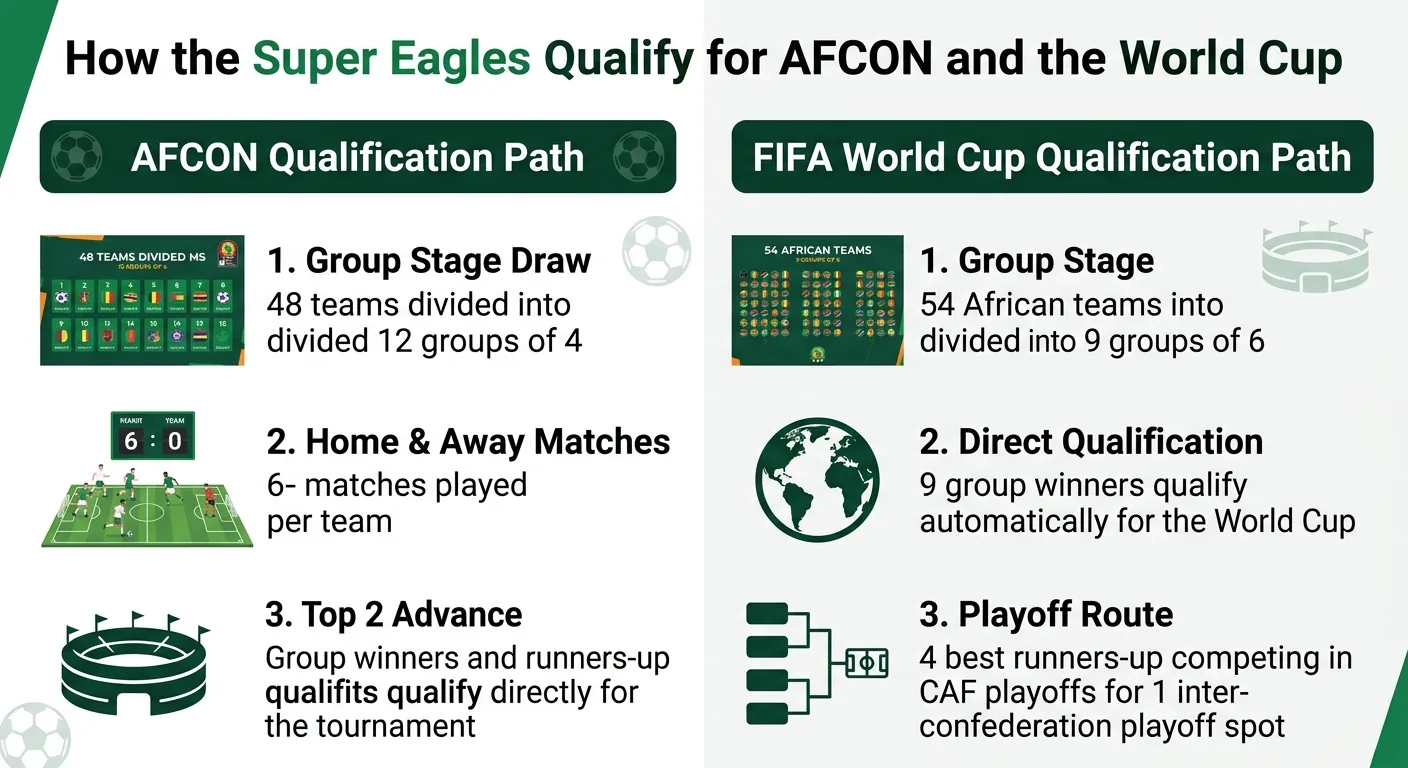
For the Nigeria Super Eagles to qualify for the Africa Cup of Nations (AFCON) or FIFA World Cup, they must earn a place through the qualifying competition run by the Confederation of African Football (CAF) under the rules for the particular tournament. Those rules are not the same for AFCON and the World Cup—and they can change between editions.
For AFCON 2027, the important detail is that Nigeria are in Group L with Guinea-Bissau, Madagascar and Tanzania. Because Tanzania are an automatic qualifier as one of three hosts, only the highest-placed country other than Tanzania will qualify from Group L. Nigeria cannot rely on the usual “top two qualify” shortcut. CAF confirmed that exception in the official group-stage draw announcement.
For the 2026 FIFA World Cup, Africa had nine automatic qualification places for group winners, plus a possible additional place through African and intercontinental play-offs. The Super Eagles missed out after losing their November 2025 CAF play-off final to DR Congo on penalties. The next men's World Cup is in 2030, but fans should not assume CAF will copy every 2026 qualifying rule into that edition without an official announcement. This article explains the rules, Nigeria's recent path and what supporters should watch. Research and factual snapshot: 12 November 2026.
AFCON vs World Cup: the basic difference for Nigeria
| Question | AFCON | FIFA World Cup |
|---|---|---|
| Who organises the competition? | CAF | FIFA, with African qualification organised through CAF |
| Which opponents does Nigeria face? | Other eligible African national teams | Other African nations in the CAF qualification pathway |
| How do countries earn a place? | Qualifying groups and any preliminaries specified for that edition | CAF qualifying groups and, when applicable, play-offs |
| How many finalists? | 24 at AFCON 2027 | 48 at the 2026 and 2030 World Cups |
| Do hosts have places? | Yes; Kenya, Tanzania and Uganda qualify automatically in 2027 | Host arrangements are tournament-specific; FIFA confirms automatic host places for 2030 |
| What matters most? | The precise rules of Nigeria's AFCON group, including the host exception | Finishing position and the officially published CAF pathway for the edition |
Neither competition awards Nigeria a place merely because of the Super Eagles' football history, FIFA ranking, high-profile players or past trophies. Those may influence expectations, but qualification is decided by results and the regulations.
How the Super Eagles qualify for AFCON 2027
The next men's AFCON is the TotalEnergies CAF Africa Cup of Nations PAMOJA 2027, co-hosted by Kenya, Tanzania and Uganda. CAF has scheduled the 24-team finals for 19 June to 17 July 2027.
CAF began qualification with a preliminary phase for lower-ranked countries. Twelve teams contested two-legged ties, and six winners joined 42 teams admitted directly to the main qualifying groups. CAF's preliminary-round explanation confirms why not every nation entered at the same stage.
The main stage has 48 nations in 12 groups of four. Each team plays the other three opponents twice, once home and once away, for six group matches. Wins ordinarily earn three points, draws one point and defeats zero; teams are ranked according to the competition's regulations.
Normally, the first two teams in a group qualify. But the exception is vital: Kenya, Tanzania and Uganda are already guaranteed places as hosts. In the three groups containing those hosts—D, H and L—only the highest-ranked non-host team joins the host at the finals. That makes Nigeria's group more demanding than a standard two-place group.
Nigeria's AFCON 2027 Group L: who are the opponents?
| Team | Qualification situation | Why their matches matter to Nigeria |
|---|---|---|
| Nigeria | Must earn the group's one non-host qualification place | Cannot assume finishing second overall is enough |
| Guinea-Bissau | Competing for the same non-host berth | Direct rival; defeated Nigeria in September 2026 |
| Madagascar | Competing for the same non-host berth | Every dropped point affects Nigeria's position among non-hosts |
| Tanzania | Already qualified as co-host | Games still count in the group table and can decide who finishes highest among the other three |
The practical rule is simple: Nigeria need to finish ahead of Guinea-Bissau and Madagascar in the qualifying ranking of non-host teams. Tanzania's final position does not remove the need to beat those rivals in the ranking. For example, Nigeria could finish second in the overall table behind Tanzania and still qualify as the best non-host. But finishing second behind Guinea-Bissau, with Tanzania below, would not give Nigeria the remaining berth.
The draw and the host exemption were reported by CAF and covered on FlyingEze in our report on the Super Eagles' AFCON 2027 opponents .
What happened in Nigeria's first two AFCON 2027 qualifiers?
After the opening two matchdays in September 2026, the group's first results gave Nigeria both encouragement and a warning. The Super Eagles came from behind to beat Madagascar 2–1 on 25 September, with George Ilenikhena and Moses Usor scoring. Four days later, they suffered a 3–0 loss away to Guinea-Bissau. Both scores were confirmed in CAF's match reports.
| Group L after Matchday 2, September 2026 | Played | Points | Goal difference |
|---|---|---|---|
| Guinea-Bissau | 2 | 6 | +5 |
| Nigeria | 2 | 3 | −2 |
| Madagascar | 2 | 1 | −1 |
| Tanzania (automatic host qualifier) | 2 | 1 | −2 |
This is a dated table after the first two fixtures, not a claim to show live standings after subsequent November matches. CAF reported that Guinea-Bissau had six points and Nigeria three entering November. FlyingEze also covered Nigeria's comeback win over Madagascar and the subsequent defeat in Guinea-Bissau .
The 3–0 defeat did not by itself eliminate Nigeria. There were four group matches remaining after Matchday 2. However, losing to a direct rival increased the importance of recovering points, strengthening the goal difference and securing results in the return fixtures. The definitive final ranking remains subject to all played matches and the official CAF tie-break rules.
When are the AFCON 2027 qualifiers played?
CAF scheduled the six main qualifying matchdays across three international windows. Its official draw report gives the following dates:
| Matchdays | Qualifying window |
|---|---|
| 1 and 2 | 21 September–6 October 2026 |
| 3 and 4 | 9–17 November 2026 |
| 5 and 6 | 22–30 March 2027 |
For the November 2026 double-header, CAF listed Nigeria versus Tanzania on Friday 13 November at 16:00 GMT (5:00 p.m. Nigerian time) and Tanzania versus Nigeria on Tuesday 17 November at 13:00 GMT (2:00 p.m. Nigerian time). These were the published fixtures at the research cut-off; readers should check CAF's current fixture page for any later schedule change or match result.
Because Tanzania are already qualified, these games will not remove their host place. But they count towards Nigeria's race with the other non-host teams. A victory is still worth three group points and may determine the final ranking.
How results, points and goal difference affect qualification
In a home-and-away qualifying group, each result has two effects: it changes the points table and can alter the goal statistics used when teams finish level. A team earns three points for a win, one for a draw and none for a defeat. Goal difference is the number of goals scored minus goals conceded, but the official regulations determine the order in which tie-breakers are applied; it is unsafe to assume goal difference is always the first tie-break.
For illustration only, a team with three wins, two draws and one loss finishes on 11 points. A team with four wins and two losses finishes on 12 points. Both can be strong campaigns, but neither total alone guarantees qualification until opponents' results are known.
That is especially true in Group L. Nigeria's task is not simply to collect a famous win against Tanzania; the Super Eagles must outperform Guinea-Bissau and Madagascar across all six matchdays. Their head-to-head results may have an important influence on the race, while other matches can change the number of points required.
How African teams qualified for the 2026 FIFA World Cup
The men's 2026 FIFA World Cup expanded to 48 teams. CAF received nine guaranteed direct places and a route to compete for one possible additional place in FIFA's intercontinental play-off tournament.
CAF originally drew 54 nations into nine groups of six; Eritrea subsequently withdrew, leaving one group with five teams. Teams played home-and-away group matches. Each of the nine group winners qualified directly for the World Cup.
It was not a standard top-two qualify system. Instead, the four best group runners-up, determined under the applicable comparison rules, progressed to a CAF play-off with two single-match semi-finals and a final. The CAF play-off winner earned a place in the FIFA Play-Off Tournament, not an automatic World Cup ticket.
That final intercontinental stage included representatives from other confederations and determined the remaining tournament berths. FIFA and CAF published this format before the qualifiers. The pathway is useful for understanding how Nigeria's campaign ended, but it should not be presented as the confirmed format for the 2030 edition.
Why the Super Eagles did not qualify for the 2026 World Cup
Nigeria did not top their original World Cup qualifying group, so they had to pursue the second-chance route through the African play-offs. The Super Eagles defeated Gabon 4–1 after extra time in the CAF play-off semi-final on 13 November 2025, before facing DR Congo in the final in Rabat on 16 November 2025.
That match ended 1–1 after extra time. Frank Onyeka scored early for Nigeria, but Meschack Elia equalised for DR Congo. The Leopards then won the penalty shootout 4–3 and advanced to the intercontinental play-off in Nigeria's place. FIFA's official report and CAF's account confirm the outcome.
Nigeria were eliminated from the 2026 qualification campaign at that point. A 2025 AFCON appearance or Nigeria's historic World Cup record could not restore a place in the 2026 finals. The route for the next edition must start afresh under the rules for 2030.
What changes for the 2030 FIFA World Cup?
FIFA awarded the 2030 World Cup to Morocco, Portugal and Spain, with centenary celebration matches in Argentina, Paraguay and Uruguay. FIFA states that those six countries qualify automatically from the relevant confederations' allocations.
For Nigeria, the key implications are that Morocco will already have an automatic World Cup place as an African co-host, while other eligible CAF members must compete through whatever African qualification arrangements FIFA and CAF approve for 2030.
As of this article's research date, the official FIFA hosting guidance does not establish a complete Nigeria-specific 2030 fixture list or justify copying the 2026 nine-group and runners-up play-off pathway word for word. When CAF publishes the 2030 draw, match calendar and regulations, those documents will determine the number of available non-host positions, the ranking rules and any play-off route.
The lesson from 2026 remains relevant: finish strongly enough to qualify by the main route whenever possible. Relying on a play-off leaves qualification exposed to one match, extra time or a penalty shootout.
Why AFCON qualification and World Cup qualification can produce different outcomes
There are several reasons a strong national team may qualify for one competition and miss another.
Different allocations. AFCON 2027 has 24 places and a group structure designed for its three automatic hosts. The 2026 World Cup had nine direct CAF tickets and one potential additional ticket through play-offs.
Different qualifying opponents. Nigeria's 2027 AFCON opponents are Madagascar, Tanzania and Guinea-Bissau. The World Cup group and play-off opposition came from a separate FIFA competition.
Different ranking thresholds. Finishing second may be sufficient in some AFCON groups, but in Nigeria's 2027 host-containing group the key is finishing as the highest-ranked non-host. In 2026 World Cup qualification, second place did not mean direct qualification.
Different calendars and player availability. National coaches work within FIFA windows, injuries, club commitments and travel demands. A team can show convincing form at a continental finals tournament and still struggle in qualification months later.
The contrast is visible in Nigeria's recent history. The Super Eagles finished third at AFCON 2025, staged in Morocco from December 2025 to January 2026, after a penalty-shootout victory against Egypt in the bronze-medal match. Yet Nigeria had already been eliminated from the 2026 World Cup qualification campaign. CAF confirms the bronze-medal result.
What the Super Eagles need to do in qualification matches
Although no tactical system can guarantee admission to a tournament, several practical requirements shape the team's chances.
- Win home qualifiers consistently. Home matches are opportunities to build points and avoid requiring improbable away results.
- Take direct rivals seriously. The three-goal loss to Guinea-Bissau shows why group reputation is not a substitute for performance.
- Protect goal margins. A heavy defeat can damage a team's goal statistics even if it remains mathematically capable of qualifying.
- Prepare for difficult away fixtures. Travel, unfamiliar playing conditions and opponent momentum are genuine features of African qualification.
- Monitor the exact qualification rules. Fans and analysts must distinguish an automatically qualified host from a rival competing for an available place.
- Maintain consistency across windows. AFCON 2027 qualification extends from September 2026 to March 2027; one good match is not enough.
- Understand the possible play-off risk. Nigeria's 2026 World Cup exit demonstrates that extra time and penalties can decide an entire qualification campaign.
These are performance factors, not claims that a particular coach, line-up or player selection has been definitively proved to cause a given result.
How fans can follow official Super Eagles qualification results
For AFCON, use CAFOnline.com for competition updates, official draw announcements, match reports and schedules. For the World Cup, consult FIFA.com and CAF for qualification rules, results and the African match calendar. The Nigeria Football Federation (NFF) is another source for official squad and team communications.
When checking a group table, record the date and number of games played. A table after Matchday 2 may be useful for understanding Nigeria's early situation but cannot be presented as a live Matchday 4 or final table. Similarly, a proposed kick-off can be changed; check the current official fixture before travelling or planning to watch.
Fans should also distinguish qualifying for the final tournament from advancing from a group once the finals begin. AFCON 2027 qualification takes place before the tournament. Once at AFCON, teams compete in a separate 24-team final-stage format; that is not the same as the qualification ranking.
Frequently asked questions
How do the Nigeria Super Eagles qualify for AFCON 2027?
Nigeria need to finish as the highest-ranked non-host team in Group L, ahead of Guinea-Bissau and Madagascar. Tanzania are already qualified as co-hosts. The teams play six home-and-away group matches.
Who are Nigeria's AFCON 2027 qualifying opponents?
Guinea-Bissau, Madagascar and Tanzania. Nigeria face each twice, home and away.
Do the top two teams in Nigeria's AFCON group qualify?
Not automatically. Because Tanzania are an automatic host qualifier, only the highest-ranked team other than Tanzania gains the group's additional finals place.
Is Nigeria already qualified for AFCON 2027?
No. After the opening two matchdays in September 2026, Nigeria had three points from a win over Madagascar and a defeat by Guinea-Bissau. Qualification depends on the remaining results and the final official group ranking.
How many matches does Nigeria play in AFCON 2027 qualifying?
Six group matches—home and away against each of the other three teams in Group L.
Why did Nigeria miss the 2026 FIFA World Cup?
The Super Eagles did not qualify directly from their CAF group and lost the African play-off final to DR Congo after a 1–1 draw, with DR Congo winning the penalty shootout 4–3 on 16 November 2025.
How many African teams qualified directly for the 2026 World Cup?
Nine group winners qualified directly. One additional CAF side had an opportunity to earn a place through the FIFA intercontinental play-off route.
Does finishing second qualify a country for the World Cup?
Not under the 2026 CAF rules. The four best runners-up entered an African play-off, and only its winner advanced to the FIFA Play-Off Tournament. Rules for 2030 must be checked separately.
Will Nigeria qualify automatically for the 2030 World Cup?
No. FIFA's confirmed automatic 2030 host places include Morocco, Spain, Portugal, Argentina, Uruguay and Paraguay—not Nigeria.
When is AFCON 2027?
CAF scheduled it for 19 June–17 July 2027 in Kenya, Tanzania and Uganda.
Where should I check the latest Nigeria qualification table?
Use the official CAF competition and match pages for AFCON, and FIFA and CAF for World Cup qualification. Check the update date before quoting a table.
Conclusion: know the route, then judge the results
To understand how the Nigeria Super Eagles qualify for AFCON and the World Cup, start with the official rules for each competition. In AFCON 2027 Group L, Nigeria must be the highest-ranked non-host team; Tanzania's guaranteed host place means the usual “top two” explanation is misleading. In 2026 World Cup qualification, nine group winners went through directly and Nigeria's second-chance campaign ended in a penalty-shootout defeat to DR Congo.
The 2030 World Cup presents a new opportunity, but its CAF qualification route must be confirmed through FIFA and CAF rather than assumed from the last cycle. Until then, fans should watch Nigeria's points, results against direct rivals, remaining fixtures and the regulations that determine final positions.
Editorial note: Researched and checked on 12 November 2026, ahead of Nigeria's November AFCON double-header. The historical Group L table is explicitly dated after Matchday 2 and must not be mistaken for live standings when later fixtures are completed. This is independent sports journalism; it does not claim access to non-public team decisions or predict qualification as a certainty.