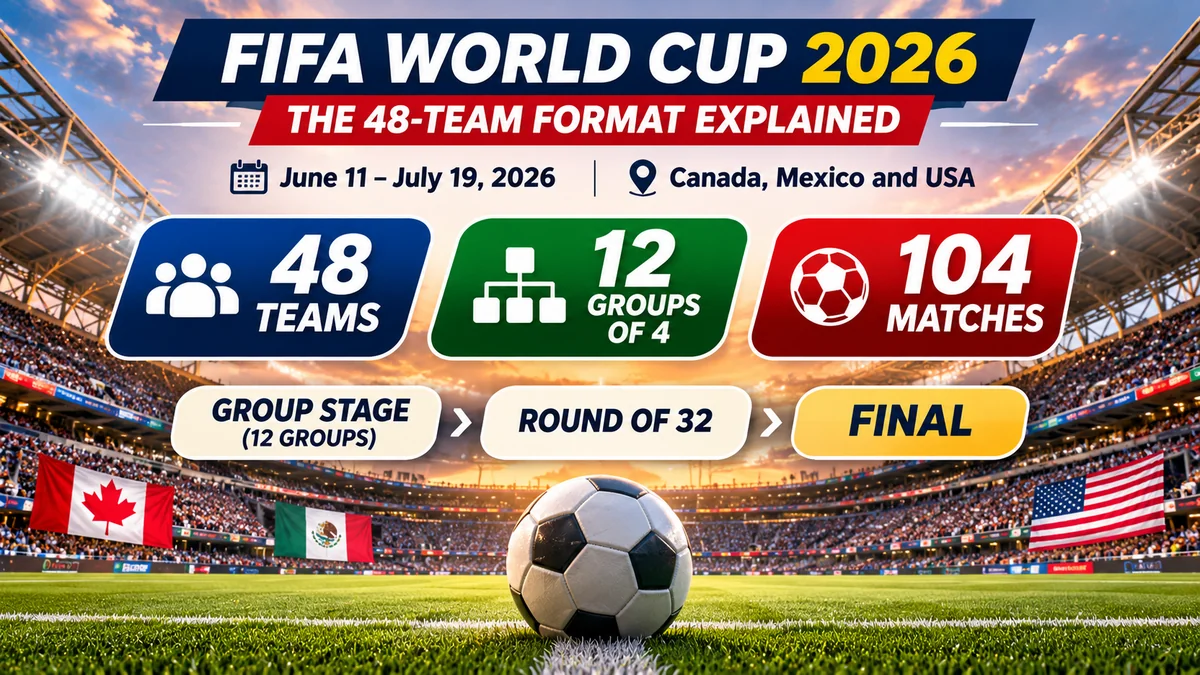
Quick answer: The FIFA World Cup 2026 started on Thursday, 11 June 2026, in Mexico City and ended on Sunday, 19 July 2026, in New York New Jersey. It was the first men's World Cup featuring 48 national teams, organised into 12 groups of four and playing a record 104 matches across Canada, Mexico and the United States. The top two teams in each group, plus the eight best third-placed teams, advanced to a new Round of 32. Spain ultimately defeated Argentina 1–0 after extra time in the final, with Ferran Torres scoring in the 106th minute.
Fans who search when is the football world cup starting need an important date clarification: as of this article's 13 November 2026 research date, the tournament has already concluded. This is a retrospective guide to the rules that governed the historic edition, not a countdown to an upcoming fixture. FIFA confirms both the match schedule and results and final standings .
Why was 2026 such a turning point? The competition grew from 32 to 48 teams, introduced another knockout round, gave more countries a chance to participate and required a finalist to play eight matches instead of seven. The format was easy to misunderstand, particularly the way some third-placed teams could still qualify for the knockout stage. Here is how it all worked, with clear calculations, examples and confirmed results.
FIFA World Cup 2026 key facts
| Question | Confirmed answer |
|---|---|
| When did the World Cup start? | Thursday, 11 June 2026 |
| When did it finish? | Sunday, 19 July 2026 |
| Who hosted? | Canada, Mexico and the United States |
| How many teams? | 48, up from 32 at Qatar 2022 |
| How many groups? | 12 groups of four, labelled A to L |
| Group games per team? | Three |
| How many progressed to knockouts? | 32 teams |
| How many matches overall? | 104: 72 group matches and 32 knockout/placement matches |
| Opening match? | Mexico 2–0 South Africa, Mexico City Stadium |
| Final? | Spain 1–0 Argentina after extra time, New York New Jersey Stadium |
| Winner? | Spain, winning its second men's World Cup title |
These dates, results and competition rules come from FIFA's official format explainer , results schedule and final report .
Why did FIFA increase the tournament from 32 to 48 teams?
From 1998 through 2022, the men's World Cup operated with 32 teams. In 2026, FIFA expanded that number by 16 additional teams—a 50% increase in the number of participating nations. The change was intended to broaden access to world football's leading international tournament and give more countries, players and supporters a chance to participate.
Expansion required a new schedule. FIFA's eventual solution preserved four-team groups while increasing their number from eight to 12. This gave every side three guaranteed group games rather than the two that would have resulted under an earlier plan for 16 groups of three. The FIFA Council approved the revised structure in March 2023 , citing sporting integrity, team rest and the need to reduce the risk of collusion.
Expansion also meant more television fixtures, more travel and a potentially longer competitive workload for the teams advancing deepest into the tournament. The benefits of broader participation therefore came with legitimate questions about player welfare, scheduling and environmental impact.
How the 12 groups of four worked
All 48 countries were divided into 12 groups of four, labelled Group A through Group L. Each team faced the other three in its group once. That meant:
- Each nation played three group-stage matches.
- Each group contained six fixtures, because there are six unique pairings among four teams.
- Twelve groups times six matches produced 72 group-stage fixtures.
- Group points were awarded in the usual way: three for a win, one for a draw and none for a defeat.
Teams were ranked within each group under FIFA's tournament regulations, with points, goal difference and goals scored among the relevant factors. Further tie-breaking rules could be needed when sides finished level. The important point is that a group ranking and the separate comparison of third-placed teams were different stages of the qualifying calculation.
For example, imagine a fictional group in which Team A finished on seven points, Team B on five, Team C on four and Team D on zero. Teams A and B would progress automatically. Team C would need its four-point record compared against the third-placed sides in the other 11 groups. Team D would be eliminated.
These are illustrative numbers, not the actual standings of a 2026 World Cup group.
How teams qualified for the Round of 32
This was the defining innovation of the expanded format. Rather than sending only two teams from each group into a Round of 16, FIFA required 32 teams for the first knockout round.
| Route to qualification | Number of teams |
|---|---|
| First-place finishers in 12 groups | 12 |
| Second-place finishers in 12 groups | 12 |
| Eight best third-place finishers | 8 |
| Total advancing to Round of 32 | 32 |
| Third-place teams eliminated | 4 |
| Fourth-place teams eliminated | 12 |
In other words, all 12 group winners and all 12 runners-up went through. Only eight of the 12 third-placed teams joined them. The four lowest-ranked third-placed sides did not advance, and all fourth-placed teams were eliminated. Exactly 16 teams exited at the group stage.
This system meant finishing third did not automatically equal elimination. Nor did third place guarantee survival. The third-placed sides were compared across groups according to the official criteria, including points and applicable tie-breakers. A team might therefore have had to wait for results from other groups to learn its fate.
Illustrative example: which third-placed sides survive?
Suppose the third-placed teams from the 12 groups earned the following fictional point totals:
| Groups | Hypothetical third-place points | Outcome in this example |
|---|---|---|
| A, B, C | 5, 4, 4 | Progress |
| D, E, F | 4, 4, 3 | Progress, assuming relevant tie-breaks |
| G, H | 3, 3 | Progress, assuming relevant tie-breaks |
| I, J, K, L | 2, 2, 1, 1 | Eliminated |
The top eight third-place records would reach the Round of 32. If the eighth and ninth sides had identical points, the applicable tie-breakers would determine the order. There was no universal number of points guaranteeing third-place qualification; the threshold depended on results across all 12 groups.
How the 2026 knockout rounds worked
After 72 group matches, the remaining 32 nations entered a single-elimination bracket. Lose a knockout tie and, except for the semi-finalists contesting third place, the tournament was over. Drawn knockout games could go to extra time and then a penalty shootout under the regulations.
| Stage | Teams involved | Matches |
|---|---|---|
| Round of 32 | 32 | 16 |
| Round of 16 | 16 | 8 |
| Quarter-finals | 8 | 4 |
| Semi-finals | 4 | 2 |
| Third-place match | 2 losing semi-finalists | 1 |
| Final | 2 finalists | 1 |
| Knockout and placement matches | 32 |
The new Round of 32 began on 28 June 2026, followed by the Round of 16, quarter-finals and semi-finals. The third-place playoff was held in Miami and the final in New York New Jersey. FIFA's knockout-stage results page records the actual bracket.
How many matches did a champion need to play? A finalist completed three group games plus five knockout ties—Round of 32, Round of 16, quarter-final, semi-final and final—for eight matches. In the 32-team era, finalists typically played seven.
Why were there exactly 104 World Cup matches?
The number is not arbitrary. It follows directly from the group structure and knockout bracket:
Group stage: 12 groups × six games = 72 matches.
Knockouts and third-place game: 16 + 8 + 4 + 2 + 1 + 1 = 32 matches.
Total: 72 + 32 = 104 matches.
Qatar 2022 featured 64 matches. The expanded 2026 World Cup therefore added 40 fixtures, an increase of 62.5%. That is a much larger rise in total matches than the 50% increase in the number of participating countries, because additional knockout games were introduced.
The total included the third-place playoff as well as the championship final. Excluding that bronze-medal fixture would give an incorrect overall count of 103.
2022 vs 2026 World Cup format: what changed?
| Feature | Qatar 2022 | Canada–Mexico–USA 2026 |
|---|---|---|
| Participating teams | 32 | 48 |
| Group configuration | 8 groups of 4 | 12 groups of 4 |
| Group-stage matches | 48 | 72 |
| Teams entering knockout stage | 16 | 32 |
| Third-place teams advancing | None | Eight of 12 |
| First knockout round | Round of 16 | Round of 32 |
| Overall matches | 64 | 104 |
| Games played by a finalist | 7 | 8 |
| Host countries | 1 — Qatar | 3 — Canada, Mexico, United States |
One feature did not change: every group still contained four teams playing each other once. FIFA considered groups of three for the expanded competition, but ultimately retained groups of four for sporting integrity and to give teams more assured matches.
Where was the 2026 FIFA World Cup played?
For the first time, three countries jointly hosted the men's World Cup. Sixteen host cities were spread across North America.
| Host | Number of host cities | Cities |
|---|---|---|
| United States | 11 | Atlanta, Boston, Dallas, Houston, Kansas City, Los Angeles, Miami, New York New Jersey, Philadelphia, San Francisco Bay Area, Seattle |
| Mexico | 3 | Guadalajara, Mexico City, Monterrey |
| Canada | 2 | Toronto, Vancouver |
| Total | 16 |
FIFA's official host-city guide confirms that breakdown. Mexico City Stadium staged the opening match, while New York New Jersey Stadium hosted the final.
Managing travel across three countries was one of the biggest organisational challenges. FIFA structured much of the tournament around geographic regions and rest periods to limit excessive transfers. Nevertheless, the enlarged footprint raised reasonable questions about long-distance travel, supporter costs and carbon emissions—issues a larger competition inevitably brings into focus.
What happened in the opening match and final?
Mexico opened the tournament on 11 June
The first match was Mexico against South Africa at Mexico City Stadium on Thursday, 11 June 2026. According to FIFA's official results , Mexico won 2–0, launching the new 48-team era at the historic stadium that had also featured prominently in the 1970 and 1986 World Cups.
The fact that the opening fixture was played in Mexico sometimes causes confusion about the three host countries. Mexico staged the tournament's first match; Canada and the United States hosted other fixtures beginning during the opening days.
Spain won the final on 19 July
The final took place on Sunday, 19 July 2026, at New York New Jersey Stadium. Spain beat defending champions Argentina 1–0 after extra time. Substitute Ferran Torres scored in the 106th minute, giving Spain its second men's World Cup title. FIFA confirmed the result in its official match report .
For additional background on the match scheduling and broadcasters' pre-final coverage, FlyingEze previously published a guide to the 2026 World Cup final's date and kick-off details . That earlier piece addressed the final as an upcoming event; the result reported here reflects the completed tournament.
What did expansion mean for African teams and Nigeria?
The enlarged field was particularly significant for Africa. The Confederation of African Football (CAF) was allocated nine direct qualification places, with another African representative able to compete in the intercontinental FIFA Play-Off Tournament. FIFA's African qualifying guide explains the process.
Ultimately, ten African teams featured at the 2026 World Cup: Algeria, Cabo Verde, DR Congo, Côte d'Ivoire, Egypt, Ghana, Morocco, Senegal, South Africa and Tunisia. Nigeria was not among the 48 qualified countries. Those nations appear in FIFA's confirmed list of participants .
The 48-team format created more places for African countries, but it did not guarantee that a particular national team would qualify. The Super Eagles still needed to progress through the applicable qualification process, regardless of the overall expansion.
FlyingEze's earlier list of all 48 World Cup qualifiers is useful for readers who want to see the full line-up beyond the African teams. Its earlier coverage of African qualification milestones provides historical context about the pathway to the tournament.
Did the bigger World Cup improve competition—or create new problems?
The 48-team model produced more opportunities and more games, but it also introduced trade-offs. There are reasonable arguments on both sides of expansion.
Benefits of the expanded format
- Broader international participation: More nations received a place on the world's largest football stage, including first-time qualifiers.
- Three guaranteed games: Four-team groups ensured every participant could play three times, rather than two under the rejected three-team-group plan.
- More knockout possibilities: Strong third-placed sides had an additional way to survive the group stage, raising the significance of results beyond the top two places.
- More fixtures for fans: The tournament grew to 104 matches, creating more opportunities to follow different countries, players and styles of football.
Challenges introduced by the change
- More matches for finalists: Teams reaching the final had an eighth fixture, increasing demands on players already navigating busy domestic and continental seasons.
- Complex third-place qualification: Supporters needed to compare results from different groups, making the qualification picture harder to understand before all group games finished.
- Greater travel demands: Three host countries and 16 cities made logistics more complicated for national teams, media and travelling supporters.
- Longer uncertainty for some nations: A team finishing third could wait for several other matches to know whether its points and tie-breakers were sufficient.
FIFA argued that keeping four-team groups helped safeguard competitive integrity, especially by preserving a final round of group matches in which teams from the same group could play simultaneously. Whether all the benefits justified the increased scale is a legitimate sporting and organisational debate, rather than a mathematical question alone.
What records did the inaugural 48-team tournament leave?
The first expanded men's World Cup produced 104 matches and 308 goals, an average of approximately 2.96 goals per game, according to FIFA's post-tournament review .
FIFA also reported an aggregate attendance of 6,810,966 across the tournament. Its 19 July 2026 championship statement described this as record-setting attendance. Those figures indicate the scale of the competition, but attendance is not the same as the number of unique people who visited stadiums: someone attending several matches is counted at each game.
The format itself also left a durable competitive legacy. Thirty-two teams reached the knockout phase, a finalist played eight times, and the third-place comparison became an essential part of understanding which countries progressed.
Frequently asked questions about the 2026 World Cup
When did the 2026 football World Cup start?
It started on Thursday, 11 June 2026, with Mexico beating South Africa 2–0 at Mexico City Stadium. The competition ended on Sunday, 19 July 2026.
Was the 2026 World Cup played in three countries?
Yes. Canada, Mexico and the United States jointly staged the tournament across 16 host cities—two in Canada, three in Mexico and 11 in the United States.
How many teams played at the FIFA World Cup 2026?
48 national teams, compared with 32 at the 2022 tournament in Qatar.
How many groups were in the 2026 World Cup?
There were 12 groups of four. Each team played three group matches, producing 72 group-stage fixtures.
How many teams qualified from each group?
The first two in every group qualified automatically. Of the 12 third-place finishers, the eight best also advanced, making a Round of 32.
Could a team finish third and still qualify?
Yes. Eight third-placed teams qualified, depending on their records relative to the third-placed sides in the other groups. Four third-placed teams were eliminated.
How many matches were played at the World Cup 2026?
104 matches: 72 in the group stage and 32 in knockout and placement rounds, including the third-place game and final.
How many games did the World Cup finalists play?
Eight each: three group-stage fixtures followed by five knockout matches. In the previous 32-team format, a finalist played seven.
Who won the FIFA World Cup 2026?
Spain defeated Argentina 1–0 after extra time in the final on 19 July 2026. Ferran Torres scored the winner in the 106th minute.
Did Nigeria qualify for the 2026 World Cup?
No. Nigeria was absent from FIFA's final list of 48 competing nations. Ten African sides were represented at the tournament.
Why did FIFA reject 16 groups of three?
FIFA ultimately preferred 12 groups of four to ensure each team played at least three games and to reduce concerns about sporting integrity and the potential for collusion.
Conclusion: the 48-team World Cup changed more than the number of countries
The 2026 FIFA World Cup started on 11 June and ended on 19 July 2026. Its 48-team structure changed how nations reached the knockout stage, increased the fixture list to 104 games and added a Round of 32. The rules were straightforward once broken down: 12 groups of four, two automatic qualifiers per group, eight additional third-place qualifiers and a 32-team knockout bracket.
The edition ended with Spain lifting the trophy after defeating Argentina in extra time. Beyond the result, 2026 established a new model of participation—more inclusive for many nations, but also more demanding in terms of workload, travel and scheduling. Those competing priorities will shape how fans and football authorities assess the expanded World Cup in the years ahead.
Editorial verification: 13 November 2026. Main sources: FIFA's official competition-format explainer, 2026 fixtures and results, final match report, final tournament standings, African qualifying guide and post-tournament statistics. The fictional third-place example is not an actual 2026 group table. The featured image is original editorial artwork rather than an official FIFA graphic.