
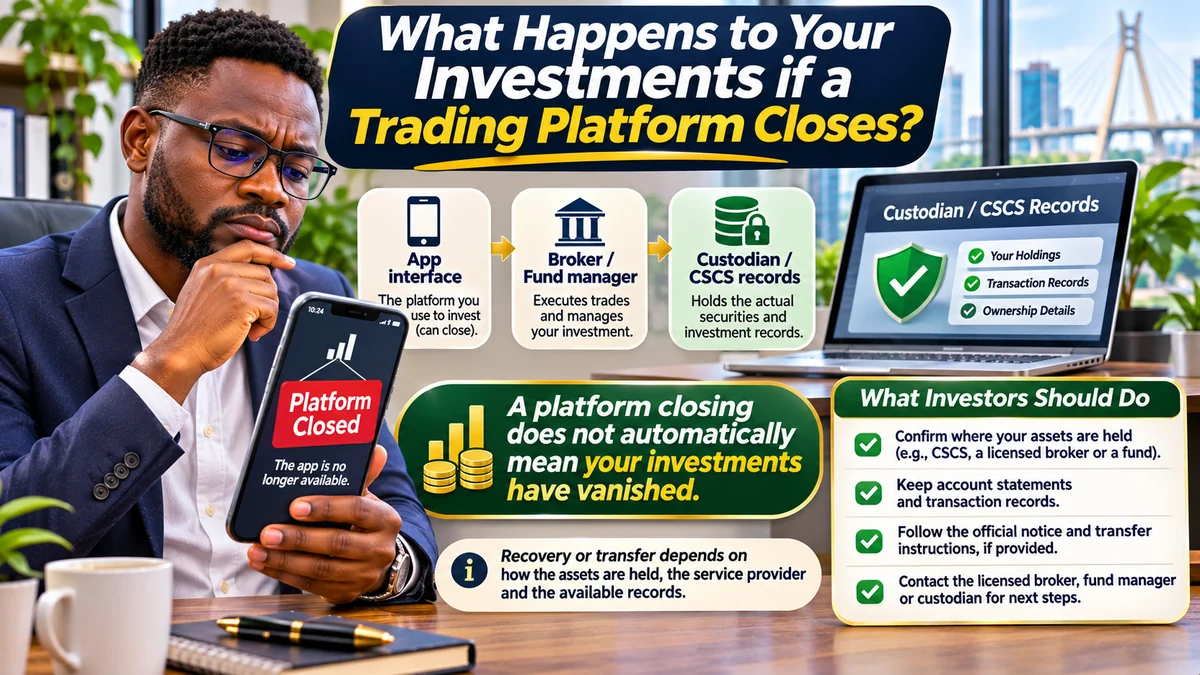
If a trading platform closes, your investments do not automatically disappear—but you are not automatically guaranteed to recover everything either. The outcome depends on whether you owned identifiable shares or fund units, who kept the underlying assets, whether client money was properly separated, and whether the problem is an orderly shutdown, a licensed broker's insolvency, a fund-management failure or fraud.
That distinction is essential for Nigerians using investing platforms to buy local equities, invest in mutual funds, hold foreign stocks or deposit money into investment wallets. A phone app may merely display your account while a broker, custodian, central depository or fund trustee keeps the underlying records. Alternatively, the money shown as an app balance may represent a contractual debt owed by the platform—not securities held independently for you.
This guide explains what could happen to the assets, how Nigeria's 2025 Investments and Securities Act and Nigerian Exchange (NGX) Investor Protection Fund work, what SIPC covers for qualifying US brokerages, and what to do immediately when withdrawals stop. Research checked: 16 November 2026. This is general educational information, not individual legal or investment advice.
Quick answer: what happens when a trading platform shuts down?
There are several possibilities, and they should not be treated as the same event.
| What has happened? | What may happen to your investment? | Your first verification step |
|---|---|---|
| Only the mobile app or website is discontinued | Holdings may remain with the licensed broker, custodian or fund; a new interface or account transfer may be arranged | Identify the underlying legal provider and get an independent account statement |
| A stockbroker becomes insolvent or loses permission | Reconciliation, transfer or liquidation procedures may apply; eligible losses may fall within NGX investor-protection rules | Check SEC/NGX notices, CSCS holdings and the official claims process |
| A mutual-fund manager closes | The scheme's assets may remain separately held under a trustee/custodian; manager replacement, restructuring or fund termination can occur | Identify the fund, registered manager, trustee/custodian and official scheme notice |
| An overseas brokerage partner fails | Foreign customer-property and liquidation rules may apply; eligible SIPC-member accounts have conditional protection | Verify the legal carrying broker, jurisdiction and any authorised claims administrator |
| An unregistered investment scheme collapses | There may be no underlying assets corresponding to the balance; recovery can depend on investigations and asset tracing | Preserve evidence, contact the payment institution and report suspected fraud |
| Only the company whose shares you bought fails | The shares may lose most or all value even when the broker remains healthy | Separate the issuer's business failure from the intermediary holding your investment |
In other words, an app going offline, an intermediary becoming insolvent and an underlying investment losing value are three different risks. Regulators and compensation schemes do not treat them identically.
First, understand the difference between the app, broker and custodian
An investing app is often a digital front door. It may accept a deposit, display a portfolio and take buy or sell instructions. Behind it, separate legal entities might execute orders, operate a collective investment scheme, maintain securities records or hold uninvested cash.
For Nigerian exchange-traded shares, the Central Securities Clearing System (CSCS) works with registered brokers in securities clearance, settlement and records. Its investor-onboarding service refers to Clearing House Numbers (CHNs), CSCS account records and ways for investors to check holdings. CSCS advises investors who already have a CHN to disclose it when opening another account, helping maintain consistent identification.
Suppose an app stops operating but your shares are properly recorded through a licensed broker and depository. The disappearance of the app interface alone does not establish that those recorded shares have disappeared. However, you may still face delays verifying ownership, transferring an account, settling an outstanding trade or accessing the funds. Account structure and paperwork matter.
Before relying on an app, ask: Who is the actual contracting entity? Who executes trades? Where are securities and client money recorded? Can I obtain a statement from an institution other than the app company? A marketing statement such as “your funds are secure” is not a substitute for those answers.
What happens if a Nigerian stockbroker closes or becomes insolvent?
A stockbroker's closure can trigger a different process from an app interface being switched off. The relevant exchange, regulator, depository and any appointed administrator may need to determine customer positions, resolve unsettled transactions, reconcile money and securities, and arrange transfers or claims according to the facts and applicable rules.
Nigeria's Investments and Securities Act, 2025 contains provisions on trust accounts for capital-market operators, client transaction records and the investor-protection framework. These provisions do not mean all investors can instantly withdraw in full from a failed firm. They set duties and mechanisms that matter when investigating what the firm actually held and owed.
If you own NGX-listed shares, request your securities holdings information and account identification from the broker or CSCS through independently verified channels. Compare those records against trade confirmations, settlement information and your funding history. The NGX investor-protection resources also provide information on member compliance and disciplinary actions.
Do not automatically sell securities in panic because an app or intermediary announces a shutdown. Selling may not even be possible during a suspension, and the right course depends on whether the underlying assets are valid, transferable and suited to your financial needs.
Will the NGX Investor Protection Fund compensate you?
Possibly, for an eligible loss—not for every loss. NGX maintains an Investor Protection Fund (IPF) intended to address qualifying monetary losses associated with exchange trading firms. The current Investments and Securities Act, 2025 , particularly sections 198–199 and 213–216, provides a statutory framework involving circumstances such as insolvency, bankruptcy, negligence, misappropriation and relevant licence revocations or cancellations.
But eligibility depends on the facts, the responsible operator and the applicable fund rules. The IPF is not a universal insurance policy against falling share prices; it is also not an automatic refund fund for every digital investment product offered in Nigeria. A loss on an issuer's shares is not itself proof that a stockbroker misappropriated the customer's money.
Do not rely on an invented fixed compensation amount. The Act makes compensation subject to relevant conditions and limits approved through the framework. The specific applicable limit, claim procedure and documentary requirements should be confirmed from NGX and the fund administrators at the time of a claim.
Where the claim concerns wrongdoing or insolvency of a licensed dealing member, preserve your trade contract notes and evidence of amounts entrusted to the operator. Follow the official process and any notice giving a deadline. Section 215 of the 2025 Act addresses verification and payment timing after claims are established; those statutory stages should not be confused with a guarantee that every investor receives money a few days after a platform shuts.
Useful distinction: If you have ₦2 million in legitimate shares and their market price falls to ₦1.5 million because the listed issuer performs poorly, the ₦500,000 decline is a market loss. If a broker wrongfully sells or fails to account for securities, a different potential compensation or recovery question arises. These are hypothetical examples, not estimates of an actual claim.
What happens if a mutual-fund app or fund manager shuts down?
Mutual funds and other collective investment schemes have a different structure. You may hold fund units rather than the individual shares, bonds or deposits inside the fund. The manager, trustee, custodian and registrar may be separate entities, each with responsibilities specified in the scheme documentation and regulatory framework.
The SEC's collective-investment FAQ section 180 of the Investments and Securities Act, 2025 treats investor money and other assets within the collective-scheme provisions as trust property. Section 179 also addresses legal separation and records of scheme assets, while section 181 deals with losses caused by a custodian's wilful or negligent actions or omissions.
That provides a legal distinction between properly constituted fund property and the manager's own operating finances. It does not eliminate investment risk or prove that every app advertising a “fund” actually runs an authorised collective investment scheme. If a genuine manager closes, authorities and the relevant scheme parties may arrange replacement management, restructuring, transfer, redemption or winding up under the fund documents and law.
Ask for the fund's exact name, scheme identifier where applicable, unit statement, trust deed or offer document, licensed manager and custodian. In a closure, use communications verified through the custodian, trustee or SEC rather than relying on a forwarded message that instructs investors to pay a “release fee”.
What if the platform only shows an “investment wallet” balance?
A displayed wallet balance can mean very different things. It could be cash pending investment, units in a mutual fund, an amount owed by a broker, money held at a partner bank, or simply an unsecured contractual claim against a company. The correct treatment depends on the contract, custody structure and applicable regulation—not on the word wallet.
This is why investors should distinguish cash, securities and contractual claims. If the money was segregated for a customer and identifiable in genuine records, the recovery process may differ from money paid directly to an insolvent business for an unsecured “investment package”.
Also, Nigeria Deposit Insurance Corporation (NDIC) cover should not be assumed for shares, mutual funds or brokerage balances. NDIC deposit insurance concerns eligible deposits at covered institutions; an investment does not automatically become an insured bank deposit just because it was funded by bank transfer.
Look for the identity of the institution holding any uninvested cash, the exact account arrangement, and whether there is written evidence explaining the position if the fintech firm fails.
Can you recover US stocks held through a Nigerian investment app?
Potentially, but the answers may come from more than one jurisdiction. Some apps give access to foreign securities through a separately regulated overseas brokerage. If the Nigerian-facing interface ceases operations, you need to establish whether you have an identifiable account at the foreign carrying broker, a nominee or omnibus interest, or another contractual arrangement.
For US securities, verify the actual brokerage firm through FINRA BrokerCheck and check whether it is a Securities Investor Protection Corporation (SIPC) member . SIPC states that customers of an eligible failed US member brokerage may have protection up to $500,000 per customer, including a limit of $250,000 for cash held for securities purchases. It also explains that non-US residents may be eligible when they actually qualify as customers of a SIPC-member broker.
Those limits are not a guarantee that every Nigerian app customer has personal SIPC coverage. The relationship between an app customer, an overseas broker and a pooled or nominee account must be examined. SIPC does not cover ordinary market declines, promises of investment performance or every asset category. SIPC's official explanation distinguishes missing customer assets in qualifying failures from investment losses.
If a US member actually enters SIPC liquidation, the trustee or claims administrator issues formal notices and claims instructions. Filing deadlines, proof and account status matter. A Nigerian-facing customer should contact the actual broker using independently verified details, not assume the app's marketing material fully describes the legal custody relationship.
What if the company whose shares you bought collapses?
Here the platform may still be fully operational. A publicly listed company can struggle, restructure or enter insolvency, causing its shares to lose value. Equity shareholders are generally exposed to the fortunes of the issuer; they are not entitled to a guaranteed return of their original purchase price.
A broker or custodian cannot guarantee the survival of an individual company. The same goes for bonds and notes: credit risk, contractual ranking and recovery vary. Holding an asset in an account at a regulated institution does not transfer ordinary issuer business risk to the broker.
For a separate explanation of how Nigerian capital-market settlement differs from share-price movement, FlyingEze has reported on Nigeria's faster T+1 stock settlement cycle . A faster settlement cycle does not mean issuers cannot default or that a closed app will process withdrawals immediately.
What happens if the “platform” was an unregistered investment scheme?
This is the highest-risk scenario because the displayed holdings may not correspond to securities actually purchased for customers. Nigeria's SEC warned in May 2026 that unregistered online investment schemes can advertise through messaging and social media, promise unrealistic returns and solicit money without the required permission.
In an April 2025 public notice about CBEX , the SEC said the named operation had not received the required registration and cited complaints of failed withdrawals and office closures. This is a documented regulatory warning, not evidence about another platform that happens to have a similar-looking app.
If your deposits went to an unregistered operator, a claims process may involve tracing the funds, investigations, court proceedings and whatever assets can be recovered. There is no sound basis to promise full reimbursement, a fixed timeline or access to NGX's IPF for an unrelated Ponzi-style app. Do not pay another person to “unlock profits” or “register your compensation”.
What to do immediately if your investment platform suddenly closes
The following sequence works as a practical starting point whether you have received an official shutdown notice or merely cannot access your account.
- Confirm what actually happened. An app outage, scheduled maintenance, withdrawal restriction, suspended licence and legal insolvency are different events. Check official announcements from the provider, SEC, NGX, the custodian or the applicable foreign regulator.
- Stop adding new funds. Avoid making further deposits while the reason for the disruption and the proper payment channels remain unclear. Do not pay an “account reactivation” fee on the instruction of an unverified stranger.
- Preserve your evidence immediately. Save account statements, screenshots, trade contract notes, order IDs, transaction histories, subscription confirmations, emails, receipts and the original account agreement. Keep copies of dates and times; do not publicly expose your NIN, BVN, passwords or OTPs.
- Identify the real legal entities. Determine the app operator, executing broker, fund manager, custodian, trustee, foreign carrying broker and receiving bank where relevant. Search the SEC registered-operator directory and verify functions rather than relying on logos.
- Confirm the underlying assets. Check CSCS or other securities/depository records, an authorised custodian statement, or the fund's unit register where available. Ask for a reconciliation of the platform's displayed balance against actual holdings and cash.
- Find the official transfer or claims procedure. Read any verified administrator, trustee, exchange or regulator instructions. Record deadlines and do not submit documents or pay fees through unofficial WhatsApp groups or cloned claims websites.
- Escalate carefully. Contact the authorised institution and regulator if records or withdrawal rights are disputed. Where a suspicious payment is involved, contact your bank promptly; preserve evidence and consider appropriate legal advice.
The SEC's information for harmed investors current contact page
Which documents should you keep to support a claim?
| Document | Why it matters |
|---|---|
| Account agreement and risk disclosure | Identifies the contracting firm and legal nature of the product |
| Account or CHN/CSCS identifiers | Helps trace listed securities and account records |
| Trade contract notes and order confirmations | Shows what orders were executed and on what terms |
| Fund subscription and unit statements | Shows participation in a specific scheme and the recorded units |
| Bank transfers and funding receipts | Documents how much money was sent and to whom |
| Withdrawal requests and responses | Shows attempted redemptions, delays and explanations |
| Support tickets and official notices | Preserves the chronology and instructions given |
| Identity verification records | May help match your legal identity to the underlying account—share only through secure verified channels |
Keep originals, a secure backup and a clear timeline. If you submit a claim, retain copies and proof of submission. Do not alter statements to make the balance look higher, and do not send original identification to an unverified “recovery agent”.
How to contact the right institution in Nigeria
The appropriate starting point depends on the failed entity and where the asset was held.
- Nigerian stockbroker or exchange trading issue: Contact the actual broker, NGX and the relevant investor-protection or claims administrator through verified channels; obtain CSCS holdings information where applicable.
- Registered fund-management or collective-scheme issue: Identify the fund manager, trustee, custodian and registrar; notify the SEC if there is an unresolved complaint or suspected misconduct.
- Unregistered scheme or suspicious transfer: Report to SEC and appropriate law-enforcement authorities, and contact your bank or payment institution promptly if funds may have been misdirected.
- Foreign brokerage: Contact the actual carrying broker and the relevant foreign regulator or formal liquidator; use SIPC only where its membership and customer-eligibility conditions are satisfied.
For Nigerian capital-market complaints, start at sec.gov.ng or SEC's official contact page . The regulator lists sec@sec.gov.ng as a contact email. Where the issue is an apparent fraudulent bank transfer, FlyingEze's guide to responding after sending money to a suspected fraudulent account provides complementary steps.
Do not assume that every complaint is entitled to NGX IPF compensation or that every delayed redemption is criminal fraud. Establish the product, authorised intermediary, evidence and applicable process first.
What investor protection does not cover
Several misconceptions can lead to poor decisions. A licensed operator is not a risk-free investment product. Regulatory supervision, properly separated assets and investor-protection funds can create important safeguards, but they do not automatically repay market losses, cure a bankrupt issuer, guarantee foreign-currency conversion rates or make an illiquid investment instantly redeemable.
Similarly, a US broker's SIPC membership does not turn all assets sold through a Nigerian-facing app into directly protected accounts. A bank partner does not make mutual-fund units NDIC-insured deposits. And an entry in an app's activity log does not establish that the operator bought the underlying securities if you cannot corroborate the purchase.
How to reduce the risk before any trading platform closes
Prevention begins long before a company announces trouble. When evaluating investing platforms, ask for the exact legal operator and permission, actual product structure, independent asset records and transfer process. Test how statements are downloaded and whether beneficiaries can reach the licensed broker or custodian without passing through the app's customer-service inbox.
Review whether cash balances are protected or merely owed by a fintech company; understand how client funds are segregated and what happens to unsettled trades. Maintain updated contact and identity information so formal notices and account-transfer instructions can reach you. Diversification across suitable assets and counterparties can reduce concentration but cannot remove all market or institutional risk.
Where a platform offers an unusually high guaranteed return or will not explain where client assets are held, do not treat app-store ratings or influencer recommendations as proof of legitimacy. Verify the provider's legal status before funding the account. A small initial deposit and successful withdrawal are not substitutes for checking regulation, legal ownership and custody.
Frequently asked questions
Will I lose my shares if my stock trading app closes in Nigeria?
Not necessarily. Properly recorded shares may remain identifiable through the licensed broker, CSCS or relevant custody arrangement even if the app disappears. But recovery, transfers and access depend on the legal relationship, actual records and the nature of the closure.
Can I transfer investments to another stockbroker?
Often it may be possible for eligible transferable securities, subject to the relevant depository, broker, account-verification and procedural rules. Not every pooled product, fractional interest or proprietary investment can be transferred in the same way. Ask the actual holder about transfer requirements before giving instructions.
What is the NGX Investor Protection Fund?
It is an investor-protection mechanism intended to compensate certain eligible monetary losses associated with trading-licence holder firms, including specified insolvency or misconduct circumstances. It is not a universal investment guarantee or a refund scheme for all apps.
Does SEC registration guarantee I will get my money back?
No. Registration indicates regulatory status and obligations, not a guaranteed investment outcome. Market losses, issuer defaults, unresolved ownership records and the details of an insolvency still affect recovery.
Are mutual fund assets separate from the fund manager's business?
In a properly constituted regulated collective investment scheme, Nigeria's 2025 Act addresses scheme property as trust property and provides for trustees and custodians. That safeguard does not remove market risk or establish that any unauthorised app calling itself a fund has the same structure.
What if I only had cash in the app wallet?
Find out whether the cash was held for investment by a regulated broker, deposited at a licensed bank, placed in a fund or owed directly by the app company. The answer determines which legal and regulatory protections might apply.
Does NDIC insure money invested through trading platforms?
Not simply because the app accepts bank transfers. NDIC covers eligible deposits at insured institutions under its rules; stocks, mutual funds and stockbroker investments are not automatically insured bank deposits.
Can SIPC protect Nigerians investing in US stocks?
Potentially, if they qualify as customers of a failed SIPC-member broker and the relevant cash or securities fall within SIPC's rules. Protection is conditional, subject to limits and not insurance against share-price declines.
What should I do if the platform blocks withdrawals but still operates?
Preserve records, check the product's redemption terms and whether there is an official restriction, contact the actual regulated operator and escalate unresolved issues through verified regulator or legal channels. Do not send additional money simply to unlock a withdrawal.
How long will recovering investments take?
There is no reliable universal timetable. Account transfers can be straightforward when records are complete, while investigations, missing securities, disputed claims and cross-border insolvency can take considerably longer. Follow deadlines in verified official notices.
What if the platform was unlicensed and the money is gone?
Preserve evidence, contact any bank or payment institution involved and report suspected unauthorised investment activity to SEC and appropriate law enforcement. Recovery may depend on tracing assets and legal proceedings; no one can promise full reimbursement.
Conclusion: the app can disappear without the asset disappearing
When a trading platform closes, the first question is not merely whether its website still loads. It is what you legally own, who controls the underlying assets and which official records prove your entitlement.
Nigerian exchange-traded shares, collective investment schemes, foreign brokerage accounts and unregistered investment products each follow different recovery and investor-protection paths. The 2025 Investments and Securities Act, CSCS infrastructure and NGX Investor Protection Fund provide meaningful mechanisms in specified situations, but they do not eliminate investment losses or guarantee immediate cash repayment.
Before investing, verify licensing and custody. If a platform shuts down, preserve your documents, independently confirm the holdings and use the official claims or transfer process—not a stranger promising to recover your money for an upfront fee.



