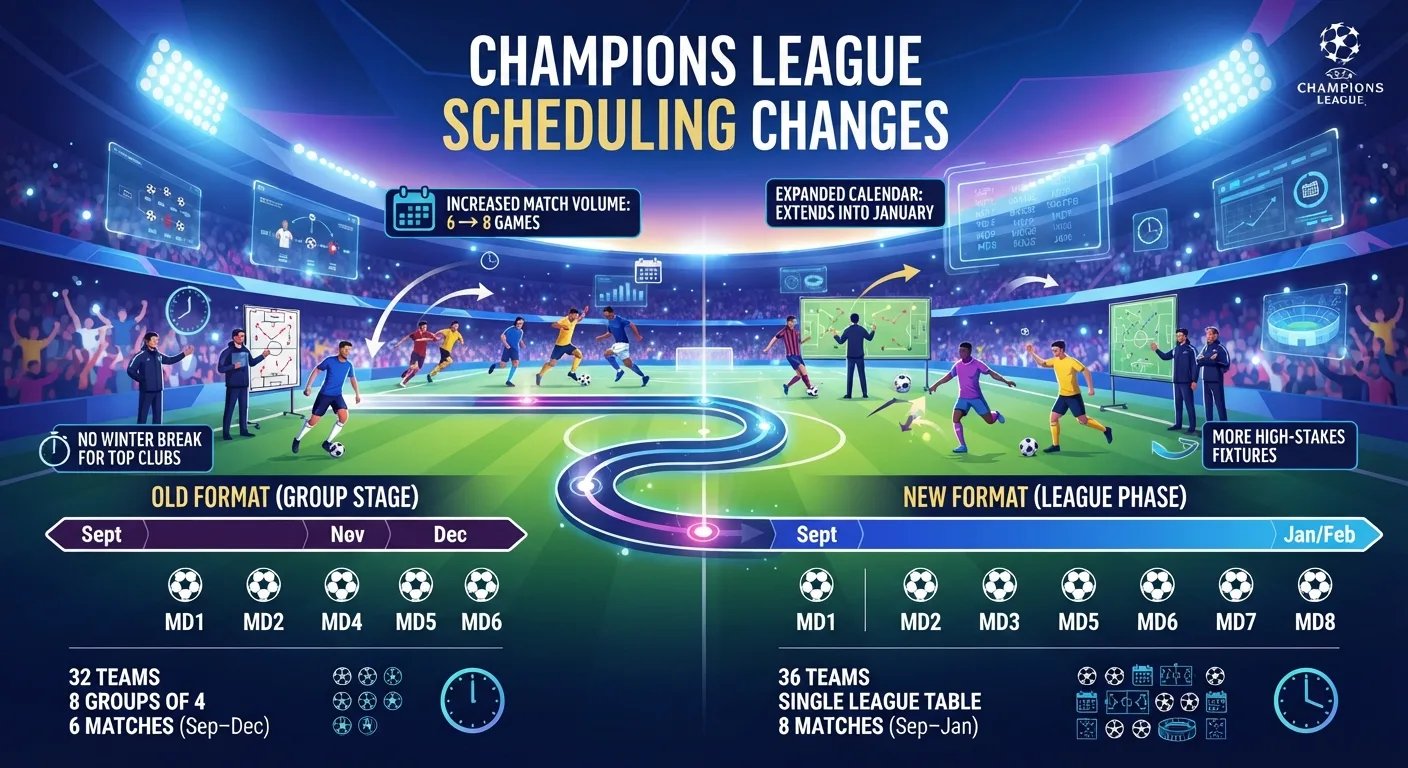
The new UEFA Champions League league phase gives every club eight matches against eight different opponents, instead of the six matches in the old four-team group stage. That means two extra guaranteed European fixtures—one additional home game and one additional away game—and a league phase that continues into January. Clubs must fit those games around domestic leagues, national cups and international breaks while managing travel, training, recovery and squad rotation.
For the 2026/27 season, UEFA's eight league-phase matchdays run from 8–10 September 2026 to 27 January 2027. The dates are not spread evenly: there are European fixtures in successive October weeks, and the final 18 league-phase matches are scheduled simultaneously. Clubs finishing ninth to 24th also face an additional two-legged knockout play-off in February, while the top eight go directly to the round of 16.
Those are the scheduling consequences worth understanding if you search for “European championship league”. The official name is the UEFA Champions League, a club tournament—not the national-team UEFA European Championship. This article explains the operational changes behind the format, drawing on UEFA's 2026/27 regulations , its 2026 league-phase draw guidance , domestic league information and player-workload research. Fact-check date: 8 November 2026.
The biggest scheduling change: eight matches, not six
From 2024/25, UEFA replaced eight four-team groups with a 36-club single league table. The familiar home-and-away arrangement against three group opponents disappeared. Instead, each team meets eight separate opponents, playing four matches at home and four away. UEFA creates the fixtures from four seeding pots and league-phase draw restrictions.
| Scheduling feature | Old group stage | Current league phase |
|---|---|---|
| Participating clubs | 32 | 36 |
| Guaranteed matches per club | 6 | 8 |
| Different first-stage opponents | 3 | 8 |
| Home/away matches per club | 3 home, 3 away | 4 home, 4 away |
| Matches across the stage | 96 | 144 |
| Calendar | Typically September–December | September–January |
| Route to last 16 | Top two of each group | Top eight directly; places 9–24 enter play-offs |
The number of first-stage matches per participating club rises by two, or one-third. Across the competition, scheduled first-stage matches rise from 96 to 144, a 50% increase—the result of both more clubs and more games per club. These are arithmetic comparisons between the two formats, not estimates of player injuries, ticket revenue or broadcasting income.
More fixtures create additional home-match operations and one more European away journey for each league-phase participant compared with the old group stage. The resulting travel distance is not necessarily greater for every club: that depends on the identities and locations of the opponents.
When are the eight Champions League matchdays in 2026/27?
The clearest evidence of the longer season is UEFA's published 2026/27 calendar :
| Matchday | Official dates | What it means for club planning |
|---|---|---|
| 1 | 8–10 September 2026 | A three-day opening matchweek |
| 2 | 13–14 October 2026 | European football returns after an interval |
| 3 | 20–21 October 2026 | A second Champions League week immediately afterwards |
| 4 | 3–4 November 2026 | Another midweek date amid domestic fixtures |
| 5 | 24–25 November 2026 | Late-autumn match commitments |
| 6 | 8–9 December 2026 | Pre-Christmas league-phase fixtures |
| 7 | 19–20 January 2027 | European competition during the January domestic calendar |
| 8 | 27 January 2027 | Final league-phase games played simultaneously |
The matchdays are not eight consecutive weeks. The gaps vary, and the specific challenge depends on the domestic league's own timetable, the club's travel and whether it remains involved in cup competitions. In particular, 13–14 October and 20–21 October form back-to-back European weeks, while the January matches are only about a week apart.
Under UEFA regulation Article 23 , Champions League matches are ordinarily on Tuesdays and Wednesdays, with the opening league-phase matchday also using Thursday. UEFA may authorise exceptions. The final takes place on a Saturday, not as part of the regular league-phase calendar.
Why the January extension matters
Historically, clubs had normally completed the Champions League group stage by December. The new league phase carries meaningful European fixtures into January. That shifts planning for clubs in countries where domestic competitions are active after New Year.
A team still competing for domestic league points may face two Champions League dates in January as well as its local league programme. A club in a league with a winter break may face a different problem: preparing for competitive European matches while its domestic calendar is interrupted or only just restarting. There is no one-size-fits-all winter schedule across Europe.
January can also be a transfer-window period in many leagues. Coaching staffs may need to accommodate squad changes and injuries while preparing for decisive league-phase matches, subject to UEFA's player-registration rules. It would be misleading to say that every January signing is automatically eligible for a Champions League match; eligibility depends on the applicable registration provisions.
The knock-on effect is strategic. A club may have to reserve recovery and tactical preparation time for the European matches rather than treating January only as a domestic or training period. The exact impact varies by country and club.
Why the new draw complicates travel and opposition preparation
In the old format, clubs prepared for three opponents, each twice. Under the new system, they face eight different opponents. UEFA's league-phase rules place clubs in four pots, and each participant faces two teams from each pot, one at home and one away.
That changes the scouting workload. Analysts and coaches cannot simply reuse an opponent-specific plan for a return fixture a few weeks later. They need preparation for eight separate sets of playing patterns, pressing structures, set pieces, individual players and stadium conditions.
From a logistics perspective, each club has four European away matches rather than three. But four trips do not necessarily mean four similar travel days. One may be a relatively short journey; another may require a longer flight, a different climate, unfamiliar local arrangements or a more demanding return itinerary. It is therefore more precise to say that the number of away fixtures rises than to claim that travel hours rise by a uniform percentage.
UEFA also attempts to balance home and away scheduling. Under Article 17 , a club should in principle not have more than two successive home or away fixtures, and should have one home and one away match across both the first two and last two matchdays. UEFA may depart from those principles when necessary.
These safeguards can reduce lopsided sequences, but they do not guarantee identical recovery periods, journey lengths or opponent difficulty for all clubs.
How domestic leagues fit around Champions League fixtures
UEFA's calendar does not replace national competition calendars. Domestic leagues and cup organisers must coordinate their own games around European dates, local stadium requirements, television obligations, travel and player recovery.
The Premier League's 2026/27 scheduling explanation offers a concrete example. It says a Premier League side playing Champions League football on a Tuesday would not normally be scheduled for a domestic league match on the preceding Sunday. It also explains how Thursday European fixtures can affect the following weekend's domestic arrangements.
These are Premier League scheduling principles, not a universal guarantee that every European domestic league gives identical recovery protection. Domestic match placement also depends on broadcasters, cup ties, weather and other fixtures.
Consider a hypothetical team with a Champions League away match on Tuesday, a domestic match the following Saturday and another European fixture the next Tuesday. The club could play three matches across an eight-day span, while also travelling, recovering and preparing tactics. This example illustrates why the sequence matters; it is not a claim about a particular real club's assigned fixtures.
Kick-off windows, simultaneous fixtures and stadium conflicts
The new league phase has operational consequences for stadiums, broadcasters and match organisers as well as players.
Tuesday, Wednesday and the opening Thursday
UEFA's 2026/27 Article 25 sets the normal league-phase kick-off at 21:00 CET, with certain matches allocated 18:45 CET slots; exceptions are possible. The opening round is spread across Tuesday, Wednesday and Thursday, giving organisers a wider first-week broadcasting and stadium schedule.
For spectators outside central Europe, local viewing times can differ depending on the season and time-zone conversion. Always check UEFA's listed kick-off against your own location rather than assuming a fixed local time throughout the year.
All 18 final matchday fixtures together
UEFA's regulations specify that, in principle, all 18 league-phase matches on 27 January 2027 are played simultaneously at 21:00 CET. The synchronised finish means competing clubs cannot normally adjust their final-match approach after seeing an earlier final result from another game. It also requires simultaneous match operations, coverage, officials and stadium readiness across the competition.
When two clubs share a city or stadium
Regulation Article 24 addresses situations where clubs from the same city, within 50 kilometres of one another or using the same stadium have declared a scheduling conflict. UEFA may confirm or alter fixture dates or kick-off times, and has the power to impose a schedule when necessary.
Clubs must therefore coordinate stadium availability, policing, stewarding, transport, pitch preparation and other operational requirements. A draw identifies the opponent and home/away status, but the detailed timetable must also satisfy practical scheduling considerations. Not every proposed domestic fixture can necessarily remain untouched.
Player workload: does the change make the calendar more demanding?
The new system clearly creates two more guaranteed league-phase matches per club than the old group stage. That increases competitive minutes and travel obligations for a team that fields largely the same players. However, it would be inaccurate to attribute any particular injury, fatigue outcome or change in performance solely to the Champions League format without investigating the full schedule.
Player organisation FIFPRO's 2025 workload research raises concerns about prolonged stretches of two games a week, travel and insufficient rest, including the interaction between domestic football, international duty and expanded club competitions. A separate medical expert consensus project identifies recovery, travel and breaks as factors requiring protection.
For clubs, sensible workload management can involve:
- Rotation: managing players' minutes across European and domestic fixtures instead of relying on the same starting eleven every match.
- Recovery planning: considering actual time available between a final whistle, travel, sleep, training and the next match.
- Opposition scouting: preparing for eight different teams without overloading limited preparation sessions.
- Medical monitoring: assessing individual readiness rather than assuming all players respond to congestion in the same way.
- Squad development: creating meaningful roles for suitable substitutes and younger squad members while following registration requirements.
These are practical implications and risk-management approaches, not a guarantee that rotation eliminates injuries or that every club has equal squad depth.
February play-offs can add two more matches
The league-phase ranking changes scheduling beyond January. The top eight go directly into March's round of 16. Clubs ranked ninth through 24th must contest a two-legged knockout play-off in February. Places 25–36 are eliminated from this competition.
For 2026/27, UEFA schedules the two play-off legs for 16–17 February and 23–24 February 2027. A team entering those ties has extra European midweeks, travel and recovery demands between the end of January and the round of 16. A top-eight team avoids the two play-off matches, giving it a different February calendar—even though it still has domestic obligations.
This also changes the maximum route to the final. Ignoring preliminary qualifying rounds, a team reaching the final by finishing in the top eight would play 15 Champions League matches (eight league-phase, six knockout games and the final). A finalist that first had to win the knockout play-offs would play 17. Under the former group-stage structure, a finalist who started in the group stage played 13 matches. The comparison counts full two-legged rounds and excludes extra qualifying matches or abnormal fixture changes.
A strong league-phase finish is therefore valuable beyond prestige: it can remove an entire knockout round from the club's schedule.
What a club's new scheduling workflow might look like
Below is an illustrative planning cycle rather than a published training plan from a named club. It shows how a coaching and operations team might approach a congested European week.
| Planning stage | Key decision |
|---|---|
| Before fixture dates are finalised | Reserve known UEFA matchweeks and identify domestic/cup conflicts |
| After draw and fixture announcement | Confirm travel, hotels, stadium logistics and opponent scouting priorities |
| Seven to four days before a match | Assess workloads, player availability and tactical preparation time |
| Two days before kick-off | Coordinate travel, media obligations, recovery and final training details |
| Immediately after the match | Monitor player recovery, arrange return travel and prepare the next domestic fixture |
| Before the next European round | Review cumulative minutes, injuries, suspensions, league ranking and qualification scenarios |
The programme becomes particularly complex when fixtures fall in consecutive midweeks. Clubs may need to coordinate the first European trip, weekend league game and second European opponent in one continuous planning block. A postponed domestic cup match or an unexpected injury may force the plan to change.
What the new schedule changes for fans and broadcasters
Supporters get four home European fixtures rather than three if their club reaches the league phase. They also see their team face eight different opponents, including clubs from several seeding pots. However, more home fixtures also mean additional ticketing dates, travel planning for supporters and potentially more competition with domestic football for time and spending.
Broadcasters and event organisers handle 144 league-phase matches instead of 96 old group-stage games. The wider inventory can create more programming opportunities, but the simultaneous final matchday and cross-competition calendars require careful scheduling. It is not possible to calculate precise broadcaster revenue or net club profit from the match count alone; commercial rights, costs and distribution terms matter.
UEFA presented the revised format partly as a way to produce more varied high-profile fixtures. For historical background, see FlyingEze's coverage of the original Champions League format approval . That earlier article provides context; the 2026/27 dates and operating rules in this guide come from newer UEFA material.
Does the new league phase make the schedule fairer?
Fairness has several dimensions. UEFA guarantees four home and four away matches and uses draw constraints to spread opponents across seeding pots. Its scheduling rules also aim to prevent long home-only or away-only runs. Those mechanisms provide structure.
But the opponents are not identical for every club. Nor does every club have equal travel distance, domestic league congestion or squad resources. A club can encounter a difficult sequence while another faces different dates and travel challenges. The format may offer broader variety and more competitive opportunities, but a precise claim about whether a particular club was advantaged requires analysis of its actual fixtures—not simply an opinion about the new system.
The league table adds another strategic layer: clubs must balance qualifying for the knockouts with trying to finish in the top eight and avoid February. This can keep the value of league-phase points high through the final matchday, making squad selection and rest decisions more consequential.
Frequently asked questions
How many Champions League league-phase games does each club play?
Eight matches against eight different opponents: four at home and four away. It is two more guaranteed matches than under the former six-game group stage.
Does the Champions League now play matches in January?
Yes. In 2026/27, matchdays seven and eight take place on 19–20 January and 27 January 2027 respectively. January fixtures are an important change from the former group-stage calendar.
Are Champions League matches always played on Tuesdays and Wednesdays?
Normally, yes, but UEFA schedules the first league-phase matchday across Tuesday, Wednesday and Thursday. The final is played on a Saturday, and UEFA regulations allow specified exceptions.
Does every team have the same travel schedule?
No. Each club has four European away fixtures, but destinations, travel distances, kick-off arrangements and domestic match sequences differ.
Can a team play three Champions League home matches in a row?
UEFA's regulations state that, in principle, a club should not play more than two consecutive home or away matches. The UEFA administration can make exceptions when needed.
Why does finishing in the top eight help the calendar?
The top eight advance directly to the round of 16 and avoid February's two-legged knockout play-offs. Teams finishing ninth to 24th must play those extra fixtures to progress.
When does the 2026/27 Champions League league phase end?
It ends on 27 January 2027, with the final 18 league-phase matches scheduled to start simultaneously, in principle at 21:00 CET.
Conclusion
The new Champions League league phase changes more than the league table. Every participating club has two additional guaranteed European matches, faces eight rather than three distinct opponents, travels for four instead of three away fixtures and continues competing into January. Teams finishing ninth to 24th can then take on another two matches in February before reaching the round of 16.
For clubs, the practical response is better coordination between European and domestic fixtures, travel arrangements, opponent analysis, player recovery and squad selection. For fans, the format means more home matches, more varied opponents and a longer period in which European results shape the calendar.
Follow UEFA's official Champions League coverage and its 2026/27 regulations for confirmed dates, fixtures and exceptions. Research verified 8 November 2026. Future schedules are subject to UEFA updates.