
Historical retrospective — researched on 6 November 2026. This independently written account examines a sports debate originally broadcast in May 2020. It should not be confused with new remarks made in 2026 or represented as a copy of FlyingEze's missing article. The original FlyingEze publication date has not been established.
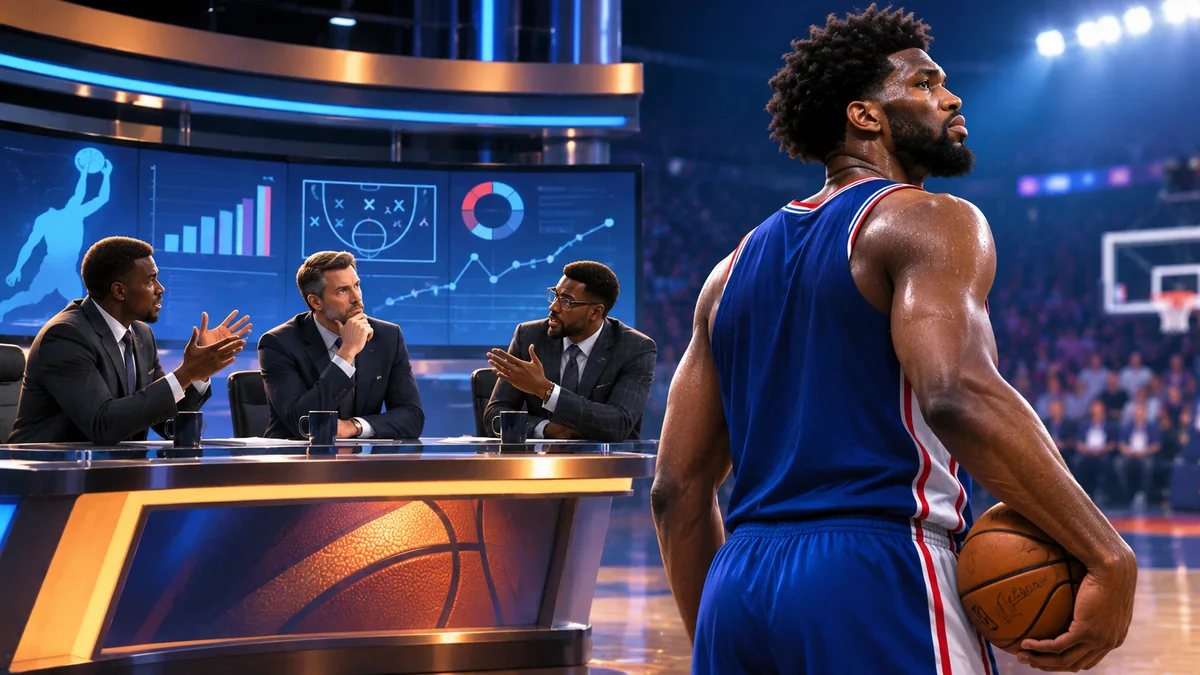
On 15 May 2020, ESPN's First Take examined a provocative question: had Philadelphia 76ers centre Joel Embiid's NBA career been a disappointment? Stephen A. Smith joined Max Kellerman and Jalen Rose to discuss a player whose talent and production were clear, but whose early injury history and team's limited playoff success had raised expectations he had yet to satisfy.
The official ESPN video, “Has Joel Embiid's career been a disappointment?” , establishes the date, topic and participants. It is the strongest direct source for the event behind the old FlyingEze headline. Crucially, the discussion happened nearly three years before Embiid won the NBA's Most Valuable Player award in May 2023. The historical question needs to be judged by what was known in spring 2020, while later achievements help explain how the conversation changed.
What did Stephen A. Smith and First Take discuss?
ESPN published the segment on Friday, 15 May 2020, describing it as a debate between Smith, Kellerman and Rose about whether Embiid's career up to that point had fallen short of expectations. That wording matters: the television programme posed a question, rather than reporting a league ruling or a verified consensus that Embiid was a failure.
Smith had been a prominent and sometimes demanding critic of the 76ers. His public commentary often separated the value of a talented player from the standard expected of someone promoted as a potential franchise centrepiece. The debate reflected a larger question faced by highly regarded athletes: should they be evaluated by individual excellence, postseason results or the gap between their achievements and the considerable hopes placed upon them?
The ESPN recording is available for anyone wishing to hear each participant's position and emphasis. This retrospective does not attribute unverified verbatim statements to the panel. The original video's title and description establish the discussion; subsequent statistics and league records help evaluate its historical setting.
Why was Embiid facing such high expectations in 2020?
Philadelphia selected Embiid with the third overall pick in the 2014 NBA Draft after his season at the University of Kansas. He was viewed as a centre with unusual coordination, shooting touch and defensive potential, capable of changing games at both ends of the court. But a foot injury forced him to miss his first two NBA seasons. His regular-season debut did not arrive until 2016.
USA Basketball's official profile records the draft position and lengthy initial recovery. The delayed start became central to his story: by the time he played, the 76ers had spent years rebuilding and assembling young talent in a strategy associated with the phrase “The Process”. Embiid adopted that phrase as a nickname.
He showed elite ability relatively quickly. In the 2018–19 regular season, he averaged 27.5 points and 13.6 rebounds per game. Those numbers, documented in Basketball-Reference's historical season record , made him one of the NBA's most productive big men. They also raised the bar: once a player can dominate individual matchups, observers naturally begin asking whether his team can contend for a championship.
That tension made a “disappointment” discussion possible even when the athlete's basic talent was not in question. Embiid had already established a high level of play; the debate concerned whether the combination of his availability, consistency and team results matched his potential.
The 2019 Raptors playoff loss shaped the criticism
Perhaps the most important basketball background was Philadelphia's 2019 Eastern Conference semi-final against the Toronto Raptors. The series went to Game 7, with a place in the conference finals at stake. On 12 May 2019, Kawhi Leonard hit a famous last-second shot that bounced around the rim and fell, giving Toronto a 92–90 victory.
The NBA's contemporary account and its 2019 playoff archive record the drama of the series. The result denied Philadelphia a chance to reach the conference finals, while Toronto went on to win the championship. For Sixers supporters, it became a particularly painful example of how close a promising team could come without progressing.
Attributing the defeat solely to Embiid would be reductive. Basketball is a team sport, and that close series turned on many possessions, coaching decisions and performances. Nevertheless, the loss became part of the public discussion of whether a celebrated young centre could lead his club to the next level.
When the ESPN panel discussed expectations a year later, that defeat was still recent history. A viewer assessing the original 2020 broadcast should remember that the title was not informed by Embiid's later MVP award, but by a Philadelphia project still seeking a breakthrough.
Why the 2019–20 76ers looked inconsistent
The season immediately preceding the broadcast had given analysts further material to debate. On 11 March 2020, the NBA suspended play because of the emerging COVID-19 pandemic. Philadelphia stood at 39 wins and 26 losses, occupying sixth place in the Eastern Conference. The club's home record was formidable, but its performances away from home had been much less convincing.
The NBA's June 2020 Sixers season reset confirms the record and describes the uncertainty surrounding Ben Simmons's availability and the team's form at the hiatus. CBS Sports' 1 May analysis identified a home record of 29–2 compared with 10–24 on the road at that point. That gulf made consistency a legitimate topic for discussion.
Injury interruptions also affected the roster. Embiid had missed games, while Simmons had dealt with a back problem. The Sixers had significant talent, but the balance between their big men, shooting, spacing and line-up combinations had not reliably produced the dominance that preseason expectations suggested.
These circumstances are not proof that Embiid personally caused every defeat. They explain why an analyst might question the overall trajectory of a franchise built around him, and why other analysts might instead point to roster construction and health as limiting factors.
What were Embiid's actual numbers?
The season averages help separate performance from commentary. Embiid finished the 2019–20 regular season with 23.0 points, 11.6 rebounds and 3.0 assists per game in 51 appearances. Those are full-season numbers, including games played after the NBA resumed competition, not a claim about his exact average on the day of the 15 May broadcast. His 2018–19 campaign had produced higher scoring and rebounding averages.
On their face, 23 points and nearly 12 rebounds per game represent substantial production. But an elite player can generate excellent statistics while his team underperforms expectations. Such a gap can be a reason to ask difficult questions, provided analysts recognise that individual statistics and playoff team outcomes measure different things.
At the time of the ESPN discussion, Embiid had also been selected as an All-Star in three consecutive seasons beginning in 2018. He was already far removed from the category of a draft prospect who had failed to make an impact. The more relevant debate was how to define success for an unusually talented but injury-affected centre.
Availability, fitness and roster construction
Embiid's health history was impossible to ignore because his first two seasons were lost to injury and his later playing time required careful management. Yet a missed game does not, by itself, demonstrate poor commitment or character. Injury histories must be reported separately from opinions about effort, preparation and performance.
Stephen A. Smith had publicly challenged Embiid's performances before this May debate. In November 2019 coverage by CBS Philadelphia , Smith criticised a scoreless game against Toronto and questioned aspects of Embiid's conditioning and offensive positioning. Those comments are a separate, dated instance of criticism—not a transcript of the May 2020 programme.
The Sixers also faced decisions that no one player could control alone. They were trying to fit Embiid and Simmons with other established players while maintaining enough spacing and late-game shot creation. Jimmy Butler had departed for Miami after the 2018–19 season. Assessing the franchise's progress therefore required consideration of management, the coaching system, teammates and opponents, not simply Embiid's box score.
That distinction is central to a fair historical article. A television debate can legitimately ask whether expectations have been met, but the answer is an interpretation of evidence, not a fact established by the strength of an on-air opinion.
Why the date of the debate matters
The NBA was paused when ESPN posted its video. The league did not formally resume games until 30 July 2020 at a single-site campus near Orlando, Florida, following public-health agreements. The 11 March suspension statement and 2020 restart guide confirm that chronology.
Consequently, the May debate could not have incorporated Philadelphia's subsequent performance in the 2020 playoff bubble. The 76ers later lost their first-round series to Boston in four games, an outcome documented in the NBA's August 2020 recap . That later result belongs in retrospective context, not as a reason Smith supposedly raised the question in May.
Historical sports reporting becomes unreliable when later outcomes are silently inserted into an earlier argument. The point is not to pretend that subsequent events did not occur, but to show clearly what observers knew at the time and how later information changed the picture.
What happened after First Take's 2020 question?
Embiid's subsequent career supplied major evidence that a categorical verdict of failure in 2020 would have been premature. In 2020–21, he averaged 28.5 points and 10.6 rebounds and finished runner-up in NBA MVP voting. Philadelphia earned the Eastern Conference's top seed, although the Sixers then lost a seven-game semi-final to the Atlanta Hawks.
The Sixers' official Game 7 recap shows Embiid contributing 31 points and 11 rebounds in the 103–96 defeat. The outcome sustained questions about Philadelphia's postseason ceiling, but it also illustrated why a team loss should not automatically be read as an individual lack of production.
In 2021–22, Embiid became the NBA's scoring champion with a 30.6-point average, according to USA Basketball's career record . He again finished runner-up to Nikola Jokić in the MVP voting. Then, on 2 May 2023, the NBA officially named Embiid the 2022–23 Most Valuable Player. He averaged 33.1 points and 10.2 rebounds that season, and the award was his first league MVP honour.
The NBA's official MVP announcement provides the definitive record. These later individual achievements do not settle every question about postseason performance, but they render any unqualified, timeless claim that Embiid's career had simply been a disappointment misleading.
Embiid also won a gold medal with the United States men's basketball team at the 2024 Olympic Games, as recorded by USA Basketball. That is another distinction that did not exist in May 2020 and should always be labelled as a later development.
How did Stephen A. Smith's assessment evolve?
A recurring theme of sports commentary is that views change when performances change. In April 2023, as Embiid's MVP case strengthened, Smith publicly stated that he intended to vote for the Philadelphia centre for the award. Contemporary reporting by NBC Sports Philadelphia, carried by Yahoo Sports , documents the change in tone and the reasons Smith gave for supporting his candidacy.
This later endorsement is significant because it demonstrates why the 2020 segment should not be treated as a permanent verdict on the player or even as a complete summary of Smith's subsequent opinion. It is possible to question whether a star has met expectations at one moment and later recognise an exceptional season.
It also shows the importance of using the original video as the source when attributing specific arguments. A headline about a debate does not justify inventing direct quotations or simplifying three commentators' positions into one single judgement.
What does “disappointment” mean in evaluating an NBA star?
There is no universally accepted statistical formula for disappointment. It depends on the standard used. If success means becoming an All-Star-calibre NBA player, Embiid had already achieved it by 2020. If it means leading a team to the conference finals, the Sixers had fallen short. If it means winning an MVP award, that milestone came in 2023. If it means balancing durability with elite production over a long career, the analysis has to account for both exceptional play and injury interruptions.
A rigorous discussion therefore separates individual quality, team results, availability and expectations. Points and rebounds describe production; awards represent recognition; playoff progress measures a team's outcomes. All are useful, but none alone answers every question.
For readers exploring the later rise that altered this assessment, FlyingEze's earlier coverage of Embiid's confidence in his MVP case provides a related, separately dated perspective. Its report on his return from an injury absence provides context on the availability concerns that accompanied his elite form. These are verified existing FlyingEze CMS records, not evidence that either later article was part of the May 2020 broadcast.
Timeline: the Embiid debate and what followed
- 2014: Philadelphia drafts Embiid third overall; he subsequently misses two seasons while recovering from foot problems.
- 2016: Embiid makes his NBA debut.
- 12 May 2019: Philadelphia's season ends against Toronto on Kawhi Leonard's Game 7 buzzer-beater.
- 26 November 2019: Smith publicly criticises Embiid's scoreless game against Toronto in a separate First Take discussion.
- 11 March 2020: The NBA suspends the season because of COVID-19.
- 15 May 2020: ESPN publishes First Take's debate over whether Embiid's career has disappointed.
- August 2020: Boston sweeps Philadelphia in the first round after the league restarts.
- June 2021: Philadelphia loses Game 7 of the Eastern Conference semi-final to Atlanta.
- 2022: Embiid wins his first NBA scoring title.
- 2 May 2023: Embiid wins his first NBA MVP award.
- 2024: Embiid wins Olympic gold with the US basketball team.
Frequently asked questions
When did Stephen A. Smith discuss whether Joel Embiid was a disappointment?
The relevant ESPN First Take video was published on 15 May 2020.
Who participated in the ESPN discussion?
Stephen A. Smith, Max Kellerman and Jalen Rose, according to the video's official description.
Was Embiid an NBA MVP when the comments were made?
No. The discussion took place in 2020. He won his first MVP award in May 2023.
Was the 2020 NBA season still underway at the time?
It was suspended. The league stopped play on 11 March and resumed the season on 30 July 2020.
What was the main criticism of Embiid's career at the time?
The discussion centred on expectations for a highly talented player whose early career had involved injuries and whose team had not advanced beyond the Eastern Conference semi-finals.
Where is the original ESPN debate?
The verified upload is “Has Joel Embiid's career been a disappointment? | First Take” on ESPN's official YouTube channel .
Conclusion
The May 2020 debate was a genuine moment in Joel Embiid's evolving reputation: a three-person ESPN discussion that asked whether extraordinary potential had yet produced sufficiently strong results. The question reflected injuries, Philadelphia's uneven season and the memory of a painful playoff defeat. It did not establish as fact that the player was a failure.
Subsequent achievements, above all Embiid's 2023 NBA MVP award, materially changed how readers should interpret that old headline. An accurate reconstruction preserves the date and the debate while acknowledging what came next. It is a reminder that sport's most definitive-sounding judgements are often arguments about a particular moment, not final histories of a career.
Editorial disclosure: This historical article is independently written from ESPN's original May 2020 video, NBA archival records and subsequent documented awards. It is not a verbatim copy of the missing FlyingEze story. No original FlyingEze publication timestamp has been recovered.

