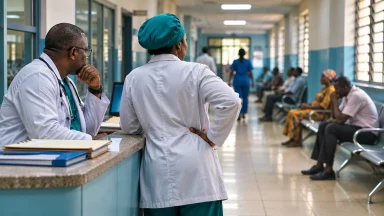
Historical retrospective — researched 7 November 2026. This report revisits the Nigerian Medical Association's ultimatum of late August 2021 during a nationwide resident doctors' strike. The deadline of 18 September 2021 and subsequent developments are historical. This is an independently researched reconstruction, not a copy of the original FlyingEze article; its original publication timestamp has not been established.
On 31 August 2021, the South-West caucus of the Nigerian Medical Association (NMA) warned that doctors in the region could join the nationwide resident doctors' strike if the Federal Government failed to address outstanding demands before 18 September. The warning followed a 21-day ultimatum backed by the NMA's national leadership and came as the National Association of Resident Doctors (NARD) continued an indefinite walkout over salaries, residency training funding and working conditions.
Dr Bolaji Salako, then secretary of the NMA's South-West caucus, explained the group's position in an interview with the News Agency of Nigeria (NAN) in Ibadan on 31 August. A Pharmanews report published on 1 September 2021 , explicitly credited to NAN, preserves the account. The same details appeared in The Interview on 31 August , while a Punch newspaper archive records a report using the exact headline on 31 August 2021.
Salako said the ultimatum also covered the concerns of the Medical and Dental Consultants' Association of Nigeria (MDCAN) and other medical professionals. The South-West leaders were threatening a possible solidarity strike; the available evidence does not show that the caucus automatically began one when the deadline arrived. The wider NARD dispute eventually moved towards suspension in early October.
What did the South-West NMA announce in August 2021?
The central announcement was a deadline, not an immediate withdrawal of medical services. The NMA's South-West caucus said the government had until 18 September 2021 to make sufficient progress on demands from resident doctors and other affiliates. If those concerns were unresolved, the caucus would consider joining the action.
According to the NAN account, Salako said an emergency meeting would be convened after the deadline to determine whether a strike or another response was appropriate. This matters because an ultimatum is a warning that action may follow; it is not proof of a strike declaration or proof that all doctors in the region had already stopped working.
The warning reflected a position previously discussed by the NMA's National Executive Council (NEC). The Nation's 29 August report described the 21-day notice and a proposed wider action involving the NMA, NARD, consultants and medical academics. Another 29 August account quoted an NMA statement signed by then-president Professor Innocent Ujah and Secretary-General Dr Philips Ekpe supporting efforts to resolve the dispute.
The South-West caucus therefore was not independently setting an unrelated deadline. Its intervention reinforced the national medical association's warning and drew attention to specific complaints in Ekiti and Osun states.
Why were Nigeria's resident doctors already on strike?
NARD's latest nationwide industrial action began on 2 August 2021. Resident doctors, who provide essential hospital care while undertaking specialist training, had been dissatisfied with the implementation of previous agreements, salary delays and outstanding professional benefits.
Channels Television reported the planned action on 31 July , following NARD's National Executive Council meeting in Umuahia, Abia State. The association said irregular payment of salaries to house officers remained unresolved despite earlier undertakings. Punch's 3 August coverage described disrupted care at public hospitals as resident doctors withdrew their services.
The matters at issue extended beyond one month's wages. Doctors demanded payment of the Medical Residency Training Fund (MRTF), resolution of salary problems affecting personnel on federal payment platforms, outstanding allowances and support for families of colleagues who had died in service. NARD also objected to decisions affecting the status of house officers in public service arrangements.
Various demands involved federal authorities, state governments, teaching hospitals or individual payroll systems. It would be misleading to imply that a single ministry controlled every unpaid entitlement or that all clinicians faced identical circumstances.
What was the 21-day ultimatum meant to achieve?
Trade unions often use deadlines to give employers or governments a fixed period to negotiate before considering more disruptive action. The 2021 NMA ultimatum served that function. It was designed to increase pressure on the government by signalling that the resident doctors' dispute could spread beyond NARD to a broader range of physicians.
Some medical consultants and specialists had continued working while residents were absent. If a much wider group of doctors had withdrawn services at the same time, hospitals could have faced an even greater challenge maintaining routine appointments, inpatient treatment and emergency services.
At its late-August meeting, the NMA discussed not just NARD's concerns but those of MDCAN and medical academics. The Nation reported that the groups were frustrated by unresolved terms of service and the implementation of agreements. The warning was a form of collective professional pressure, not a verified report that every affiliated group had begun a simultaneous strike.
Salako also appealed for the government to honour its commitments so that doctors could return to patients. His message connected pay and employment disputes to the broader need for public confidence in institutions, especially while hospitals were treating people during the COVID-19 pandemic.
What complaints did the South-West caucus raise about Ekiti?
Beyond the national strike, Salako drew attention to allegations that the Ekiti State Government had not paid doctors their full and appropriate salaries. This complaint was included in the NAN report, which named Ekiti as one of the local examples illustrating medical workers' dissatisfaction.
The allegation concerned remuneration and working conditions as represented by the doctors' association. The available contemporaneous sources reviewed for this reconstruction do not provide audited payroll records for the individual workers involved or a detailed response from the Ekiti State Government to this particular statement.
It would therefore be wrong to supply a specific monetary debt, an exact number of affected doctors or a court finding that was not established by the sources. The documented fact is that the South-West NMA raised the salary complaint publicly in its late-August warning.
The broader problem was that health-sector negotiations at the federal level could not necessarily resolve every state-level salary dispute. Conditions differed by employer and payment system, creating pressures across the region even while NARD's national strike dominated headlines.
Why did the association mention maternity-leave allowances in Osun?
The NMA South-West caucus also criticised the reported refusal to pay call-duty and related allowances to female doctors on maternity leave at Obafemi Awolowo University Teaching Hospitals, Ile-Ife, in Osun State. The NAN report described the association's objection as a complaint of unfair treatment.
A separate Punch HealthWise archive entry dated 31 August 2021 records reporting on the same concern. This provides additional support that the maternity-leave dispute was part of the contemporaneous South-West discussion, rather than an allegation invented in a later retelling.
Call-duty allowances normally relate to professional responsibilities and arrangements for duty outside ordinary schedules. The precise treatment of such allowances during maternity leave may depend on employment terms, applicable rules and agreements. The available report does not establish the legal outcome of the dispute or precisely which employer had the final payroll responsibility.
In particular, the teaching hospital's identity as an institution in Osun must not be confused with proof that the Osun State Government directly controlled each disputed payment. This account accurately attributes the NMA's complaint without treating its view as a final legal ruling.
The issue shows why the South-West warning was not simply about backing another union. It addressed conditions that affected doctors' livelihoods, including gender-related questions about equitable treatment during maternity leave.
How did the Federal Government respond to the wider doctors' strike?
The Federal Government argued that it was pursuing negotiations and applying relevant labour rules, while NARD maintained that important obligations had not been fulfilled. The dispute escalated through both collective bargaining and litigation.
On 23 August 2021, the National Industrial Court of Nigeria announced that Justice John Targema had ordered the parties to suspend hostilities, with an order directed at the resident doctors' ongoing action pending further proceedings. The ruling did not immediately end the strike.
The government then directed federal tertiary-hospital managers to apply the “no work, no pay” provision to striking doctors. TheCable reported on 27 August that the instruction was contained in a letter dated 26 August, signed by Dr Adebimpe Adebiyi, Director of Hospital Services in the Federal Ministry of Health.
The ministry relied on provisions of the Trade Disputes Act concerning remuneration during strike action. NARD and other doctors' representatives objected to the measure and pressed the government to fulfil the disputed agreements. Their positions were not interchangeable: the government emphasised labour law and budgetary processes, while the doctors emphasised unpaid entitlements and the need for credible implementation.
On 17 September 2021, close to the NMA ultimatum's expiry, a further National Industrial Court ruling directed resident doctors to suspend their strike. The Nation's 18 September account reported NARD's intention to appeal, with the association disputing the fairness of the proceedings. The existence of court orders should not be mistaken for an immediate resolution of every salary and welfare disagreement.
What was the risk for patients and hospitals?
Resident doctors form a substantial part of the clinical workforce in teaching hospitals and specialist facilities. When many withdraw services, consultants, nurses, house officers and other health professionals may have to assume additional tasks within the limits of their qualifications and institutional responsibilities.
The effects were documented early in the 2021 strike. At Lagos State University Teaching Hospital, reporting described patients encountering reduced services and senior doctors under pressure. FlyingEze's related historical reconstruction of the August 2021 LASUTH disruption explores how the nationwide strike affected that particular hospital. It is a separate event report, not proof that the South-West solidarity warning resulted in another region-wide shutdown.
Longer queues, postponed consultations and pressure on emergency services were credible concerns. However, the available reports do not provide a reliable total of patients harmed specifically by the South-West NMA's proposed action, because the warning itself was not a recorded region-wide strike.
Salako's concern also came amid a resurgence of COVID-19 cases. The possibility of extending the withdrawal of medical services to a wider range of doctors raised obvious public-health questions. At the same time, unresolved wages, allowances and workforce conditions could undermine hospital staffing and the ability to retain skilled clinicians over time.
The episode illustrates a difficult tension: patients require continuity of care, while doctors argued that repeated unfulfilled commitments were making their work unsustainable. Responsible coverage can acknowledge both the immediate disruption and the long-term staffing issues without presuming that one side's entire account was proven.
Did the South-West NMA actually start its threatened solidarity strike?
The contemporary evidence establishes a threat and a deadline, not a confirmed start of a comprehensive South-West solidarity walkout on 18 September 2021. Salako explicitly described a planned emergency meeting at which the caucus would decide whether to strike or pursue another course.
The later documentary record centres on negotiations, court proceedings and the continuing NARD strike. It does not provide sufficient evidence to conclude that the entire NMA South-West caucus carried out the threatened action as originally proposed. A historical headline using the phrase “threatens solidarity strike” must retain that conditional meaning.
The broader NARD strike did continue beyond the 18 September deadline. Doctors and government representatives remained in talks; NARD issued further demands and its leadership changed during the dispute. These developments should not be retrospectively rewritten as though the South-West caucus's threatened regional strike had automatically gone into effect.
How did the nationwide resident doctors' dispute end in October?
On 4 October 2021, NARD announced the suspension of its nationwide strike following an emergency leadership meeting and reported progress on some demands. Doctors were directed to resume work on Wednesday, 6 October.
TheCable's 4 October report quoted new NARD president Dr Godiya Ishaya confirming the decision. The Guardian and Punch independently recorded the return-to-work timetable.
Reports varied in describing the length of the stoppage as approximately 63 or 64 days, depending on the counting convention and the point at which it was measured. The firm dates are clearer: the strike began on 2 August, was suspended on 4 October and services resumed from 6 October.
Its suspension was not a declaration that every concern had been permanently resolved. NARD said the government had made progress on such issues as the residency training fund and salary payments, while further obligations remained subject to implementation. In an official statement on 7 October , the Federal Ministry of Labour welcomed the suspension and discussed a proposed annual allocation for hazard allowances beginning in the 2022 budget.
This later outcome gives context to the August warning: medical associations were trying to obtain negotiated improvements, but the solution emerged over several weeks rather than from a single ultimatum.
What did the dispute reveal about Nigeria's health workforce?
The South-West caucus's demands reflected problems at multiple levels of the health system: pay administration, specialist training, doctors' career structures and treatment of workers across different employers.
When salary disputes persist, health workers may lose confidence in the institutions responsible for their employment. When hospitals cannot maintain stable medical staffing, patients face delays and the burden of care can shift onto fewer clinicians. This was especially consequential during a pandemic that placed unusual pressure on health facilities.
Yet disputes of this kind require careful distinction between reported grievances and confirmed outcomes. Unpaid salaries alleged by a union, a government claim that payment has been processed and an audited payroll record are not identical forms of evidence. The fairest historical account identifies the source of each claim and what later developments can actually confirm.
For readers encountering the old headline, the enduring significance is less the threat of an imminent 2021 walkout than the underlying challenge of establishing credible, sustainable agreements between doctors, hospitals and governments.
Timeline: South-West NMA ultimatum and the 2021 NARD strike
- 31 July 2021: NARD announces a new nationwide strike to begin on 2 August.
- 2 August 2021: Resident doctors begin an indefinite industrial action over unresolved pay and employment demands.
- 21–23 August 2021: Negotiations continue; the National Industrial Court issues an interim order concerning the strike.
- 26–27 August 2021: The Federal Ministry of Health directs hospital managers to apply a no-work-no-pay rule.
- 28–29 August 2021: The NMA's national leadership supports a 21-day ultimatum covering demands of doctors and affiliates, set to expire on 18 September.
- 31 August 2021: South-West caucus secretary Dr Bolaji Salako tells NAN in Ibadan that a solidarity strike is possible if the outstanding demands are not addressed.
- 17–18 September 2021: The industrial court issues another return-to-work order; the ultimatum deadline arrives. A region-wide South-West solidarity walkout is not established by the reviewed sources.
- 4 October 2021: NARD announces that its nationwide action has been suspended.
- 6 October 2021: Resident doctors resume duties under the association's return-to-work direction.
Frequently asked questions
When did the South-West NMA threaten a solidarity strike?
Its warning was reported on 31 August 2021, amid NARD's nationwide industrial action.
What was the deadline given to the government?
The 21-day NMA ultimatum was scheduled to expire on 18 September 2021.
Who spoke for the South-West caucus?
Dr Bolaji Salako, then the caucus secretary, spoke to the News Agency of Nigeria in Ibadan.
Which doctors' organisations were involved?
The warning concerned the NMA, the striking National Association of Resident Doctors and other affiliates, including the Medical and Dental Consultants' Association of Nigeria.
What were the regional complaints?
The caucus cited alleged shortfalls in doctors' salaries in Ekiti and disputed non-payment of call-duty and other allowances to female doctors on maternity leave at an Ile-Ife teaching hospital.
Did the threatened regional strike definitely happen?
The available reports establish that it was threatened and that a decision was to follow an emergency meeting. They do not establish that the entire South-West caucus began a regional strike on 18 September.
When did the national resident doctors' strike end?
NARD suspended its strike on 4 October 2021, directing members to resume work on 6 October. Some demands still required implementation.
Conclusion
The South-West NMA's ultimatum in August 2021 reflected mounting frustration over a nationwide resident doctors' strike and a wider set of doctors' welfare complaints. With an 18 September deadline, the caucus warned it could join the withdrawal of services if the government failed to address concerns involving NARD, consultants and other medical professionals.
The warning mattered because it suggested that disruption could spread beyond resident doctors at a time when hospitals were already under severe pressure. But the threat was conditional. Historical accuracy requires distinguishing it from an actual regional strike and recognising that the broader dispute continued through negotiations and litigation until NARD suspended its action on 4 October 2021.
Editorial disclosure: This is an independently written historical reconstruction for FlyingEze. It draws on contemporary NAN-based coverage, NMA and NARD reporting, National Industrial Court records and October 2021 reports of the strike's suspension. The original FlyingEze article text and publication timestamp were not recovered. The accompanying featured image is an AI-generated editorial illustration and is not an authentic photograph of the 2021 NMA meeting or any particular hospital.