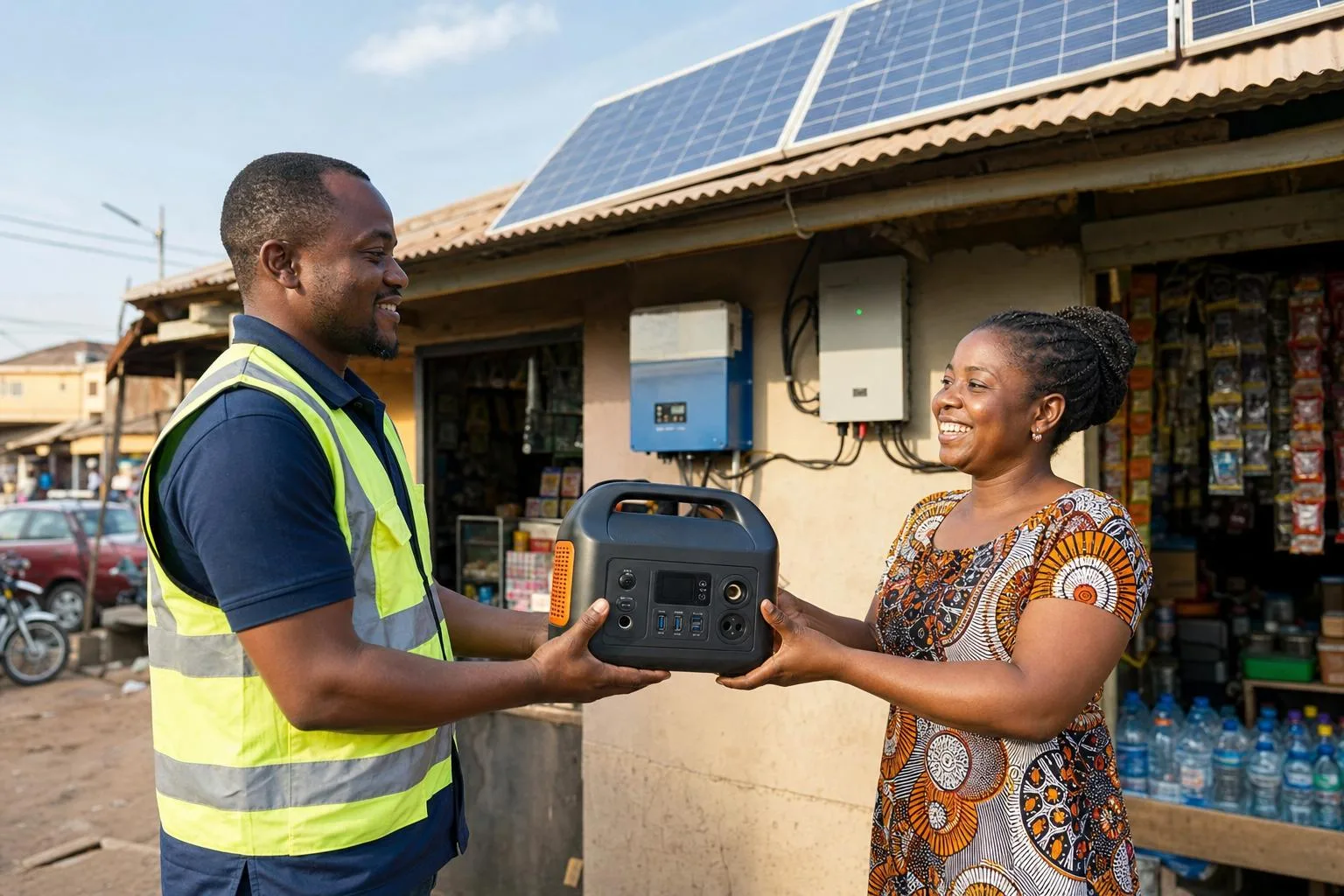
For Nigerian shop owners, pharmacies, restaurants and small offices, solar electricity can reduce generator use and disruption from grid outages. But the wrong installer can turn a promising investment into an expensive and potentially unsafe system. Choosing solar power for small businesses therefore involves more than comparing panel prices or the number printed on an inverter.
A competent provider should verify your electricity requirements, choose compatible components, explain safety measures and support the installation after handover. Nigeria’s Electricity Management Services Agency (NEMSA) operates competency certification for relevant electrical installation personnel. Before signing a contract, ask these seven questions.
1. Are you certified and qualified to install solar systems in Nigeria?
Request the installer’s current NEMSA certification details, company registration information and the name of the practitioner responsible for the work. NEMSA’s renewable-energy installation scheme covers photovoltaic arrays, battery storage, hybrid systems, protective systems and maintenance. Verify credentials through NEMSA digital services or its certified-company directory . A certificate should be current, appropriate for the work and attributable to the actual installation team. Do not rely on WhatsApp images alone. Red flag: refusal to provide verifiable qualifications.
2. Will you inspect my business and calculate its actual electricity requirements?
A credible installer conducts an energy audit rather than selling a generic inverter size. They should document appliance wattages, quantities, hours of use, simultaneous loads, compressor starting currents and how long backup is needed. For example, five 10W LED bulbs running eight hours consume 400Wh; two 50W fans for eight hours use 800Wh; a 25W POS/router for ten hours consumes 250Wh; a 60W laptop for five hours uses 300Wh. Together that is 1,750Wh (1.75kWh) daily. Inverter sizing also requires the simultaneous wattage, while battery sizing depends on the portion of energy needed during outages. Ask for the calculations, assumptions about local sunshine, conversion losses and battery usable capacity in writing. Read FlyingEze’s solar panel and battery sizing guide for a worked example. Red flag: a guarantee that an inverter will power everything before examining your loads.
3. Which solar panels, inverter and batteries will you install?
Request exact manufacturer names, models and datasheets—not vague descriptions like ‘premium’ or ‘original’. For panels, compare rated watts, electrical specifications, efficiency and warranty terms. For the inverter, check continuous AC output, surge capability, MPPT voltage range and battery compatibility. For batteries, ask about chemistry, nominal and usable kilowatt-hours, maximum charge/discharge currents, depth of discharge, battery-management-system support and expected performance under specified conditions. A 25.6V, 100Ah battery contains a nominal 2.56kWh, not necessarily that amount of usable AC energy. The Standards Organisation of Nigeria has renewable-energy and electrical-installation standardisation committees; ask which applicable standards each item meets. Red flag: refusal to identify exact equipment models.
4. Can you show completed installations and provide customer references?
Ask for examples of similar projects and, with permission, speak to previous customers. A pharmacy’s refrigeration needs differ greatly from those of a boutique or phone-accessories shop. Confirm whether installed systems achieved their expected backup duration, whether faults occurred and how service requests were handled. Customer references that have operated for several months can be more informative than pictures of freshly installed panels. The US Department of Energy also recommends interviewing several installers, examining experience and checking testimonials. Its recommendations are general consumer guidance, not Nigerian certification rules. Red flag: exclusively unverifiable portfolio images or unwillingness to supply references.
5. How will you ensure the installation is electrically and structurally safe?
Ask for an inspection of roof conditions, shading, panel mounting and wind exposure, as well as cabling routes and the existing distribution board. Your written design should address appropriate earthing and bonding, isolation, circuit protection, surge protection, correctly sized conductors, suitable battery placement and adequate equipment ventilation. Grid-connected installations also require proper interconnection safeguards and any applicable approvals. NEMSA specifically lists earthing, grounding, lightning protection, battery installation and hybrid-system competencies in its renewable-energy certification guidelines . Ask what testing, inspection and commissioning documentation will be handed over. Red flag: calling protective components ‘unnecessary extras’ or dismissing safe testing.
6. What exactly is included in the total price and warranty?
Require itemised pricing for equipment, brackets, cables, fuses/breakers, isolators, protection devices, labour, transport, commissioning, necessary electrical modifications and applicable taxes. Obtain several comparable quotations based on the same loads and backup assumptions. Distinguish manufacturer product warranties, panel performance warranties, battery capacity-retention terms and the installer's workmanship warranty. Ask what exclusions apply, who pays for transport and replacement labour, where service is obtained and how claims are filed. Warranty durations should come from the actual offered products, not sales promises. The Department of Energy recommends checking the paperwork and manufacturer support. Red flag: demanding full payment before specifications and contract terms are provided.
7. What happens if the system develops a fault after installation?
Confirm who provides support, their contact details, fault-reporting procedures, service-area coverage and written response-time commitments. Ask about periodic inspections, remote monitoring where supported, battery-management-system diagnostics and spare-part availability. At handover request invoices, serial numbers, equipment datasheets, warranty documents, operating instructions, system diagrams and commissioning records. Demonstrations should include normal shutdown procedures and warning indicators; customers must not be encouraged to attempt electrical repairs. An installer based far away may still be suitable if travel charges and service arrangements are agreed clearly. Red flag: ‘call anytime’ promises with no support arrangement.
How to compare solar quotations
A cheap quotation is not necessarily good value if it provides half the battery capacity, lacks protection devices or omits servicing. Compare proposals on the same appliance load, backup hours, battery usable energy, array rating, inverter surge performance and warranty coverage.
| Assessment | Suggested importance |
|---|---|
| Credentials and qualifications | 20% |
| Load assessment | 20% |
| Equipment specifications | 15% |
| Experience and references | 10% |
| Safety and commissioning | 15% |
| Cost and warranty clarity | 10% |
| After-sales service | 10% |
This editorial scorecard helps organise comparisons; it does not replace certification or safety review. Serious safety problems and invalid credentials should disqualify a bid regardless of the score.
Common warning signs
Be cautious of unrealistic promises to power every appliance continuously, pressure to transfer money immediately, vague quotations and refusals to supply paperwork. No system can guarantee identical output across every weather condition without accounting for generation and storage limits. Ask for documented payment milestones, an installation completion test and a support contact. Avoid self-installation or unsafe repairs.
Checklist before signing
- Verify certification and the responsible technical person.
- Insist on an appliance-level load survey.
- Record each major equipment model and technical datasheet.
- Speak to at least one previous customer with a comparable system.
- Confirm protective devices, inspections and tests.
- Compare itemised quotations, contract milestones and warranties.
- Get written after-sales support and handover commitments.
Frequently asked questions
Is NEMSA certification important for solar installers?
Yes. Verify the appropriate Nigerian electrical installation competencies and certification for those undertaking the work.
How do I confirm a solar installer is genuine?
Cross-check business information, certification, customer references, specifications and contract terms. No single certificate or review guarantees service quality.
Should I pay the full amount upfront?
Use clear written milestones and invoices rather than paying everything solely on a verbal promise.
How many quotations should I request?
Three comparable quotations are a practical starting point, provided they cover equivalent loads, backup duration and equipment quality.
Can an installer from another state handle the project?
Yes, provided site assessment, travel costs, technical supervision and ongoing service are clearly arranged.
What paperwork should I receive after installation?
At minimum seek warranties, invoices, serial numbers, wiring diagrams, commissioning and inspection documentation as applicable, plus instructions for safe operation.
Conclusion
Hiring a solar installer in Nigeria is a decision about long-term reliability and safety, not only purchase price. Check the installer’s qualifications, demand an appropriate system design, verify equipment, inspect previous work, insist on a safe installation and clarify warranties and support. Ask these seven questions before paying. For wider context, read FlyingEze’s report on investment in Nigerian renewable-energy deployment .