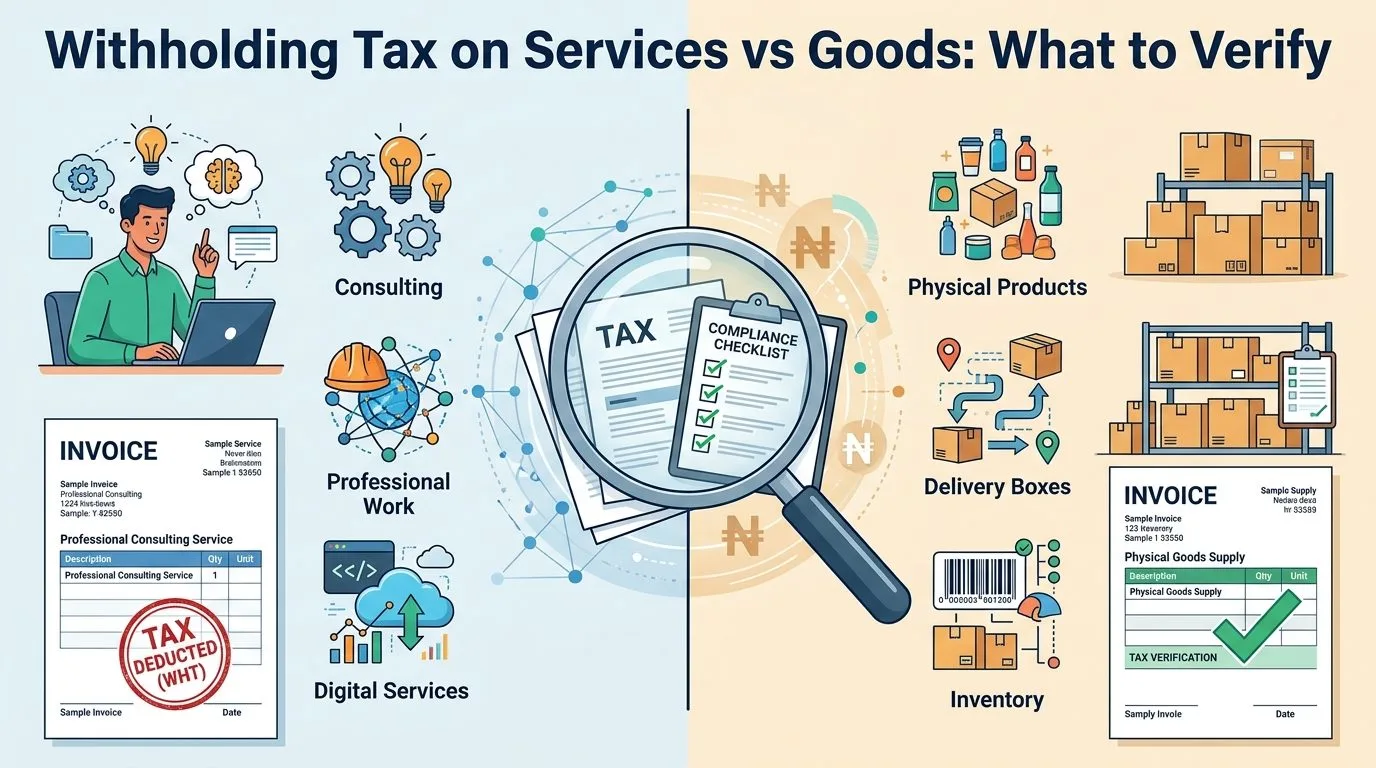
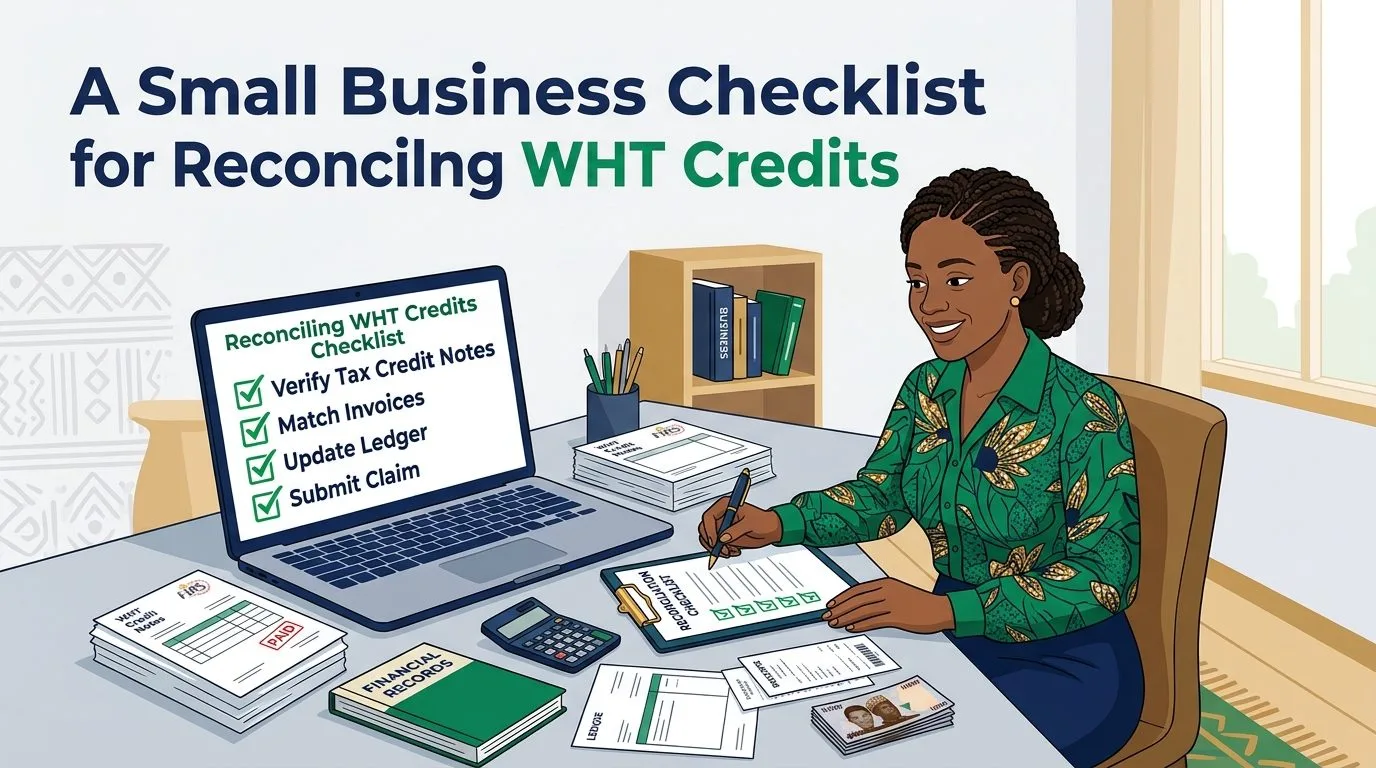
To reconcile withholding tax (WHT) credits in Nigeria, a small business should match each customer's deduction to the original invoice, the net payment received, the prescribed WHT receipt and the balance recorded in its tax-credit ledger. It should then compare those records with the amounts accepted or applied by the relevant tax authority. A deduction appearing on a bank payment advice is not, on its own, proof that a valid WHT credit has been documented.
The practical problem is familiar: a customer owes ₦1,000,000 for qualifying consultancy services, deducts 5% WHT and transfers ₦950,000. If the supplier records only ₦950,000 as sales, it understates turnover. If it leaves ₦50,000 outstanding as an ordinary customer debt, it overstates trade receivables. And if it claims ₦50,000 without a proper audit trail, it may face a difficult year-end tax reconciliation. The right records show ₦1,000,000 gross income, ₦950,000 cash and ₦50,000 WHT deducted, subject to the receipt and credit rules.
This guide provides a monthly checklist, an example reconciliation register, follow-up procedures for missing credit notes, and a year-end calculation for Nigerian SMEs. It covers creditable WHT: some deductions are final tax and require different treatment. The applicable tax position depends on the law, reporting period and individual facts.
What exactly are WHT credits?
Withholding tax is deducted from prescribed income payments by an eligible payer. The deduction is generally an advance payment of the recipient's income tax; in specified circumstances, such as some non-resident and investment income, it may be final. Regulation 5 of the Deduction of Tax at Source (Withholding) Regulations, 2024 describes it as an advance or final tax of the supplier—not a sales discount or additional contract cost.
Where WHT is creditable, a properly supported deduction can offset the tax ultimately assessed on the business. The Lagos State Internal Revenue Service explains that excess eligible WHT credits may be carried forward or refunded under the Nigeria Tax Administration Act, 2025, subject to the law and supporting documents. A WHT credit register is therefore a record of taxes already deducted on the enterprise's behalf, not a register of cash available to spend immediately.
For the rates themselves, confirm the First Schedule to the 2024 regulations. Common resident categories include 2% for qualifying non-manufacturer supplies, 5% for specified consultancy and professional fees, and 10% for rent. These figures are examples rather than one rate for all payments; exemptions and other rules matter. This article focuses on reconciliation, not on reclassifying every type of contract.
What does a correct WHT reconciliation need to prove?
A reliable reconciliation answers five questions: Was the income recorded in full? Was the customer payment received correctly? Was the difference actually WHT? Is there legally adequate documentation? Has the credit already been used, refunded or carried forward?
That means checking four sources rather than relying on a single bank statement:
- Sales invoice or contract: the underlying gross income and transaction description.
- Bank receipt or payment advice: what the customer actually paid and when.
- WHT receipt or credit statement: beneficiary identity, gross payment, tax deduction and relevant period.
- Accounting and tax records: the WHT receivable account, tax returns, official acknowledgements and credits used.
Differences must be classified. A short payment might be WHT, but it could also be a genuine discount, bank charge, part-payment or disputed invoice. Treating every difference as withholding tax can manufacture tax assets that the authority has no reason to recognise.
Small-business WHT credit reconciliation checklist
1. Create a WHT receivable account and a separate credit register
Set up an account named WHT receivable, tax paid at source or income-tax prepayment for supportable creditable deductions. This should be kept apart from trade receivables, VAT and WHT payable—the latter is the amount the business itself deducts from suppliers and owes the tax authority. A company can have both balances without being entitled to net them against one another.
In the transaction-level register, record the customer, invoice number, transaction date, gross qualifying income, WHT rate, amount deducted, payment date, tax period, receiving authority, receipt reference, evidence status and any credit used. Identify the legal entity's TIN and the beneficiary named on the receipt.
2. Reconcile gross invoices before looking at the bank
Start with the invoices and revenue ledger, not the net bank receipts. For a consultancy invoice of ₦1,000,000 before VAT, 5% WHT is ₦50,000. The full ₦1,000,000 remains the qualifying fee in the company's books. If separately charged VAT applies, record it independently. Do not calculate WHT on a separately stated VAT component merely because the invoice total includes both amounts.
Make sure the same invoice is not entered twice. When a credit note changes the commercial fee, follow the actual contract and correction history rather than quietly changing an already issued tax-credit receipt.
3. Match each invoice to cash and payment advice
Link customer bank transfers to their source invoices. A payment advice or statement explaining the WHT helps determine why the bank deposit is lower than the invoiced fee. Record genuine instalments separately so that an unpaid portion of the invoice is not wrongly treated as tax deducted. A bank fee or payment-processor charge may also explain a small difference.
For each payment, calculate the expected deduction = qualifying amount settled × applicable WHT rate, then compare it with the customer's actual stated deduction. If the rate differs, investigate the transaction category, recipient's TIN and any exemption rather than automatically posting the larger amount as a valid credit.
4. Obtain and validate the prescribed WHT receipt
Regulation 8 and the Third Schedule to the 2024 regulations require the deducting party to provide a receipt and prescribed statement. The supporting information includes the payer and beneficiary names, their tax identities, the transaction type, gross amount, amount deducted and month; the specimen Third Schedule receipt also includes its serial number and remittance date.
Check that the beneficiary on the receipt matches the legal taxpayer claiming the credit and that the reporting period agrees with the transaction. Keep the receipt in a structured folder linked to the register. If a credit note covers several invoices, retain the schedule explaining the allocation. A customer email that simply says “5% WHT taken” is not a substitute for the prescribed evidence.
5. Separate supported, pending and disputed credits
Use clear statuses, such as deducted—receipt pending, receipt received, authority verified, claimed, applied, refunded and disputed. Avoid putting every transaction into an undifferentiated “available tax credits” total.
There is an important legal protection: under regulation 8(3), where a payer has issued a prescribed receipt for tax deducted but has not remitted it, the beneficiary should nevertheless be credited; the authority can recover the unremitted tax from the payer. The supplier should preserve that prescribed receipt and pursue official clarification if the credit does not appear in its records. This protection is distinct from the practical difficulty of proving a deduction where no valid receipt exists.
6. Reconcile the register to the general ledger
At month-end, compare the WHT credit register total with the balance in WHT receivable. Reconcile the opening balance, newly recognised deductions, credits already used, refunds and any documented corrections. Where a deduction is not legally creditable or is unlikely to be recoverable, refer it for proper accounting treatment; do not present every unverified deduction as a guaranteed asset.
Keep a separate account or subledger for each revenue authority where useful. WHT on corporate income generally belongs to the Nigeria Revenue Service (NRS), whereas payments to resident individuals or business names generally relate to the relevant state internal revenue service. A taxpayer should match credits against the authority administering its income tax, not automatically against the customer's head-office location.
7. Match credits against tax-return and authority records
Before an income-tax return is finalised, compare credit receipts with the official taxpayer record or acknowledgement available from the NRS or state authority. Where records are incomplete, retain the receipt, invoice, payment advice and communication with the customer or authority. Confirm the tax period and that a credit was not applied to a different assessment or claimed twice.
The LIRS FAQ advises taxpayers to upload supporting WHT receipts when filing returns. It also specifically recognises the regulation 8 protection for prescribed receipts covering deductions not yet remitted. A taxpayer should not assume that a portal's temporary absence of an entry conclusively cancels a legal entitlement; equally, it should not fabricate a credit when the underlying deduction cannot be established.
8. Review unused credits, ageing and year-end claims
Group unutilised balances by age—such as under 30 days, 31–90 days, 91–180 days, and over 180 days—and assign responsibility for chasing missing documentation. Age bands are an internal control, not statutory claim deadlines. Track whether each credit is unused, partly used, carried forward, under review or included in a refund application.
Where creditable WHT exceeds the final assessed tax liability, examine the current set-off or refund rules. Section 55 of the Nigeria Tax Administration Act, 2025 provides for refunds after review; its 90-day timeframe runs from the relevant authority's decision, not automatically from the date a customer deducts WHT. A written refund claim under that section must generally be made within six years after the end of the applicable year of assessment. Official procedures and supporting evidence still govern the outcome.
Example: reconcile three customer WHT deductions
Consider a fictional resident small consultancy-and-trading business that receives three qualifying payments. For simplicity, all amounts below exclude separately billed VAT; the company has valid tax identification and its customers are required to deduct WHT. The goods transaction is a qualifying sale by a non-manufacturer.
| Customer / invoice | Gross fee | WHT rate | WHT deducted | Net cash received | Evidence status |
|---|---|---|---|---|---|
| Customer A / INV-101 — consultancy | ₦1,000,000 | 5% | ₦50,000 | ₦950,000 | Receipt received |
| Customer B / INV-102 — technical service | ₦800,000 | 5% | ₦40,000 | ₦760,000 | Receipt pending |
| Customer C / INV-103 — resale goods | ₦1,500,000 | 2% | ₦30,000 | ₦1,470,000 | Receipt received |
| Total | ₦3,300,000 | — | ₦120,000 | ₦3,180,000 | ₦40,000 pending receipt |
Assume all three short payments have been confirmed by payment advice and are properly recorded as WHT deductions. The WHT ledger may show ₦120,000 before utilisation. But the documentary status is different: ₦80,000 is backed by prescribed receipts, while ₦40,000 from Customer B requires follow-up. The accountant should not treat the ₦40,000 as an ordinary customer discount or automatically write it off. Nor should it be represented as an already accepted authority credit without verification.
When Customer B issues the prescribed receipt, the business links it to INV-102, changes the evidence status and follows the appropriate authority's credit verification process. If the bank deposit had instead been ₦750,000 with no explanation, a further ₦10,000 difference would need investigation rather than being labelled WHT by default.
How to reconcile the WHT receivable account: a roll-forward
The reconciliation should explain movement in the balance, not merely list outstanding receipts. A simple formula is:
Closing WHT receivable = opening WHT receivable + creditable deductions recognised − credits applied to tax − refunds received ± supported adjustments.
Suppose an SME begins the year with ₦60,000 in supported unused credit, records ₦120,000 of qualifying new deductions, applies ₦100,000 against an assessed tax liability, and receives no refund or adjustment. The closing balance is ₦80,000. That total still needs to be broken down by tax period and evidence status. The original gross sales from which the credits arose belong in revenue records, not in the WHT ledger as a substitute for income.
Use a journal review to confirm that the corresponding amounts cleared customer trade receivables when the deductions occurred. A WHT credit should not also remain as an unpaid debtor balance unless an actual separate customer debt exists. For other bookkeeping controls, read FlyingEze's daily payment reconciliation checklist .
How does the SME use WHT credits against its income-tax liability?
For an illustrative assessment, assume the business has ₦240,000 of income tax due and ₦80,000 in valid, accepted creditable WHT supported by the relevant documents. After applying that credit, the remaining cash tax payable is ₦160,000. If a further ₦40,000 receipt is later verified and the related credit is accepted for the same assessment, the balance could fall to ₦120,000, subject to the authority's procedures.
Tax credits do not automatically reduce sales revenue or VAT payable. They are applied in the relevant income-tax computation under the law. If the business qualifies for a particular exemption or its WHT was a final tax, those circumstances may change what can be credited. This is why a reconciliation must retain the transaction category and legal basis rather than looking only at a percentage.
What if a customer has not supplied the WHT receipt?
Start with a polite, specific written request that identifies the invoice number, payment date, gross amount, stated deduction and beneficiary's tax identifier. Ask the customer for the prescribed receipt and any remittance reference available. Record the request date, person contacted and follow-up outcome in the register.
If the customer says it has deducted WHT but has not yet remitted it, refer to regulation 8's receipt and beneficiary-credit provisions, request lawful documentation and obtain advice where the authority questions the claim. Never backdate a receipt or enter a fabricated remittance reference. Where the customer denies deducting WHT, investigate whether the difference is actually a pricing dispute, bank charge or part-payment.
If the issue persists, approach the relevant NRS or state revenue office with the available documentary trail. Avoid claiming that every informal deduction email must be accepted automatically. The prescribed receipt provides a specific statutory evidentiary route, which may be important when an authority's electronic records have not yet caught up.
What if the receipt amount is wrong or the deduction rate was excessive?
Do not silently overwrite the customer payment or the original record. A wrong beneficiary name or TIN should be corrected through the payer or the authority's official amendment procedure. A receipt for a different month, or one combining unrelated transactions, should be reconciled to a detailed schedule that supports the correct amount.
If the payer has deducted 5% from a transaction properly subject to 2%, identify the over-deduction and whether it was remitted. The correction may involve an amended return, the customer's repayment of an improper short payment, a tax adjustment or an authorised refund request. The NRS's June 2026 tax-refund guidance, as reported by professional advisers, identifies WHT remitted above statutory rates as a potential refund category, subject to eligibility, audit and documentary requirements. Avoid assuming a refund is automatic.
Keep the original receipt, corrected receipt, invoice and correspondence. An audit trail is more credible than a spreadsheet row that has been altered without explanation. For additional record-keeping mistakes to avoid, see Five Tax Record-Keeping Mistakes Nigerian Digital Workers Should Avoid .
How to organise WHT receipts and supporting files
A business can operate a useful reconciliation process with a spreadsheet and structured folders, provided it uses consistent identifiers. Give every transaction a unique code such as 2026-INV-0101, then store the invoice, contract, bank advice and WHT receipt under that same code. Keep an index of document links in the register rather than storing receipts in staff members' personal messaging apps.
Protect supplier and taxpayer identification information with appropriate access controls. Staff responsible for sales collections may need to view payment status, while tax advisers and finance managers may need access to receipts and tax IDs. Back up the register and restrict unauthorised edits; a clear correction log should record who changed a rate, amount or status and why.
For businesses with multiple branches, keep branch-level invoice ownership for operational review but reconcile credit claims against the legal taxpayer and correct tax authority. A branch label is not a substitute for the beneficiary's actual registered identity on the tax receipt.
What to review every month, quarter and year-end
| Frequency | Recommended controls |
|---|---|
| Every payment cycle | Confirm gross invoice, net cash, actual deduction, rate and customer advice |
| Monthly | Match WHT register to bank, receivables and ledger; chase missing receipts |
| Quarterly | Review aged balances, wrong identities, duplicate receipts and pending corrections |
| Before annual tax filing | Check accepted credits against tax assessment and document claims or carried balances |
| After tax assessment / refund decision | Record credits used, refunds, authorised adjustments and closing balance |
These intervals are recommended operational controls, not separate statutory WHT filing deadlines. The payer's legal obligation to remit and submit monthly WHT returns is a distinct responsibility governed by the 2024 regulations and the tax-administration framework.
Common reconciliation errors that can cost small businesses money
- Recording the net bank amount as turnover. This hides the tax already deducted from the gross income.
- Calling every short payment WHT. Genuine debt, fees and discounts must be identified separately.
- Failing to request prescribed receipts. Unsupported entries can delay tax-credit claims.
- Using a single credit total for all tax authorities. The correct taxpayer and authority must be identified.
- Double-claiming one receipt. Track amounts already used or refunded, not just deductions received.
- Confusing WHT receivable with WHT payable. Tax deducted by the SME from its suppliers is a different liability.
- Using WHT to offset VAT informally. Income-tax credits and input-VAT credits have separate rules.
- Ignoring aged and disputed balances. Unresolved receipts can become difficult to reconstruct years later.
Frequently asked questions
How do I reconcile withholding-tax credits in Nigeria?
Match each gross invoice to the bank receipt, confirmed deduction, prescribed WHT receipt, tax-credit register and the credit applied or acknowledged by the relevant authority. Investigate all differences and maintain a roll-forward of opening balances, new credits and utilisation.
What if my customer deducts WHT but does not remit it?
Regulation 8(3) provides that a beneficiary holding the prescribed receipt should still be credited even where the payer has not remitted. Keep the statutory receipt and escalate any credit-recognition dispute to the authority. A bare bank shortfall without proper evidence is a different problem.
Should WHT be debited to an expense account?
For creditable, recoverable deductions it is ordinarily tracked as income tax paid in advance or a tax receivable, not an ordinary operating expense. Final WHT and uncertain claims require separate accounting judgement.
Can my business claim more WHT than its tax due?
Excess valid credits may be eligible for carry-forward or a refund under the relevant rules and procedures. Refunds require review and documentation and are not automatically paid simply because a register shows an excess.
Does the Nigeria withholding tax rate determine the credit amount?
The rate helps establish the expected deduction, but the recoverable credit also depends on the actual transaction, tax status, documentation, applicable law and whether the credit has already been used.
Do I need an official WHT credit note for every invoice?
Prescribed receipts and statements are the statutory basis for proving deductions, but the format and allocation may vary with the authority's procedures. Maintain a clear link from each deduction to the relevant prescribed document and any supporting schedule.
Conclusion
A small business should never lose track of withholding tax simply because it was deducted before the money reached the bank. Reconciliation begins with the gross invoice, continues through the cash receipt and prescribed WHT documentation, and finishes with an accurate tax-credit balance matched to the relevant authority and tax return.
The most useful routine is straightforward: maintain a transaction-level register, match every deduction to evidence, separate pending receipts from verified credits, reconcile the ledger monthly and document every credit used or carried forward. Under Nigeria's 2024 withholding-tax regulations and 2026 tax-administration framework, those controls can help SMEs avoid overstating receivables, understating income, double-claiming credits or missing lawful tax relief.
Last fact-checked: 18 November 2026. This guide is general information; confirm transaction-specific eligibility and later official directions with the relevant Nigerian tax authority or a qualified adviser.