
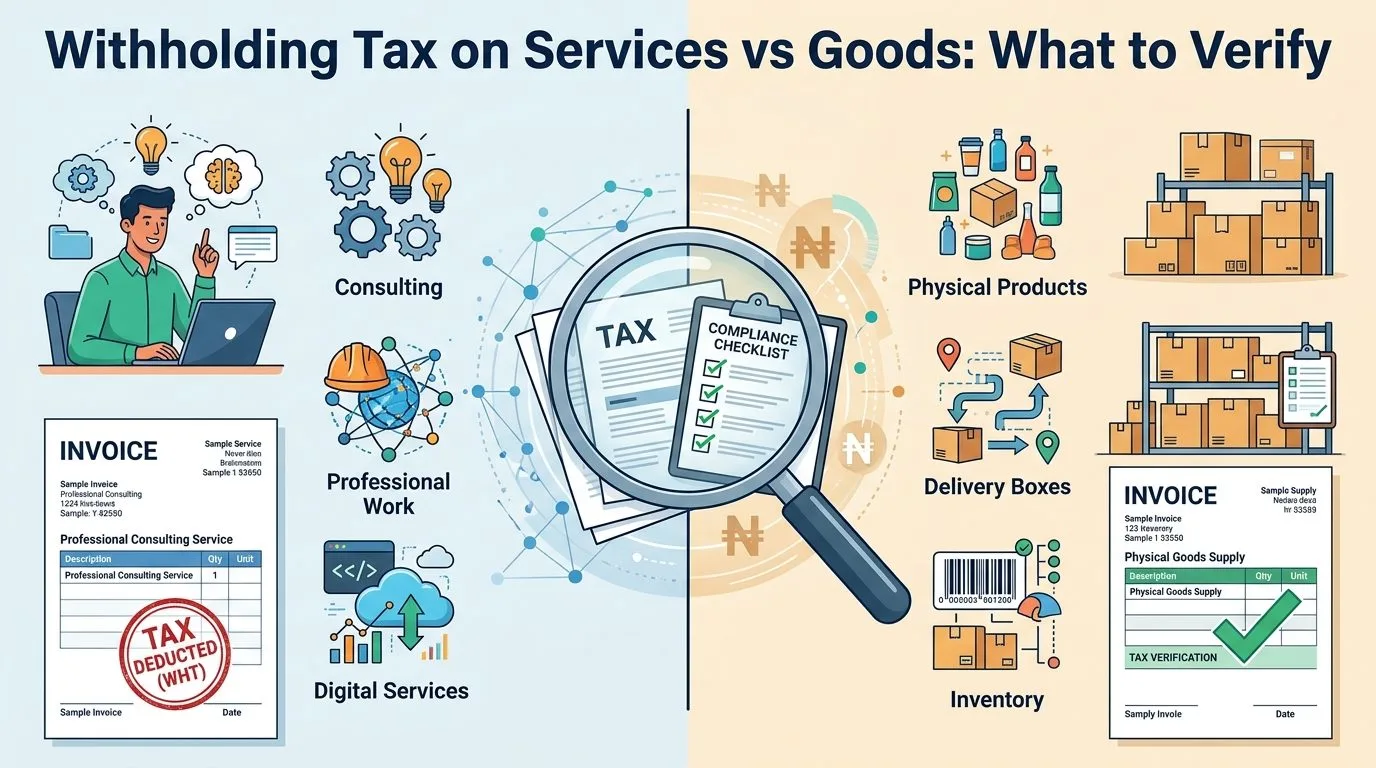
Goods and services do not automatically attract the same withholding-tax treatment in Nigeria. Under the 2024 Deduction of Tax at Source (Withholding) Regulations, a qualifying supply of goods or materials by a resident trader who is not the manufacturer or producer generally attracts 2% WHT. Goods supplied directly by the person who manufactured or produced them can be exempt. For services, the resident rate is commonly 2% for other services not separately listed, but 5% for consultancy, technical, management and professional fees. Certain construction services have their own 2% or 5% categories.
The most important question before payment is therefore not simply “goods or services?” It is what exactly was supplied, by whom, under which contractual arrangement and subject to which exemption? A company buying equipment from a distributor might deduct 2%, while a qualifying direct purchase from the equipment manufacturer may have no WHT. An ordinary service contract may attract 2%, while a separate engineering consultancy might attract 5%. The wrong classification can lead to deductions that are too high, too low or unnecessary.
This guide shows Nigerian business owners, procurement teams, accountants and suppliers how to make those checks in 2026. It explains the rates, manufacturer exemption, services classification, supply-and-installation contracts, VAT, missing tax identifiers and documentation. It is general information and does not replace tax advice for a particular contract.
What is the difference between WHT on goods and services?
Withholding tax (WHT) is deducted at source from certain payments by a payer required to make the deduction. Regulation 5 of the Deduction of Tax at Source (Withholding) Regulations, 2024 says that it is not a separate contract cost: the amount is treated as advance or final tax of the recipient, depending on the income. The regulations came into application on 1 January 2025 and remain an important rate reference alongside the Nigeria Tax Act and Nigeria Tax Administration Act applicable in 2026.
Goods and services have distinct entries in the First Schedule. The goods category explicitly distinguishes supplies from a non-manufacturer from supplies made by the manufacturer or producer. The services category distinguishes general or other services from specifically listed professional, technical, consulting, construction and other payments. As a result, there is no safe default of “5% on all contracts” or “2% on all invoices”.
| Type of eligible transaction | Common resident rate | Main verification |
|---|---|---|
| Goods or materials supplied by a trader, reseller or non-producer | 2% | Is the payee actually a non-manufacturer? |
| Goods manufactured or materials produced by the supplier itself | Exempt from WHT deduction where regulation 10(1)(e) applies | Did this payee manufacture or produce these goods? |
| Services not otherwise specifically listed | 2% | Is this genuinely an ordinary service rather than a listed category? |
| Consultancy, technical, management or professional fees | 5% | What specialist advice or technical service does the contract cover? |
| Construction of roads, bridges, buildings and power plants | 2% | Does the actual contract fall within this listed construction category? |
| Other construction and related activities | 5% | Does the work belong to a different construction category? |
Scope note: This table describes common rates for resident corporate and non-corporate recipients under the First Schedule. Non-resident treatment is more complex, and other categories such as rent, royalties and brokerage have separate rates. Consult the gazetted schedule and Lagos State Internal Revenue Service (LIRS) official WHT guidance rather than applying this table universally.
How to determine the WHT treatment of goods
Goods supplied by a distributor or reseller
A business that buys finished products from another company and resells them is generally not the manufacturer or producer of those goods. Where a withholding obligation applies and no other exemption is available, the First Schedule places the supply of goods or materials other than by the manufacturer or producer in the 2% resident category.
For example, a Nigerian business buys office equipment worth ₦1,200,000, excluding any separately charged VAT, from a resident distributor. Assuming a valid supplier TIN, a corporate payer required to deduct, and no exemption, the WHT is ₦24,000. The distributor receives ₦1,176,000 of the underlying amount, with ₦24,000 accounted for to the relevant revenue authority on its behalf.
Goods supplied directly by their manufacturer
Regulation 10(1)(e) expressly exempts goods manufactured or materials produced by the person making the supply. The key condition is the identity and activity of the actual supplier, not merely the branding on the product.
Suppose the same ₦1,200,000 equipment is bought directly from the company that manufactured it. If the facts satisfy regulation 10(1)(e), the transaction may be exempt from WHT deduction. If that manufacturer instead sells unrelated items it purchased for resale, the exemption should not automatically be extended to those items merely because the company also operates a factory.
Regulation 13 defines manufacturing or production to include assembling final products or producing parts or components using raw materials or other inputs, including labour and overheads. It also includes production of energy. However, simply repackaging, distributing or marketing a product does not establish that the payee actually produced it for the purposes of every transaction.
What should you verify before claiming the manufacturer exemption?
Ask for the supplier's legal name and TIN, the contract or purchase order, a detailed invoice and reasonable evidence that the invoiced goods were manufactured or produced by that same supplier. Depending on the circumstances, production records, product specifications, a factory or producer declaration and supporting business documents may help.
A manufacturer's declaration is evidence to assess, not an automatic legal certificate. A wholesaler cannot convert a resale transaction into a direct-manufacturer supply just by writing “manufacturer price” on its invoice. For high-value or unusual contracts, document why the supplier meets the legal test and obtain professional advice where the facts are unclear.
Importantly, the exemption is from deduction at source; it does not automatically mean the supplier's business income is exempt from income tax. Regulation 10(2) makes that distinction explicit.
How to determine the WHT treatment of services
Services need careful classification because the schedule does not apply one identical rate to all service payments. The ordinary or residual service category carries 2% for resident recipients, but listed consulting, professional, management and technical fees carry 5%. Relevant construction activities are separately classified.
Ordinary services not separately listed: generally 2%
Where a genuine service is not covered by a more specific First Schedule category, the resident rate for supplying or rendering other services is generally 2%. A routine commercial service may fall here, depending on its actual scope. It is unsafe to assume that every invoice using the word “maintenance” or “support” belongs here, because some engagements may be technical, professional or construction-related.
Consultancy, technical, management and professional fees: generally 5%
Regulation 13's definition of professional fees includes regulated occupations requiring specialist training and generally professional licences, such as accountants, lawyers, engineers and architects; it also includes technical, management and consultancy services. The applicable category is based on the work performed, not just the vendor's company name.
For example, a firm engaged to prepare a specialised engineering assessment may fall in the 5% technical or professional category. By contrast, a vendor making a qualifying ordinary service supply may fall in the 2% residual category. A software provider can sell equipment, provide ordinary support and perform specialist consultancy under separate agreements; its tax classification may therefore vary by assignment.
Construction-related contracts: verify the project type
The First Schedule distinguishes construction of roads, bridges, buildings and power plants (2% for resident recipients) from other construction and related activities (5%). A contract for building work is not necessarily treated the same way as a contract for a specialised installation or related construction activity. Verify the actual obligations and seek a documented classification for mixed or unusual construction contracts.
Worked comparison: same payment amount, different WHT outcome
Consider three independent ₦1,000,000 transactions, excluding separately stated VAT, paid by a corporate payer required to deduct WHT. Each recipient is resident, has a valid TIN and no other exemption applies except the direct-manufacturer exemption identified below.
| Scenario | WHT rate | WHT deducted | Net underlying payment |
|---|---|---|---|
| Goods from resident distributor | 2% | ₦20,000 | ₦980,000 |
| Qualifying goods supplied by their manufacturer | Exempt | ₦0 | ₦1,000,000 |
| Resident engineering consultancy | 5% | ₦50,000 | ₦950,000 |
The difference is meaningful for suppliers' immediate cash flow. A reseller and a consultant might both invoice ₦1,000,000 but receive different net amounts. The manufacturer might receive the full underlying fee where the statutory exemption applies. These figures are illustrations of WHT only; VAT, contractual adjustments or separate statutory obligations can affect the final bank settlement.
Mixed supply and installation contracts: the most important classification trap
A purchase order may cover equipment, delivery, installation, testing, training and technical supervision under one commercial agreement. That does not necessarily mean the entire value must be taxed as goods, or that every part automatically attracts the professional-fee rate. The legal classification depends on whether the components are genuinely separate supplies and how the relevant rules apply.
For illustration, a contract explicitly and genuinely separates ₦1,500,000 of equipment resale from ₦500,000 of independently contracted specialist engineering consultancy. Under the stated assumptions, 2% of the goods portion would be ₦30,000 and 5% of the professional consultancy portion would be ₦25,000, producing a total potential WHT of ₦55,000.
But this is not a universal rule for splitting contracts. An indivisible supply-and-installation contract might be treated differently, particularly where the installation constitutes construction work or where the contract's substance is a single service. A buyer should not arbitrarily allocate a single unbroken fee between 2% and 5% to reduce WHT, and a supplier should not rename consultancy “materials” to obtain a lower rate.
Best practice is to obtain the full signed contract, itemised scope, pricing support and written tax classification for each genuinely separable component. Escalate ambiguous contracts before payment, especially where equipment is supplied together with engineering design, commissioning, maintenance or training.
What if the supplier provides both goods and services regularly?
A vendor profile showing “IT company”, “contractor” or “engineering company” is not sufficient to determine every WHT deduction. The same supplier may make different transactions under different purchase orders. Avoid setting one permanent WHT percentage at the vendor level if your accounting software supports transaction-specific categories.
For example, a resident technology company might sell third-party laptops, provide recurring general support and undertake specialist systems consultancy. The correct treatment must be determined for the specific underlying service or goods supplied in each case. A supplier's registration category can inform due diligence but should never replace reviewing the contract.
Do the supplier's residency and TIN change the rate?
Yes. The First Schedule distinguishes resident and non-resident recipients for several service categories. For example, the scheduled non-resident rate for consultancy, technical, management and professional fees is generally 10%, while certain ordinary services list 5%. However, the Nigeria Tax Administration Act, 2025 and applicable treaty or taxable-presence provisions can alter the analysis for specific non-resident services. Do not mechanically apply one domestic rate to cross-border payments.
Regulation 3(c) also says the First Schedule rate is doubled for qualifying non-passive transactions where the recipient lacks a TIN. For a resident non-manufacturer goods supply normally at 2%, the rate may become 4%; for a resident consultancy normally at 5%, it may become 10%. This is not a blanket doubled rate for passive income such as dividends.
Confirm the supplier's actual legal identity, residency and valid tax identifier before payment. For businesses needing to strengthen registration records, see FlyingEze's income-tax record-keeping guide .
Does the small-business exemption apply to goods and services?
Regulation 4(2) creates conditional relief from the payer's duty to deduct for a qualifying small company or an equivalent unincorporated body where its supplier has a valid TIN and the transaction value is ₦2 million or less in the relevant month. This is not the same as saying a small supplier's income is always exempt from WHT when a larger company pays it.
2026 caution: The regulation's definition of a small company refers to the former Companies Income Tax Act, repealed during the 2025 reforms. Legal practitioners have noted uncertainty over how the cross-reference operates under the new tax laws. Businesses should obtain updated official guidance before relying on this exemption, especially for professional-service providers or borderline eligibility. The contract value alone does not settle entitlement.
What about over-the-counter purchases, imports and other exemptions?
Regulation 10 exempts specified transactions including qualifying across-the-counter purchases, certain imported goods that create no taxable presence in Nigeria for a foreign supplier, telephone charges, internet data, airline tickets, insurance premiums and several other listed categories. Across-the-counter treatment requires an instantaneous payment without an established contractual relationship or prior formal contracting arrangement; paying by immediate transfer under a standing supply contract does not automatically satisfy the definition.
These exemptions should be considered regardless of whether someone informally describes the purchase as goods or services. Record the factual basis for the exemption, because an invoice that attracts 0% deduction for a valid legal reason is different from a payer simply forgetting to withhold.
How do VAT and WHT work on the same goods or services invoice?
WHT is generally calculated on the underlying eligible amount when VAT is properly stated separately. VAT is a different consumption tax, charged at the standard rate of 7.5% on qualifying supplies under the Nigeria Tax Act, 2025; exempt and zero-rated supplies have their own rules.
Suppose a resident non-manufacturer distributor invoices ₦1,000,000 for standard-rated goods, plus ₦75,000 VAT. Assuming 2% WHT, and that the buyer has no separate obligation to withhold VAT, the net bank payment is:
| Line | Amount |
|---|---|
| Underlying goods value | ₦1,000,000 |
| VAT at 7.5% | +₦75,000 |
| Invoice total | ₦1,075,000 |
| WHT on goods at 2% | −₦20,000 |
| Net cash transfer | ₦1,055,000 |
The distributor records the full underlying ₦1,000,000 in sales income under the relevant revenue-recognition policy, treats VAT separately and tracks the ₦20,000 WHT as an advance tax credit where legally creditable. For the buyer, the deducted amount becomes a liability to remit, not a commercial discount. Designated persons may have separate VAT withholding or self-accounting obligations, which must not be confused with income-tax WHT.
Who must deduct WHT, and where does it go?
Regulation 4 identifies companies, qualifying unincorporated organisations, government bodies, institutions and payment agents among those required to deduct. An individual acting solely in a personal capacity is not automatically a deduction agent for an ordinary purchase. The payer's status, any conditional relief and the specific transaction must all be reviewed.
According to LIRS guidance , WHT deducted on payments to Nigerian companies and non-resident recipients generally goes to the Nigeria Revenue Service (NRS). WHT on payments to resident individuals and business names generally goes to the relevant state internal revenue service in the recipient's state of residence.
The 2024 regulations prescribe general remittance deadlines of the 21st day of the following month for federal WHT and the 30th day of the following month for ordinary state WHT. Because newer administration rules and state guidance can require a more cautious deadline assessment, confirm the current instruction from the actual receiving authority rather than assuming another day is available. The payer also needs to provide the supplier with a prescribed WHT receipt and statement under regulation 8.
Documents to check before paying for goods or services
A standardised payment review should include:
- Supplier identity: Legal name, company or individual status, tax residence and valid TIN.
- Contract: Purchase order, scope of supply, evidence of delivery and itemised pricing where appropriate.
- Classification: Resale goods, manufacturer-produced goods, ordinary service, professional fee, construction or another listed category.
- Exemption: Evidence supporting a direct-manufacturer supply, genuine over-the-counter transaction or other regulation 10 exemption.
- Calculation: Gross qualifying value, correct rate, separately stated VAT and amount to deduct.
- Payment record: Actual net amount paid to supplier, any part-payment and the WHT payable ledger entry.
- Remittance documentation: Correct authority, tax return, bank payment or official acknowledgement and the prescribed supplier receipt.
The supplier should retain its invoice and WHT receipt so a creditable deduction can be claimed against its income-tax assessment. Under regulation 8(3), a beneficiary issued the prescribed receipt remains entitled to credit even if the payer has not remitted the amount, while the authority may pursue the payer. This is why accurate receipt documentation matters as much as the original percentage. See FlyingEze's guide to tax record-keeping mistakes .
Common goods-versus-services WHT errors
Using 5% for every supplier: A trading supply or qualifying ordinary service may fall in the 2% category, and direct manufacturer supplies may be exempt.
Assuming all goods are exempt: The manufacturer exemption does not cover every distributor, retailer or reseller.
Assuming every service is 2%: Consultancy, technical, management, professional and certain construction services have their own scheduled rates.
Splitting a mixed contract without contractual support: Artificial allocations between goods and services may misstate WHT. Work from the real scope and facts.
Ignoring a missing TIN: The prescribed rate can double on qualifying non-passive payments to a recipient without a TIN.
Using the VAT-inclusive invoice total as the WHT base: When VAT is correctly separated, the usual WHT calculation uses the underlying qualifying payment value.
Treating a small supplier as automatically exempt: Conditional small-payer relief concerns the payer's deduction obligation and does not automatically protect a small business's receipts from deduction.
Frequently asked questions
Is the withholding tax rate on goods in Nigeria 2%?
For qualifying goods or materials supplied by a resident non-manufacturer or non-producer, the scheduled rate is generally 2%. Goods supplied directly by the person who manufactured or produced them may be exempt under regulation 10(1)(e).
What is the WHT rate for services in Nigeria in 2026?
The resident rate is generally 2% for other services not separately listed, and 5% for consultancy, technical, management and professional fees. Specified construction and other categories have separate treatment.
Does supply and installation attract 2% or 5%?
There is no universally safe percentage based on that phrase alone. Determine whether the contract covers a single integrated supply, ordinary services, specialist technical work or a construction-related activity. Review the legal classification of genuinely distinct components before calculating WHT.
Does a manufacturer's invoice always have no WHT?
No. The regulation 10 exemption concerns qualifying goods manufactured or materials produced by the person making the supply. Other activities or goods resold by the same company may need separate classification.
Does the supplier's TIN affect WHT?
Yes. For qualifying goods, services and other non-passive payments, the rate is doubled under regulation 3(c) where the recipient has no TIN. Confirm the relevant status and documentation before payment.
Can a supplier use WHT deducted on goods and services as a tax credit?
Where the withholding represents an advance payment of income tax, properly documented deductions can generally be credited against the recipient's income-tax liability. Final WHT and non-resident cases need separate review.
Conclusion
The critical difference between withholding tax on services and goods in Nigeria is that the law distinguishes how goods were supplied and what type of service was performed. The common 2% rate on non-manufacturer goods is not the same as the manufacturer exemption; the 2% residual services category is not the same as the 5% professional-fee category.
Before approving payment, confirm the supplier's legal identity and TIN, examine the actual contract, test the exemption, select the correct First Schedule category, separate any applicable VAT, and document the remittance and receipt. For mixed supply-and-installation agreements or non-resident contracts, seek a documented legal classification rather than using the invoice label alone.
Research and rate verification: 18 November 2026. This article reflects the 2024 gazetted Withholding Regulations and 2026 tax-administration guidance reviewed on that date. Check later official circulars or obtain advice before applying the rules to unusual or high-value contracts.