
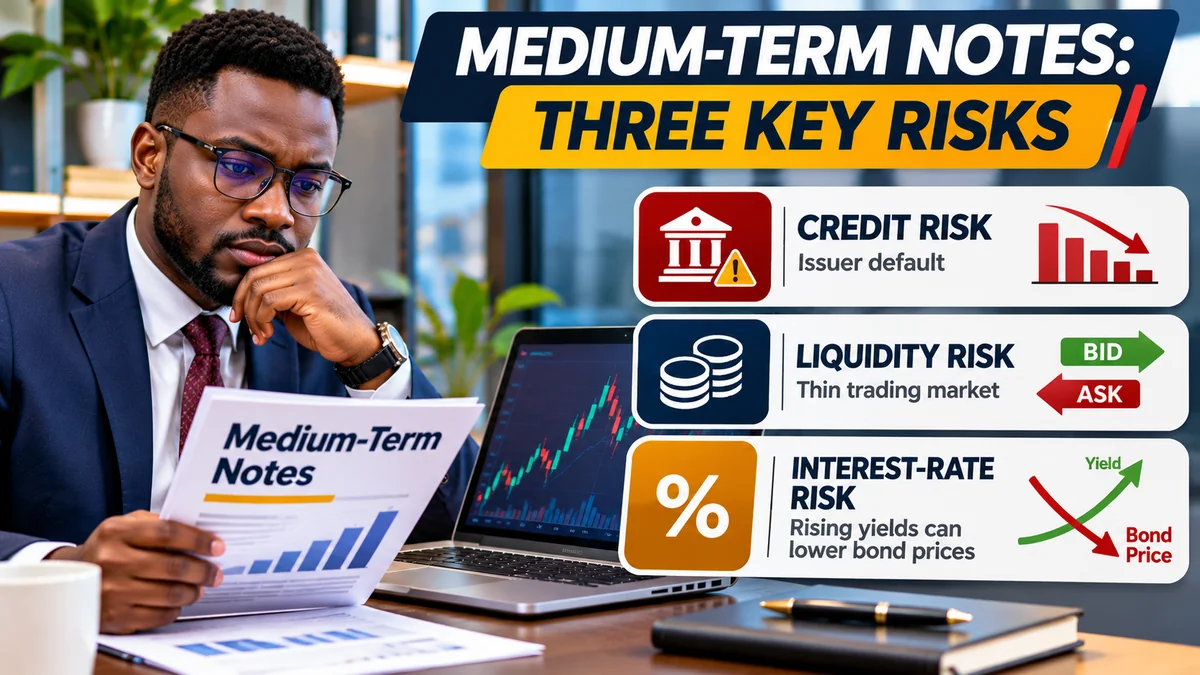
Investing in medium-term notes (MTNs) exposes you to three important risks: the issuer may fail to pay you, the note may be difficult to sell before maturity, and changes in market interest rates may reduce its resale value. These are known as credit risk, liquidity risk and interest-rate risk. A fixed coupon does not eliminate them, and the name “medium-term note” is not a capital guarantee.
An MTN is a debt security, often issued through a programme that allows a company, bank or other eligible borrower to sell separate series over time. It can resemble a conventional corporate bond, with a stated maturity, interest terms and repayment obligation. The Nigerian Securities and Exchange Commission (SEC) highlights default, changes in bond prices, poor trading liquidity and early-redemption risks for debt investors. The US SEC gives similar warnings in its corporate bond investor bulletin .
This guide explains how the risks work, illustrates potential losses with naira examples, and provides a practical checklist for investors considering an MTN in Nigeria or elsewhere. It does not recommend any particular security. Research verification: 8 November 2026.
What are medium-term notes, and why do investors buy them?
When you buy a medium-term note, you generally become a creditor of the issuer rather than an owner of the business. The issuer promises payments under a contract: perhaps fixed coupons every six months and repayment of principal on a particular date. Some notes pay floating rates; others have call provisions, discounted issue prices or more complex returns. Each issue has its own final terms.
The word “medium-term” is not a universal maturity limit. Thomson Reuters Practical Law explains that MTNs are generally issued under a reusable programme and can have varying maturities. Their economic risks therefore arise from the actual debt obligation, not merely its label. A medium-term note issued by a corporation can itself be a corporate bond.
Investors may be attracted by scheduled cash flows, a defined contractual maturity and the possibility of earning more than some other fixed-income securities. But higher advertised returns can reflect greater borrower risk, more restrictive terms or an illiquid market. Comparing only coupon rates is not enough.
At a glance: the three principal MTN risks
| Risk | What can go wrong? | Key question |
|---|---|---|
| Credit or default | The issuer pays late, misses coupons, restructures debt or cannot repay principal | Can this issuer meet the obligation? |
| Liquidity | Few buyers are available or an early sale requires a steep discount | Could I sell at a fair price when needed? |
| Interest rates | Rising market yields reduce the price of an existing fixed-rate note | What happens if I must sell before maturity? |
The three can interact. If an issuer's financial health deteriorates as borrowing costs rise, investors may demand a higher yield to hold its notes. The market price may fall while prospective buyers become more scarce. A higher promised coupon does not automatically compensate for all three exposures.
1. Credit risk: the issuer may not repay as promised
Credit risk is the possibility that a note issuer will fail to make interest or principal payments on time. It can range from a delayed coupon to restructuring, a distressed exchange or insolvency. The US SEC describes these outcomes as core risks of corporate debt, and Nigeria's SEC stresses that even a rated bond requires investor due diligence.
How a loss can happen
Imagine you buy an illustrative ₦1 million MTN paying a 14% annual coupon, with principal scheduled for repayment in four years. If the issuer pays as promised, an annual coupon would be ₦140,000 before tax and fees. But suppose the company experiences persistent losses, falls behind on debt servicing and proposes to repay only part of the principal or extend the maturity. You could receive less money, wait longer or lose some or all of the investment. Holding until maturity does not eliminate default risk.
The loss depends on the issuer's assets, other claims, applicable insolvency rules, security or guarantees and any restructuring outcome. Being a debt investor generally provides a different claim from being a shareholder, but it does not ensure full recovery.
How to examine the issuer's financial strength
Read recent audited financial statements, applicable interim reports, the use-of-proceeds disclosures and the programme prospectus together with the final terms for your specific series. Consider the company's cash flow from operations, existing borrowing, near-term refinancing needs, interest expense and its ability to service debt during a downturn. A profitable company can still face a cash shortage when large debts fall due.
Also review whether your note is secured or unsecured, where it ranks against other creditors, and whether it has covenants limiting additional debt or requiring financial ratios. A guarantee is meaningful only to the extent that the guarantor has both a legally enforceable obligation and the financial capacity to pay.
Can a credit rating protect you?
A rating may help compare an issuer's relative credit risk, but it is an opinion, not an insurance policy or promise to repay. Ratings can be downgraded. The US SEC's credit-ratings bulletin notes that ratings do not measure liquidity or interest-rate risk, and investors should use them alongside their own analysis.
For Nigerian offerings, check which entity was rated, the rating date, whether the rating refers to the particular note or only the issuer, and any conditions affecting the rating. The Nigerian SEC's bond FAQ similarly advises investors not to rely on a credit rating alone.
2. Liquidity risk: you may not find a buyer when you need cash
Liquidity risk arises when you want to sell an MTN before maturity but cannot find a buyer promptly, or you can sell only at an unattractive price. Some note series are relatively small or are held by investors who rarely trade. A security can be listed without having an active secondary market.
Suppose your note has a ₦1 million face value and you unexpectedly need cash. The closest dealer may offer only ₦940,000, while an indicative selling price from another market participant is ₦980,000. These are hypothetical quotes. Selling at ₦940,000 would realise ₦60,000 less than face value before any accrued interest, fees or tax adjustments. If no buyer is available, you may have to wait rather than sell immediately.
The difference between a dealer's bid (what it offers to pay) and ask (what it wants to charge) is one clue to trading costs. But the availability of a quoted price does not guarantee the dealer will buy your full holding at that amount. The US SEC's corporate bond bulletin notes that trading volume and market depth can materially affect the price an investor receives.
Questions to ask before investing
- Is the particular MTN series listed or quoted on an eligible trading venue?
- Are there recent genuine trades, and how frequently have transactions occurred?
- Does a broker or dealer offer regular two-way prices, and on what terms?
- Are there transfer restrictions, minimum lot sizes or early-redemption provisions?
- Could you hold the security to maturity without needing the money for emergencies?
If you need cash for rent, school fees or business operations on short notice, an instrument with uncertain resale opportunities may be unsuitable for that portion of your savings. Even if its scheduled interest is attractive, it cannot serve the same role as readily available emergency money.
3. Interest-rate risk: rising yields can reduce the resale price
For a typical fixed-rate MTN, market price and required yield tend to move in opposite directions. If investors can obtain higher yields on comparable new debt, an existing lower-coupon note becomes less attractive unless its price falls. If required yields decline, the value of the existing fixed coupon may rise. Nigeria's SEC explains this inverse relationship in its bond education resources, while the US SEC's interest-rate bulletin describes how maturity and coupon affect price sensitivity.
Worked example: what if required yields rise?
Consider a purely hypothetical five-year note with ₦1,000,000 face value, a fixed 10% annual coupon paid once a year and principal repaid at the end of year five. Assume it begins at a market price of ₦1,000,000 because its yield to maturity is 10%, with no credit deterioration, fees, taxes, calls or other complications.
If comparable investors then require a 13% yield while all the remaining promised cash flows stay unchanged, the present value of five ₦100,000 coupons and the ₦1 million principal is approximately ₦894,483. That is a theoretical price decline of about 10.6%.
| Illustrative metric | Value |
|---|---|
| Face amount | ₦1,000,000 |
| Annual coupon | 10% = ₦100,000 |
| Original required yield | 10% |
| New required yield | 13% |
| Estimated price at new yield | ₦894,483 |
| Estimated mark-to-market price decline | Approximately ₦105,517 (10.6%) |
This is a simplified mathematical example, not a live Nigerian bond quotation, a forecast or the price of a real MTN. An actual trade can differ because of accrued interest, credit spreads, liquidity and the note's exact terms. If you hold a plain fixed-rate note until maturity and the issuer pays in full, market-price fluctuations alone do not change the contractual principal due. But if you must sell early, the loss may become realised; and if the issuer defaults, holding longer provides no guarantee.
Why maturity and floating rates matter
Longer-duration fixed-rate notes generally react more strongly to yield changes than otherwise similar shorter-duration notes. Lower-coupon debt can also be more sensitive. An MTN with a floating coupon may have less price sensitivity to benchmark-rate changes, but it still faces credit risk, the terms of its reset formula and possible changes in the issuer's credit spread.
Rate expectations affect Nigeria's wider fixed-income markets too; FlyingEze's earlier report on public discussion of potential Nigerian interest-rate reductions illustrates why changes in expected borrowing costs attract investor attention. That historical report should not be treated as a current interest-rate forecast.
Other risks MTN investors should not overlook
Call and reinvestment risk
Some notes allow an issuer to redeem them before maturity. When market rates fall, a borrower may have an incentive to call higher-coupon notes and refinance at a lower cost. You may receive your money back earlier than planned and have to reinvest at a lower yield. The final terms should specify any call dates, conditions, prices and notice requirements.
Inflation risk
A fixed coupon can arrive on schedule yet lose purchasing power. If prices of goods and services increase faster than the investment's net return, its real spending value falls. Investors should consider inflation, taxes and fees when interpreting an advertised nominal yield.
Currency risk
For a Nigerian whose regular expenses are in naira, buying a dollar- or euro-denominated note creates foreign-exchange exposure when the investment is measured in naira. Currency movements can increase or decrease the effective naira return. International notes can also have different settlement, transfer and legal risks.
Complex or structured-note risk
Not every MTN is a structured note. Some notes have relatively straightforward fixed or floating coupons; others may link payments to equity indices, currencies, commodities or other reference assets. The US SEC's structured-notes bulletin warns that complex payoffs, issuer credit risk, calls, fees and poor resale markets can make these securities hard to evaluate. Even language suggesting “principal protection” must be checked carefully against the contract and the issuer's ability to pay.
How MTN risks can compound during a market shock
Consider a hypothetical company that borrowed through an MTN programme when financing was relatively cheap. Two years later, interest rates rise, the company's profits weaken and investors question its ability to refinance. The company may face higher future funding costs; investors may demand an additional credit-risk premium; and dealers may reduce their willingness to buy its existing notes.
In that situation, interest-rate, credit and liquidity risks reinforce one another. A price drop is not necessarily explained by changing benchmark rates alone, and an apparently high market yield can reflect the possibility of serious credit losses. This is why looking at coupon, maturity or rating in isolation is insufficient.
What should Nigerian investors verify before purchasing an MTN?
The Nigerian SEC maintains a registered capital-market-operator search . Its May 2026 investor warning urges the public to check promoters and platforms rather than trust attractive promises circulated on social media. Verification reduces the risk of engaging an unauthorised operator, but does not make an authorised investment risk-free.
Before committing funds, use this practical checklist:
- Confirm the issuer. Identify the legal entity that owes principal and interest, not simply the group brand or sales agent.
- Read the correct documentation. Obtain the prospectus or offering circular and the final terms or pricing supplement for the exact series being sold. A programme-wide limit is not the amount you are guaranteed to receive.
- Assess credit quality. Review audited statements, cash flow, outstanding debt, maturity schedule, rating and any recent adverse disclosures.
- Inspect creditor protections. Determine whether the note is secured, guaranteed, senior or subordinated and what covenants or trustee arrangements apply.
- Check liquidity. Find out whether there is an active resale market, what dealers might bid and how much you could lose by exiting early.
- Understand the return. Look at purchase price, coupon, yield to maturity, call provisions and relevant fees or tax treatment. A high coupon is not necessarily a high realised return.
- Check suitability. Match the earliest likely need for your money with the note's maturity and realistic ability to sell.
- Verify the intermediary. Check the broker, issuing house or adviser through the regulator's current register and confirm payment instructions independently.
For readers comparing issuance structures, a separate FlyingEze guide titled Medium-Term Notes vs Corporate Bonds: Five Differences to Understand was prepared for publication ahead of this risk guide. The present article concentrates instead on the risks of owning an actual note. For historical context on Nigeria's wider fixed-income market, see FlyingEze's report on a sovereign bond auction and green debt listing ; government debt and corporate MTNs involve different issuers and credit exposures.
Red flags in an MTN investment offer
- Promises of guaranteed high returns with no risk, without legally meaningful supporting details.
- Refusal to identify the issuer, provide final terms or explain repayment sources.
- Pressure to transfer money to an individual's private bank account.
- Claims that SEC registration automatically guarantees principal or coupons.
- No credible information about security, guarantees, ratings or how a dispute would be handled.
- Statements that the note can be sold at face value any time without evidence of a real market or contractual redemption right.
Do not mistake a prominent company name or a document displaying the regulator's logo for independently verified authorisation. Confirm the details through official sources and a suitably qualified adviser where appropriate.
Frequently asked questions
Can you lose your principal in a medium-term note?
Yes. An issuer may default, and a sale before maturity can produce a loss. Whether and how much an investor recovers after default depends on the instrument's terms, creditor ranking, available assets and legal process.
Are MTNs safer if they have a credit rating?
A credible rating may provide information about relative credit risk, but it does not guarantee repayment and does not cover every other risk. Ratings may change as the issuer's circumstances change.
Does holding an MTN until maturity remove interest-rate risk?
Holding a simple fixed-rate note to maturity can avoid having to realise a market-price loss caused solely by rising yields, if the issuer pays as promised and the investor does not need to sell. Default, reinvestment, inflation and other contractual risks can remain.
Can I sell an MTN before its maturity date?
It depends on the note's terms and whether a willing buyer or permitted redemption route exists. Being listed does not guarantee that it can be sold promptly at face value.
Do higher MTN yields always mean better returns?
No. A higher yield can compensate investors for greater default risk, illiquidity, a longer maturity or more complex terms. An advertised coupon is not the same thing as the return an investor actually realises.
Are medium-term notes covered by a bank deposit guarantee?
Do not assume a debt security is protected like an eligible bank deposit. MTNs are securities, and protections depend on the legal product and jurisdiction. Ask for the actual contractual protection and independently verify any claimed guarantee.
Where can I check a Nigerian investment intermediary?
Start with the Nigerian SEC's registered-operator search and verify the specific firm's authorised functions. Registration of a firm does not mean every advertised investment has been separately endorsed or guaranteed.
Conclusion: understand the risk before accepting the coupon
Medium-term notes can provide contractual income and a defined repayment schedule, but they remain debt investments with meaningful downside risk. The three central questions are whether the issuer can pay, whether you can exit when necessary and how market interest rates could affect the value of your note.
Examine the specific issuer, series and final terms; review the credit position and potential selling costs; and plan for the possibility that you might need cash before maturity. Use the Nigerian SEC's bond education material and its operator register as starting points for independent verification. A quoted return is only one part of a responsible investment decision.
Editorial note: Research checked on 8 November 2026. General financial education only; not a recommendation to buy or sell any note. Regulatory requirements, ratings, prices and issuer circumstances can change.



