
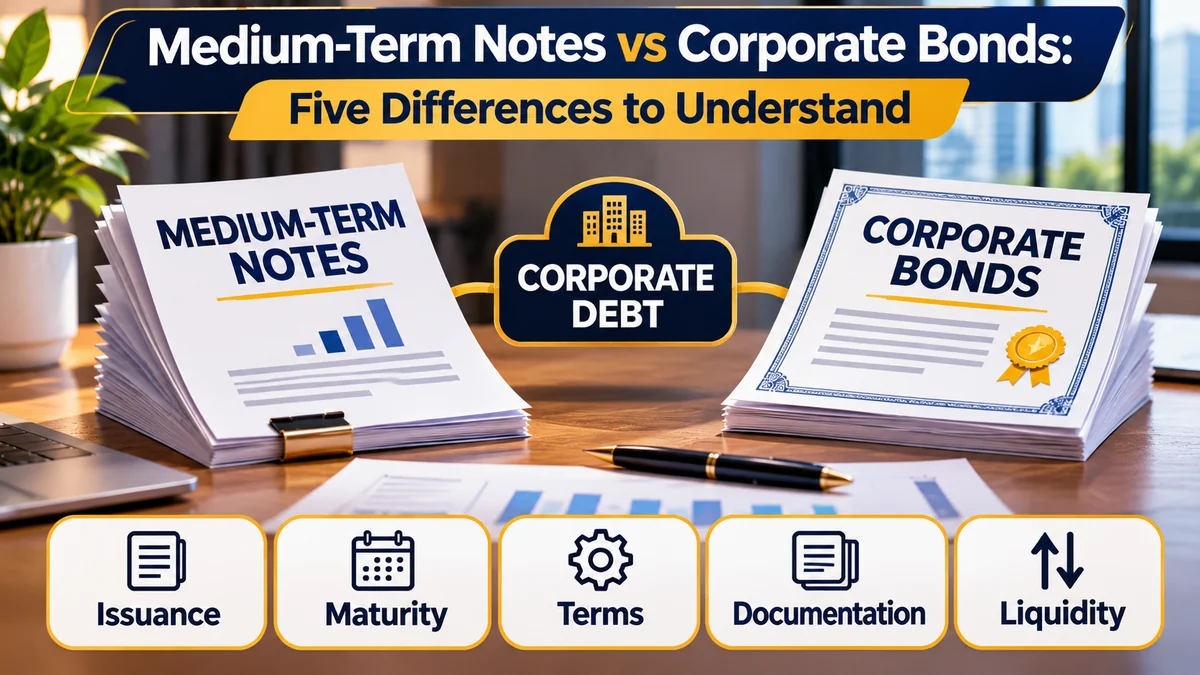
Medium-term notes (MTNs) and corporate bonds are not necessarily competing types of investment. An MTN issued by a company may itself be a corporate bond. The most meaningful comparison is often between a medium-term note programme—which lets an issuer offer different series of debt over time—and a stand-alone corporate bond issue, usually arranged for a particular financing transaction.
The five practical differences are how the securities are issued, the maturity choices, how terms are set, the documentation and funding process, and potential secondary-market liquidity. None of these differences guarantees a higher return or makes one instrument inherently safer. The issuer's financial strength and the exact terms of an individual note or bond remain decisive.
This guide explains those distinctions in accessible language, including what they mean for investors and businesses seeking funding. It draws on guidance from securities regulators, market participants and established legal sources, with a Nigerian capital-markets perspective. Research verified on 8 November 2026.
What is a medium-term note?
A medium-term note (MTN) is a debt security: investors lend money to an issuer, which promises repayment according to stated terms. The issuer may pay a fixed or floating coupon, issue the note at a discount, or attach features such as an early-redemption option. Companies, financial institutions and other eligible issuers can use MTN programmes.
The label is somewhat misleading. Although “medium-term” suggests a middle-length investment, an MTN programme is not universally restricted to three, five or ten years. Law firm Mayer Brown describes programmes that can offer debt securities with maturities extending from more than 270 days to as long as 30 years. Actual eligible terms depend on the programme and market.
What distinguishes a programme-based MTN in practice is the issuance framework. A company can establish a set of core documents, then sell one or more series at different times using supplements that specify their particular terms. The US Securities and Exchange Commission's interpretive guidance describes base prospectuses, programme supplements and later pricing supplements for registered MTN offerings.
What is a corporate bond?
A corporate bond is debt issued by a business to raise money—for example, to refinance existing borrowings, purchase equipment or support investment. Bondholders are creditors, not shareholders. They may receive regular coupons and repayment of principal at maturity, but the actual structure can differ from issue to issue.
The US SEC's investor education guidance classifies corporate bonds by maturity, credit quality and interest arrangements. Bonds may be fixed-rate, floating-rate, callable, secured or unsecured. The legal term “note” versus “bond” does not by itself establish a separate risk category.
A company might launch one large bond issue with a particular coupon and maturity. Alternatively, it might arrange an MTN programme and issue several series of corporate debt over time. That is why an MTN programme and a stand-alone bond issue are sensible comparators, while MTNs and corporate bonds are overlapping categories.
MTNs versus stand-alone corporate bonds: comparison at a glance
| Feature | Medium-term note programme | Typical stand-alone corporate bond issue |
|---|---|---|
| 1. Issuance | Can support repeated series or tranches under programme documentation | Typically launched as a particular offering; reopening may be possible |
| 2. Maturity | Different series may have varied maturity dates and tenors | Original issue ordinarily specifies its maturity schedule |
| 3. Terms and pricing | Coupons, currencies and structural features can be set for each series | Terms normally fixed for a particular series, though new bonds can differ |
| 4. Documentation | More setup work initially, with later supplements facilitating repeat issuance | Documentation and execution arranged for the particular offering |
| 5. Liquidity | Depends on each series' size, trading, listing and investor base | Also depends on issue size, trading activity and market demand |
Important qualification: these are tendencies associated with issuance methods, not absolute differences in the rights or safety of the securities.
Difference 1: Issuance method and timing
The first distinction concerns when and how a company raises debt funding.
MTNs: a reusable programme
Under an MTN programme, an issuer establishes a framework that permits multiple issues over time, subject to its programme limit, applicable approvals, current disclosures and other conditions. It can decide when to issue a new series and what that series will look like. In some markets, an issuer may offer notes continuously or respond to an investor's request for a particular structure.
The US SEC's guidance addresses continuous and delayed MTN offerings, while Trowers & Hamlins' legal comparison explains how programmes can support multiple issues with different coupons and tenors. The issuer is not necessarily required to raise the full programme amount at once.
Stand-alone bonds: a particular transaction
In a conventional stand-alone bond deal, the issuer structures and markets an offering of a stated amount with defined terms. It may use an underwriter or a book-building process, depending on the market and transaction. The company can later issue another bond, or potentially reopen an existing bond if the documents and market arrangements allow, but that is not identical to maintaining a broad programme for repeated issues.
What this means: an MTN programme can suit a frequent borrower with ongoing funding needs. A company raising money once for a major project might find a stand-alone bond more straightforward. Neither approach means investors will receive payment sooner.
Difference 2: Maturity and repayment flexibility
The second difference is the issuer's ability to offer different maturities across issues, not a universal rule that MTNs mature earlier than bonds.
A bond or note's maturity date is when the issuer is due to repay principal under the contract, unless a valid earlier redemption, restructuring or default changes what happens. An MTN programme can issue one series maturing in three years and another maturing in seven or fifteen years. A stand-alone bond issue usually starts with one defined maturity schedule, although a company can launch additional series with different maturity dates.
For general investor education, the US SEC describes bonds of short, medium and long maturities. That maturity classification is separate from the label attached to a specific MTN programme. The name “medium-term note” should therefore never replace reading the actual maturity date.
Investors must also examine amortisation and call options. Some debt returns all principal at final maturity; other instruments repay in instalments. A callable note or bond permits the issuer to redeem it early under contractual conditions, potentially forcing the investor to reinvest when available returns are less attractive. Freddie Mac's MTN product information illustrates how MTNs can carry callable structures and varied maturities.
What this means: compare the repayment timetable and early-redemption provisions of the actual securities. Do not assume an MTN is a short-term cash substitute or that a corporate bond must be a long-term holding.
Difference 3: Interest rates, pricing and customised terms
Both MTNs and stand-alone corporate bonds can pay fixed or floating interest. Both can be issued at a premium or discount, and both can include additional features. What often differs is the flexibility to price and structure successive MTN series without launching an entirely new programme each time.
For example, an issuer may sell one MTN series with a fixed coupon, then offer a later series with a floating rate linked to a stated benchmark plus a margin. The later series may have a different issue price, currency, tenor or call provision. Freddie Mac describes MTN issuance sometimes arranged through “reverse inquiry”, in which investors and dealers help shape the desired yield, size and structure.
A stand-alone corporate bond can also be tailored when it is first issued. It is therefore inaccurate to say that only MTNs have flexible terms or that all conventional bonds have fixed-rate coupons. The distinction is largely how efficiently an issuer can produce multiple differently priced series under an established framework.
Coupon is not the same as return
Suppose an illustrative debt security has ₦1,000,000 face value and a fixed 12% annual coupon. If the contract pays once each year and the issuer performs, the annual coupon is ₦120,000 before any taxes or costs. But that does not mean every buyer earns a 12% yield. A person buying above or below face value may realise a different yield, and selling before maturity can produce a gain or loss. Calls, defaults, fees, floating-rate resets and timing of cash flows also matter.
What this means: compare yield to maturity or an appropriate yield-to-call measure—not simply the advertised coupon—alongside credit and structural risk.
Difference 4: Documentation, setup costs and repeated borrowing
An MTN programme requires upfront legal, disclosure and operational preparation. The documents usually establish common conditions across future issues; subsequent notes can then be issued with updated disclosures and a pricing or final-terms supplement identifying the relevant series. The US SEC specifically discusses the use of such supplements in registered MTN programmes.
A stand-alone bond requires the transaction's own documentation, approvals and marketing work. For a company that only needs to borrow once, the initial work of establishing and maintaining an MTN programme may not be justified. For frequent issuers, the programme can make later issues more efficient—but it also entails updating documents, paying professional fees and complying with continuing obligations.
Trowers & Hamlins' comparison makes this trade-off explicit: a programme can cost more to establish than a single stand-alone issue, while reducing repeated documentation work when later series are offered. These potential efficiencies do not imply that MTNs are free to issue or that investors automatically pay lower fees.
What about Nigeria?
Nigeria's Securities and Exchange Commission (SEC) publishes rules and amendments affecting corporate debt offerings, including amendments to corporate bond rules in 2025. Its published framework addresses registration, disclosure and issuance arrangements. The particular documentation, approvals and offering exemptions for a Nigerian programme or bond depend on the issuer, type of offer and current rules.
Before investing, identify the regulator-relevant documents and verify them with an authorised capital-market intermediary. A programme's headline size is an issuance ceiling or framework, not proof that the issuer already borrowed the full amount or that regulators guaranteed repayment.
What this means: programme issuance can improve a repeat borrower's flexibility; investors still need the documents for the specific series they are buying.
Difference 5: Trading liquidity and how easily investors can exit
Liquidity means the ability to sell a security reasonably promptly at a price close to its current fair value. It is not guaranteed by either the word “note” or the word “bond”.
An MTN programme may generate several smaller or customised series. Some may trade infrequently because only a limited number of investors hold them. A large benchmark corporate bond can sometimes attract more secondary-market trading. But a small, privately placed stand-alone bond may be even less liquid than a widely held MTN series. Listing also does not guarantee an active market.
The US SEC's bond investor guidance and Nigeria's SEC bond FAQ both warn about credit, interest-rate and liquidity risk. If yields increase after issuance, the market price of many existing fixed-rate securities may decline. An investor who must sell before maturity can receive less than the amount originally paid.
Before buying, ask whether the specific issue is listed or quoted, whether dealers make two-way prices, how often it trades and what transaction costs apply. A quoted yield that looks attractive is of limited use if you need your money early and cannot find a buyer.
What this means: assess liquidity at the individual security level, not at the programme name level.
A practical example: one financing need, two approaches
Imagine a hypothetical Nigerian manufacturing business that expects to raise up to ₦30 billion over several years as projects reach different stages. The amounts and rates here are illustrative, not a real offering.
MTN programme approach: the company establishes an appropriately approved programme up to a specified ceiling. It might issue ₦8 billion in one series for equipment, then later issue ₦5 billion for expansion with a different coupon and maturity. Each series has its own final terms and investors can choose whether to participate. No additional issue is guaranteed to occur.
Stand-alone bond approach: the company arranges a ₦13 billion bond for a particular project with its stated rate, maturity and other contractual terms. It could later issue another bond, but that additional financing may involve new documentation and a separate execution process.
For investors, neither structure reveals whether the borrower is financially healthy. They still need to assess operating cash flow, debt servicing, security, ranking of obligations, credit rating, covenants and the price being offered.
Are MTNs safer than corporate bonds?
No general safety advantage follows from the label. A medium-term note issued by a financially weak company could be riskier than a well-documented corporate bond issued by a stronger borrower, and the reverse may also be true. A company could even issue both through different funding arrangements.
Five common risks apply to both:
- Credit/default risk: the issuer fails to make contractual interest or principal payments.
- Interest-rate risk: changes in market yields affect the value of existing securities, especially fixed-rate ones.
- Liquidity risk: the investment cannot readily be sold at a reasonable price.
- Call/reinvestment risk: early redemption means money must be reinvested, potentially at a lower available rate.
- Inflation and currency risk: inflation erodes purchasing power, while foreign-currency investments add exchange-rate exposure when measured in the investor's home currency.
There can also be ranking and security differences. A senior secured issue may have claims over designated assets, while an unsecured or subordinated obligation has different recovery prospects in insolvency. A credit rating is an assessment, not an insurance policy. Some structures are complex, and callable or structured notes may expose buyers to outcomes that simple coupon comparisons fail to capture.
It is equally important not to confuse MTNs with commercial paper. Nigeria's FMDQ Exchange describes commercial paper as short-term corporate obligations with tenors of up to 270 days. The two financing categories are not interchangeable merely because both may be referred to as “notes”.
What should Nigerian investors check before buying?
Rather than choosing an MTN or bond on its name alone, review the actual offering with these questions:
- Who owes the money? Identify the legal issuer, any guarantor and their financial position. An associated brand name is not necessarily a legal guarantee.
- What exactly am I buying? Confirm the series, tranche, currency, issue price, face value and identifier, if available.
- When and how will I be repaid? Check coupon dates, maturity, possible amortisation, early-redemption terms and any floating-rate reset formula.
- Where does my claim rank? Determine whether the debt is secured, senior, subordinated or guaranteed, and understand the covenants.
- Can I sell it? Ask about listing, the secondary market, available dealers, recent trades and estimated transaction costs.
- What do I actually earn? Calculate returns using price, coupon, holding period, fees and applicable tax, not only the headline interest rate.
- Who oversees the offer? Check current registration or exemption requirements and verify the intermediary and documents through legitimate SEC and market channels.
Nigeria's SEC publishes investor FAQs on bonds and the rules portal . Readers exploring related debt-market instruments may also find useful historical context in FlyingEze's coverage of a Nigerian sovereign bond auction and green debt listing . Government debt and corporate debt have different issuers and credit considerations; that report is context, not evidence that they are equivalent products.
Which is better: medium-term notes or corporate bonds?
The answer depends on the specific security and your objectives. For a business seeking funding, an MTN programme may make sense if it expects multiple issues and wants flexibility across maturities and pricing. A stand-alone bond can be sensible for a single clearly defined financing need. Fees, approvals and market demand can change the decision.
For a retail investor, the question is more practical: Can the issuer meet its obligations? Do the contractual cash flows suit your needs? Is the offered price reasonable for the risks? Can you hold until maturity if there is no active resale market? Those questions matter far more than whether the certificate says MTN, note, debenture or bond.
There is no universally superior yield or safer category. Be wary of sales pitches presenting MTNs as automatically guaranteed, more liquid or higher paying. Ask for the official offer documents and examine the precise series.
Frequently asked questions
Is a medium-term note the same as a corporate bond?
They can overlap. An MTN issued by a corporation is a type of corporate debt security and can have the economic features of a bond. “MTN” often describes a programme-based issuance method; “corporate bond” describes debt issued by a business.
Do all medium-term notes mature in five years?
No. Despite the name, many MTN programmes allow a wide range of maturities. Consult the particular series' final terms rather than assuming a five-year deadline.
Are MTNs always issued at floating interest rates?
No. Both MTNs and corporate bonds can carry fixed or floating coupons. Their actual pricing and redemption provisions depend on the individual offering.
Are MTNs guaranteed to repay principal?
No. An investor generally relies on the issuer's contractual obligation and creditworthiness, plus any valid security or guarantee stated in the documents. A programme's approval or credit rating does not guarantee payment.
Can I sell an MTN before maturity?
Possibly, but that depends on the market, issue terms and available buyers. You may have to accept a lower price, and some instruments may have little or no active secondary-market trading.
What is the difference between an MTN and commercial paper?
Commercial paper is generally short-term corporate borrowing. FMDQ says Nigerian commercial paper can have tenors up to 270 days. MTN programmes commonly support debt with longer and more varied maturities, but actual programme terms matter.
Conclusion
Medium-term notes and corporate bonds should not be presented as two entirely separate asset classes. The clearest five differences concern issuance cadence, maturity choices, pricing flexibility, documentation economics and potential liquidity. These distinctions usually compare an MTN programme with a conventional stand-alone corporate bond issue, rather than dictate what every individual investor will earn.
Before investing, read the issue-specific prospectus and final terms, evaluate the issuer, consider the repayment and call provisions, and understand the realistic exit options. A familiar product name is not a substitute for credit analysis or due diligence.



