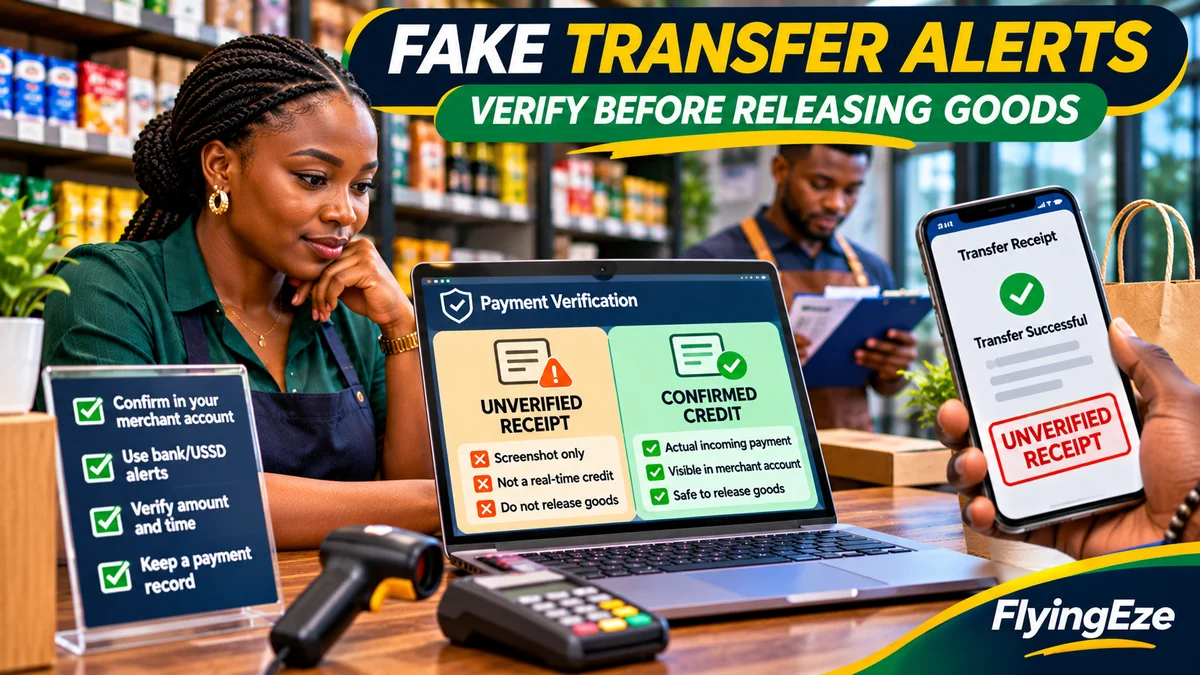
The safest way for Nigerian small businesses to prevent fake bank transfer alerts is to verify every payment independently from the business's own bank account or authorised payment-provider dashboard before handing over goods, delivering services or marking an invoice paid. A customer's screenshot, SMS, printed receipt or claimed debit is not proof that the seller's money has arrived.
Picture a busy shop in Nsukka or Lagos: a customer buys goods worth ₦85,000, shows a phone screen saying “Transfer successful,” and asks the cashier to hurry because a driver is waiting. If the cashier releases the goods without independently checking the merchant account, the shop could lose both the products and the payment. The same risk affects POS agents, market traders, restaurants, hotels and WhatsApp sellers.
Although digital payments bring speed and convenience, the fraud problem is significant. NIBSS reported that estimated digital-payment fraud losses in Nigeria declined from ₦52.26 billion in 2024 to ₦25.85 billion in 2025. These are industry-wide losses across multiple fraud categories, not an estimate of fake-transfer-alert losses alone. Social engineering and account compromise remain concerns. Research verified 3 November 2026.
What is a fake bank transfer alert?
A fake transfer alert is a fraudulent message or payment-looking document designed to make a seller believe money has reached the seller's account when it has not. It can take the form of a forged SMS credit notification, edited screenshot, fabricated bank receipt, impersonated bank email or misleading payment-status screen.
Another scenario involves a real outgoing debit visible in the buyer's app even though the beneficiary's account has not been credited. The buyer may be acting honestly; delayed bank processing should not automatically be labelled fraud. The seller still needs independent confirmation before fulfilment. A disputed or subsequently reversed payment is also different from a wholly invented transfer, and each requires proper investigation.
The Central Bank of Nigeria's fraud-awareness guidance describes phishing, impersonation and social engineering as important threats. Its basic advice is to verify communications through trusted channels rather than rely on messages that could be fabricated.
The five checks to complete before releasing goods
| Check | What the seller should confirm |
|---|---|
| 1. Source | The payment appears in the business's own trusted banking or provider channel |
| 2. Status | It is an actual successful incoming transaction, not pending, failed or merely initiated |
| 3. Amount | Credited amount matches the invoice; partial payments are handled under an explicit policy |
| 4. Identity/reference | Available transaction details can be matched to the correct customer/order without relying only on a screenshot |
| 5. Record | The transaction is recorded and has not already been used to fulfil another order |
These checks are stronger together. A new credit of ₦85,000 in the business's statement is useful evidence but should also be matched to the right order; it might relate to a different customer. For processor-based payments, a verified transaction reference tied to an invoice is particularly helpful. Keep the merchant's credentials private during every check.
1. Verify the incoming credit from your own bank account
Open the bank's official app, internet banking or another authenticated channel belonging to the business. Check recent incoming transactions, not just an SMS notification or a general balance that may have changed for unrelated reasons. Confirm the amount, time, reference and any available payer details.
Where the bank offers a business transaction history, merchant portal or transaction-search tool, use it. If there is a discrepancy, request confirmation through the bank's official customer-service channel. Do not call a number supplied in the suspicious receipt or open a purported “verify transfer” link sent by the customer.
A genuine credit is not an unconditional promise against every subsequent bank dispute or lawful adjustment. For unusual, high-value or suspicious deposits, seek further clarification from your bank and use proportionate fulfilment controls. The practical rule is verified receipt first, fulfilment second.
2. Never treat a screenshot or SMS as settlement proof
A receipt may look professional, contain a plausible reference, carry a bank logo or show the customer's account being debited. None of those elements independently verifies a credit into your account. A message received on the merchant's own phone is also not as authoritative as the underlying bank transaction record, because notifications can be delayed, spoofed or misunderstood.
Do not train staff to detect fraud simply by judging font colours or looking for spelling mistakes. Those clues can help raise suspicion, but sophisticated fakes may be visually convincing, and legitimate banks can use different receipt layouts. An independent merchant-side check is more dependable than visual inspection.
The [EFCC's phishing advisory](https://www.efcc.gov.ng/news/beware-of-rising-phishing-activities) warns that deceptive emails, messages and fake websites can impersonate trusted institutions. Staff should not follow payment-verification links in unsolicited messages.
3. Handle pending or delayed transfers fairly
Nigerian bank transfers can occasionally be delayed by network or processing issues. The buyer may show a successful debit without the merchant immediately seeing a corresponding credit. A good policy protects the business without treating every delayed payment as a scam.
Say politely that the order will remain reserved until the business confirms receipt. Give the customer an order number, record the time and allow a reasonable recheck or bank follow-up. Never pressure a customer to send the same payment again without first checking the original transaction's status, because that could lead to double payment.
Moniepoint's transfer support guidance advises customers to provide the transaction session ID to help trace a disputed transfer and contact the relevant bank or provider. A session ID is useful for investigation but is not, by itself, proof of merchant settlement. Do not share private account credentials to facilitate tracing.
4. Use payment providers' verified statuses for online orders
For an online store, a payment gateway or collection platform can offer order-linked references and automatic reconciliation. However, integration quality is essential: do not mark an order paid merely because the browser returns to a “success” page or the shopper sends a receipt.
Paystack's Verify Payments documentation explains that a transaction may be ongoing, pending, failed, reversed or success. In its verification response, the outer status: true indicates that the API request succeeded; the actual payment state is in data.status. Confusing the two can lead to false approvals.
To fulfil safely, a merchant integration should confirm the correct order/reference, expected amount and currency, and a provider-confirmed successful state. Paystack's bank-transfer documentation describes charge.success notifications and ways to check pending payments. The exact workflow must follow the provider and product actually used.
5. Secure webhooks and prevent duplicate order fulfilment
A webhook allows a payment provider to notify the merchant's server when a transaction changes state. Unlike a customer's screenshot, this can provide machine-verifiable information—but only if the merchant validates the event before acting.
Paystack's webhook guidance documents verification of the x-paystack-signature header using HMAC-SHA512 with the merchant's secret key. Server-side verification should protect secret keys, reject invalid event origins and check the matching payment record. Do not trust an arbitrary public callback POST just because it contains “success.”
Use a unique order identifier and make fulfilment idempotent: processing the same payment notification twice must not ship two parcels or credit a digital wallet twice. Record the provider transaction ID and whether the order has already been delivered. Paystack explicitly recommends preventing repeat fulfilment and monitoring failed webhook deliveries. Its support documentation also describes viewing and retrying webhook events.
6. Give each customer a clear payment reference
When payments arrive in a shared account, it can be difficult to identify which customer paid for which invoice. A unique invoice number, payment request or virtual account assigned to an order can make matching easier. This reduces the temptation to approve whatever receipt a buyer presents at a busy counter.
For example, Order FE-1042 might require ₦85,000. Staff should match the provider's transaction record to FE-1042 before marking it paid. If the customer sends ₦50,000, the system should show a partial-payment state rather than silently treating the entire order as settled.
FlyingEze has previously covered the business value of organised collections in its report on FCMB Collect and digital payment collection tools . The broader lesson is to use reconciled business records, not personal screenshots, to determine which invoices are paid.
7. Train cashiers, POS operators and dispatch staff
Payment security must become a standard operating procedure, not a judgement left to the least experienced employee during a queue. Give cashiers a short rule: “Receipt shown” is not “payment confirmed.” For larger payments, require a supervisor to review the confirmed merchant transaction before goods leave.
Assign roles: one staff member records the sale, an authorised cashier verifies payment, and dispatch releases goods only when the order status is confirmed. In very small shops where one person performs all duties, the same person should still separate these steps and keep a minimal payment log.
Train staff to handle urgency without confrontation. Fraudsters may use pressure, fake customer-service calls, promises to “send proof later” or threats of a bad review. Genuine customers can also be impatient. Use a uniform policy rather than making accusations based on the customer's appearance or identity.
8. What to do if the bank app is offline
Connectivity failure is a common operational complication. If the merchant cannot securely check an incoming payment, do not assume the transfer succeeded and do not invent an alternative verification service. Use an authorised secondary channel if the bank provides one, such as approved internet banking, a trusted merchant terminal or official transaction-history access.
If independent verification is still unavailable, keep the goods and order on hold. Explain the delay clearly, offer a callback or pickup option, and document the customer's claim so it can be reconciled later. For services that are irreversible—digital vouchers, airtime, accommodation access or high-value deliveries—extra caution is justified.
A paid-looking receipt does not become more reliable because the shop's internet is down. Likewise, the business should not publicly label a customer fraudulent merely because its network has failed.
9. Protect staff accounts and business phones
Fake alerts are only one form of payment fraud. If a criminal takes over the merchant's banking or payment-provider account, even the business's internal messages may become unreliable. Use unique passwords, multi-factor authentication, device screen locks and the least privileges necessary for each staff role. Remove access promptly when an employee leaves.
The CBN's fraud guidance warns against phishing and identity theft, while Moniepoint's fraud-awareness guide warns that impostors may ask for OTPs, PINs and confidential banking details. Never disclose banking OTPs or API secret keys to callers claiming to be support agents.
Separate business collection accounts from staff personal accounts where feasible. For a multi-branch company, record which branch, till and user approved each payment. FlyingEze has also covered broader cybersecurity concerns for small businesses , which reinforce the need for good account-access controls.
10. Reconcile every day's sales against actual collections
Even when individual payments are verified, reconciliation catches missing, duplicated or misallocated transactions. At closing time, compare the day's sales register with bank and gateway transaction records, cash counted, refunds, approved credit sales and pending orders.
For illustration, a shop records ₦760,000 in sales: ₦300,000 confirmed bank transfers, ₦260,000 confirmed POS/card payments, ₦120,000 cash and ₦80,000 still pending customer payment. Confirmed collections total **₦680,000**, not ₦760,000. The pending ₦80,000 should remain a receivable or unfulfilled order according to the business's policy—not settled cash.
Reconcile discrepancies by reference and timestamp, not by forcing a total to balance. A ledger can separate initiated, awaiting verification, confirmed, partially paid, failed, disputed and refunded states. Inventory or accounting systems such as those described in P-Biz Solutions' product catalogue can support broader operational recordkeeping, but businesses should verify which payment-verification and reconciliation integrations are actually available.
What if the goods have already been released?
Act promptly. Preserve the invoice, order number, receipts or messages supplied, bank account information shared, transaction history and relevant delivery or CCTV evidence lawfully held. Contact the receiving bank or payment provider through official channels, explain that a suspected fraudulent payment claim was used, and obtain a complaint or case reference.
Report suspected criminal conduct to appropriate authorities. The EFCC advises prompt reporting of phishing and related fraudulent activity to its offices or law-enforcement agencies. Do not publish a customer's identification details online or attempt vigilante recovery.
The CBN complaints-management guidance provides an escalation process when a regulated financial institution fails to address a complaint. That is different from treating CBN as a guarantee that a private customer or fraudster will reimburse a merchant. CBN's general bank-complaint guidance describes allowing the institution an initial resolution period before escalating unresolved complaints; suspected active fraud should be reported immediately, not delayed for two weeks.
Recovering funds is not guaranteed. If the buyer's debit was genuine but the receiving account was not credited, ask both sides to follow their provider's trace and dispute procedure without making an unsupported fraud allegation.
A printable verification checklist for Nigerian shops
| Before delivery | Staff action |
|---|---|
| Invoice recorded | Save order ID, expected amount and customer contact as appropriate |
| Customer claims transfer | Mark payment awaiting verification, not paid |
| Business confirms credit | Check official merchant bank/provider transaction history |
| Details matched | Confirm amount, reference, order and status |
| Duplicate checked | Ensure the transaction was not used on another order |
| Goods released | Record approving staff member and delivery time |
| Day-end reconciliation | Match orders against bank/provider settlement records and exceptions |
The checklist should be displayed near the till, incorporated into cashier onboarding and reviewed periodically. For higher-value or unusual transactions, require an additional approval step without unnecessarily obstructing ordinary customers.
Frequently asked questions
Can a customer show a successful transfer screenshot even if the seller has not received money?
Yes. A screenshot or receipt can be fabricated, or a real outgoing transfer may not yet have reached the merchant's account. Check independent receiving-side records.
Is a debit alert proof of payment?
No. It describes activity on the sender's side and does not, by itself, prove successful credit to the intended beneficiary.
Should goods be released if the bank transfer says pending?
Normally no. Keep the order pending until the business independently confirms payment or uses a documented, authorised credit arrangement.
Can an API or webhook fully eliminate payment fraud?
No. Proper verification and secure integration reduce certain risks, but compromised accounts, disputes, reversals, staff collusion and other fraud still require operational controls.
What if the customer was debited and my bank has not credited me?
Request the relevant transaction reference, give the banks or provider time to investigate under their procedures, and avoid duplicate collection. Keep the order on hold until status is resolved.
Who should a Nigerian small business report a fake bank-transfer scam to?
Notify its bank or payment provider promptly, preserve evidence and report suspected crime to appropriate law enforcement. Use the CBN's complaints procedure for unresolved issues involving regulated financial institutions where applicable.
Conclusion
The strongest protection against fake bank transfer alerts is a repeatable payment-verification process. Keep order records, verify incoming credits from a trusted merchant-side system, distinguish pending payments from confirmed ones, protect payment integrations, and reconcile transactions every day.
Fraud prevention should not require accusing honest customers or delaying every sale unnecessarily. A clear policy lets staff act consistently and gives genuine buyers a reasonable way to resolve processing delays—while ensuring no screenshot alone releases the goods.