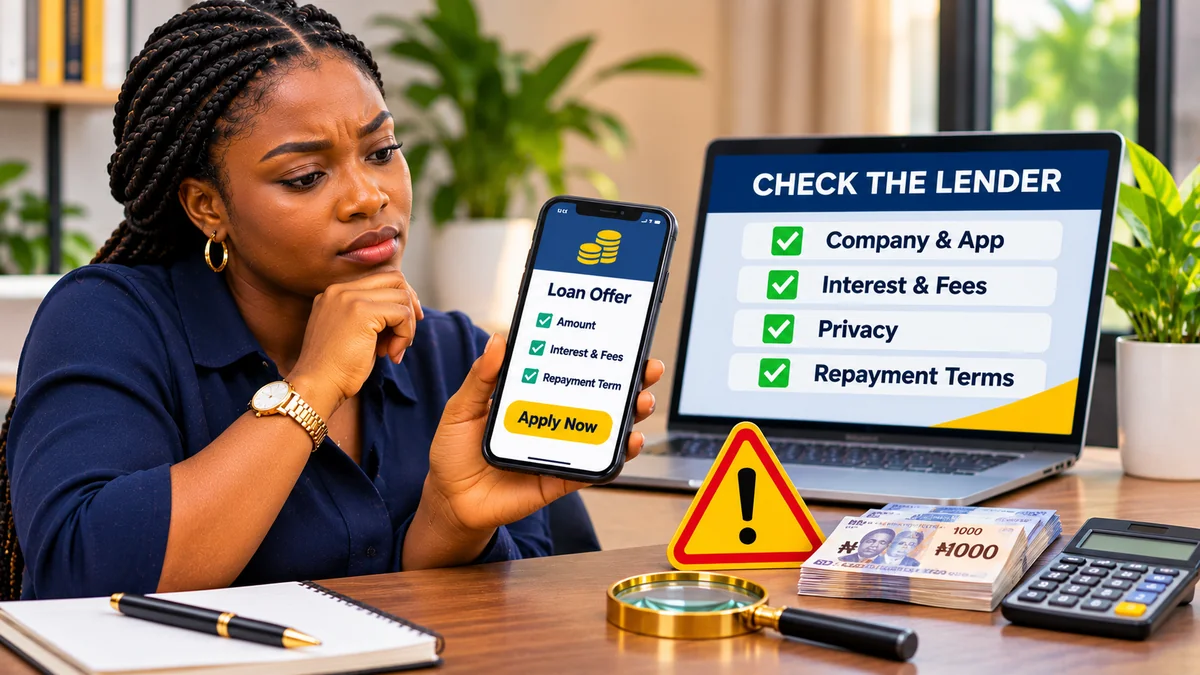
Quick answer: Before accepting a digital loan in Nigeria, identify the company behind the app, verify its current regulatory status, read the complete repayment terms and examine the data permissions it requests. Start with the Federal Competition and Consumer Protection Commission (FCCPC) digital-lender register if the service is covered by its digital-lending framework. If the lender says it is a bank or microfinance bank, verify that claim with the Central Bank of Nigeria (CBN) . Watch for hidden fees, pressure to borrow immediately, unnecessary access to your contacts, threats to shame family members and demands for payment to a personal account.
Searching for a loan online can turn up hundreds of quick-cash apps, salary advances and credit offers. Many consumers use legitimate digital credit, but an application interface, a polished advert or an app-store listing is not proof that the lender has complied with Nigerian consumer-protection rules. The safest decision combines identity verification, regulatory checks, transparent pricing, privacy review and realistic repayment planning.
This guide explains how to identify predatory lending red flags, correctly interpret the FCCPC's approval categories and report abusive digital-loan practices. It distinguishes verified regulatory facts from illustrative scenarios; it does not accuse any particular named lender of misconduct.
Research verified 13 November 2026. Sources include the FCCPC's lender directory, DEON lending rules and 20 July 2026 enforcement update, the CBN's lending disclosures and complaints guidance, and the Nigeria Data Protection Commission's reporting portal. Directory entries and licences can change, so always check the relevant regulator at the point of application.
What is predatory lending, and why does it matter?
Predatory lending describes lending practices that exploit or unfairly disadvantage borrowers through deceptive, abusive or excessively one-sided terms and conduct. Potential warning signs include obscured repayment costs, coercive acceptance, misuse of private information, unexplained changes to terms and humiliating recovery tactics.
A high interest rate alone does not automatically prove that a particular loan is illegal or predatory. The interest rate, loan duration, mandatory fees, affordability assessment, clarity of the agreement and lender conduct all matter. A short-term loan can be expensive even when its advertised percentage looks small, while a longer loan can accumulate large total interest despite a modest monthly payment.
The FCCPC's September 2025 explanation of its digital-lending regulations identifies transparency, data protection, fair treatment and abusive recovery as central consumer-protection concerns. The Commission also says borrowing should be undertaken on an opt-in basis rather than through automatic or pre-authorised credit without active consent.
How to check a digital lender in Nigeria: the official verification process
There is no single checklist that proves every lender is safe. A provider may be an FCCPC-registered non-bank digital lender, a CBN-regulated bank or microfinance bank, or a business operating through an approved partnership. First work out which legal entity is actually issuing the credit.
Step 1: Find the lender's legal company name
Open the loan agreement, app information and privacy policy. Note the registered company name, exact app name, app-store developer, physical or business contact, official website and any named lending partner. An app's marketing name may differ from the lender's legal identity. A matching logo is not enough: copied logos, lookalike names and impersonation can deceive applicants.
If the app refuses to identify the company responsible for the loan, will not provide accessible contractual terms or only communicates through an anonymous WhatsApp number, do not proceed until the identity is independently verified.
Step 2: Check the FCCPC's live digital-lender register
Visit the FCCPC registration page directly, not a screenshot circulated in a social-media group. The Commission publishes a directory of digital lending companies and related app names, including links to an approval list .
Search for the legal company and the precise app, then check whether the company is listed as approved or conditionally approved. The FCCPC also publishes watchlist and delisted-app sections. Those labels are not interchangeable:
| FCCPC listing | How to interpret it | Next step |
|---|---|---|
| Approval | The company or app appears in the Commission's published approval category | Confirm the exact entity/app and still review the terms and conduct |
| Conditional approval | Approval is qualified rather than equivalent to ordinary full approval | Check the latest conditions or ask the regulator for clarification |
| Watchlist | The Commission has flagged the app for attention | Do not assume approval; check the latest regulatory notices |
| Delisted | The app appears in a delisting category | Do not treat a previous listing as current authorisation |
| Not located | The search did not find an exact match | Check spelling, legal entity and sector regulator before drawing conclusions |
Important: A name can resemble another brand, and entries in a lengthy web directory can change or need clarification. A screenshot of an old approval does not establish current standing. An approved listing is not a guarantee that any specific loan is cheap, suitable or free of complaints. Likewise, not finding a bank-branded app on a non-bank lender list does not by itself prove the bank is unlicensed—verify its claimed regulatory route.
Step 3: Verify bank or microfinance-bank licensing claims with the CBN
If the provider claims to be a bank, microfinance bank or other CBN-regulated lender, check the legal name using the CBN's current official website and financial-institution information . Do not rely only on an app claiming “CBN approved”.
This distinction matters because licence status can change. The CBN reported that it revoked the licences of 46 microfinance banks effective 1 July 2026 . That does not make every app using a microfinance-bank name fraudulent, but it demonstrates why a historical licence document or outdated online list is not enough to confirm current authorisation.
Step 4: Match the website, app developer and payment destination
Use the official company website or a verified publisher link to locate the actual app. Compare the developer's identity, company name, support details and website domain with the information you verified. A Google Play or Apple App Store listing is not itself a regulator's approval; the FCCPC has previously addressed unapproved apps appearing in app marketplaces.
Do not install an APK supplied privately through Telegram, SMS or WhatsApp merely because it promises easier eligibility. Treat requests to pay a “release fee”, “verification charge” or “unlocking deposit” to an individual's bank account as serious warning signs, especially before you have a clear written loan offer.
Ten predatory lending red flags borrowers should recognise
1. The lender will not show the full interest and fee breakdown
A responsible loan offer should show how much you will receive, repayment dates, interest calculations and all mandatory charges before you commit. The FCCPC's digital-lending FAQ says clear terms and disclosure of rates, fees and repayment schedules are expected under the DEON rules. Vague promises such as “low interest” without a written total repayment figure are insufficient for informed consent.
2. Upfront deductions make the amount received much smaller
Some financing products deduct fees before disbursement. Such deductions are not always unlawful, but hiding them or refusing to explain them is a warning sign. The borrower may owe instalments calculated on the advertised loan amount despite receiving less usable cash. Compare net proceeds, not just the approved principal.
3. The repayment deadline is much shorter than advertised
A seven-day repayment date is very different from a 30-day term. If an advert and the actual offer disagree, review the contract before accepting. Do not assume an introductory “up to 90 days” claim applies to your specific approval. Request the exact date and total obligation in writing.
4. The app demands unrelated permissions
Some apps request access to contacts, photos, SMS or other device functions. Certain permissions can be legitimately needed for a specific feature, but broad access without a necessary and clear purpose deserves scrutiny. Never assume a loan app should copy your entire phonebook or send your contacts debt-collection messages. The FCCPC's DEON rules require compliance with the Nigeria Data Protection Act 2023 and other applicable privacy obligations.
5. The lender threatens to shame or intimidate borrowers
Threats to publish personal information, send defamatory messages to relatives, or embarrass someone at work are serious warning signs. The FCCPC has publicly identified abusive debt recovery and privacy violations among the practices targeted by its regulatory framework. A legitimate debt can remain repayable even when a collector behaves improperly; misconduct is a reason to document and report the behaviour, not a guarantee that the underlying debt disappears.
6. The contract changes without a clear basis
Watch for unexplained fees, a changed repayment date, or an increased amount after the offer is accepted. The DEON rules address misleading terms and unfair contractual variation. Ask for the contract version and any term permitting the change, and challenge an alteration you did not authorise through the provider's complaint process.
7. Loan money appears without an application or clear acceptance
The FCCPC framework requires consumer lending on an opt-in basis and addresses automatic or pre-authorised lending. If a loan is disbursed unexpectedly, do not spend the money or send it to an unknown “refund agent”. Contact the legitimate provider or account institution through independently verified support and preserve the transaction evidence.
8. The app offers another loan to repay an existing one
Taking a new expensive loan to repay an old one can turn a short-term need into repeated fees and growing debt. This does not make every consolidation or refinancing offer harmful, but a lender that relies on constant rollovers while withholding total costs is a warning sign. Compare the new total repayable amount with your existing obligation before agreeing.
9. It promises guaranteed approval or asks for credentials
Be cautious about “instant guaranteed approval” where the provider asks for banking PINs, one-time passwords, mobile-money credentials or remote access to your device. A legitimate lender may verify identity and income, but an unsolicited agent does not need your account security codes to process an application. Walk away from pressure to share passwords.
10. There is no working complaint channel
A legitimate provider should identify where a consumer can question charges, report a privacy incident or obtain an account statement. Under the DEON regulations, applicable lenders must disclose complaint channels and redress information. A social-media-only contact that disappears after disbursement makes disputes much harder to resolve.
Worked example: a ₦100,000 loan that costs more than it first appears
Imagine a hypothetical mobile lending offer advertising a ₦100,000 principal and a repayment of ₦118,000 after 30 days. Before disbursement, the service deducts ₦7,000 in processing and ₦3,000 in another compulsory charge. The customer receives ₦90,000, not ₦100,000.
| Illustrative item | Amount |
|---|---|
| Advertised principal | ₦100,000 |
| Processing and compulsory charges deducted | ₦10,000 |
| Usable cash received | ₦90,000 |
| Total repayment after 30 days | ₦118,000 |
| Total cash borrowing cost | ₦28,000 |
| Cost relative to money received | 31.1% over 30 days |
The arithmetic is ₦118,000 − ₦90,000 = ₦28,000, and ₦28,000 divided by ₦90,000 is about 31.1% of the cash received. This is a period cash-cost illustration, not a legally calculated APR, a verified market offer or a declaration that any specific quoted rate is unlawful. Ask the provider for the applicable annual percentage rate or comparable annualised disclosure and check whether the term is affordable.
When financing a business, also compare the cost and repayment obligations of borrowing with alternatives discussed in FlyingEze's guide to business grants, loans and equity funding . Whether borrowing for business or personal needs, the full repayment obligation matters.
What Nigeria's 2025 digital-lending rules require in 2026
The FCCPC issued the Digital, Electronic, Online or Non-Traditional Consumer Lending Regulations (DEON), 2025 to govern applicable consumer-lending services. They address registration, disclosure of interest and fees, fair consumer treatment, responsible business conduct, privacy and complaint handling.
Current enforcement status: The FCCPC says implementation was temporarily suspended following a Federal High Court interim order in April 2026, but resumed on 20 July 2026 after the court dismissed the challenge and discharged the interim restraint. Therefore, as of 13 November 2026, the Commission says the DEON regulations are fully operational and enforceable. The brief suspension should not be described as an ongoing ban on enforcement.
The rules do not mean that every loan must carry a government-set, universally low interest rate. Instead, they establish obligations concerning transparency, consent, fair conduct and relevant regulatory oversight. Applicants should evaluate the specific product's cost and legality rather than relying on vague claims that “any high rate is banned”.
For banks and other CBN-regulated financial institutions, the CBN Consumer Protection Regulations contain disclosure requirements such as the nature and calculation of interest and fees, credit tenor, annual percentage rate (APR) and complaint procedure. The applicable regulator depends on the lender's legal status and the issue raised.
Can a lender contact your friends and family about a debt?
Not every contact made during debt recovery has the same legal significance. A valid guarantor may have contractual responsibilities, and a borrower can authorise limited communication for particular purposes. That does not mean a loan app has unlimited authority to harvest a phone's contact list, broadcast allegations about a customer, or reveal sensitive personal details to uninvolved people.
If an app requests access to your contacts, ask why, whether the access is necessary, how the information is used, and what happens if consent is withheld. Read its privacy notice before continuing. If people in your phonebook receive intimidating or defamatory messages, save the communications and report the privacy and recovery conduct through appropriate official channels.
The Nigeria Data Protection Commission's breach-reporting portal provides a route for reporting data protection and privacy violations. For unfair lending conduct within the FCCPC framework, the Commission provides a separate complaint channel. Keep the two issues clear even when a single incident involves both.
What to do if you have already borrowed from a suspicious app
If the loan has already been disbursed, avoid acting impulsively. Determine whether you actually received the money, identify the lender, preserve the agreed terms and review any authorised repayment instruction.
- Secure your accounts. If you exposed a password, OTP or bank PIN, change credentials through the legitimate account provider and review access from unknown devices.
- Keep evidence. Save the app name, developer, contract, disbursement receipt, net cash received, payment schedule, demands, screenshots and contact details. Do not publicly share your NIN or unredacted financial information.
- Review app permissions. Remove unnecessary contacts, photos, SMS or accessibility access through device settings. If a suspicious application is installed, consider support from your device provider before deleting evidence needed for a complaint.
- Identify the accurate outstanding amount. Request a written statement from the real lender. Dispute charges that differ from the contract instead of assuming the loan can simply be ignored.
- Report harassment or data misuse. Notify the provider using a verified address and escalate through the correct regulator when appropriate.
- Protect people receiving unwanted messages. Advise them not to engage with threatening messages or make payments to strangers, and ask them to keep copies of the communications.
Deleting an app does not erase a genuine credit agreement. Conversely, a lender's demand does not make every claimed charge valid. Ask for an itemised calculation and seek professional legal advice when the dispute is complex or threats are serious.
Where to report predatory digital lending in Nigeria
Start by identifying what happened and who regulates the service. Where practical, complain to the actual provider and retain its response or complaint reference. For severe threats or suspected criminal conduct, do not postpone appropriate police or emergency assistance merely to complete an ordinary customer-service process.
| Problem | Relevant route | What to include |
|---|---|---|
| Unregistered non-bank digital lending, unclear costs, abusive recovery | FCCPC ; the published digital-lending complaint email is lenderstaskforce@fccpc.gov.ng | Company/app identity, terms, payments, complaint history and evidence |
| Bank or CBN-regulated microfinance-bank loan dispute | CBN Consumer Protection Department guidance after the lender's process | Institution complaint reference, loan agreement and disputed charges |
| Misuse of contact lists or personal data | NDPC data-protection reporting portal | Privacy concern, permission evidence and copies of offending communications |
| Fraud, threats or identity theft | Appropriate law enforcement; consider the NPF National Cybercrime Centre for an online-fraud report | Threats, messages, transaction records, relevant accounts and dates |
The FCCPC publishes lenderstaskforce@fccpc.gov.ng in its regulations and enforcement materials. The Commission's website also links to a consumer complaint portal, but contact details and forms should be checked at the time of reporting. The CBN's loan and excess-charge complaint guidance describes a 30-day period for specified loan-related complaints at banks before escalation. Do not assume the same timeline or process applies to every non-bank lender.
Reporting is not a guarantee that money will be refunded or a debt cancelled. The practical purpose is to document the allegation, secure the account where necessary and obtain a reasoned review through the competent channel.
Safer alternatives when a digital loan fails the checks
A red flag is a reason to pause and investigate, not a reason to accept another app's offer immediately. Compare written quotes from verified lenders, consider whether the expense can wait, speak to your current bank about suitable regulated credit and check whether a genuinely cheaper repayment arrangement exists. Avoid rolling over high-cost short-term debt repeatedly.
Business owners may also weigh debt against grants or equity funding. FlyingEze explains the differences in Business Grants vs Loans vs Equity Funding: What Nigerian Startups Should Know . Students should not assume a quick-cash app has the same terms as a targeted public programme; see the separate NELFUND student-loan eligibility guide for that distinct scheme.
A practical safety checklist before you press “Accept”
| Question | Evidence to check |
|---|---|
| Who is lending to me? | Legal entity, company and app name, official contact details |
| Is the lender authorised? | Current FCCPC category or appropriate CBN licence verification |
| How much will I receive? | Net disbursement after any mandatory deductions |
| How much must I repay? | Full repayment schedule, interest method, fees and APR where applicable |
| What happens if I am late? | Contractual default charges, recovery terms and complaint route |
| What personal information is accessed? | Privacy notice and app permissions genuinely needed |
| Can I afford the repayment? | Realistic income after basic living and business expenses |
| Do I have a copy of the terms? | Written agreement, dated acceptance and saved confirmation |
If a lender cannot answer these questions in clear language, do not rely on a social-media advert or an agent's verbal assurance. Pause until the terms can be independently checked.
Frequently asked questions
How can I check whether a loan app is approved in Nigeria?
Find the app's legal company and developer details, then consult the FCCPC's live digital-lender directory . For a claimed bank or microfinance bank, verify the institution's licensing with the CBN. An app-store presence alone is insufficient.
Does appearing on the FCCPC list guarantee a safe loan?
No. It is one regulatory verification step, not a guarantee of low prices, suitable repayment terms or perfect conduct. Inspect the actual offer and check whether the listing is approved, conditional, watchlisted or delisted.
Is an expensive digital loan automatically illegal?
Not necessarily. Evaluate the disclosed total cost, interest calculation, consent, affordability assessment and any misleading or abusive conduct. There is no single universal interest-rate number that establishes the lawfulness of every lending product in Nigeria.
Can a loan app access my phone contacts?
Only access that is lawful, appropriately disclosed and supported by a valid basis should occur. Unnecessary phonebook harvesting or sharing people's details for humiliation is a serious privacy warning sign. Review permissions and the lender's privacy notice.
What if the app lends money before I accept?
The FCCPC's DEON rules address automatic or pre-authorised lending and require active consumer opt-in. Document the transaction, do not send funds to an unverified person, and contact the legitimate provider to investigate.
Can a lender contact my employer or relatives about my debt?
Rights and obligations depend on the contract, lawful purpose and whether the recipient is legitimately involved, such as a guarantor. Broadcasting private information or using threats to shame uninvolved people is a warning sign that should be documented and reported.
What is the difference between FCCPC and CBN lender checks?
The FCCPC administers the applicable digital-lending framework and directory; the CBN supervises licensed banks and other financial institutions under its mandate. Determine which legal entity is issuing the credit and which regulator is competent for that service.
Where do I report harassment by a loan app?
Save the evidence and use the lender's complaint channel. Report covered digital-lending conduct to the FCCPC at lenderstaskforce@fccpc.gov.ng; privacy violations can also be reported through the NDPC, while threats or suspected crimes may require law-enforcement involvement.
Should I stop repaying if a loan app behaves abusively?
Do not assume misconduct automatically cancels a valid debt. Dispute the harmful conduct and any incorrect charges through proper channels, preserve the agreement and seek qualified advice if needed. Avoid paying strangers or changing repayment instructions without verification.
Conclusion: verify the lender before borrowing, not after a problem
A safe digital borrowing decision begins with the company behind the offer—not the size of the promised loan. Check the current regulator listing, match the real app to the legal lender, scrutinise interest and deductions, read data permissions and insist on a clear repayment schedule.
Nigeria's digital-lending rules are enforceable again after the FCCPC's 20 July 2026 announcement. But regulatory verification remains only one part of borrower protection: the terms must still be transparent and affordable, and recovery practices must respect consumer rights. If a lender refuses basic answers, uses coercion or pressures you to reveal private credentials, do not accept the loan until the concerns are resolved.
Editorial verification: 13 November 2026. Principal sources: FCCPC public lender register and 2025 DEON rules, FCCPC July 2026 enforcement notice, CBN disclosures and complaints guidance, NDPC privacy reporting, and NPF-NCCC. The hypothetical example is not a market rate, and no individual company is assessed or accused.