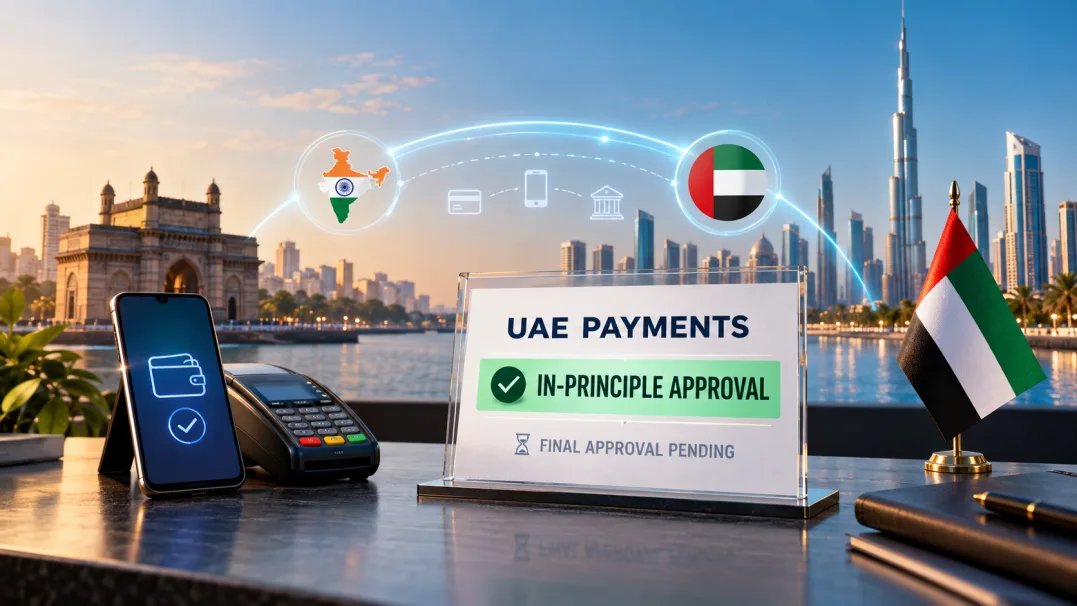
PhonePe has received in-principle approval from the Central Bank of the United Arab Emirates for two payment licence categories, taking the Indian digital-payments company a step closer to launching locally regulated services in the Gulf state.
The approvals cover Retail Payment Services and Card Schemes (RPSCS) and Stored Value Facilities (SVF). They follow initial regulatory due diligence, but they are not a final licence to begin commercial operations. PhonePe must still complete the remaining regulatory requirements and receive final approval from the UAE central bank.
Key takeaways
- PhonePe has secured in-principle, rather than final, UAE regulatory approval.
- The approvals cover Retail Payment Services and Card Schemes and Stored Value Facilities.
- Commercial operations in the UAE cannot begin until final regulatory approval is obtained.
- PhonePe says it plans to work with regional banks, licensed payment providers and local technology vendors after final approval.
- The company also intends to explore support for the UAE's domestic Aani and Jaywan payment rails.
What PhonePe has been approved to pursue
PhonePe's announcement on 22 September 2026 describes the decision as its first international regulatory footprint. The RPSCS and SVF approvals cover two important parts of a locally regulated payments operation: payment and card-scheme services on one side, and stored-value facilities on the other.
For consumers and merchants, however, the most important distinction is between an in-principle approval and final authorisation. The current milestone means the regulator has allowed the application to progress after initial due diligence. It does not mean every planned PhonePe service is already available to UAE customers.
Final approval is still required
PhonePe said it will continue working towards final approval before commencing business operations. Reuters separately reported that the company still needs final central-bank sign-off before it can begin commercial operations in the UAE.
That qualification matters because regulatory announcements can easily be mistaken for product launches. PhonePe has not announced a general commercial launch date for its proposed UAE operation in the material reviewed for this article.
How PhonePe plans to approach the UAE market
Once final regulatory approval is secured, PhonePe says it intends to collaborate with regional banks, licensed payment service providers and local technology vendors. Its stated strategy is to integrate with the existing UAE payments ecosystem rather than simply transplant its Indian product unchanged.
The company also plans to explore opportunities around Aani and Jaywan, two domestic payment rails in the UAE. Aani is an instant-payments platform, while Jaywan is the UAE's domestic card scheme. PhonePe has not said that these integrations are already live, so they should be treated as planned areas of exploration rather than currently available features.
PhonePe already has a cross-border connection to the UAE
The planned regulated operation is different from the cross-border payment capability already available to some Indian travellers. Through NPCI International Payments Limited partnerships, PhonePe users have been able to make certain UPI-based QR payments at supported UAE merchants.
A locally licensed PhonePe operation would represent a broader step: establishing a regulated presence capable of working more deeply with UAE financial institutions, payment providers and domestic infrastructure.
Why the UAE matters for PhonePe
The UAE is a major commercial and travel corridor for India, with substantial flows of workers, tourists, businesses and remittances between the two countries. That makes payments infrastructure connecting the markets strategically useful, while the UAE has also invested in modernising its domestic payment systems.
PhonePe said its expansion plans align with the UAE's Financial Infrastructure Transformation programme and the country's push towards a more digital payments economy.
What users should expect next
The next meaningful milestone is final regulatory approval. Until that happens, users should not interpret the in-principle decision as confirmation that a full PhonePe UAE service can be opened or used immediately.
If final approval is granted, details to watch will include which consumer and merchant services launch first, eligibility requirements, supported banks, pricing, settlement arrangements, and whether integrations with Aani and Jaywan move from exploration to actual availability.
What this means for the wider payments market
PhonePe's move adds another large digital-payments company to the group seeking deeper participation in Gulf financial infrastructure. Its experience operating at scale in India's UPI ecosystem gives it relevant technical experience, but success in the UAE will still depend on local regulation, partnerships, product fit and competition.
For businesses evaluating digital-payment infrastructure more broadly, FlyingEze has also covered Flutterwave's digital-payments partnership with Yango in Zambia and explained how payment-gateway integration can affect website credibility .
Bottom line
PhonePe's UAE approval is a significant regulatory step, but it remains preliminary. The company has clearance to continue towards licences covering retail payments, card schemes and stored-value facilities; it does not yet have final approval to launch commercial UAE operations. The practical story now shifts to the remaining regulatory process and the local partnerships and payment-rail integrations that may follow.