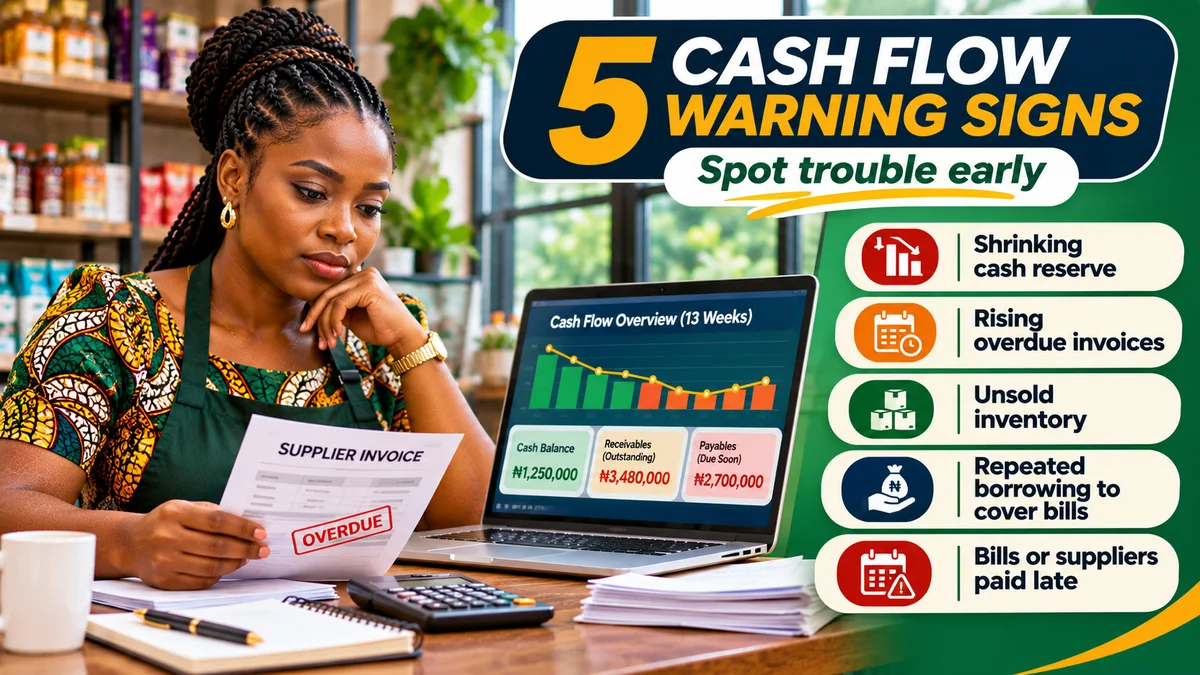
A shop that issues twenty PDF invoices a week may assume it has plenty of time before Nigeria's next phase of electronic invoicing. But when new reporting requirements arrive, the biggest obstacles are often old problems: missing customer information, inconsistent product names, duplicate invoice numbers and records scattered across a POS, WhatsApp messages and spreadsheets.
Nigeria's Nigeria Revenue Service (NRS) Merchant Buyer Solution (MBS) introduces structured invoice data and fiscal validation. For many businesses in the NRS 'emerging taxpayer' segment, the published timetable envisages onboarding activity in 2027. That makes the remaining months of 2026 an opportunity to prepare without changing everything at once. This guide offers a practical readiness checklist for Nigerian SMEs; it is not a claim that every SME must be live on 1 January 2027.
1. Check whether the 2027 phase applies to your business
The NRS February 2026 implementation notice grouped taxpayers by annual turnover. Large taxpayers, generally above ₦5 billion, entered an earlier phase, with a revised full-compliance deadline of 31 July 2026. Medium taxpayers of approximately ₦1 billion–₦5 billion had a 1 July 2026 go-live and proposed enforcement in January–March 2027. Emerging taxpayers below ₦1 billion are scheduled for engagement January–March 2027, pilot April–June, go-live 1 July 2027, review October–November and enforcement January–March 2028.
Those future dates are indicative, not a guarantee that later NRS notices cannot revise them. The rollout category 'emerging taxpayer' must not be confused with every statutory definition of a small business or VAT exemption. At exactly ₦5 billion, classification also needs confirmation because official materials have used slightly different boundary wording. The detailed timeline appears in KPMG's February 2026 summary , while the July NRS notice clarifies the large-taxpayer extension.
A business operating in multiple legal entities should check the relevant taxpayer classification for each entity. Obtain guidance from NRS or a qualified tax adviser where turnover, taxable-supply status, exemptions or registration responsibilities are unclear. For the complete eligibility context, see FlyingEze's Nigeria e-invoicing 2026 compliance timeline .
2. Understand what the checklist is preparing you for
A PDF exported from Word or accounting software is a useful customer document, but does not by itself prove successful NRS fiscalisation. The NRS system requires prescribed transaction information and an applicable portal or integration process for validation. The official NRS resources describe individual portal entry, Excel batch uploads and API-based integration. Different approaches may suit businesses with different invoice volumes, and availability depends on the business's status and the current platform.
Section 23 of the Nigeria Tax Administration Act 2025 establishes the use of an electronic fiscal system when deployed, while giving NRS responsibility for its transition arrangements. Preparing before enforcement should therefore focus on good invoice source data, responsible staff and tested processes rather than merely buying a new PDF template.
3. The 12-point SME e-invoicing readiness checklist
| Readiness item | Evidence of completion |
|---|---|
| 1. Confirm taxpayer band | Turnover assessment and current NRS guidance retained |
| 2. Verify Tax ID | Matching legal name, ID and contact data |
| 3. Inventory invoice sources | List of POS, Excel, ERP, website and manual books |
| 4. Standardise invoice numbering | Documented uniqueness and correction rules |
| 5. Clean customer details | Verified buyer records and privacy controls |
| 6. Classify goods, services and taxes | Approved item and tax-category catalogue |
| 7. Check amounts and units | Tested quantities, discounts, totals and unit codes |
| 8. Choose collection/reporting route | Documented portal or provider decision |
| 9. Plan security and records | Access permissions, backups and audit records |
| 10. Prepare adjustments | Refund, credit-note and partial-payment procedure |
| 11. Test with sample invoices | Successful and failed cases logged |
| 12. Assign budget and ownership | Named lead, cost plan and review calendar |
Use this as a working checklist rather than a statutory form. Record each item as not started, in progress, tested or complete, and keep proof of the work. The following sections explain how to make the most important items practical.
4. Verify your Tax ID and legal business profile
Start with your legal name, registration records, business address and tax identity. The NRS portal announced on 13 July 2026 that Tax ID replaces TIN as the legal identifier for e-invoicing businesses and directed taxpayers to taxid.nrs.gov.ng to retrieve their Tax ID. Match the number to the correct legal business rather than using a director's personal data as a substitute.
Some versioned API examples still label a technical field tin. That does not mean developers should arbitrarily rename required API keys: use the current business identifier while following the actual schema for the integration version. Fix misspellings and obsolete contact emails now, and retain confirmation of any correction.
5. Create one reliable invoice register
Many SMEs accept orders through WhatsApp, a cash register and an e-commerce site at the same time. If each channel issues its own numbers without central rules, duplicated identifiers and missed transactions become likely. Create a master invoice register containing invoice number, legal seller, customer, issue date, item details, currency, tax classification, totals, payment status, and any correction reference.
Prevent the same number being assigned to separate invoices within the relevant business scope. Keep an original invoice and record later changes through authorised adjustments rather than deleting history. If several employees or branches issue invoices, define who owns numbering and when a final invoice is locked.
6. Clean your products, services, quantities and tax codes
The NRS invoice schema includes required fields such as BusinessID, IssueDate, InvoiceKind, TaxTotal, LegalMonetaryTotal and InvoiceLine. Structured reporting needs consistent product descriptions, quantities, accepted units, relevant tax categories and correctly calculated values.
For a business selling bottled drinks and bulk grains, write consistent inventory units instead of switching between 'piece', 'pcs' and 'one'. The NRS April 2026 update added standardised unit-of-measure codes such as EA (each), KGM (kilogram) and LTR (litre). Use the accepted code catalogue rather than guessing what the integration will accept.
Tax categories matter equally. Do not apply a universal 7.5% VAT rate to every invoice without confirming whether the supply is taxable, exempt or otherwise treated differently. Have an accountant review the relevant goods and services and the basis for their tax treatment. NRS also documented additional tax-category resources and changes in its API changelog .
7. Reconcile the numbers with an example invoice
Suppose a business provides a service worth ₦40,000 and that particular supply is correctly subject to 7.5% VAT. The illustrative VAT is ₦3,000 and total payable is ₦43,000. The accounting software should reconcile the line value, taxable amount, tax amount and final total. If there is a discount, the documented calculation rules should be applied consistently.
This is an arithmetic example, not tax advice about which supplies must be taxed. When the NRS schema expects monetary totals and tax details to agree, a mismatch can cause a submission error. Run sample cases involving multiple items, discounts, a taxable item and an exempt item, and make sure the invoice register matches the accounting ledger.
8. Select the right submission route instead of buying software blindly
The MBS portal supports business registration and access to invoicing functions. The NRS resource centre describes individual invoice forms and Excel batch submission, while the developer documentation describes eligible API-based reporting and the roles of System Integrators and Access Point Providers. A simple business may begin by evaluating the portal route, while a busy retailer or hospitality operator may need integrated automation.
Ask the vendor to demonstrate how the software handles your actual invoices, not generic screenshots. Request evidence of its current NRS-compatible workflow, approval where required, invoice reference handling, validation responses, correction methods, monitoring and data export. An accounting package that sends PDFs is not necessarily an approved fiscalisation service.
9. Protect customer records and API credentials
Some records contain customer identities, addresses, invoice information and Tax IDs. Give staff role-based access, limit the amount of personal data collected, and protect backups and exported files. If connecting through an API, store credentials server-side and use HTTPS. The NRS authentication guide currently documents application credentials in x-api-key and x-api-secret headers for the described API version.
Separate test and production environments, prevent secrets from appearing in public source code, and log who creates, approves, submits or changes an invoice. A small business using a spreadsheet should still control access and preserve backups. If a provider manages submission, agree who is responsible for errors, incident response and record retention.
10. Prepare for failed invoices, refunds and instalments
Not every invoice will pass validation on the first attempt. Document who reviews errors, who corrects source data, when a failed request may be retried and how to prevent two fiscal invoices being created for one sale. The NRS validation test interface can assist with sample UBL JSON payloads, but passing a test is not the same as completing production onboarding.
Businesses must also support credit notes, debit notes, refunds and part-payments as applicable. The April 2026 NRS changelog introduced a PARTIAL payment status for instalment-based settlements. Preserve the original invoice history and link the adjustment to the correct transaction. A confirmed customer bank transfer is not the same thing as official invoice validation or net settlement into the merchant's account.
11. Create a 90-day readiness plan before 2027
| Period | Priority actions | Deliverable |
|---|---|---|
| Days 1–30 | Confirm category, Tax ID and all billing sources; assign the project owner | Current-state inventory and compliance register |
| Days 31–60 | Clean products and customers; standardise invoice numbering and tax mappings; shortlist vendors | Clean sample dataset and vendor comparison |
| Days 61–90 | Test example invoices, exceptions, backups and user permissions; set 2027 monitoring dates | Test report, budget and launch-readiness decision |
Starting in November 2026, a 90-day preparation programme can continue into early 2027; it does not replace the NRS's actual stakeholder-engagement or pilot calendar. Keep weekly reviews small and practical. Many SMEs can make meaningful progress through better source records before paying for advanced integration. If the business is already in a medium or large taxpayer band, it must follow the earlier applicable phase rather than this emerging-taxpayer planning schedule.
12. Budget realistically for the transition
List expected costs for accounting-software updates, data cleanup, provider onboarding, training, ongoing support, secure storage and possible hardware or connectivity improvements. Request itemised quotations rather than assume one mandatory fee applies to every business. Include a buffer for fixing old records and a recurring cost for keeping systems current after launch.
For hospitality organisations improving day-to-day finance records, P-Biz Solutions' hospitality accounting page describes receivables, payables, journals and reconciliation. Those are relevant operational capabilities to investigate, but official NRS MBS accreditation or a live fiscalisation integration has not been independently verified. Request documentation and a demonstration before relying on any vendor for compliance.
A business owner can also use KudiScope to track and plan software subscriptions, staff training and implementation spending. KudiScope is a money-tracking and budgeting platform, not an NRS invoice-submission service or bank; its role here is financial planning, not tax compliance.
13. What evidence should you keep in a readiness folder?
- A copy of the latest official timetable or NRS correspondence relevant to the taxpayer band.
- Business registration and verified Tax ID details, with appropriate access protection.
- A list of invoicing systems and staff responsibilities.
- A sample invoice register and an agreed numbering policy.
- A clean catalogue of products, services, units, tax categories and sample calculations.
- Vendor quotations, verified approval claims and integration responsibilities.
- Test results for validation, duplicates, partial payments, corrections and connectivity failures.
- A budget, training record and dated management sign-off.
The folder should be maintained securely and updated as guidance changes. It is an internal preparation record, not a substitute for the official filings or validation evidence required once the business enters its applicable fiscalisation process.
14. Readiness checklist by business type
Retail shops and online sellers: focus on item catalogues, POS records, refunds, online orders and consistent receipt-to-invoice matching. Hotels and restaurants: identify sales across rooms, food, beverages, events and branches, and confirm the legal entity responsible for invoicing. Schools and training providers: review tuition invoices, instalment plans, customer identity and applicable tax treatment. Agencies and SaaS businesses: verify recurring invoices, contract milestones, subscriptions, foreign customer data and correction workflows.
None of these categories is automatically exempt or automatically required to use the system on one universal date merely because of its industry. Apply the taxpayer's actual legal and turnover classification.
15. Common preparation mistakes
- Treating the 2027 emerging-taxpayer go-live as a universal deadline for every Nigerian business.
- Waiting for enforcement before identifying incorrect invoice or customer records.
- Assuming that any PDF containing a QR code is officially validated.
- Buying software solely because an advertisement claims 'NRS ready'.
- Changing a schema field labelled TIN without checking the current technical version.
- Deleting original invoices to fix mistakes instead of maintaining valid correction records.
- Allowing multiple staff to reuse the same invoice number.
- Failing to budget for training, ongoing support and exception handling.
The key lesson is to treat readiness as a controlled business-process change, not a last-minute document-format conversion. The broader legal background is covered in FlyingEze's report on the original national e-invoicing initiative .
Frequently asked questions
Must every Nigerian SME implement e-invoicing before 1 January 2027?
No. The February NRS timetable gives emerging taxpayers below ₦1 billion a planned 1 July 2027 go-live and later enforcement. Medium and large taxpayers have earlier phases. Check later notices and the specific taxpayer's status.
Can a small business continue issuing PDF invoices in 2026?
PDFs may remain useful commercial records, but where NRS fiscalisation is applicable they do not replace the prescribed structured submission and validation. Other invoice and bookkeeping obligations still apply.
Do I need an ERP to prepare?
Not necessarily. The NRS describes portal and Excel batch workflows as well as technical integrations. Even without an ERP, you can clean customer data, organise invoice references and test records before your applicable phase.
Can I use a provider that claims to be NRS certified?
Check the current NRS provider directory and ask what the provider's approval covers. Verify that the product supports your transaction types and provides actual validation and audit evidence.
Is my Tax ID the same as the old TIN?
The NRS announced Tax ID as the current legal identifier in July 2026. Retrieve and verify your official Tax ID, and use the field mappings required by the applicable API version rather than assuming that all legacy technical labels have disappeared.
Conclusion
For Nigerian SMEs, the smartest e-invoicing preparation before 2027 is not necessarily a costly software replacement. It is a deliberate process: confirm the correct NRS band, verify the Tax ID, organise invoices, improve tax and customer records, choose an appropriate integration route and test the system before the relevant go-live.
The emerging-taxpayer timeline creates an opportunity to prepare, but dates and requirements should be checked against subsequent NRS guidance. A well-maintained readiness checklist gives business owners evidence of progress and helps avoid preventable technical and accounting problems when electronic fiscalisation becomes applicable.