As of 17 November 2026, the Nigeria Immigration Service (NIS) lists ₦100,000 for a 32-page, five-year standard passport and ₦200,000 for a 64-page, ten-year standard passport when applying within Nigeria. Its revised April 2026 service-level agreement also lists 42 days after successful biometric enrolment for a fresh passport and 21 days after successful enrolment for renewal or reissue. These are official service timelines, not guaranteed collection dates and not a countdown from payment.
If you are researching how to obtain international passport in Nigeria, there are two separate things to verify before spending money: the published fee for your precise passport category and the current stage of your individual application. This guide explains where to check both, how to distinguish an official price increase from an outdated screenshot, why processing estimates differ from appointment waiting times, and what to do if your application appears delayed.
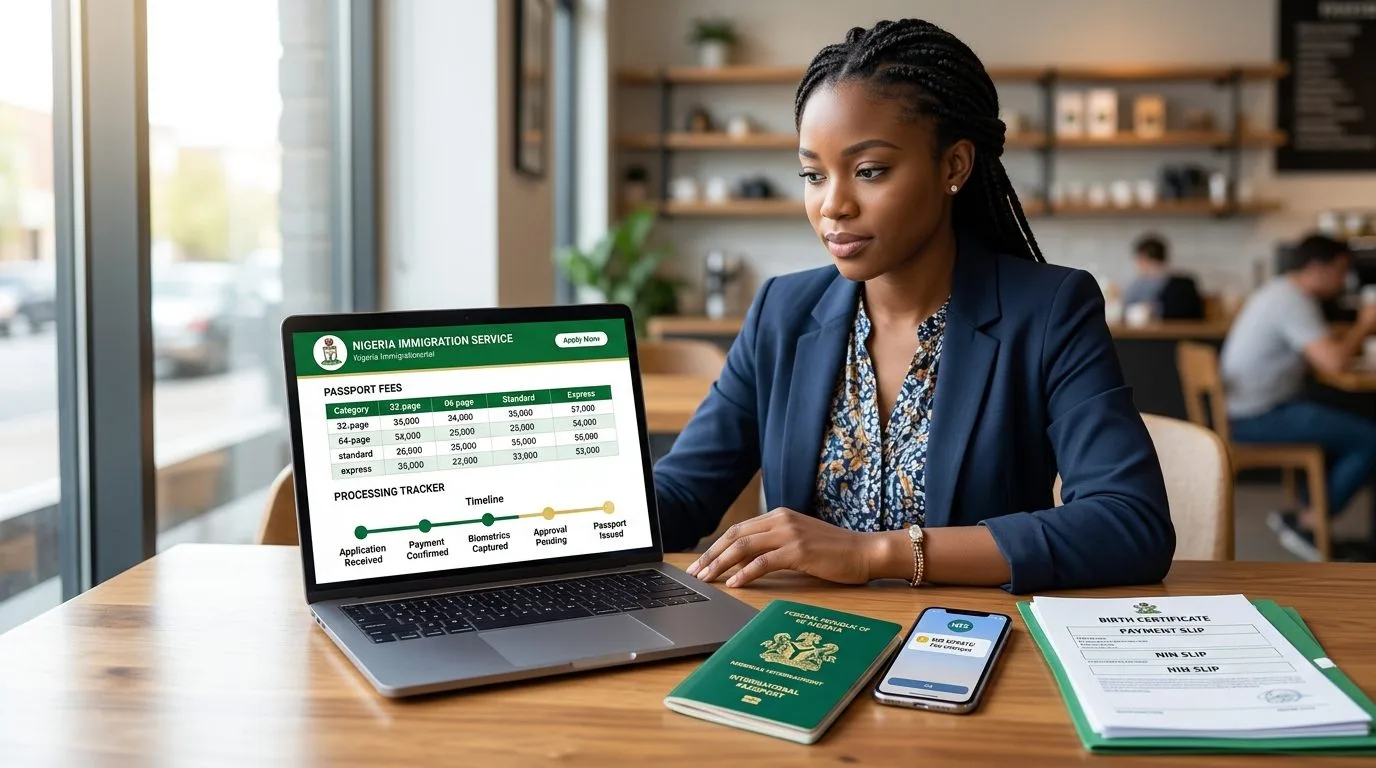
Nigerian passport fees and processing times in 2026: the verified figures
| Service or booklet | Official figure | Important qualification |
|---|---|---|
| Standard 32-page passport, five-year validity, domestic application | ₦100,000 | Excludes bank/processing charges shown by authorised payment channel |
| Standard 64-page passport, ten-year validity, domestic application | ₦200,000 | Confirm age/category eligibility before selecting a booklet |
| 32-page, five-year application abroad | US$150 under NIS's published overseas schedule | Check the current mission and service arrangement; contactless options can have different components |
| 64-page, ten-year application abroad | US$230 under NIS's published overseas schedule | Do not convert to a fixed naira price or assume every overseas service is identical |
| Fresh standard passport processing | 42 days | Counted after successful enrolment, not initial form completion |
| Renewal/reissue processing | 21 days | Counted after successful enrolment; actual completion may differ |
| Correction of passport data | ₦30,000 administrative charge listed in the April 2026 SLA | Separate from the applicable passport booklet price; correction rules and timelines are category-dependent |
The domestic fees were announced by NIS on 28 August 2025 for implementation from 1 September 2025. The original fee announcement distinguishes Nigerian applications from the diaspora. The April 2026 NIS Service Level Agreement (pages 10–12) independently repeats the standard prices and processing targets. This comparison is a dated snapshot: confirm the live portal amount before any payment.
Which Nigerian passport fee is official—and why are older prices still online?
NIS has revised passport charges over time. An older article may accurately quote a figure that applied when it was published but is no longer suitable for a new 2026 domestic application. That is why a news headline or a chart on social media should not be used as a payment instruction on its own.
The August 2025 NIS notice is especially clear: the upward review affected applications made in Nigeria, setting ₦100,000 for the 32-page/five-year booklet and ₦200,000 for the 64-page/ten-year booklet. It stated that the then-existing diaspora standard fees remained US$150 and US$230. In April 2026, NIS published a newer service-level document repeating the prices, with the qualification that the amounts exclude bank charges.
Neither notice establishes a universal all-inclusive fee for every correction, replacement, urgent case or overseas contactless service. The online application should show the payable amount for the exact route, and the current government notice should explain any genuine policy change. An applicant should also check eligibility before selecting a ten-year booklet rather than assume that every child or special-category applicant can use it.
How to check official Nigerian passport fee updates: a six-step method
- Begin at the agency's authentic site. Open immigration.gov.ng yourself, rather than following a paid advert, private message or link that merely resembles the government domain.
- Locate the latest dated fee announcement. Review the NIS press releases or the published 2025 standard-fee revision . Note the date a rate takes effect, not just the date someone reposted it.
- Compare the service-level agreement. Read the passport section of the 2026 SLA , which includes fees and service targets. If an even newer official agreement is published, use the most applicable current version.
- Choose your real application category. At passport.immigration.gov.ng , identify fresh, renewal/reissue or correction of data, and check the booklet and the processing route you qualify for.
- Review the official checkout amount before authorising payment. Distinguish the government booklet fee from a displayed bank or transaction charge. Save the transaction details and official receipt after a successful payment.
- Resolve conflicting figures through NIS. If an official news post, service agreement and portal appear inconsistent, do not guess or send funds to an agent. Use NIS's published support and SERVICOM contact page and provide the relevant dated source URLs.
Use this same method after a new policy announcement, rather than silently replacing an article's prices without recording the effective date. A claimed “2026 passport price increase” is not verified simply because the post was shared in 2026.
What exactly is included in the standard passport fee?
The quoted ₦100,000 or ₦200,000 is the standard government booklet fee under the published domestic schedule, with applicable bank charges excluded. It is not a promise covering every possible additional service or applicant expense. Travel to a centre, obtaining supporting documents and other personal logistics are separate, while certain NIS administrative procedures have their own documented charges.
For example, the April 2026 service agreement lists a ₦30,000 correction-of-data administrative charge. That should not be mistaken for a price for an entirely new passport, nor should it be added automatically to every application. Some correction cases require specific records and further formal procedures; the final amount depends on the authorised workflow.
Equally, an intermediary's demand for a “priority”, “connection”, “slot reservation” or “guaranteed collection” payment is not an officially established government fee just because it appears in an invoice or WhatsApp conversation. NIS's passport guidance emphasises online payment, application tracking and reducing middlemen. Keep payment within the official system.
When does the passport processing clock really start?
The most common timing misunderstanding is counting from the wrong event. An applicant may pay online on one day, obtain a biometric appointment some time later, complete enrolment on a third date and receive the passport later still. The NIS service-level target begins at successful enrolment, not at the first payment or account-registration date.
| Stage | What it means | Does it start NIS's 42-day fresh-passport service target? |
|---|---|---|
| Online account/form | Application details are started or entered | No |
| Payment confirmation | The official payment has been recorded | No |
| Appointment booked | A biometric visit is reserved for a specific date and centre | No |
| Successful biometric enrolment | NIS has completed the required in-person enrolment process | Yes, under the published service standard |
| Production, dispatch or collection | Post-enrolment application and passport fulfilment stages | The applicant still needs an actual status update |
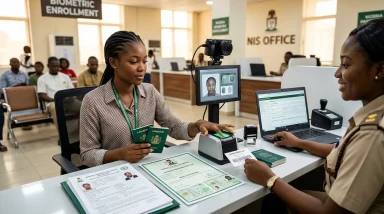
NIS's standard-passport instructions require NIN verification, document upload, payment, appointment booking and in-person biometric capture. No source reviewed establishes a nationwide guaranteed maximum wait for an appointment at every centre. Therefore, “42 days to get your passport from today” is an unreliable promise for someone who has not yet enrolled.
Fresh applications versus renewals: why the targets differ
The April 2026 SLA gives 42 days after successful enrolment for a fresh standard passport, compared with 21 days after successful enrolment for renewal or reissue. The published figures do not mean every renewal will be exactly twice as fast as every first application. They are service targets for different categories, not a forecast based on an individual's processing centre, documents or biometrics.
An applicant who already owns a Nigerian passport should select the correct reissue route and provide the existing passport details. A person who has never held one should use the fresh route. A lost booklet, incorrect personal data or change of name can require separate records or processing conditions; the 21-day reissue figure should not be applied indiscriminately to all complicated correction cases.
For full eligibility and document preparation, see FlyingEze's published first-time Nigerian passport application guide and document and biometric appointment checklist . The focus here is verifying the fees and interpreting the official time estimates.
How to check passport appointment availability before planning travel
The NIS domestic portal provides “Check Centre Availability” and “Book Appointment” functions. The linked appointment system includes appointment-management and rescheduling facilities. Use the availability displayed for your application category and chosen centre; it can vary over time.
When calculating your personal planning window, keep the unconfirmed appointment period separate from the 42-day or 21-day post-enrolment target. A passport office's distance from your home does not reveal the earliest available slot, and a slot shown in one browser session may no longer be available later.
Keep the confirmed appointment location and date, along with required payment and acknowledgement slips. Do not assume you can appear at a different centre or buy access to an earlier appointment from a stranger. If a booking problem occurs, use official rescheduling or support rather than creating duplicate applications and charges.
How to track your individual Nigerian passport application
General service timelines cannot tell you the status of your own passport. NIS maintains an official tracker at track.immigration.gov.ng . It requests two details: your application number and reference number. These normally come from your official application records and acknowledgements. Keep them private.
- Open the tracker directly through NIS's website or type its authentic domain yourself.
- Enter the application number exactly as recorded.
- Enter the reference number and submit the status lookup.
- Read the actual stage displayed; do not interpret an acknowledgement as proof of printing or dispatch.
- Keep a dated record of a persistent delay and contact official NIS support if necessary.
If the tracker does not produce a useful result, first review what you entered and whether your application and payment were properly registered. A temporary site problem, missing record or failed verification does not by itself establish that your passport is lost. FlyingEze has a separate published passport tracking and appointment availability guide for more detailed troubleshooting.
Why a passport can take longer than the published service target
The NIS service standard is valuable for expectations and enquiries, but it is not a guarantee of personal issuance on a specific day. Delays can arise at different stages:
- Before enrolment: unavailable appointment slots, incomplete paperwork or a missed booking.
- Identity checks: NIN details differing from submitted birth or personal information, or a citizenship record requiring clarification.
- Supporting documents: a scanned page, official seal, consent form or existing passport record that needs further validation.
- After enrolment: application review, production or collection/dispatch problems, or technical interruptions.
- Applicant contact issues: an outdated email, missed official message or incorrect reference information preventing timely follow-up.
These are possible causes—not claims about the present performance of a particular NIS processing centre. If a name or birth-date mismatch is involved, read FlyingEze's guide to identifying the correct passport/NIN correction process . The right response is to identify the actual obstacle, not automatically restart the application or pay someone promising an instant fix.
Domestic versus diaspora fees: avoid mixing two price schedules
The NIS standard-fee revision explicitly distinguished Nigerians applying within Nigeria from those applying abroad. In its August 2025 press release, the agency stated that overseas standard-passport rates remained US$150 for 32 pages/five years and US$230 for 64 pages/ten years. The April 2026 service agreement also includes overseas figures in its standard-passport tables.
However, diaspora processing can involve a particular Nigerian mission, different booking steps and, for some eligible applicants, a separate contactless passport service. Its fees and eligibility must be checked under that service's current instructions; do not simply add a random “contactless fee” to the standard dollar figure or treat a naira conversion as a government rate. NIS published a contactless-service technical update in September 2025, illustrating that the operation is distinct from ordinary first-time domestic enrolment.
For Nigerians outside the country, FlyingEze's published diaspora passport renewal checklist covers mission-specific preparation. Neither the domestic price nor the domestic appointment timeline should be assumed to apply identically to every overseas applicant.
What does the NIS refund policy say about wrong or duplicate payments?
Passport applicants should understand the refund rules before paying. NIS's official online-payment refund policy generally treats transactions as final, subject to defined exceptions. It says a refund may be considered for two payments made against one application and in some passport cases where no appointment has been booked, excluding the specified contactless category.
The policy also lists several non-refundable situations: an appointment already booked, an error discovered after payment, a second application merely to change booklet size, two separate applications for the same person, and certain queried or rejected applications. It states that refund requests must be made within 21 days of payment, with review and approval remaining at NIS's discretion. It describes a typical six-week period for processing approved refunds following receipt of a complaint—not a guarantee that any requested refund will be granted.
If your account has been debited but your application still shows no payment, save the transaction reference and proof of debit, check the official portal and use the current contact or refund instructions shown on the NIS site. Do not immediately pay again or submit a new application. Avoid handing payment credentials or sensitive identity documents to unofficial account-recovery agents.
How to check whether a passport fee increase is real
News about a possible new price is common when government charges change. Use a disciplined source check before sharing a claim:
| Verification question | What counts as reliable evidence? |
|---|---|
| Who announced the change? | A dated NIS or competent government notice hosted on an authentic official website |
| When does it take effect? | An explicit implementation date, not merely a screenshot timestamp |
| Where does it apply? | Domestic applications, overseas applications or a specific service identified clearly |
| Which booklet or service? | Specified number of pages, validity, renewal/correction category and other conditions |
| What is excluded? | Bank/processing charges or documented extra administrative fees |
| Does the application portal agree? | The official payable amount for your actual route, checked before authorisation |
| What if sources conflict? | Escalation through verified NIS contacts rather than a speculative payment |
An old official press release is still useful for historical context, but a newer valid notice can supersede it. Record both the published date and the effective date, and never substitute a third-party quotation for the amount on the real government checkout screen.
Practical cost and timing scenarios
Scenario A — First-time adult within Nigeria: An eligible applicant selects a standard 32-page/five-year booklet. Under the published domestic schedule the government fee is ₦100,000, excluding bank charges. The person then books biometrics. NIS's 42-day service standard starts only after successful enrolment, so an unknown appointment wait cannot be counted as zero.
Scenario B — Renewal of an existing passport: A traveller chooses the appropriate reissue route and prepares the existing booklet and NIN records. The relevant standard booklet fee must be checked in the portal. The published reissue service target is 21 days after successful enrolment; it is not a commitment that the booklet will be ready 21 days after an initial online payment.
Scenario C — Correcting an inaccurate date of birth: The applicant discovers the mismatch before paying. NIS lists a correction-of-data administrative charge of ₦30,000 in its 2026 agreement, but the process and full payable amount depend on the exact category. Correct the underlying lawful records and check NIS requirements before selecting a correction workflow. This is not the same as a routine renewal.
Scenario D — Nigerian living overseas: The person sees the domestic ₦100,000 figure online but will apply through a Nigerian mission or an eligible diaspora route. That naira price is not the overseas tariff. The applicant must check the published dollar schedule, mission-specific instructions and any distinct contactless fees directly before payment.
These are illustrative planning situations, not individual fee quotations, appointment searches or forecasts of actual issuance dates.
Frequently asked questions
How much is a Nigerian international passport in 2026?
For standard applications made within Nigeria, NIS's published schedule lists ₦100,000 for a 32-page, five-year passport and ₦200,000 for a 64-page, ten-year passport, excluding bank charges. Verify the live fee and eligibility on the official application portal before payment.
What is the official Nigerian passport application website?
For applications made within Nigeria, use passport.immigration.gov.ng , reached from immigration.gov.ng . NIS links to a separate route for applications from outside Nigeria.
When did the current standard passport fees begin?
NIS announced the domestic fee change on 28 August 2025, effective 1 September 2025. The same standard rates appeared in its April 2026 service agreement reviewed for this article.
How long does a fresh Nigerian passport take?
The April 2026 NIS service-level agreement lists 42 days after successful biometric enrolment. It is a published standard, not a guaranteed collection date, and excludes any preceding appointment wait.
What is the processing time for passport renewal?
The official service-level target is 21 days after successful enrolment for a standard renewal or reissue. Application difficulties or differing categories can alter an individual timeline.
Can I get a Nigerian passport in one week by paying extra?
Do not rely on a private promise of one-week issuance or a paid “connection”. The ordinary fresh and reissue targets published in April 2026 are different. Only a genuine NIS notice for an authorised service can establish any distinct official expedited option.
Does the 42-day period begin after payment?
No. The NIS document explicitly counts from successful enrolment, which follows the required biometric appointment, not from payment or form submission.
How can I track my passport after biometrics?
Open track.immigration.gov.ng and enter the application number and reference number recorded in your official documents. Use NIS support if a persistent problem cannot be resolved.
Is there a separate passport correction charge?
The April 2026 SLA lists a ₦30,000 correction-of-data administrative charge. It does not establish that every correction costs only ₦30,000 in total. Check the application type and displayed official charges.
Are Nigerian passport fees the same abroad?
No. The 2025 NIS announcement separately listed US$150 and US$230 for the two standard overseas passport options. Embassy/consulate and eligible contactless workflows require current verification.
Can I get a refund if I accidentally make two payments?
Possibly, where two payments were made for one application, subject to NIS verification and policy conditions. Separate duplicate applications and many booked-appointment cases are excluded. The policy says refund requests must be made within 21 days of payment.
What should I do if an agent quotes a different passport fee?
Ask for the dated official NIS source and compare the figure with the authentic portal and the latest relevant notice. Do not send money to a personal account for an unverifiable appointment, fee increase or guaranteed issuance date.
Final checklist: verify price, enrolment and status
- Use NIS's authentic website to identify the correct fresh, renewal/reissue or correction category.
- Check the most relevant dated fee notice and confirm its effective date.
- Compare the advertised fee with the official application checkout, noting bank charges and applicable extras.
- Check NIN and supporting documents before submitting or paying.
- Use the official system to check appointment availability, then complete biometric enrolment.
- Count the NIS service standard from successful enrolment, not from payment.
- Track the individual application with its official number and reference number.
- Keep receipts and use NIS support for real discrepancies; avoid repeat payments and unofficial agents.
Bottom line: Nigerian passport costs and processing times should be verified through the issuing authority, not taken from an old social-media chart or an agent's promise. As of 17 November 2026, the standard domestic figures confirmed in NIS publications are ₦100,000 and ₦200,000, while the published processing targets are 42 days for a fresh passport and 21 days for a reissue after successful enrolment. Checking the application category, effective fee date and actual tracking status gives prospective travellers a more reliable basis for planning.
Editorial verification: 17 November 2026. This article uses the Nigeria Immigration Service's August 2025 official fee revision, April 2026 service-level agreement, authentic passport application and tracking portals, service information, online refund policy and support guidance. Figures and processes are subject to change; verify the current terms before payment or travel arrangements. This guide is not an individual fee quotation, appointment availability check or guarantee of passport issuance.