Airtel Money is reportedly considering a smaller London initial public offering after investor feedback, in a move that would reduce the fundraising ambition attached to one of Africa’s most closely watched fintech listings.
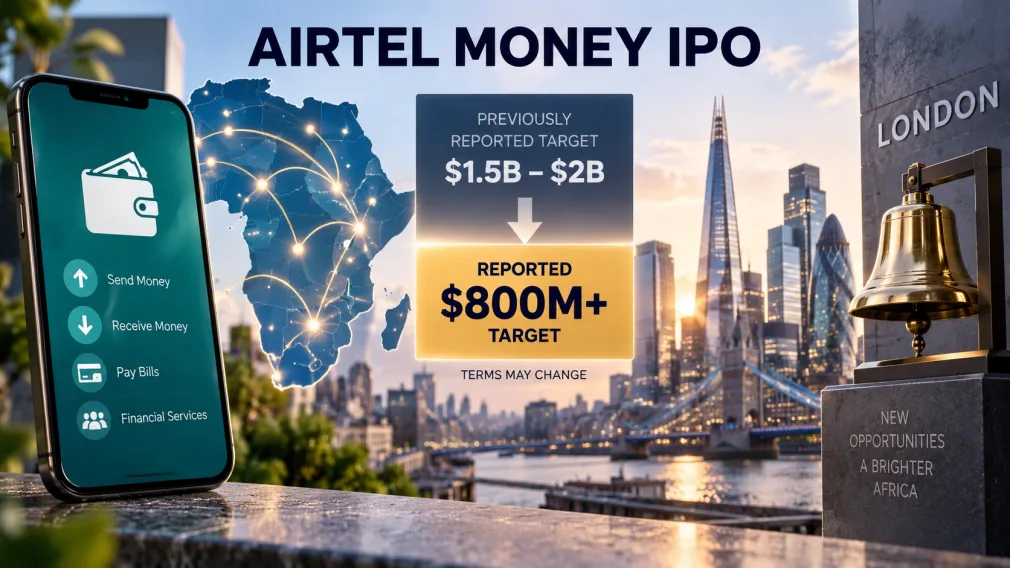
Reuters, citing Bloomberg News, reported on 17 September that Airtel Africa’s mobile-money unit is planning to reduce the size of its upcoming London IPO. Other reporting has put the revised target at at least $800 million, compared with an earlier reported range of $1.5 billion to $2 billion.
The key caveat is that the revised size has not been confirmed as final by Airtel Africa. IPO terms can change materially before launch depending on investor demand, market conditions, valuation discussions and the final prospectus.
Key takeaways
- Airtel Money is reportedly considering a London IPO of at least $800 million.
- That is below the previously reported $1.5 billion to $2 billion fundraising range.
- The reduction is being linked to investor feedback and market conditions.
- Airtel Africa has previously identified London as its preferred venue for the planned listing.
- The final offer size, valuation and timing may still change before launch.
What has changed in Airtel Money’s IPO plan?
The main reported change is the size of the proposed offering. Earlier reporting had associated the transaction with a fundraising target of roughly $1.5 billion to $2 billion. The newer figure of at least $800 million represents a substantially smaller offer if it becomes the final structure.
That does not necessarily mean Airtel Money’s underlying business has suddenly weakened. IPO size is shaped by more than company performance. Bookbuilding conversations with institutions, valuation expectations, market volatility, comparable-company multiples and the amount existing shareholders are willing to sell can all influence how large an offer ultimately becomes.
For investors, the distinction between “reported target” and “confirmed offer” matters. Until formal terms are published, the $800 million figure should be treated as a reported plan rather than a completed financing decision.
Why investor feedback matters before an IPO
Before a large public listing, banks and company advisers typically test investor appetite. Potential buyers may indicate how much stock they would consider buying and at what valuation. That feedback can shape the eventual size and pricing range of the transaction.
If investors push back on valuation or signal weaker demand at the original deal size, a company can respond by reducing the amount offered, adjusting pricing expectations, changing the mix of new and existing shares or delaying the transaction.
A smaller deal can sometimes make an IPO easier to complete because less capital must be placed with investors. It may also help create stronger demand relative to the number of shares available, although there is no guarantee that reducing the size will improve post-listing performance.
Why London remains important
Airtel Africa is already a public company with shares traded in London and Nigeria. Its shareholder information confirms that Airtel Africa plc ordinary shares have traded on the main market of the London Stock Exchange and the Nigerian market since 2019.
That existing presence gives investors a familiar listed parent company through which to assess governance, reporting and regional exposure. A separate Airtel Money listing would give the mobile-finance business its own public-market valuation and investor base.
For London, a major African fintech flotation would also be notable at a time when the city has been trying to attract more high-growth technology and financial-services listings.
Why Airtel Money matters to Africa’s fintech sector
Mobile money has become core financial infrastructure across many African markets. It allows customers to transfer money, receive payments, pay bills and access other financial services without relying solely on traditional bank branches.
Airtel Money is part of that broader shift from telecom connectivity towards financial platforms. For investors, that means the business is often evaluated not simply as an add-on to mobile telecom services, but as a payments and financial-services network with its own growth, transaction and customer-economics profile.
A separate listing could therefore make it easier for public-market investors to value the mobile-money operation independently from Airtel Africa’s telecom business.
What a smaller IPO could mean for Airtel Africa
The impact depends on the eventual structure. If the IPO raises less money than previously expected, Airtel Africa and Airtel Money may have less immediate capital from the transaction than under a larger offer. On the other hand, a smaller flotation could reduce execution risk if investor demand is more cautious at the higher fundraising range.
The final valuation is just as important as the amount raised. A company can technically raise less money while still achieving an attractive valuation if fewer shares are sold. Conversely, a larger raise at a lower valuation may dilute existing shareholders more heavily.
That is why investors should avoid judging the eventual deal solely from the headline fundraising amount.
What investors should watch next
The most important next step is formal documentation. Investors should watch for confirmation from Airtel Africa or its advisers covering the offer size, price range, valuation, expected free float, use of proceeds and timetable.
They should also distinguish between primary shares, which raise new capital for the company, and secondary shares sold by existing shareholders. The balance between the two can materially affect how much fresh money reaches Airtel Money itself.
Another important factor will be the level of institutional demand once the formal bookbuilding process begins. Strong orders can support pricing and deal confidence, while weak demand may lead to further changes in size or valuation.
What this means for African fintech
Airtel Money’s proposed listing matters beyond one company because it could provide a new public-market reference point for large African digital-finance businesses. Public valuations can influence how investors assess other mobile-money, payments and fintech platforms across the continent.
A successful listing could demonstrate that global investors remain willing to back African financial infrastructure at scale. A difficult transaction, by contrast, could reinforce concerns about valuation discipline, market volatility and the challenge of bringing fast-growing fintech businesses to public markets.
For now, the clearest conclusion is that the IPO remains a live process rather than a finished deal. The reported reduction to at least $800 million suggests Airtel Money is adjusting its plans to investor feedback, but the definitive structure will only be known when the company publishes formal terms.
Reporting basis: Reuters/Bloomberg reporting on 17 September 2026, Airtel Africa investor information and subsequent market coverage. Terms remain subject to change until formally announced.