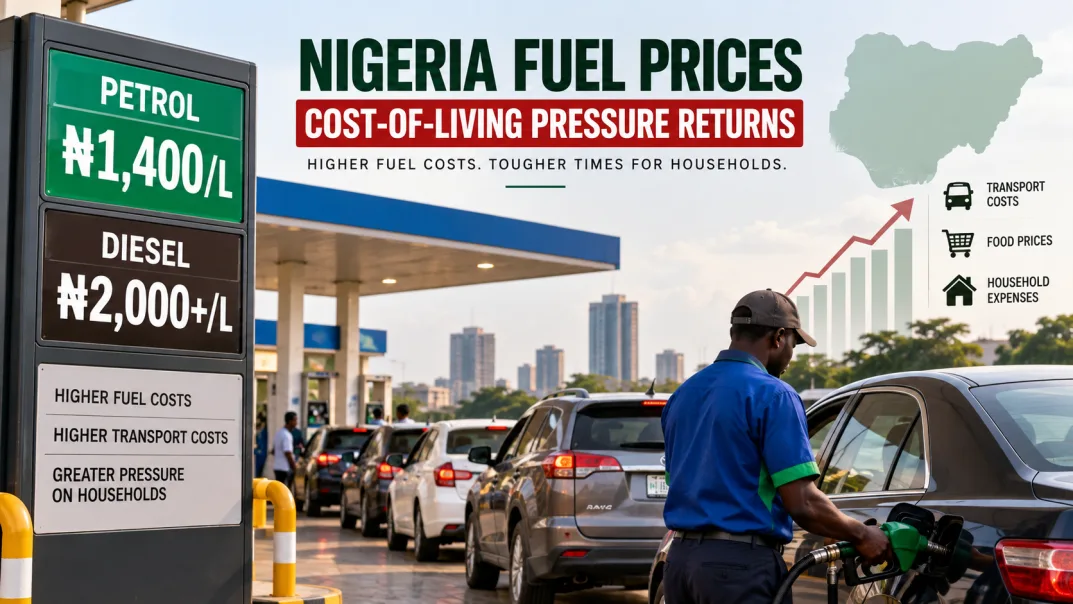
Fuel prices have climbed to record levels in parts of Nigeria, renewing pressure on household budgets, transport costs and businesses that rely heavily on petrol and diesel.
Petrol is selling at around ₦1,400 per litre in Lagos and Abuja and as much as ₦1,500 in parts of northern Nigeria, while diesel has moved above ₦2,000 per litre, according to current market reporting.
The latest increases come as higher international crude-oil prices feed through to domestic fuel costs. Nigeria is a major crude producer, but changes in global oil prices still affect the cost of refined products and the economics of domestic refining.
Why petrol and diesel prices are rising
Global crude prices have risen amid heightened geopolitical tensions and concerns about energy supply. Higher crude costs increase the cost base for refiners, including domestic producers buying Nigerian crude at market-linked prices.
The Dangote refinery is operating at full capacity of about 700,000 barrels per day, but domestic refining does not completely insulate consumers from international oil-market movements. Crude remains the principal input into petrol and diesel production, so a sustained rise in crude prices can translate into higher wholesale and retail prices.
What the increases mean for households
Fuel prices have a broad impact on Nigeria's cost of living because road transport is central to the movement of people, food and consumer goods.
Higher petrol prices affect motorists, commercial transport operators and businesses using petrol generators. Diesel increases can be particularly important for logistics companies, manufacturers, large retailers and other businesses that rely on diesel-powered vehicles or backup electricity generation.
When those operating costs rise, businesses may pass some of the additional expense on to customers through higher transport charges and product prices.
Transport and food costs under pressure
Food distribution is especially sensitive to diesel and petrol prices because agricultural produce often travels long distances by road before reaching urban markets.
Higher haulage costs can therefore affect the final price of food even when farm-gate prices have not changed significantly. Commuters may also face higher fares if commercial transport operators adjust prices to reflect increased fuel expenses.
Domestic refining changes the market, but not the oil price
The expansion of domestic refining has reduced Nigeria's dependence on imported refined products and changed the country's downstream fuel market. However, it does not remove exposure to global crude prices.
Refiners must cover the cost of crude, processing, distribution and other operating expenses. As a result, domestic pump prices can still move higher when international oil prices rise sharply.
What to watch next
The direction of Nigerian fuel prices will depend partly on global crude markets, exchange-rate conditions, refinery pricing and competition across the downstream sector.
Consumers and businesses will also be watching whether higher fuel costs feed more broadly into transport fares, food prices and inflation in the coming weeks.
FlyingEze will continue to monitor significant developments affecting Nigeria's fuel market and household costs.