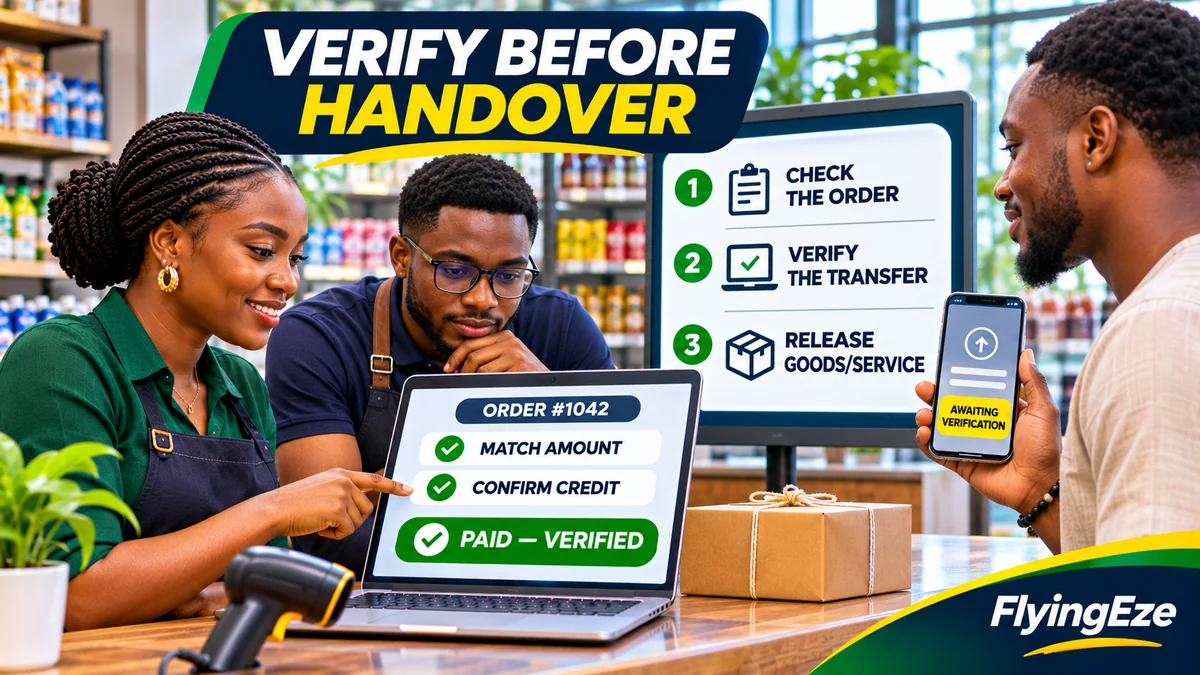
Before releasing goods or services after a Nigerian bank transfer, verify that the business has received a genuine payment through its own bank account or authorised payment platform, match it to the correct order and amount, and record who approved the handover. A customer's SMS, debit alert, screenshot or transfer receipt is not independent evidence that the merchant has been paid.
This is the difference between “the buyer says a transfer was sent” and “the merchant has verified the transaction.” In a busy supermarket, hotel, electronics shop or WhatsApp business, the gap can lead to unpaid deliveries, duplicate fulfilments or arguments over delayed payments. The answer is not to accuse customers. It is to follow the same documented verification process for everyone.
According to the Nigeria Inter-Bank Settlement System (NIBSS) , digital-payment fraud losses in Nigeria fell to ₦25.85 billion in 2025 from ₦52.26 billion in 2024. Those industry-wide figures cover numerous fraud types, not just fake bank alerts. They nevertheless underline the importance of payment security for businesses.
This guide is a step-by-step point-of-sale and fulfilment checklist for small-business owners and employees. It also covers payment-provider APIs, delayed transfers and what to do when a transaction cannot be verified. Research verified 3 November 2026. Examples and policies are illustrative, not legal or bank-specific mandates.
First, know what counts as payment confirmation
When customers transfer directly into a business bank account, the strongest routine evidence is an incoming credit recorded in the business's own authenticated account history or a confirmation from its bank through an official channel. When customers use a payment gateway's transfer checkout or virtual account, an authenticated merchant-side successful payment record may authorise fulfilment under that provider's terms even if the provider's later payout to the merchant's settlement bank has not happened yet.
Do not confuse the two workflows. A customer's debit is not the merchant's credit; and a payment-provider dashboard showing a confirmed charge is not necessarily the same as money already paid out to the business's commercial bank.
Paystack's Pay with Transfer guidance explains how successful payments appear in a merchant dashboard, while its verification documentation explains the provider's payment states. A transfer reference is helpful for investigation, but a number printed on the customer's phone does not independently authenticate receipt.
The six-check verification procedure before handover
| Checkpoint | Required staff action | Do not mistake for proof |
|---|---|---|
| 1. Identify order | Confirm invoice or order number, items, customer and expected total | A customer's spoken price |
| 2. Check merchant channel | Sign in to the business's authorised bank or merchant dashboard | Screenshot from the customer's device |
| 3. Confirm status | Find a genuine incoming credit or successful provider transaction | Initiated, pending or sender-debited transaction |
| 4. Match details | Compare amount, currency, reference and available order/payer information | Any unrelated credit of the same value |
| 5. Check reuse | Ensure the same credit has not settled another order or been refunded | Previously used receipt |
| 6. Authorise fulfilment | Change status to verified paid, record staff member and release instruction | Verbal pressure to release goods immediately |
The sequence matters. A payment should not become “paid” because a cashier saw an attractive receipt and later plans to check the account. A good POS or order register keeps Awaiting payment, Payment under review, Paid and verified and Released/fulfilled as separate states.
Step 1: Start with the exact invoice and amount
Before asking the buyer to transfer, record what is being purchased and how much is due. For example, an electronics retailer creates order FE-1042 for ₦185,000, including any agreed delivery fee. The person confirming payment must know that specific amount rather than guess from the customer's screenshot.
Give the customer only the designated business collection details. Display the bank name and beneficiary name clearly, so the buyer can check the intended recipient before sending. Protect against a different problem too: staff accidentally using a personal account or a changed account number from an unauthorised WhatsApp message.
For businesses with multiple branches or many simultaneous customers, consider invoice numbers, payment links or provider-supported dedicated accounts to reduce ambiguous deposits. Paystack's dedicated virtual account documentation describes how eligible Nigerian businesses can associate incoming transfers with customer records; feature availability and fees depend on the provider and account.
Step 2: Confirm the incoming credit on the receiving side
For a direct bank transfer, open the business's banking app, internet banking portal or another authorised account-history channel. Locate the actual incoming transaction, not merely a change in the balance or an SMS. Compare its date, amount, narration and reference with the invoice, taking account of what your bank actually displays.
Never let a customer log into a screen on your behalf, hand over their phone for “verification,” or call a support number printed on a questionable receipt. Use official bank contact details already trusted by the business. The Central Bank of Nigeria's fraud guidance specifically warns against impersonation, phishing links and requests for confidential information.
If the business uses a payment provider, inspect the transaction from the merchant's dashboard. The provider's verified success state must be tied to the correct order, not merely a notification that “a payment was made.”
Step 3: Read the transaction status, not its appearance
A payment may be initiated, pending, unsuccessful, reversed or successfully processed. A customer's bank may show a debit while the receiving institution is still tracing the transfer. These cases require different next actions.
Paystack's Verify Payments documentation lists statuses including ongoing, pending, failed, reversed and success. For an API integration, response.status = true can simply mean that the API request itself worked; the relevant payment result is response.data.status. Its payment acceptance guidance also requires checking the transaction amount before delivering value.
For direct transfers that do not use Paystack, follow the receiving bank's own transaction-history and confirmation process instead of importing another provider's codes. A pending or unverified transfer should not be recorded as a completed sale. If payment later arrives, complete the verification and proceed without asking the buyer to repay unnecessarily.
Step 4: Match the payment to the right order
Suppose the business sees a genuine ₦185,000 credit. That alone may not prove it belongs to FE-1042: another customer could have paid the same amount minutes earlier. Match the reference, available sender details, expected account or payment link, and transaction timestamp. Keep a clear exception process when the bank's narration is incomplete.
A useful illustrative record is:
| Field | Recorded value |
|---|---|
| Order | FE-1042 |
| Expected amount | ₦185,000 |
| Verified incoming amount | ₦185,000 |
| Merchant source | Business bank transaction history |
| Transaction reference | Recorded from receiving-side transaction details |
| Payment state | Paid and verified |
| Fulfilment authorisation | Cashier ID and timestamp |
If only ₦100,000 arrives against a ₦185,000 invoice, record the actual credit and keep the remaining ₦85,000 outstanding unless the owner explicitly authorised a partial-payment or credit arrangement. Do not automatically deliver a fully paid order on the strength of partial funds.
Step 5: Prevent the same transfer from paying for two orders
A common reconciliation risk is reusing one genuine transaction to justify a second handover. Record a unique bank or payment-provider transaction identifier and link it to a specific invoice. When staff try to apply an already-used reference again, require investigation rather than creating a second paid order.
This is especially important for digital products and prepaid value, which may be delivered instantly and cannot always be recovered. Paystack warns merchants to avoid duplicate fulfilment when both webhooks and payment-verification calls are used.
Where a single customer intentionally makes one transfer to pay several invoices, the system should support an authorised allocation record showing exactly how much of that credit was applied to each invoice. A unique credit can cover multiple invoices under an explicit reconciliation workflow; it must not be counted twice.
Step 6: Release only after a recorded approval
Finally, the cashier or authorised staff member marks the payment as verified, then issues the release instruction to the storekeeper, dispatch rider, waiter, front desk or service team. The release record should include the order identifier, approving person, confirmation time and what was handed over.
For higher-value electronics, bulk supply or expensive services, a second-person check may be appropriate. For a small roadside shop, one person can perform the same checks in sequence. The rule is the same: **do not let a customer-provided receipt bypass the merchant verification step**.
Businesses using integrated POS and operational records can assess products such as those listed in P-Biz Solutions' catalogue , while confirming which specific payment and reconciliation integrations are actually available. The important capability is a dependable paid-order record, not an unverified claim that a system eliminates fraud.
What if the customer was debited but your shop has not been credited?
Do not accuse the customer of fraud solely because your own bank has not yet displayed the transfer. Equally, do not release goods on the assumption that a debit means your account must eventually receive money. Put the order into Payment under review, retain the agreed price for a stated period if feasible, and ask the customer to contact the sending institution through its official channel.
The payment reference or NIBSS session identifier can help the banks trace a transfer. NIBSS's NIP service description lists a Transaction Status Query capability used by financial institutions; it does not mean a shopkeeper can independently query the interbank switch using a screenshot.
Offer a fair alternative: reserve the goods, arrange pickup later, or provide written confirmation once the credit appears. Never direct the customer to make a duplicate payment without discussing the risk of a double debit and a proper refund process if two credits ultimately arrive.
When bank services are offline, do not invent a verification shortcut
A weak mobile network, unavailable banking app or failed merchant terminal can interrupt checkout. This is operationally frustrating but does not convert a screenshot into proof. If a separate authorised business channel can independently show the credit, use it. Otherwise keep the order pending.
Tell customers the hold-up is a verification issue rather than calling the transaction fake. For perishable goods or urgent services, explain the business's predetermined policy for unverified transfers. A business may separately choose to extend approved customer credit, but this should be recorded as a credit decision, not a verified bank payment.
For online orders, make payment verification a server-side gate
A website should never mark an order paid merely because the customer's browser reaches /payment/success, a callback contains a reference, or the frontend displays “successful.” The backend must verify the payment against the provider or validate a signed notification, then compare the returned amount, currency, reference and linked order.
In a Paystack integration, webhook documentation instructs developers to validate the x-paystack-signature using HMAC-SHA512 and the merchant's secret key. Webhook endpoints also need idempotent processing because events may be retried; Paystack's retry guide explicitly warns about fulfilling the same transaction more than once.
A safe sequence is:
- Create the order with an unpaid status and generate a unique payment reference.
- Receive the provider's server-to-server event or request a server-side transaction lookup.
- Authenticate the provider response, verify successful payment, and match amount, currency and order ownership.
- In a database transaction or equivalent atomic operation, mark the payment once, rejecting repeated fulfilment attempts.
- Queue the delivery, wallet credit, booking confirmation or receipt only after the verified payment transition.
- Log failed events and reconcile provider records against orders periodically.
Do not put payment secret keys in browser JavaScript. If a provider's settlement into the business bank account happens later, reconcile that payout separately from the already-confirmed customer charge. These are related but distinct accounting records.
Printable cashier decision table
| Situation | Correct order state | Recommended action |
|---|---|---|
| Customer shows only a screenshot or SMS | Awaiting verification | Check merchant-side records; do not release |
| Sender app shows debit, no receiving-side record | Payment under review | Preserve order; trace via official bank channels |
| Provider transaction is pending or failed | Unpaid / pending | Do not fulfil; recheck final status |
| Matching bank credit or successful gateway transaction verified | Paid and verified | Authorise release once, record staff and time |
| Partial credit received | Partially paid | Record balance due and follow approved credit policy |
| Duplicate reference or conflicting order | Exception / held | Reconcile before releasing anything |
| Possible reversal, dispute or suspicious activity | Under investigation | Escalate to authorised manager and bank/provider |
How to train staff without slowing down every sale
Make the procedure part of the normal checkout script. One staff member can say: “Thank you. We will confirm the transfer in our business account and release your order as soon as it appears.” This is more professional than examining a customer's phone and implying dishonesty.
Give cashiers access only to the account views needed to confirm transactions, not unrestricted authority to transfer money. Protect logins with strong credentials and multi-factor authentication. Train staff not to disclose OTPs or click bank-verification links in unsolicited messages. The CBN's fraud-awareness page specifically warns about phishing and social engineering.
Review how long normal verification takes and where queues arise. For stores with dozens of transfers each hour, payment references, dedicated collection accounts and automated dashboard notifications can reduce manual matching. FlyingEze's published article on organised digital collections through FCMB Collect provides useful business context, though the products available to each merchant should be checked directly.
End-of-day reconciliation: the safety net
At closing time, compare the sales register with actual bank credits, provider-confirmed transactions, cash received, refunds, credit sales and unsettled orders. Each posted incoming credit should have a documented allocation or appear on an unresolved-exception list.
Consider a fictional shop with ₦920,000 in invoices: ₦450,000 confirmed transfers, ₦270,000 confirmed card payments, ₦120,000 cash and ₦80,000 still unverified. The verified collections total ₦840,000. Recording ₦920,000 as cash received would overstate the money collected. The ₦80,000 remains an open payment/receivable or unfulfilled order depending on the contractual terms.
Review duplicate credits, unapplied deposits, cash differences, refunds and outstanding settlements separately. A payment provider's successful charge and its later bank payout should not be counted as two customer sales.
What to do after a suspected fraudulent or wrongly applied transfer
Preserve the order, merchant transaction history, customer-provided receipt, staff approval log and lawful delivery records. Immediately contact the bank or provider through its official fraud or support channel. If a staff account may be compromised, secure access and rotate affected credentials. For suspected criminal conduct, make a prompt report to appropriate law enforcement instead of posting personal information publicly.
The CBN's fraud guidance recommends prompt notification of the financial institution and relevant authorities. Its complaints page describes how unresolved complaints against regulated financial institutions can be escalated after reporting to the institution first. That is different from a guarantee that CBN will recover a business's goods or force a private purchaser to pay.
Keep the language factual during investigation. A customer with a genuine delayed debit may be facing the same processing uncertainty as the merchant.
Frequently asked questions
Can a real sender debit alert prove my business received the transfer?
No. It shows activity on the sender's account, not independent confirmation on the beneficiary's side. Verify the incoming credit or successful merchant payment record.
Must I wait for my bank SMS before handing over goods?
No. SMS is not necessarily the best proof and may be delayed. Use the business's official account transaction history or verified merchant platform instead.
What if an online provider shows success but has not paid out to my bank?
Under many gateway models, a verified successful customer charge can authorise order fulfilment according to provider terms, while the later payout is reconciled separately. Confirm the provider's exact processing and risk rules.
Should I ask the customer to transfer again when my app is offline?
Not automatically. First investigate the existing payment to avoid double collection. Keep the order pending and provide a clear follow-up process.
Is a NIBSS session ID enough to release goods?
No. It can support tracing by the institutions but does not replace receiving-side confirmation.
Can one verified transfer pay multiple invoices?
Yes, if the merchant deliberately allocates the single credit across those invoices and records the amounts. It must never be counted twice.
Conclusion
Before releasing goods or services, verify the payment from the merchant's side, match it to the specific order, and record an authorised fulfilment decision. Treat screenshots as information supplied by customers, not proof of settlement; keep delayed transactions under review without accusing honest buyers; and build secure, idempotent verification into online orders. A consistent process is faster to teach, fairer to customers and much harder to bypass than checking receipts by eye.