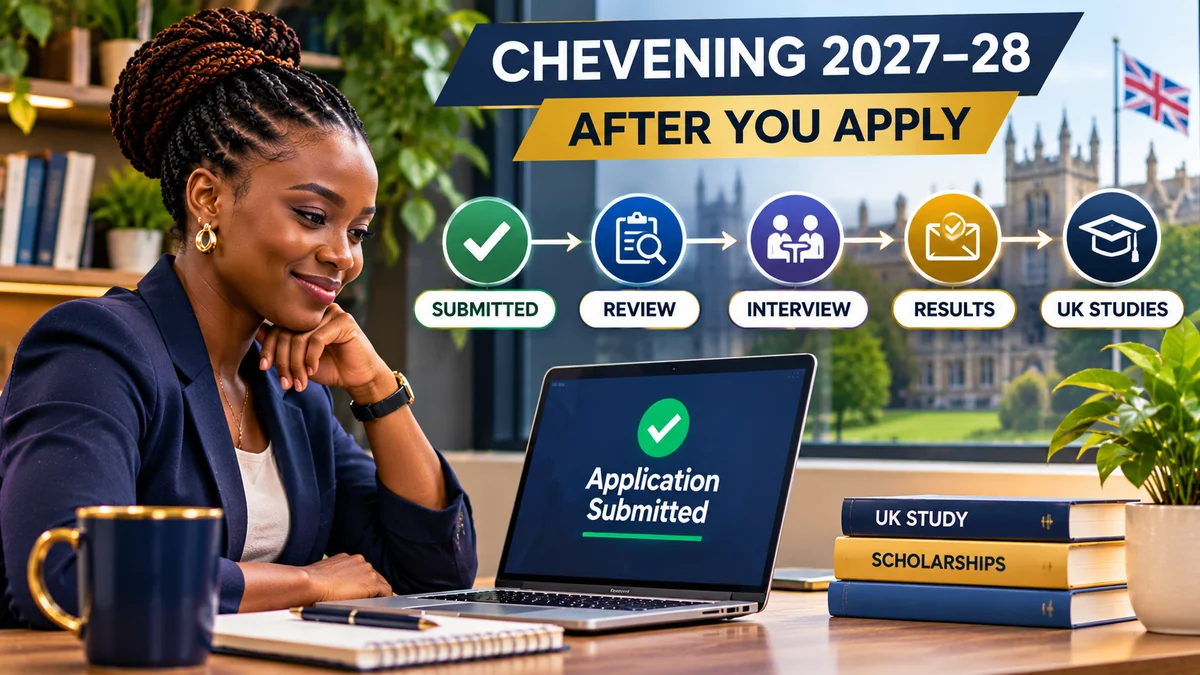
The best way to prepare for a Chevening Scholarship interview is to revisit the experiences in your submitted application, assemble truthful evidence of your impact and explain how a specific UK master's course supports a realistic plan to create change at home. Chevening does not publish a fixed list of questions that every panel uses. What it does publish is its assessment framework, document requirements and guidance on what shortlisted candidates should be ready to discuss.
For the 2027–28 Chevening Scholarship cycle, the official selection timeline schedules interview shortlisting for mid-February 2027 and interviews for March–April 2027. As checked on 2 November 2026, applications from Nigeria are closed , and applications are being assessed. Preparing early does not mean you have been shortlisted.
This guide provides a practical bank of illustrative practice questions, an evidence-gathering method, a mock-interview plan and a document checklist. None of the suggested questions should be mistaken for an official question bank, a leaked interview script or a guaranteed prediction.
What Chevening interviewers are trying to assess
Chevening describes its interview as a competency-based panel assessment in English, with representatives of the British embassy or high commission. The panel revisits your application and asks about your professional and personal aspirations, leadership, relationships, course choices and university application status. Its official interview guidance confirms that the location and format are provided when candidates book their slots.
The official application criteria identify four areas that are useful preparation headings:
| Assessment area | What to demonstrate | Evidence to prepare |
|---|---|---|
| Leadership and influence | You identified a challenge, influenced people and delivered a meaningful result | Decisions, your individual contribution, outcomes and lessons |
| Professional relationships | You built and sustained relationships that produced positive results | Partners, your role, collaboration, benefits and how ties continued |
| UK course fit | Your first-choice course has specific learning relevant to your goals | Verified modules, skills gaps, three selected courses and admission status |
| Career plan and impact | Your short-, medium- and long-term plans are feasible and beneficial | Milestones, partners, constraints, accountability and impact measures |
Do not substitute generic claims such as “I am passionate about change” for the real details of what you did, why it mattered and what you learned. A compelling interview should sound like the same person who wrote the application.
Step 1: Re-read your submitted essays line by line
Print or securely save the exact application you submitted, where available. Highlight every leadership example, figure, project, job title, organisation, date, collaboration, claim about your community and reason for choosing your courses. For each significant statement, write a one-sentence explanation and identify how you would substantiate it if asked.
Chevening's interview success advice specifically urges candidates to prepare to discuss examples from their essays, the expected impact of the scholarship and the status of all three course applications. The interview is not an invitation to replace your history with a more dramatic story. You can update the panel on genuine developments since submission, but clearly distinguish recent developments from the facts you had already submitted.
It is sensible to keep an evidence record for your own preparation—not to bring confidential workplace material to a panel. Never disclose other people's personal information or claim access to proprietary documents you have no permission to share.
Step 2: Create a leadership evidence bank
Choose two or three specific examples involving leadership, influence or initiative. The candidate does not need a senior job title to demonstrate leadership. The important questions are whether you recognised a problem, took responsibility, influenced people or decisions and produced an identifiable outcome.
For each example, record the situation, task, action and result (STAR), then add reflection: what did not work, what you changed and what you would do differently. Chevening alumni have recommended STAR as a useful preparation technique; it is a communication framework, not a mandatory answer format or substitute for genuine experiences. Chevening's alumni interview advice emphasises connecting past achievements with future impact.
Illustrative example, not an actual candidate interview: Imagine a community volunteer coordinating a reading programme in a Nigerian public school. The evidence might include the initial attendance challenge, conversations with teachers, the volunteer's specific actions, independently recorded participation changes and a lesson about sustaining the programme. The candidate must use their own real project figures and must not copy this hypothetical example as personal experience.
Be cautious with numbers. If you cannot verify an exact 40% improvement, do not invent one for emphasis. An honestly described improvement supported by records is better than an impressive but unsupported percentage.
Step 3: Prepare networking and relationship-building stories
Chevening treats professional relationship-building as a distinct competency. Networking is more than collecting names or attending a conference. Think about people with different interests whom you brought together, how trust was developed, and what continued after the initial meeting.
Useful evidence could include a cross-sector project, an academic-industry collaboration, a business partnership, a mentoring arrangement or a coalition addressing a local problem. Document the relationship's purpose, your contribution, a difficult moment, the shared result and the steps taken to maintain it.
In your answer, avoid taking personal credit for everyone else's work. The panel needs to understand both your contribution and the contribution of collaborators.
Step 4: Research your three UK courses—but know your first choice especially well
Chevening applicants submit three eligible UK master's course choices in order of preference. Its course guidance makes clear that you must apply to the universities independently; putting a course on the scholarship form is not the same as applying to that institution.
Research current university prospectus pages for module names, course structure, specialist methods and how the learning applies to your intended work. Record the current status of every university application, outstanding conditions, communications and deadlines. Check that a course still runs in the intended academic year before describing it as certain.
Your best answer to “Why this course?” should connect an existing skills gap → a specific part of the programme → a real professional application → a measurable benefit after returning home. Avoid claiming that a university offers a module without checking its official page. Generic rankings or the appeal of living in London are not sufficient explanations of course fit.
Chevening's selection criteria emphasise the first-choice course as the principal justification in the written application while the panel may discuss all three choices and their status. Keep the two points consistent rather than treating the three choices as interchangeable.
Step 5: Turn your career ambitions into a credible implementation plan
Prepare short-, medium- and long-term goals that explain what you want to change, who will help, how you will act and how progress can be observed. Chevening cites growth and prosperity, climate resilience, security and stability, and more inclusive societies among priority areas; your contribution should be authentic and connected to your own background rather than fitted artificially to a slogan.
For a Nigerian applicant interested in education technology, an illustrative plan might involve first applying newly learned evaluation methods, then testing a school-support model with partners, and later helping a larger network adopt approaches that have evidence of benefit. This is a fictional planning example, not a reported scholarship recipient's plan.
Name realistic obstacles such as funding, regulation, stakeholder resistance or lack of data, and describe how you would respond. Strong plans distinguish aspirations from promises. You should also be able to explain why Chevening's network and the UK learning environment matter to your work, while recognising the scholarship's expectation of future contribution at home.
Practice questions: a useful rehearsal bank, not leaked Chevening questions
Use the following prompts with a friend or mentor. They are original practice questions created for this guide from the publicly stated assessment themes. Actual Chevening panels can ask different questions, follow-up probes or questions not represented here.
| Theme | Illustrative practice question | Best evidence to prepare |
|---|---|---|
| Leadership | Describe a situation in which you persuaded people who initially disagreed with your proposal. | Initial resistance, actions, your influence, outcome |
| Leadership | Tell us about a decision you made that did not produce the expected result. | Ownership, honest reflection and corrective action |
| Relationships | How did you build cooperation across organisations with different priorities? | Partners, trust-building and lasting result |
| Relationships | What value would you contribute to an international alumni network? | Existing reciprocity and credible future contribution |
| Course choice | Which element of your first-choice master's course addresses a current skills gap? | Verified module or course element and application |
| Course choice | How do your three course choices compare, and where do your university applications stand? | Course rationale, current statuses and deadlines |
| Career plan | What would you realistically accomplish during your first two years back home? | Steps, collaborators, indicators, risks |
| Career plan | How would you measure the change you hope to create over five years? | Baseline, indicators and feasible data sources |
| Motivation | Why is this scholarship relevant to your work now, rather than at some later point? | Present readiness and concrete next steps |
| Follow-up | Which part of your written application would you explain differently after gaining more experience? | Genuine learning without contradicting facts |
Do not memorise a response word for word. Listen carefully and answer the actual question. Practise shorter and longer versions of the same truthful story so that you can respond naturally to follow-up questions.
Step 6: Use a claim-and-evidence worksheet
A simple worksheet can expose weak claims before a panel does. For each major application statement, record:
| Worksheet field | Example of the information to prepare |
|---|---|
| Claim in application | Led a community project to improve access to learning |
| Your exact role | Designed outreach, arranged meetings, coordinated volunteers |
| Evidence | Dates, permitted programme records, documented deliverables |
| Outcome | What changed, what did not, how it was assessed |
| Leadership lesson | What you learned about managing disagreement |
| Chevening connection | How future study builds on the experience |
The table is a template, not a real applicant case study. Do not include fabricated certificates, manipulated screenshots, made-up testimonies or unverifiable metrics. Evidence primarily helps you give accurate answers; Chevening's mandatory interview upload list does not request a portfolio of every project mentioned in your essays.
Step 7: Book the interview and meet the documentation deadline
If shortlisted, Chevening instructs you to use the official invitation to access ASAMS and book an interview slot by the displayed booking deadline. Its interview instructions explain how to recover a lost eight-character access code and how to contact your local Chevening team if access fails. You should not send your code to a third-party “Chevening consultant.”
The 2027–28 timeline and reference guidance specify uploading required documentation at least seven working days before the interview. One Chevening interview-information section uses the shorter expression “seven days”; follow the stricter working-day timeline and any instructions or earlier deadline stated in your invitation.
- Photo ID: upload the permitted passport or national identity card and bring the required original document.
- Undergraduate degree certificate/diploma: use the official award document; a transcript alone is not an acceptable substitute.
- Two references: ensure both letters meet the stated requirements, are in English or accompanied by the prescribed notarised English translation, and are submitted on time.
Chevening does not collect the letters for you. Suitable referees may be academic or professional contacts who know your work, but not friends or relatives. The official references page also allows a change of referee in certain circumstances, provided the candidate can explain the difference from the original nomination.
If reasonable interview adjustments are needed, contact the local team using the details in the invitation as early as possible; Chevening asks for at least seven working days' notice when new circumstances arise.
Step 8: Rehearse under realistic conditions
Organise two practice sessions with someone who will ask follow-up questions instead of only praising you. In the first, practise your four core assessment areas. In the second, mix the questions and challenge assumptions: “What did you do personally?”, “How do you know it worked?” and “What would you change?”
Record yourself only with everyone involved consenting. Review whether the answer addresses the prompt, gives concrete evidence, separates individual effort from team achievement and avoids exaggeration. A short pause to think can be better than a confident but inaccurate statement. Chevening alumni advice published in March 2026 encourages practice, feedback and authenticity rather than copying someone else's story.
Check the format and location in your actual interview booking. If online, test the connection, camera and a quiet location; if in person, plan the route and bring the required ID. Do not assume online or in-person delivery until the Chevening invitation confirms it.
A 14-day interview preparation plan
| Period | Preparation priority |
|---|---|
| Days 1–3 | Re-read your application; map claims, roles, dates and outcomes |
| Days 4–6 | Develop STAR notes for leadership and networking, including setbacks |
| Days 7–8 | Verify three course details and university admission statuses |
| Days 9–10 | Refine career milestones, partnerships, risks and measurable outcomes |
| Days 11–12 | Conduct mock interviews with challenging follow-up questions |
| Days 13–14 | Confirm documents, instructions, logistics, identification and rest |
This is a suggested rehearsal plan, not Chevening's mandatory schedule. Do not wait until day 13 to upload documents if the seven-working-day deadline falls earlier. Book your slot and submit requirements as soon as you have the invitation and compliant files.
Mistakes that weaken an otherwise promising interview
Reciting instead of listening: a memorised essay may not answer a panel's actual question. Use your preparation to understand your examples, not to deliver a script.
Claiming every team's success as personal leadership: identify your precise contribution and recognise collaborators.
Choosing a university for prestige alone: show a specific academic fit and why the course matters for your career.
Offering an unrealistic career plan: give practical steps and acknowledge obstacles instead of promising to transform a country immediately.
Overstating statistics or credentials: inconsistent dates and invented achievements undermine trust. Accuracy is more persuasive than inflated claims.
Missing essential uploads: Chevening warns that missing reference deadlines can result in an application no longer being considered.
Buying guaranteed questions or answers: Chevening does not endorse paid shortcuts. Its application guidance prohibits generating written essay responses with AI and presenting them as original work. Use genuine reflection and your own voice throughout preparation.
What happens after the interview?
Under the current 2027–28 timetable , outcomes are communicated from mid-June 2027. A candidate may be conditionally selected, placed on reserve or unsuccessful. Conditional selection is not a Final Award Letter.
Continue working on admissions to the three eligible courses. If successful in the scholarship process, you must supply at least one qualifying unconditional UK university offer by 8 July 2027 at 17:00 BST. The post-interview guidance says candidates should wait for the Final Award Letter before starting a UK visa application. In July, 17:00 BST corresponds to 17:00 West Africa Time in Nigeria.
Frequently asked questions
When are Chevening interviews for the 2027–28 scholarship?
The official timetable schedules shortlisting for mid-February 2027 and interviews for March–April 2027. The precise date and format depend on an individual invitation.
Are the practice questions in this article official Chevening questions?
No. They are illustrative prompts based on Chevening's published assessment themes, not leaked, confirmed or guaranteed interview questions.
Must I use STAR when answering?
No official rule requires it. Chevening alumni recommend STAR as a way to explain real situations, individual actions and outcomes clearly. Use a natural structure that fits the question.
Do I need a UK university offer before the interview?
Not necessarily. However, apply directly to your three approved courses, know your application status and secure at least one qualifying unconditional offer by the July 2027 deadline if selected.
What if my undergraduate transcript is the only document available?
Chevening says a transcript is not a substitute for the required undergraduate degree certificate or diploma. Contact your university early to obtain the proper document and seek official guidance if a genuine difficulty arises.
Can I change a referee after applying?
Chevening permits alternative referees where necessary, but applicants must supply compliant letters on time and be ready to explain the change at interview.
Does an interview invitation mean I have won?
No. Shortlisting means you have advanced to panel assessment. The result follows later, and even conditional selection requires further documentation and confirmation before a final award.
Conclusion
Strong Chevening interview preparation is an exercise in evidence, reflection and clarity. Revisit the application you actually submitted, prepare specific examples of leadership and relationships, know your university choices, and connect an achievable career plan to the change you want to create after returning home. Use practice questions to test understanding—not to manufacture a personality or an achievement record. Finally, treat documentation and university deadlines with the same seriousness as the conversation itself. An authentic, well-supported story gives the panel something concrete to evaluate.